Gravity at the surface of the Earth
Drop a stone near the ground and its velocity grows by about 9.8 metres per second every second. This steady increase is the acceleration due to gravity, written g. It is produced by the whole Earth pulling the stone towards its center. Its value depends on two things: the mass of the Earth, M, and how far the object is from the center of the Earth. For an object resting on the surface, that distance is simply the radius of the Earth, R. So at the surface:
\[ g = \frac{GM}{R^2} \]
Here G is the universal gravitational constant, \( 6.67 \times 10^{-11}\ \text{N m}^2/\text{kg}^2 \). G is fixed and the mass of the Earth does not change either. That leaves only one quantity in the formula that can change: the distance at the bottom of the fraction. Putting in the Earth's mass and radius gives about \( 9.8\ \text{m/s}^2 \) at the surface. The question for this topic is what happens to g when the object is taken higher and higher above the Earth.
Acceleration due to gravity (g): the acceleration produced in a freely falling body by the gravitational pull of the Earth. Its SI unit is \( \text{m/s}^2 \), and its average value at the Earth's surface is about \( 9.8\ \text{m/s}^2 \).
Going farther from the center of the Earth
Picture a row of points, each one farther from the center of the Earth than the last. The first is at a distance d = R, which is right on the surface. The next is at d = 2R, then d = 3R, then d = 4R. Call the acceleration due to gravity at a distance d from the center \( g_1 \):
\[ g_1 = \frac{GM}{d^2} \]
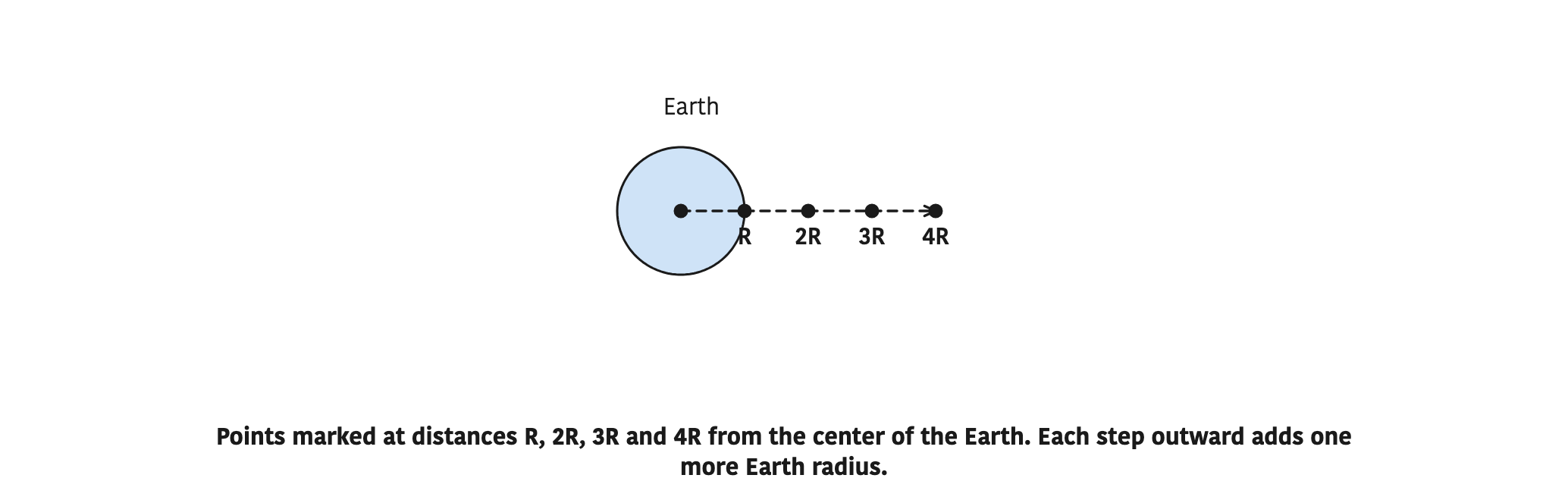
The distance in the formula is squared, so g does not simply halve when the distance doubles. Work it out for the point at d = 2R.
Step 1: Putting d = 2R into the formula:
\[ g_1 = \frac{GM}{(2R)^2} = \frac{GM}{4R^2} \]
Step 2: Since \( \frac{GM}{R^2} = g = 9.8\ \text{m/s}^2 \), this is one quarter of g:
\[ g_1 = \frac{1}{4} \times 9.8 = 2.45\ \text{m/s}^2 \]
Doubling the distance from the center cuts g to one quarter. At three times the distance the bottom of the fraction becomes \( 9R^2 \), so g drops to one ninth of its surface value. At four times the distance it drops to one sixteenth. In other words, the acceleration due to gravity is inversely proportional to the square of the distance from the center of the Earth:
\[ g \propto \frac{1}{d^2} \]
When the distance from the center becomes a certain number of times larger, g becomes that number squared times smaller. Twice the distance gives one quarter of the gravity.
d is always measured from the center of the Earth, not from the ground. A point at d = 2R is only one Earth radius above the surface.
Acceleration due to gravity at a height h
Now think of a satellite orbiting the Earth at a height h above the surface. Its distance from the center of the Earth is made of two parts joined end to end: the radius R, from the center up to the surface, and the height h, from the surface up to the satellite. So the satellite is at a distance d = R + h from the center.
Height or altitude (h): how far a point is above the surface of the Earth.
Distance from the center (d): how far a point is from the center of the Earth. For a point at height h above the surface, d = R + h.
Putting R + h in place of d in \( g_1 = \frac{GM}{d^2} \) gives the acceleration due to gravity at a height h:
\[ g_1 = \frac{GM}{(R+h)^2} \]
Compare this with the surface formula \( g = \frac{GM}{R^2} \). Both have the same GM on top, so the only difference is underneath. Because h is positive, \( (R+h)^2 \) is greater than \( R^2 \). Dividing the same number by something larger gives a smaller answer, so \( g_1 \) is less than g. The higher the satellite, the smaller the value of g where it is.
As the height above the surface of the Earth increases, the acceleration due to gravity decreases.
G is given in metres, so R and h must both be changed from kilometres to metres before they go into the formula. 1 km = 1000 m.
Worked example: the International Space Station
Question: The mass of the Earth is \( 5.97 \times 10^{24}\ \text{kg} \) and its radius is 6371 km. Calculate the acceleration due to gravity at the International Space Station, which is at an altitude of 400 km above the surface of the Earth.
- Mass of the Earth: \( M = 5.97 \times 10^{24}\ \text{kg} \)
- Radius of the Earth: \( R = 6371\ \text{km} = 6371000\ \text{m} \)
- Height of the station: \( h = 400\ \text{km} = 400000\ \text{m} \)
- Gravitational constant: \( G = 6.67 \times 10^{-11}\ \text{N m}^2/\text{kg}^2 \)
Step 1: Writing the formula for g at a height:
\[ g_1 = \frac{GM}{(R+h)^2} \]
Step 2: Multiplying G by M to get the top of the fraction:
\[ GM = 6.67 \times 10^{-11} \times 5.97 \times 10^{24} \]
\[ GM = 39.82 \times 10^{13} \]
Step 3: Adding R and h, \( 6371000 + 400000 \), to get the distance from the center:
\[ R + h = 6771000\ \text{m} \]
Step 4: Squaring that distance:
\[ (6771000)^2 = 4.5846 \times 10^{13} \]
Step 5: Dividing GM by the squared distance:
\[ g_1 = \frac{39.82 \times 10^{13}}{4.5846 \times 10^{13}} \]
\[ g_1 \approx 8.69\ \text{m/s}^2 \]
So the acceleration due to gravity at the International Space Station, 400 km up, is about \( 8.69\ \text{m/s}^2 \). It is less than at the surface, but it is still roughly nine tenths of the surface value. 400 km sounds high, yet it is only a small addition to a radius of 6371 km.
Keep enough digits after squaring. If \( (6771000)^2 \) is rounded up to \( 4.60 \times 10^{13} \), the answer comes out as 8.66 m/s². Careful working gives about 8.69 m/s².
Astronauts float inside the space station, but gravity there is not zero. g is still about 8.7 m/s². They seem to float because they and the station are falling around the Earth together.
The top of a hill and Mount Everest
The top of a hill is a little farther from the center of the Earth than its bottom. The bottom is at distance R, and the top is at R plus the height of the hill. So g is slightly less at the top of a hill than at its foot. The difference is very small, because even the highest mountain in the world is tiny next to the radius of the Earth. Take Mount Everest, whose height is 8848.86 m, and work it out.
Step 1: Adding R and h to get the distance of the summit from the center:
\[ d = 6371000 + 8848.86 \]
\[ d = 6379848.86\ \text{m} \]
Step 2: Squaring the distance:
\[ d^2 = 4.0702 \times 10^{13} \]
Step 3: Dividing the same GM as before by this square:
\[ g_1 = \frac{39.82 \times 10^{13}}{4.0702 \times 10^{13}} \]
\[ g_1 \approx 9.78\ \text{m/s}^2 \]
Step 4: Working out g at the surface from the same data for comparison, where \( R^2 = (6371000)^2 = 4.0590 \times 10^{13} \):
\[ g = \frac{39.82 \times 10^{13}}{4.0590 \times 10^{13}} \approx 9.81\ \text{m/s}^2 \]
Step 5: Subtracting to find the difference:
\[ 9.81 - 9.78 = 0.03\ \text{m/s}^2 \]
At the summit of Mount Everest, g is only about \( 0.03\ \text{m/s}^2 \) less than at the surface. The reason is easy to see: the distance from the center goes from 6371 km to only 6379.85 km, an increase of about 8.85 km. Such a small change in distance produces only a very small change in g. That is why g can be taken as about 9.8 m/s² anywhere people live on Earth, high in the mountains or down on the plains.
Worked example: gravity on the Moon
The formula for g is not only for the Earth. It gives g at the surface of any planet or moon, as long as you use that body's own mass and radius.
Question: The acceleration due to gravity of the Earth is 9.8 m/s². If the mass of the Moon is \( 7.35 \times 10^{22}\ \text{kg} \) and its radius is \( 1.74 \times 10^{6}\ \text{m} \), what is the acceleration due to gravity of the Moon? Compare it with that of the Earth.
Step 1: Writing the formula for g at the Moon's surface, with \( M_m \) the Moon's mass and \( R_m \) the Moon's radius:
\[ g_m = \frac{G M_m}{R_m^2} \]
Step 2: Multiplying G by the Moon's mass for the top:
\[ G M_m = 6.67 \times 10^{-11} \times 7.35 \times 10^{22} \]
\[ G M_m = 4.902 \times 10^{12} \]
Step 3: Squaring the Moon's radius:
\[ R_m^2 = (1.74 \times 10^{6})^2 = 3.0276 \times 10^{12} \]
Step 4: Dividing the top by the square:
\[ g_m = \frac{4.902 \times 10^{12}}{3.0276 \times 10^{12}} \approx 1.62\ \text{m/s}^2 \]
Step 5: Taking the ratio of the Earth's g to the Moon's g to compare them:
\[ \frac{g_e}{g_m} = \frac{9.8}{1.62} \approx 6.05 \]
The acceleration due to gravity on the Moon is about 6 times less than on the Earth. The reason is that the Moon is far lighter than the Earth: its mass is about 81 times smaller. Its radius is smaller too, but only about 3.7 times smaller. A smaller radius on its own would make g larger, but the loss of mass is much bigger, so g on the Moon ends up much smaller.
When finding g on the Moon, use the Moon's own mass and the Moon's own radius. Putting in the Earth's radius gives a completely wrong answer.
Comparing the values
Putting all these results in one table makes the pattern clear. The greater the distance from the center, the smaller g becomes. A small height makes very little difference, but adding a distance as large as the Earth's radius makes g fall a great deal.
| Place | Distance from the center | Acceleration due to gravity |
| Surface of the Earth | 6371 km | 9.81 m/s² |
| Summit of Mount Everest | 6379.85 km | 9.78 m/s² |
| International Space Station | 6771 km | 8.69 m/s² |
| Distance 2R from the center | 12742 km | 2.45 m/s² |
| Surface of the Moon | 1740 km from the Moon's center | 1.62 m/s² |
The four rows about the Earth all come from the one formula \( g_1 = \frac{GM}{(R+h)^2} \). The Moon's row belongs to a different body, which is why it uses the Moon's own mass and radius.
The full lesson is waiting for you
The notes are free to read in full. A free account opens the rest of the practice, and tracks your progress and confidence score for every subject. Presentations and videos need approval from Learn Yeti.