Mass: The Quantity of Matter
Everything around you is made of matter. A pencil, a bucket of water, your own body and even a single electron all contain some amount of matter. The total quantity of matter present in an object is called its mass.
Mass: the total quantity of matter present in an object. It is a scalar quantity and its SI unit is the kilogram (kg).
Mass is a scalar quantity. A scalar has size only and no direction. When you say a bag of rice has a mass of 25 kg, nothing more needs to be said. There is no such thing as "25 kg upward" or "25 kg to the east".
The mass of an object does not depend on where it is. Imagine a 1 kg block of iron. Keep it in Kathmandu, carry it to the International Space Station, land it on the Moon or send it to Mars. In every place the block holds exactly the same iron, so its mass stays 1 kg. Nothing has been added and nothing has been taken away.
Every object has a definite mass, however small it is. An electron is one of the smallest particles known, yet its mass is not zero. Because every object has mass, even the smallest mass feels the force of gravity.
Mass is the same everywhere. Moving an object from one place to another does not change how much matter it contains.
Weight: The Pull of Gravity
The Earth's gravity pulls every object on its surface towards its centre. When you hold a school bag, the downward pull you feel in your hand is this force. The weight of an object is the measure of the force of gravity acting on it.
Weight: the force of gravity acting on an object. It is a vector quantity and its SI unit is the newton (N).
Since weight is a force, it is measured in newtons, the unit of force, and not in kilograms. Weight is also a vector quantity, because a force always acts in a particular direction. Being the force of gravity, weight is always directed towards the centre of the planet or satellite that pulls the object.
This is why "down" points in different directions in different countries. A person standing in Nepal and a person standing in South America both have their weight pointing straight down, yet both weights point towards the same place: the centre of the Earth.
Weight is measured with a spring balance. The object hangs from a hook, gravity pulls it down, the spring stretches, and a pointer moving along a scale shows the weight. A bigger pull stretches the spring further.
Calculating Weight
Newton's second law of motion says that force equals mass multiplied by acceleration. On an object of mass m, the force of gravity produces the acceleration due to gravity, g. So the force of gravity on the object, which is its weight, is:
\[ W = mg \]
Here W is the weight in newtons, m is the mass in kilograms and g is the acceleration due to gravity in \( \text{m/s}^2 \). The formula shows that weight depends on two things: the mass of the object and the value of g at the place where the object is.
Weight depends on both the mass and the acceleration due to gravity: \( W = mg \).
Heavier Objects Need More Force to Lift
Because gravity pulls every object towards the centre of the Earth, lifting an object from the ground means applying an upward force at least equal to the force of gravity on it, that is, its weight. A small force cannot lift a big load.
At any one place, the value of g stays constant. Then the weight of an object changes only with its mass. Double the mass and the weight doubles; halve the mass and the weight halves. So, keeping g constant, weight is directly proportional to mass:
\[ W \propto m \]
This is why a big stone needs more force to lift than a small pebble, and why a 50 kg sack of rice is harder to carry than a 5 kg packet. Objects with greater mass weigh more, so more force must be applied to lift them.
How Mass and Weight Differ
In everyday speech people use the word "weight" for both ideas, but in science they are two different quantities. The table sets them side by side.
| Mass | Weight |
| Total quantity of matter in an object | Force of gravity acting on an object |
| Scalar quantity: size only | Vector quantity: acts towards the centre of the planet or satellite |
| SI unit: kilogram (kg) | SI unit: newton (N) |
| Remains the same everywhere | Changes as g changes from place to place |
| Does not depend on g | Depends on both m and g, since \( W = mg \) |
| Measured with a beam balance | Measured with a spring balance |
When someone says "my weight is 50 kg", they really mean their mass is 50 kg. In science, the kilogram is the unit of mass. Weight is always written in newtons, so a person of mass 50 kg on the Earth has a weight of about 490 N.
Weight Changes When g Changes
Now keep the mass fixed and change the place. Weight is still \( W = mg \), so if g becomes larger the weight becomes larger, and if g becomes smaller the weight becomes smaller. Keeping mass constant, weight is directly proportional to the acceleration due to gravity:
\[ W \propto g \]
The value of g is not the same at every place on the Earth, so the weight of an object also changes from place to place. The value of g is inversely proportional to the square of the distance from the centre of the Earth:
\[ g \propto \frac{1}{R^2} \]
So the farther a place is from the Earth's centre, the smaller g is there, and the smaller the weight of an object there. Hilltops and high mountains are farther from the centre than the land at their base, so g is less on them. An object therefore weighs a little less at the top of a mountain than at its foot, while its mass does not change at all.
The Earth is not a perfect sphere either. It is slightly flattened at the poles and bulges a little at the equator. The polar regions are therefore slightly closer to the centre, so g is greater there and an object weighs more. In the equatorial region g is less, so the same object weighs less. At the place on the Earth's surface where g is greatest, the weight of an object is also greatest.
| Pair of places | Where g is less | Where g is more | Weight of the object |
| Equatorial and polar regions | Equatorial region | Polar region | Less at the equator, more at the poles |
| Base and top of a mountain | Top of the mountain | Base of the mountain | Less at the top, more at the base |
The differences in weight from place to place on the Earth are small, but they are real. A person who travels from the equator to a pole, or from a valley to a mountain top, keeps the same mass while their weight changes slightly.
Weight on the Moon
The Moon is much smaller than the Earth and has much less mass, so its gravity is weaker. The acceleration due to gravity on the Moon is about one sixth of that on the Earth:
\[ g_m \approx \frac{1}{6}\, g_e \]
Here \( g_m \) is the acceleration due to gravity on the Moon and \( g_e \) is that on the Earth. Since weight is directly proportional to g, an object of a definite mass weighs almost 6 times as much on the Earth as it does on the Moon. An astronaut with a mass of 60 kg still has 60 kg of mass on the Moon, but her weight drops from about 588 N to about 98 N.
This has two interesting results. First, a person can jump about 6 times higher on the Moon than on the Earth, because the same push from the legs works against a pull about 6 times weaker. Second, a person can lift about 6 times as much mass on the Moon as on the Earth. Their muscles have not become stronger. Each kilogram simply weighs about one sixth as much.
The Moon's g is about one sixth of the Earth's g, not six times it. So weights on the Moon are smaller, and an object's weight on the Earth is about 6 times its weight on the Moon.
Weight on Other Planets
Every planet and satellite has its own value of g, so the same object has a different weight on each of them, while its mass never changes. The table shows an object of mass 50 kg on five heavenly bodies. Each weight is found from \( W = mg \).
| Heavenly body | g (m/s²) | Weight of a 50 kg object (N) |
| Moon | 1.63 | 81.5 |
| Mercury | 3.61 | 180.5 |
| Mars | 3.75 | 187.5 |
| Venus | 8.83 | 441.5 |
| Earth | 9.81 | 490.5 |
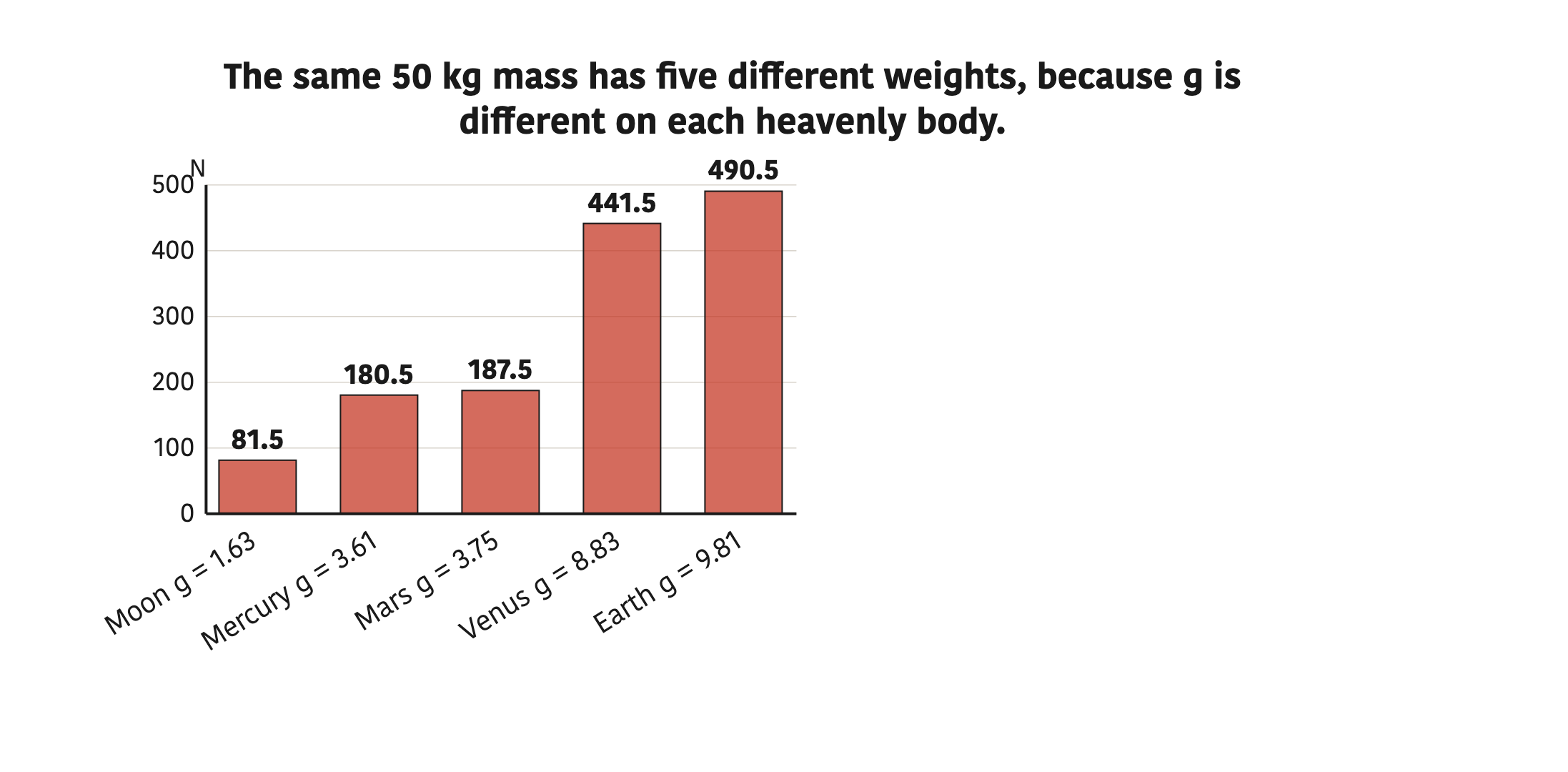
Reading down the table, the weight grows as g grows. Mars and Mercury have nearly the same g, so the object weighs nearly the same on both. On the Earth it weighs about 6 times what it weighs on the Moon.
Worked Example: Weight of a Student
A student has a mass of 45 kg. Find the student's weight on the Earth, where \( g = 9.8\ \text{m/s}^2 \), and on the Moon, where \( g = 1.63\ \text{m/s}^2 \).
Step 1: Writing the formula for weight:
\[ W = mg \]
Step 2: Putting in the Earth's value of g:
\[ W_e = 45 \times 9.8 = 441\ \text{N} \]
Step 3: Putting in the Moon's value of g:
\[ W_m = 45 \times 1.63 = 73.35\ \text{N} \]
So the student weighs 441 N on the Earth and 73.35 N on the Moon. The mass is 45 kg in both places.
Worked Example: Lifting on the Moon
A person can lift a mass of 100 kg on the Earth. What mass can the same person lift on the Moon? Take the acceleration due to gravity as \( 9.8\ \text{m/s}^2 \) on the Earth and \( 1.63\ \text{m/s}^2 \) on the Moon.
- Mass that can be lifted on the Earth: \( M = 100\ \text{kg} \)
- Acceleration due to gravity of the Earth: \( g = 9.8\ \text{m/s}^2 \)
- Acceleration due to gravity of the Moon: \( g' = 1.63\ \text{m/s}^2 \)
- Mass that can be lifted on the Moon: \( m = ? \)
The key idea: the force a person's muscles can exert against gravity is the same on the Earth and on the Moon. So the weight that can be lifted on the Moon equals the weight that can be lifted on the Earth.
Step 1: Setting the two weights equal:
\[ m \times g' = M \times g \]
Step 2: Dividing both sides by \( g' \) to make m the subject:
\[ m = \frac{M \times g}{g'} \]
Step 3: Putting in the values:
\[ m = \frac{100 \times 9.8}{1.63} \]
Step 4: Multiplying the numbers on top:
\[ m = \frac{980}{1.63} \]
Step 5: Dividing 980 by 1.63:
\[ m = 601.23\ \text{kg} \]
Therefore a person who can lift 100 kg on the Earth can lift 601.23 kg on the surface of the Moon, which is roughly 6 times as much.
The full lesson is waiting for you
The notes are free to read in full. A free account opens the rest of the practice, and tracks your progress and confidence score for every subject. Presentations and videos need approval from Learn Yeti.