Gravity: The Pull of a Planet
Let go of a pen and it falls to the floor. Throw a ball straight up and it comes back down to you. Something is pulling these objects, and that something is the Earth. The Earth, the other planets and their satellites all pull the objects near them towards their own centres. A satellite is a body that moves around a planet, such as the Moon moving around the Earth.
Force of gravity: the force with which a planet or a satellite pulls a nearby object towards its centre. The force of gravity acting on an object is also called the weight of that object.
This pull is not equally strong everywhere. Newton's universal law of gravitation tells us that the force of gravity becomes weaker as an object moves higher above the planet. At a certain distance it becomes so small that it can be ignored. So the pull of a planet reaches only a definite distance around it, and that region is its gravitational field. The Earth has a gravitational field, and so does every other planet and satellite.
Gravitational field: the definite region around a planet or satellite within which its force of gravity acts on objects.
Effects of Gravity Around Us
The Earth's gravity is at work every moment of the day, and you can notice many of its effects for yourself:
- (a) Every object has weight because gravity pulls on it. A sack of rice feels heavy in your arms for exactly this reason.
- (b) The Earth is wrapped in a layer of air called the atmosphere. Gravity holds this air to the Earth, so it does not drift away into space.
- (c) An object dropped from a height falls towards the centre of the Earth. A ripe mango that breaks from its stalk drops straight to the ground.
- (d) Water in rivers and streams flows downwards, from the hills towards the plains, because gravity pulls it.
- (e) The force of gravity produces acceleration in a falling object, so the object keeps getting faster as it falls.
The last effect raises two questions. How quickly does a falling object speed up, and is the answer the same for a heavy object and a light one?
Measuring Acceleration Due to Gravity
You can measure how quickly a falling object speeds up with nothing more than a small stone, a stopwatch and a friend. Hold the stone out from the first floor of a building and release it. Do not throw it and do not push it downwards. Simply loosen your fingers, so that your fingers put no downward force on it and it starts from rest. Your friend starts the stopwatch the moment you let go and stops it when the stone reaches the ground. Then measure the height h from your hand to the ground. Repeat the drop from the second floor and from other heights.
Before you drop the stone, make sure nobody is standing or walking below. Use only a small stone, stay behind a safe railing, and never lean out of a window or over the edge of a roof.
Two equations of motion connect the height h, the time t, the initial velocity u, the final velocity v and the acceleration a:
\[ h = ut + \frac{1}{2}at^2 \]
\[ v^2 = u^2 + 2ah \]
The stone is released from rest, so its initial velocity is \( u = 0 \). The first equation then becomes \( h = \frac{1}{2}at^2 \), and rearranging it gives the acceleration from the height and time you measured:
\[ a = \frac{2h}{t^2} \]
With \( u = 0 \) the second equation becomes \( v^2 = 2ah \), which gives the velocity of the stone at the moment it hits the ground:
\[ v = \sqrt{2ah} \]
One drop on its own can easily mislead you, because a stopwatch started or stopped a fraction of a second late changes t. So the stone is dropped three times, an acceleration is worked out each time as \( a_1 \), \( a_2 \) and \( a_3 \), and the average \( \frac{a_1 + a_2 + a_3}{3} \) is taken as the result. The readings are kept in a table with columns for h, t, a, the average acceleration and v.
Worked Example: Timing a Falling Stone
A stone is released from rest from a height of 4.9 m. The stopwatch reads 1.0 s when the stone lands. Find the acceleration of the stone and its velocity when it hits the ground.
Step 1: Writing the equation of motion for the height, with \( u = 0 \) because the stone starts from rest:
\[ h = \frac{1}{2}at^2 \]
Step 2: Rearranging to make a the subject:
\[ a = \frac{2h}{t^2} \]
Step 3: Putting in h = 4.9 m and t = 1.0 s:
\[ a = \frac{2 \times 4.9}{(1.0)^2} \]
Step 4: Multiplying on top and dividing by the square of the time:
\[ a = \frac{9.8}{1.0} = 9.8\ \text{m/s}^2 \]
Step 5: Using \( v^2 = u^2 + 2ah \) with \( u = 0 \) for the final velocity:
\[ v = \sqrt{2 \times 9.8 \times 4.9} \]
Step 6: Multiplying the numbers under the square root:
\[ v = \sqrt{96.04} \]
Step 7: Taking the square root:
\[ v = 9.8\ \text{m/s} \]
So the stone speeds up at 9.8 m/s² and strikes the ground at 9.8 m/s. Now suppose the same stone is dropped three times and the three accelerations come out as 9.6 m/s², 9.9 m/s² and 9.9 m/s². The average acceleration is:
\[ \frac{9.6 + 9.9 + 9.9}{3} = \frac{29.4}{3} = 9.8\ \text{m/s}^2 \]
A dropped object starts from rest, so u is always 0 here. Taking u as anything else gives a wrong acceleration. Write m/s² after every acceleration and m/s after every velocity, because a number without its unit is not a complete answer.
Why a Falling Object Speeds Up
Once the stone leaves your hand, the Earth's gravity sets it moving, and gravity keeps acting on it at every point of the fall. It does not stop after the first instant. So the farther the stone falls, the faster it goes. An increasing velocity means the stone is accelerating, and the cause of this acceleration is gravity. When air resistance is so small that it is almost zero, the acceleration of a falling stone near the Earth's surface is 9.8 m/s². This is the acceleration due to the gravity of the Earth.
Acceleration due to gravity: the acceleration produced in a freely falling object due to the force of gravity. It is denoted by g, and its SI unit is metre per second squared (m/s²).
Near the Earth's surface, g is about 9.8 m/s². A freely falling object gains about 9.8 m/s of velocity for every second it falls.
An object falls freely when gravity is the only force that matters on it: no hand pushes it, and the air hardly holds it back. A stone dropped from a balcony is very close to this.
Weight and g are not the same thing. Weight is the force of gravity on an object, so it is a force. g is the acceleration that this force produces, and it is measured in m/s².
Does a Heavier Object Fall Faster?
Most people expect a heavy stone to fall faster than a light piece of paper. A simple test shows whether mass really decides this. Tear a sheet of paper into two equal halves. Leave one half flat and squeeze the other tightly into a ball. Now drop the flat sheet, the paper ball and a small stone together from the same height, and watch which one reaches the ground first.
The flat sheet and the paper ball have exactly the same mass, yet they fall at different velocities. The paper ball and the stone have very different masses, yet they fall together. So the rate at which the velocity of a falling object changes is not related to its mass.
What holds the flat sheet back is the air. As the sheet falls, the air pushes upwards on its wide surface, and this upward push reduces its velocity. For the paper ball and the stone, which are small and compact, this push is negligible. They fall together towards the centre of the Earth under the pull of gravity alone.
Air resistance: the upward force that air exerts on an object falling through it. It slows the object down, and it is larger on an object with a larger surface area.
Falling Where There Is No Air
The Moon has no atmosphere, so there is no air on its surface to hold anything back. Every object there falls freely, without obstruction, and every object falls with the same acceleration, the acceleration due to gravity of the Moon. If the flat sheet and the paper ball were dropped together on the surface of the Moon, they would fall side by side and land together.
Aristotle's Idea and Galileo's Test
For a very long time people accepted the laws of motion put forward by Aristotle, a thinker born in Greece in 384 BC. According to Aristotle, heavier objects fall before lighter ones. It sounds sensible, and nobody tested it carefully for centuries.
Around the year 1590, Galileo dropped two balls of different masses together from the Leaning Tower of Pisa in Italy. Both balls hit the ground together. Galileo concluded that all freely falling bodies fall with the same acceleration due to gravity, and Aristotle's law was disproved.
The Feather and Coin Experiment
Galileo's conclusion was later proved by the feather and coin experiment. A long glass cylinder is connected to a vacuum pump, a machine that sucks the air out of a closed container. A feather and a coin are placed inside, resting at the bottom. The cylinder is then turned upside down twice:
- (a) With air inside, the cylinder is turned upside down. The coin falls quickly and reaches the bottom first, while the feather floats down slowly behind it.
- (b) The air is then pumped out with the vacuum pump, and the cylinder is turned upside down again. This time the coin and the feather fall together and reach the bottom at the same moment.
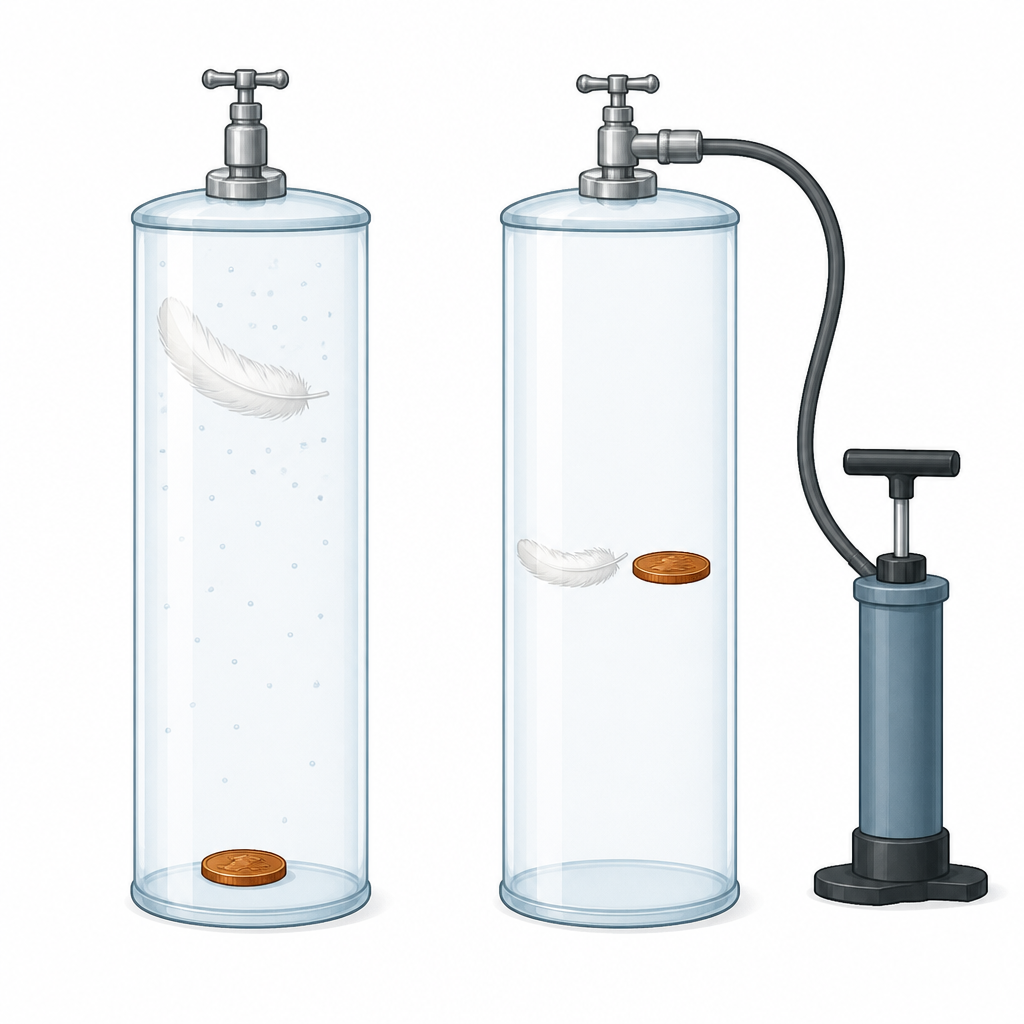
Vacuum: a space from which the air has been removed, so that there is no air resistance inside it.
Why do the two trials differ? The first time, air inside the cylinder resists both falling objects. The feather has a much larger surface area than the coin, so the air resistance on the feather is much greater and its acceleration is reduced. That is why the feather falls more slowly. The second time there is no air inside the cylinder, so there is no air resistance on either object, and both fall together.
In the absence of air resistance, the acceleration due to gravity is the same for all objects. The value of g does not depend on the mass of the falling body.
The flat sheet of paper, the Moon, Galileo's two balls and the feather in the tube all point to one fact. When a light object falls slowly, the air is the reason, not its small mass.
The full lesson is waiting for you
The notes are free to read in full. A free account opens the rest of the practice, and tracks your progress and confidence score for every subject. Presentations and videos need approval from Learn Yeti.