Why Things Fall Towards the Earth
Open your hand and a stone drops to the ground. A ripe mango breaks off its stalk and lands under the tree. A ball kicked high into the air always comes back down. None of these things drifts sideways or floats away. The Earth pulls every object towards its centre, and every fall we see is that pull at work.
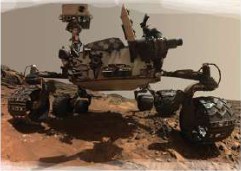
This pull does not belong to the Earth alone. The Earth and the Moon attract each other. Mars also attracts objects towards its centre. When the Perseverance Rover was sent from the Earth to Mars, it came down through the Martian sky on a parachute. Without the parachute, the pull of Mars would have made it hit the ground far too fast.
Newton and the Falling Apple
Sir Isaac Newton was a British mathematician and physicist. When he saw a fruit fall from a tree to the ground, he began to wonder about something most people never question: why did it fall straight down and not off to one side? After much study and thought he concluded that the apple and the Earth attract each other, and that this attraction pulls the apple towards the centre of the Earth.
Newton then took the idea much further. If the Earth pulls an apple, what keeps the Moon, the planets, the Sun and the stars in their places in the sky? He concluded that a force of attraction exists between all bodies, whether they are apples, people, mountains or planets. He named this force gravitation. In 1687 he put forward the Universal Law of Gravitation, which tells us how strong this force is between any two bodies.
Gravitation: the force of attraction that exists between all bodies in the universe.
How Mass and Distance Change the Force
The size of the gravitational force between two bodies depends on two things: their masses and the distance between them. A computer simulation shows this clearly. Two spheres sit on a track, and sliders change the mass of each sphere and the distance between their centres. The screen shows the force each sphere puts on the other.
Start with a sphere of 300 kg and a sphere of 400 kg whose centres are 4 m apart. The force between them is only 0.000000500556 N, far too small for anyone to feel. That is why two chairs in a room never slide towards each other. Now change one thing at a time and watch the force.
| What is changed | First mass | Second mass | Distance | Force | Compared with the start |
| Nothing (starting case) | 300 kg | 400 kg | 4 m | 0.000000500556 N | Same |
| First mass doubled | 600 kg | 400 kg | 4 m | 0.000001001112 N | 2 times |
| Both masses doubled | 600 kg | 800 kg | 4 m | 0.000002002224 N | 4 times |
| Distance doubled | 300 kg | 400 kg | 8 m | 0.000000125139 N | One quarter |
Look first at the rows where only the masses change. Doubling one mass changes the product of the masses from \( 300 \times 400 \) to \( 600 \times 400 \), which is double, and the force doubles. Doubling both masses changes the product from \( 300 \times 400 \) to \( 600 \times 800 \), which is four times as large, and the force becomes four times as large. So when the distance stays the same, the gravitational force is directly proportional to the product of the masses of the two objects.
Now look at the last row. The masses stay the same and the distance doubles from 4 m to 8 m. The force does not halve. It falls to one quarter of its first value, because \( 2^2 = 4 \). So when the masses stay the same, the gravitational force is inversely proportional to the square of the distance between the two objects.
Directly proportional: when one quantity becomes 2 or 4 times larger, the other also becomes 2 or 4 times larger. Inversely proportional: when one quantity becomes some number of times larger, the other becomes that same number of times smaller.
Newton's Universal Law of Gravitation
Both findings from the simulation are joined in one statement, Newton's universal law of gravitation.
Newton's universal law of gravitation: the gravitational force produced between any two objects in the universe is directly proportional to the product of their masses and inversely proportional to the square of the distance between them.
To write the law in symbols, let two objects A and B have masses \( m_1 \) and \( m_2 \), let the distance between their centres be \( d \), and let the gravitational force between them be \( F \). The first part of the law says that \( F \) is directly proportional to the product of the masses:
\[ F \propto m_1 m_2 \quad \text{(i)} \]
The second part says that \( F \) is inversely proportional to the square of the distance:
\[ F \propto \frac{1}{d^2} \quad \text{(ii)} \]
Combining (i) and (ii):
\[ F \propto \frac{m_1 m_2}{d^2} \]
A proportion becomes an equation when a constant takes the place of the proportional sign. That constant is \( G \), the universal gravitational constant:
\[ F = \frac{G m_1 m_2}{d^2} \quad \text{(iii)} \]
Equation (iii) lets us calculate the gravitational force between any two objects. The force acts on both of them at once. A pulls B towards itself with force \( F \), and B pulls A towards itself with a force of exactly the same size. Neither pulls harder than the other, even when one is a planet and the other is a pebble.
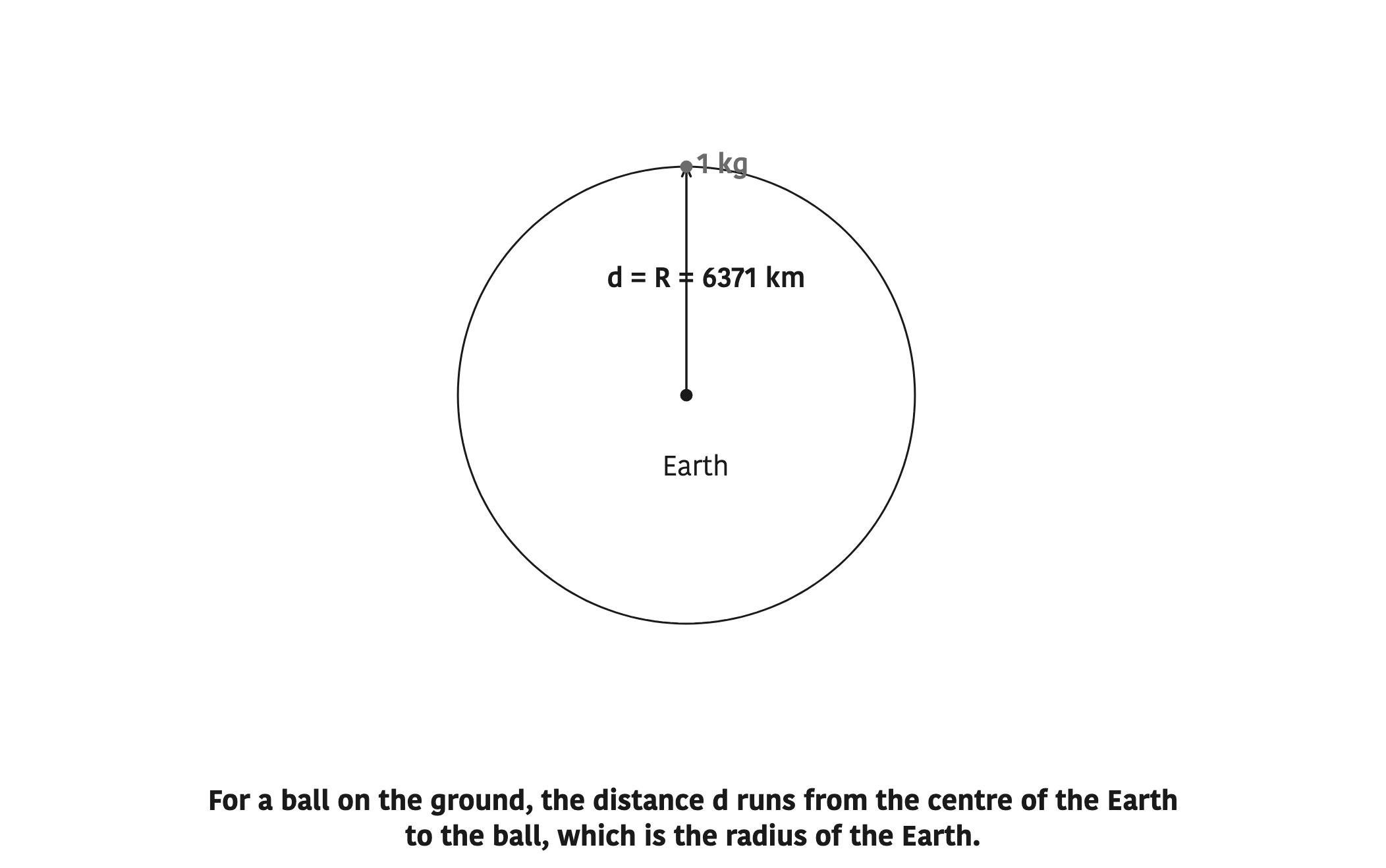
The distance d is measured between the centres of the two objects, not between their surfaces. For an object resting on the ground, d is the radius of the Earth, because the centre of the Earth lies one radius below your feet.
The Universal Gravitational Constant G
Universal gravitational constant (G): the magnitude of the gravitational force produced between two unit masses that are separated by a unit distance.
To see why, put \( m_1 = m_2 = 1 \) kg and \( d = 1 \) m into equation (iii):
\[ F = \frac{G \times 1 \times 1}{1^2} = G \]
The value of G was first measured by Henry Cavendish in 1798, using an instrument called the Cavendish balance. His experiment gave:
\[ G = 6.67 \times 10^{-11}\ \text{N m}^2/\text{kg}^2 \]
The value of G stays the same whatever the bodies are made of and whatever lies between them, whether air, water or empty space. That is why it is called the universal gravitational constant. Its SI unit comes from equation (iii) itself. Rearranged, the equation gives \( G = \frac{F d^2}{m_1 m_2} \), so the unit of G is newton multiplied by metre squared, divided by kilogram squared: \( \text{N m}^2/\text{kg}^2 \).
The number \( 10^{-11} \) is tiny. Two 1 kg masses placed 1 m apart pull each other with less than a billionth of a newton. This is why the pull between everyday things goes unnoticed, and why gravitational force becomes large only when at least one of the bodies is enormous, like the Earth.
Worked Example: The Earth and a 1 kg Iron Ball
Question: The mass of the Earth is \( 5.97 \times 10^{24} \) kg and its radius is 6371 km. Calculate the gravitational force between the Earth and an iron sphere of mass 1 kg lying on its surface.
The sphere lies on the surface, so the distance between the two centres is the radius of the Earth.
Step 1: Writing down the two masses:
\[ m_1 = 5.97 \times 10^{24}\ \text{kg} \]
\[ m_2 = 1\ \text{kg} \]
Step 2: Changing the radius into metres, because G is given in metres:
\[ d = 6371 \times 1000\ \text{m} \]
\[ d \approx 6.37 \times 10^{6}\ \text{m} \]
Step 3: Putting G and the two masses into the top of the formula:
\[ G m_1 m_2 = 6.67 \times 10^{-11} \times 5.97 \times 10^{24} \]
Step 4: Multiplying the numbers, since \( 6.67 \times 5.97 = 39.82 \), and adding the powers, since \( -11 + 24 = 13 \):
\[ G m_1 m_2 = 39.82 \times 10^{13} \]
Step 5: Squaring the distance:
\[ d^2 = (6.37 \times 10^{6})^2 \]
\[ d^2 = 40.58 \times 10^{12} \]
Step 6: Dividing the top by the bottom:
\[ F = \frac{39.82 \times 10^{13}}{40.58 \times 10^{12}} \]
Step 7: Dividing 39.82 by 40.58 and subtracting the powers, since \( 13 - 12 = 1 \):
\[ F = 0.981 \times 10 \]
\[ F = 9.81\ \text{N} \]
So the Earth and a 1 kg iron ball on its surface pull each other with a force of 9.81 N.
Change kilometres into metres before substituting. G is in \( \text{N m}^2/\text{kg}^2 \), so masses must be in kg and distances in m. A distance left in km makes the answer wrong by a factor of a million.
Worked Example: The Earth and the Moon
Question: The mass of the Earth is \( 5.97 \times 10^{24} \) kg and the mass of the Moon is \( 7.34 \times 10^{22} \) kg. The distance between the Earth and the Moon is \( 3.84 \times 10^{5} \) km. Calculate the gravitational force between them.
Step 1: Writing down the two masses:
\[ m_1 = 5.97 \times 10^{24}\ \text{kg} \]
\[ m_2 = 7.34 \times 10^{22}\ \text{kg} \]
Step 2: Changing the distance into metres, multiplying by 1000:
\[ d = 3.84 \times 10^{8}\ \text{m} \]
Step 3: Multiplying G by the two masses. Since \( 6.67 \times 5.97 \times 7.34 = 292.28 \) and \( -11 + 24 + 22 = 35 \), the top of the formula is:
\[ G m_1 m_2 = 292.28 \times 10^{35} \]
Step 4: Squaring the distance:
\[ d^2 = (3.84 \times 10^{8})^2 \]
\[ d^2 = 14.75 \times 10^{16} \]
Step 5: Dividing the top by the bottom:
\[ F = \frac{292.28 \times 10^{35}}{14.75 \times 10^{16}} \]
\[ F = 19.82 \times 10^{19}\ \text{N} \]
Step 6: Writing the answer in standard form, with one digit before the decimal point:
\[ F = 1.982 \times 10^{20}\ \text{N} \]
The Earth and the Moon pull each other with a force of about \( 1.982 \times 10^{20} \) N. The Moon is much smaller than the Earth and very far away, yet the force is enormous because both masses are so large.
Why the Ball Falls but the Earth Seems to Stay Still
The Earth and a 1 kg ball pull each other with about 9.8 N, and this force acts on both of them. Yet when the ball is dropped, only the ball seems to move. The Earth does not rise to meet it. Newton's second law of motion explains why. The acceleration a force produces depends on the mass it acts on:
\[ a = \frac{F}{m} \]
For the 1 kg ball:
\[ a = \frac{9.8}{1} = 9.8\ \text{m/s}^2 \]
For the Earth, whose mass is \( 5.97 \times 10^{24} \) kg:
\[ a = \frac{9.8}{5.97 \times 10^{24}} \]
\[ a \approx 1.64 \times 10^{-24}\ \text{m/s}^2 \]
The same force gives the ball a large acceleration and gives the Earth an acceleration so small that no instrument could ever detect it. The Earth really does move towards the ball, but by a far too tiny amount, so all we see is the ball falling.
Changing the Mass: Working It Out From the Formula
The results of the simulation can be proved with the formula itself. Suppose two objects A and B have masses \( m_1 \) and \( m_2 \), the distance between them is \( d \), and the force at the start is \( F_1 \):
\[ F_1 = \frac{G m_1 m_2}{d^2} \quad \text{(i)} \]
Case 1: the mass of one object is doubled and the distance stays the same.
Step 1: Putting \( 2m_2 \) in place of \( m_2 \) in equation (i):
\[ F_2 = \frac{G m_1 \times 2m_2}{d^2} \]
Step 2: Taking the 2 out in front of the fraction:
\[ F_2 = 2 \times \frac{G m_1 m_2}{d^2} \]
Step 3: Replacing the fraction by \( F_1 \), which equation (i) says it equals:
\[ F_2 = 2F_1 \]
Case 2: the masses of both objects are doubled and the distance stays the same.
Step 1: Putting \( 2m_1 \) in place of \( m_1 \) and \( 2m_2 \) in place of \( m_2 \):
\[ F_2 = \frac{G \times 2m_1 \times 2m_2}{d^2} \]
Step 2: Multiplying the two 2s together to get 4:
\[ F_2 = 4 \times \frac{G m_1 m_2}{d^2} \]
Step 3: Replacing the fraction by \( F_1 \):
\[ F_2 = 4F_1 \]
So, with the distance kept constant, doubling the mass of one object doubles the gravitational force, and doubling the masses of both objects makes it four times as large.
Changing the Distance: Working It Out From the Formula
Case 3: the distance between the objects is halved and the masses stay the same.
Step 1: Putting \( \frac{d}{2} \) in place of \( d \) in equation (i):
\[ F' = \frac{G m_1 m_2}{(d/2)^2} \]
Step 2: Squaring the half distance, since \( (d/2)^2 = d^2/4 \):
\[ F' = \frac{G m_1 m_2}{d^2/4} \]
Step 3: Dividing by one quarter is the same as multiplying by 4:
\[ F' = 4 \times \frac{G m_1 m_2}{d^2} \]
\[ F' = 4F_1 \]
Case 4: the distance between the objects is doubled and the masses stay the same.
Step 1: Putting \( 2d \) in place of \( d \) in equation (i):
\[ F' = \frac{G m_1 m_2}{(2d)^2} \]
Step 2: Squaring \( 2d \), which gives \( 4d^2 \):
\[ F' = \frac{G m_1 m_2}{4d^2} \]
Step 3: Taking \( \frac{1}{4} \) out in front and replacing the fraction by \( F_1 \):
\[ F' = \frac{1}{4} \times \frac{G m_1 m_2}{d^2} \]
\[ F' = \frac{1}{4} F_1 \]
So, with the masses kept constant, halving the distance makes the gravitational force four times larger, and doubling the distance makes it four times smaller. The distance always acts through its square. The four cases together:
| Change (everything else kept the same) | New force |
| Mass of one object doubled | \( 2F_1 \) |
| Masses of both objects doubled | \( 4F_1 \) |
| Distance halved | \( 4F_1 \) |
| Distance doubled | \( \frac{1}{4} F_1 \) |
Doubling the distance does not halve the force. The distance is squared in the formula, so doubling it cuts the force to one quarter, and tripling it cuts the force to one ninth.
What Gravitational Force Makes Happen
Gravitational force shapes the world at every scale, from a whole solar system down to a ball in your hand. Three of its consequences are these:
- Gravitational force has made the existence of the universe, including the solar system, possible. The gravitational force between the Sun and the planets causes the planets to revolve around the Sun.
- The Moon is much closer to the Earth than the Sun is, so its pull on the Earth matters even though its mass is very small compared with the Sun. The effect of the Moon's gravitation is more visible on seawater than on land, and this is what causes tides.
- The gravitational force between the Earth and the objects on it keeps those objects on the Earth's surface. An object thrown straight upwards falls back to the surface for the same reason.
Why does the Moon affect the sea more than the land? Water can flow and solid ground cannot. When the Moon pulls, the sea responds by heaping up a little, and as the Earth turns, the level of the sea along a coast rises and falls. These regular rises and falls of the sea are the tides.
The full lesson is waiting for you
The notes are free to read in full. A free account opens the rest of the practice, and tracks your progress and confidence score for every subject. Presentations and videos need approval from Learn Yeti.