Why Children Look Like Their Parents
No living thing lives forever. A mango tree grows old and dies, and so do cows and people. Before that happens, a mature organism produces offspring like itself. A mango seed grows into a mango plant, never a guava plant, and a calf grows up to be a cow. In every organism, characters are passed on from one generation to the next, and that is why offspring resemble their parents.
Heredity: the passing of characters from parents to their offspring, from one generation to the next.
The carriers of these characters are the chromosomes found in the nucleus of the cell. When a cell divides, its chromosomes first replicate, which means they make copies of themselves, and then divide so that each new daughter cell receives them. In this way the characters of a cell reach every cell made from it.
Offspring resemble their parents, yet no two are exactly alike. Two brothers with the same parents can differ in height, voice and skin colour. Differences like these among organisms of the same species are called variation. Variation comes from the characters received from the parents together with the influence of several other factors, including the environment. A child who eats well and plays outdoors may grow taller than a brother who was often ill, even though both received their characters from the same parents.
Variation: the differences found among organisms of the same species.
Chromosomes, Genes and Genetics
Look at any cell under a microscope and you will see thread-like structures inside its nucleus. These are chromosomes, and they determine the characteristics of living beings. What an organism is like depends upon the number of chromosomes it has and the millions of genes present in those chromosomes.
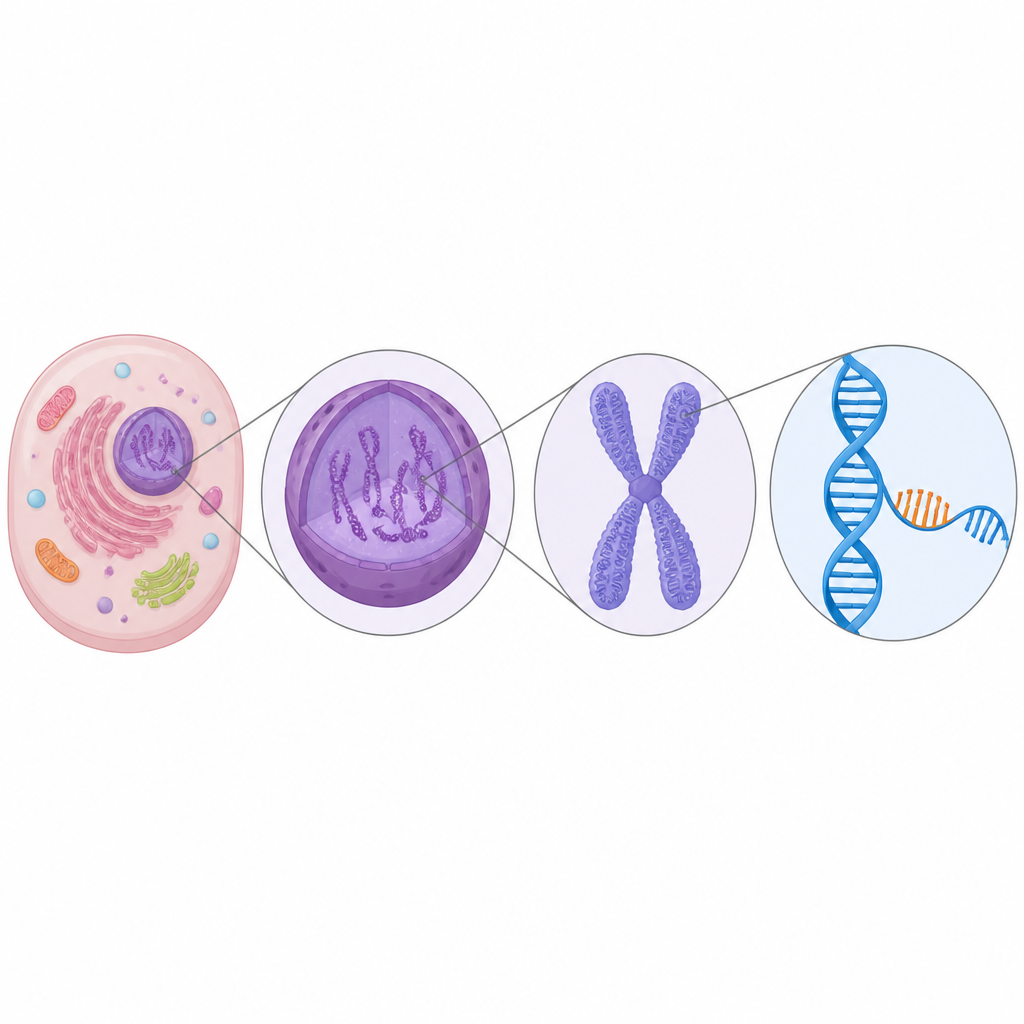
Chromosome: a thread-like structure in the nucleus of a cell that carries genes and determines the characteristics of a living being.
Gene: a unit present in a chromosome that determines a physical characteristic of a living being and helps transmit that characteristic to the next generation.
Not every chromosome does the same job. Some are called sex chromosomes, and they have the main role in determining sex, that is, whether an offspring will be male or female. Physical characteristics such as eye colour or straight or curly hair are determined by the genes on the chromosomes, and the same genes carry those characteristics on to the next generation.
Genetics: the branch of biology that deals with the study of genes.
Genetics Today
Mendel founded various laws of genetics, and his laws made it much easier to carry out experiments in this field. Since then, many technologies have been developed in genetics. They have proved useful both in research and in the daily lives of human beings.
One such technology is genetic engineering. Scientists cut out a small piece of DNA and join another piece in its place. Because genes are made of DNA, doing this can change a characteristic of the organism. The development of genetic engineering has made it possible to reproduce various animals through artificial means and to develop various hybrid animals.
Genetic engineering: the technology of changing an organism's characteristics by removing or adding pieces of its DNA.
From One Cell to a Whole Body
It is assumed that prokaryotic cells evolved into eukaryotic cells, and that over a long time unicellular eukaryotic organisms slowly evolved into multicellular ones. You are a multicellular organism made of an enormous number of cells, yet your life also began as a single cell.
At the time of sexual reproduction, cells in the male and female reproductive organs undergo meiosis cell division to form gametes. The male gamete is the sperm and the female gamete is the egg. These gametes fuse during mating or copulation to form a zygote. A zygote is a single cell. It divides again and again by mitosis cell division until it becomes a mass of cells. These cells then change into different kinds, such as muscle, bone and blood cells, a change called differentiation. In this way a complete body, the combined form of countless cells, develops from one zygote.
Chromosome numbers are written as \( n \) and \( 2n \). The body cells of the father and the mother have \( 2n \) chromosomes. The sperm and egg made by meiosis carry only half of that, \( n \). When the two gametes fuse, the zygote has \( 2n \) again. The mitosis that follows does not change this number, so the body cells of the offspring are also \( 2n \).
Cell division: the process by which one mother cell divides to form new daughter cells.
Gamete: a reproductive cell, the sperm or the egg, formed by meiosis cell division.
Zygote: the single cell formed when a male gamete and a female gamete fuse, from which a new organism develops.
The Two Phases of Cell Division
Both mitosis and meiosis are completed in two phases. First the nucleus divides. The chromosomes are inside the nucleus, so this is where the most important sharing happens. Only after the nucleus has divided does the cytoplasm, together with the cell membrane, pinch in and separate to make separate cells.
Karyokinesis: the first phase of cell division, in which the nucleus divides.
Cytokinesis: the phase that follows karyokinesis, in which the cytoplasm divides along with the cell membrane.
Students often swap these two words. Karyo means nucleus and cyto means cell, so karyokinesis is the nucleus dividing and it always comes first. Cytokinesis, the cytoplasm dividing, comes second.
Mitosis and Meiosis Compared
The body makes two kinds of cells: cells that build the body, and gametes for reproduction. These two kinds are not made in the same way. The table sets the two kinds of division side by side.
| Point | Mitosis | Meiosis |
| Where it happens | All body cells except reproductive cells | Cells of the male and female reproductive organs |
| Daughter cells from one mother cell | Two | Four |
| Kind of cells formed | Somatic or vegetative cells | Gametes (sperm and egg) |
| Chromosome number | Same as the mother cell, \( 2n \) | Half, \( n \) |
| Main job | Growth, development and repair | Sexual reproduction |
Somatic cells: all the cells of the body other than gametes, formed by mitosis. They are also called vegetative cells.
Mitosis Cell Division
Mitotic cell division occurs in all cells of the body except reproductive cells. During mitosis a cell divides into two daughter cells. This type of cell division mainly occurs for the growth, development and repair of the tissues of the body.
Mitosis: the type of cell division in which one mother cell divides into two daughter cells, each with the same number of chromosomes and the same DNA as the mother cell.
In our body, every cell except the gametes is diploid. A diploid cell contains two sets of chromosomes: one set is paternal, from the father, and the other set is maternal, from the mother. Such cells are represented by \( 2n \).
Diploid cell (\( 2n \)): a cell containing two sets of chromosomes, one paternal set and one maternal set.
Before the cell divides, the DNA in the chromosomes of the nucleus is replicated and forms two identical copies. At the end of the division, two identical daughter cells are formed, each having one copy of the DNA. This is how the genetic characteristics found in the mother cell are established in the daughter cells. So there is no change in the number of chromosomes in the daughter cells formed by mitosis.
Equational division: a division in which the daughter cells keep the same number of chromosomes as the mother cell. Mitosis is also called equational division for this reason.
Mitosis copies first and shares second. Because the DNA is doubled before the cell splits, each daughter cell ends up with exactly what the mother cell started with.
Counting Cells and Chromosomes
Human body cells have 46 chromosomes, so \( 2n = 46 \). A human zygote divides by mitosis three times in a row, and every cell divides each time. How many cells are there at the end, and how many chromosomes does each cell have?
Step 1: The first division turns one cell into two:
\[ 1 \times 2 = 2 \]
Step 2: In the second division both of those cells divide, doubling the count:
\[ 2 \times 2 = 4 \]
Step 3: In the third division all four cells divide, doubling it again:
\[ 4 \times 2 = 8 \]
Step 4: Mitosis does not change the chromosome number, so the number in each of the eight cells stays:
\[ 2n = 46 \]
Answer: there are 8 cells, and each cell has 46 chromosomes. The number of cells doubles every time, but the number of chromosomes in each cell stays the same. That is why every body cell grown from one zygote carries the same chromosome number.
A Model of Mitosis
A simple model of mitosis can be made with coloured clay and woollen thread. The clay makes the outline of each cell, and two threads of different colours stand for two chromosomes. One colour can stand for a chromosome from the father and the other for a chromosome from the mother.
The model shows three stages in order. The first cell holds two threads of two colours. In the second cell each thread is doubled, two copies joined together, to show DNA replication. Finally there are two separate cells, and each again holds one thread of each colour. While studying the model, count how many cells there were at the start, how many there are at the end, and how many chromosomes each cell holds.
The count makes the result clear. One cell became two, yet each cell still holds two chromosomes, and of the same two colours. The model shows that mitosis increases the number of cells without changing the genetic makeup of any of them.
Significance of Mitotic Cell Division
Mitotic cell division matters to living things for these reasons:
- It plays a key role in physical growth, because it increases the number of cells with the same genetic makeup. A seedling becoming a tree and a baby becoming an adult both depend on it.
- It helps regenerate cells in injured areas, returning them to their original state. A cut on your finger closes because the cells around it divide by mitosis and fill the gap.
- It helps in the asexual reproduction of some plants and invertebrates. A piece of potato with an eye grows into a new plant, and a bud growing out of a hydra becomes a new hydra.
- It maintains genetic stability. Every new cell has the same number of chromosomes and the same genes as the mother cell, so the genetic makeup of the body's cells stays unchanged.
The full lesson is waiting for you
The notes are free to read in full. A free account opens the rest of the practice, and tracks your progress and confidence score for every subject. Presentations and videos need approval from Learn Yeti.