Fertilization Without Mating
In nature, a new animal begins when a sperm from the male joins an egg from the female. This joining is called fertilization. In most farm animals, fertilization follows natural mating, when the male and the female come together. For a long time farmers had no other choice. If a farmer wanted a calf of a good breed, the cow had to be taken to a bull of that breed, or the bull had to be brought to the cow.
The development of new technologies has changed this. Today fertilization is possible without any mating between the male and the female. Semen can be collected from a male kept far away, carried to where the female lives, and placed inside her body. Because of this, producing offspring of advanced varieties has become very common.
Picture a farmer in a hill village who keeps a local cow. The cow is healthy but gives only a little milk. At a livestock breeding centre in a city there is a bull of an advanced breed whose daughters grow up to give plenty of milk. Walking the cow to the city is not practical, and buying such a bull costs far more than the farmer can afford. Even so, the farmer can get a calf from that bull. The method that makes this possible is called artificial insemination.
What Artificial Insemination Is
Artificial insemination (AI): the technique of collecting semen from advanced breeds of male and allowing it to enter the female reproductive tract at the right time through the use of equipment.
This definition has three key parts. First, the semen comes from an advanced breed: a male chosen for good qualities such as high milk yield in his daughters, fast growth or good health. Second, the semen is placed in the female's reproductive tract with equipment, not by mating. Third, it is done at the right time, when the female is ready to conceive. If the timing is wrong, no egg is ready to be fertilized and the effort is wasted.
In practice, healthy sperm is collected from the male and allowed to pass into the uterus of a healthy female at the appropriate time, using artificial means. After that, everything happens just as in natural reproduction. The sperm meets the egg inside the female's body, fertilization takes place, and the young one grows in the uterus. Offspring produced by this technique are found to be as normal as those produced by natural mating.
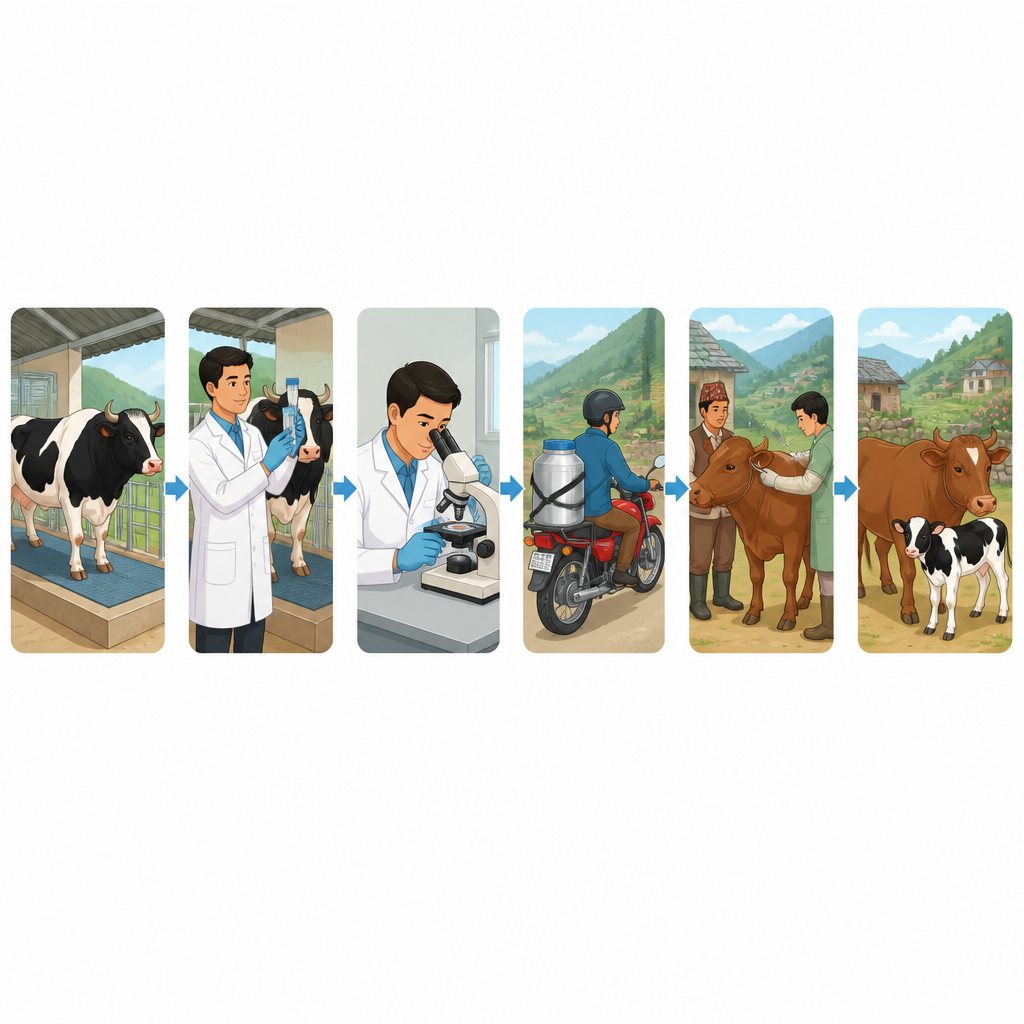
The word artificial describes only the way the semen reaches the female. The calf, kid or lamb that is born is a completely natural animal, and fertilization still happens inside the female's own body.
Spallanzani's Discovery
The first scientific research on artificial insemination of domestic animals was carried out in dogs in 1784 by the Italian scientist Lazzaro Spallanzani. By placing semen into a female dog without any mating, he showed that puppies could be born this way.
Semen: the fluid released by a male animal, made of a very large number of microscopic sperm floating in a liquid.
Spallanzani's experiment also settled an important question. Semen has two parts: the tiny sperm, which can be seen only under a microscope, and the liquid in which they float. Which part makes fertilization possible? His experiment confirmed that fertility resides in the microscopic sperm that float in semen, not in the liquid part of the semen. This is why semen used for artificial insemination today is checked to make sure it holds plenty of healthy, active sperm.
Why Farmers Use Artificial Insemination
The main objective of artificial insemination is to produce a large number of advanced offspring by transmitting the sperm of an advanced breed of male to a female ready for conception. The semen of one male can be divided and used for many females, so one excellent male can father far more young ones than he ever could through natural mating.
Animal husbandry is the raising and care of farm animals such as cows, buffaloes, goats and sheep. For a farmer in animal husbandry, a male with special qualities is expensive to buy, and costly to feed, house and look after. With artificial insemination, farmers can avoid the trouble of rearing such expensive males. They get better offspring without that expense, and better animals give more milk, meat or wool. In this way the technique also helps to strengthen the farmers' economic status.
Currently artificial insemination is practised instead of natural mating in many animals, such as cows, buffaloes, goats and sheep. It is a subsidiary method of reproduction, which means it works alongside natural reproduction rather than replacing it, and it is now practised worldwide. Because each new generation receives the qualities of an advanced breed, it is a useful technique to improve genetic quality in animal husbandry.
One carefully chosen male, many improved offspring, and no expensive male for the farmer to keep: that is the whole purpose of artificial insemination.
Advantages of Artificial Insemination
Compared with natural mating, artificial insemination has many advantages. The main ones are these:
- There is no need to rear a male for breeding, which saves the expense of rearing him.
- It helps to control infection and the spread of disease that can pass between animals during mating.
- After semen is collected from the male, it is tested and its fertility is checked, which makes sure the male is fertile.
- Collected semen of a special male can be used even after that male has died.
- Collected semen can be transported easily over long distances, so a female in a remote village can receive semen from a male at a distant centre.
- It prevents injury to the female or the male at the time of fertilization. This matters most when a heavy male would mate with a small female.
- It increases the rate of fertilization, because the semen is placed in the right place at the right time.
- It helps to keep a good record of reproduction: which male's semen was used, on which date, and for which female.
For the hill farmer's cow, three of these advantages do all the work: no bull has to be kept, the semen can travel from the city, and it can be used even if the bull is no longer alive.
Disadvantages of Artificial Insemination
The technique also has some disadvantages:
- It needs well trained manpower and special equipment. A technician must know the right time and the right way to inseminate, and not every village has one.
- It requires more time than natural breeding, because the semen has to be collected, tested, stored and carried, and the female has to be watched to see when she is ready.
- If the equipment is not properly sanitized during artificial insemination, reproduction may not take place, or there may be a chance of infection.
Disease control and the risk of infection are two sides of one coin. Artificial insemination stops diseases passed on during mating, but only when the equipment is clean.
Natural Mating and Artificial Insemination Compared
In both methods fertilization happens inside the female's body and the young ones are normal. The difference lies in how the semen reaches the female and what that requires.
| Point | Natural mating | Artificial insemination |
| How semen reaches the female | By mating | With equipment |
| Male kept on the farm | Needed | Not needed |
| Distance | Male and female must meet | Semen can travel far |
| After the male dies | No more offspring from him | Stored semen can still be used |
| Disease passed in mating | Can spread | Controlled |
| Trained person and equipment | Not needed | Needed |
| Offspring | Normal | Equally normal |
The full lesson is waiting for you
The notes are free to read in full. A free account opens the rest of the practice, and tracks your progress and confidence score for every subject. Presentations and videos need approval from Learn Yeti.