When a Couple Cannot Have a Child
Most couples who want a child are able to have one naturally. Some cannot, even after trying for years. When a couple cannot conceive after trying for a long time, we say they face infertility. Sometimes doctors find a clear cause, such as a blocked fallopian tube or too few sperm. Sometimes every test comes back normal and the cause stays unknown.
Infertility: the condition in which a couple is unable to conceive a child even after trying for a long time.
Here is a case of the kind doctors meet often. A woman aged 38 and her husband aged 42 have been trying to have a child for five years. Tests for infertility show no cause. Her ovulation cycle is regular, which means her ovary releases a mature egg every month as it should. Her reproductive tract is also normal, as shown by hysterosalpingography. Her husband's sperm count is normal too. Still they have no child, and they are disappointed. In this situation the doctor advises them to adopt in vitro fertilization, or IVF.
Hysterosalpingography: a special X-ray of the internal female reproductive organs, used to check whether the uterus and fallopian tubes are normal.
Why would a doctor suggest IVF when every test is normal? In IVF the egg and sperm do not have to meet inside the woman's body at all. They are brought together in a laboratory, where the doctors can see for themselves whether fertilization has taken place. Whatever hidden problem is stopping conception inside the body, this gives the couple another way.
What In Vitro Fertilization Means
In normal conception, the father's sperm meets the mother's ovum (egg) inside her fallopian tube, so fertilization happens inside her body. In vitro fertilization is different. The words "in vitro" are Latin and mean "in glass". The name tells you where fertilization takes place: outside the body, in a glass dish in a laboratory.
In vitro fertilization (IVF): a method of conception in which a mature ovum taken from a woman's ovary is fertilized by sperm in a dish in a laboratory, and the embryo formed is then placed in her uterus to grow.
IVF is a method of conception that differs from normal sexual intercourse. It is not one single act but a complex series of procedures. It is used to help couples with reduced fertility and couples with genetic problems. The medical methods that help such couples are together called assisted reproductive technology, and IVF is the most effective of them.
Assisted reproductive technology: the group of medical methods that help a couple with fertility problems to have a child. IVF is the most effective of them.
Test-tube baby: the common name for a baby born through IVF, because its life began with fertilization outside the body, in a laboratory.
A test-tube baby does not grow in a test tube or a dish. Only fertilization and the first few days of the embryo happen in the laboratory. After that the embryo is placed in the mother's uterus and grows there for the whole pregnancy, like any other baby.
A child born through IVF is physically and mentally normal. IVF changes only the place where the egg and sperm meet. It does not change the child who grows from them.
The World's First IVF Baby
The story of IVF begins in Manchester, England. A woman named Lesle Brown had suffered for many years because of a blockage in her fallopian tubes. The fallopian tube is the path an egg travels from the ovary to the uterus, and it is where sperm normally meets the egg. With her tubes blocked, egg and sperm could never meet, so she could not conceive.
The British gynaecologist Patrick Steptoe and the scientist Robert Edwards had been doing research on IVF for about ten years. In November 1977, Lesle Brown underwent the experimental IVF procedure. A mature ovum was taken out of her ovary and fused with her husband's sperm in a dish in the laboratory, forming an embryo. A few days later the embryo was transplanted into her uterus.
When the media found out about her conception, she faced intense investigation, because nothing like it had happened before. On 25th July 1978, Lesle Brown gave birth to a daughter by caesarean section. The girl was named Louise Joy Brown. She is the first child in the world to be born by in vitro fertilization.
Louise Joy Brown, born in England in 1978, is the world's first IVF baby. Her birth proved that fertilization outside the body can give a normal child.
IVF in Nepal
In Nepal, IVF technology began in 2004, when an IVF centre was established at Om Hospital. On March 3, 2005, Rajendra Tamang and Sandhya Tamang had a baby through this process. The baby was named Om Mani Tamang, and is Nepal's first test-tube baby. Since then, couples in Nepal no longer have to travel abroad to try this method.
| When | What happened |
| November 1977 | Lesle Brown undergoes experimental IVF in Manchester, England |
| 25 July 1978 | Louise Joy Brown, the world's first IVF baby, is born |
| 2004 | IVF begins in Nepal with an IVF centre at Om Hospital |
| 3 March 2005 | Om Mani Tamang, Nepal's first test-tube baby, is born |
How IVF Is Carried Out
IVF is done in a sophisticated laboratory. The whole process follows the journey of one egg: out of the ovary, into a dish, and back into the uterus as an embryo.
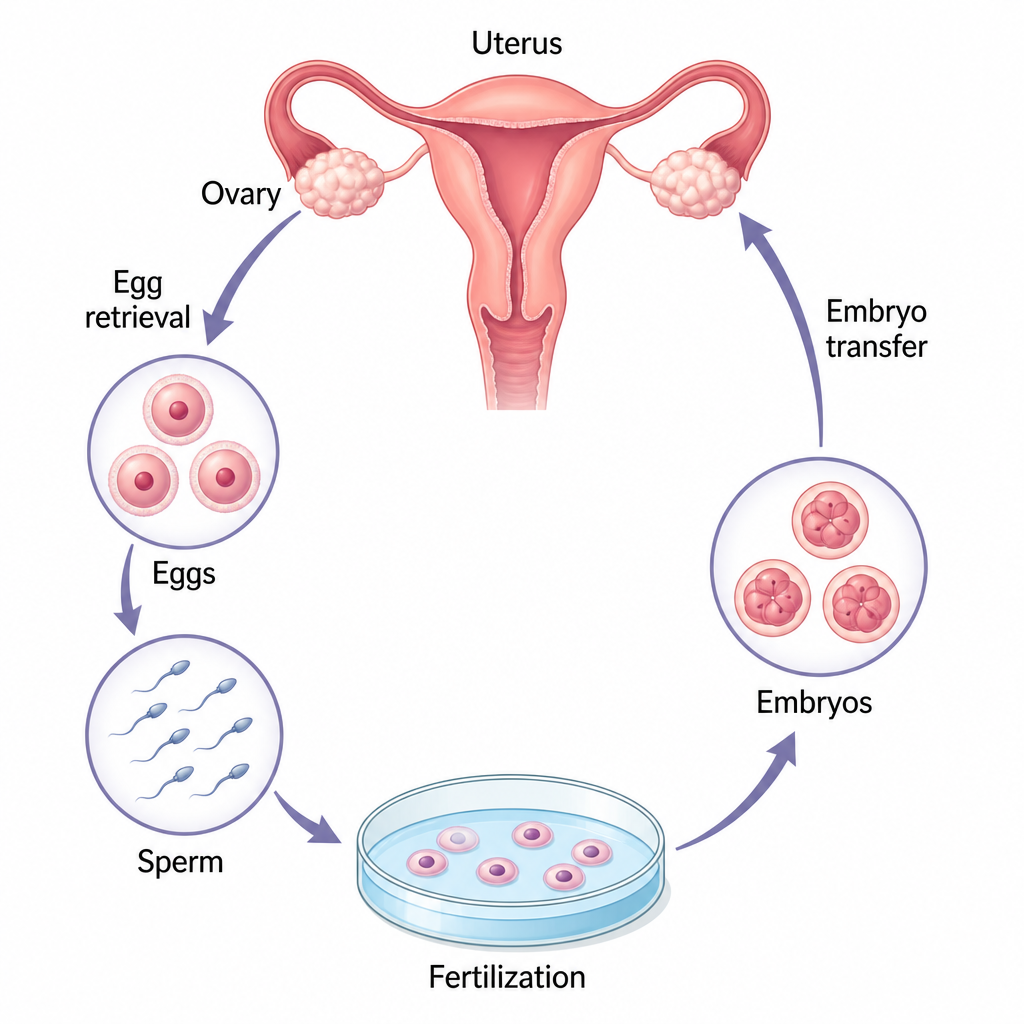
The procedure goes in this order:
- A mature ovum (egg) is taken out of the woman's ovary. This is called egg retrieval.
- The ovum is kept in a petri dish in the laboratory.
- Sperm from the man are added to the dish, and the ovum and a sperm fuse. This is fertilization, and it happens outside the body.
- The fertilized ovum divides and becomes an embryo. It is kept in the laboratory for a few days.
- The embryo is transferred into the woman's womb (uterus). This is called embryo transfer.
- The embryo grows in the uterus just as in a normal pregnancy.
One complete IVF cycle takes about three weeks. It may take longer, depending on the nature of the couple's problem. Some couples need more than one cycle before a pregnancy begins.
In IVF, only fertilization happens outside the body. The baby develops inside the mother's uterus.
Does an IVF Child Look Like Its Parents?
A child's characters come from the ovum and the sperm that formed it. So whether an IVF child resembles its parents depends on whose ovum and whose sperm were used.
If the couple's own ovum and sperm are used, the child inherits characters from both of them, like any other child. But some couples have problems producing ovum or sperm. For them, an egg, sperm, or both can come from a donor, who may be known or unknown to the couple. A child formed from a donor's egg or sperm carries the donor's characters for that half. So the characteristics of a child born through IVF may or may not match those of the parents who raise it.
| Ovum from | Sperm from | Child's characters come from |
| The mother | The father | Both the mother and the father |
| A woman donor | The father | The woman donor and the father |
| The mother | A man donor | The mother and the man donor |
Advantages of IVF
IVF has given children to many couples who had lost hope. Its main advantages are these:
- IVF is the best method of conception for couples who cannot conceive because of various problems related to conception.
- It allows conception using a couple's own sperm and ovum, or a donor's sperm and ovum.
- It is more successful than other assisted reproductive techniques.
- It helps to solve problems related to various chromosomal disorders in the child.
- Infertility and genetic problems can be solved by this technique.
- It increases fertility and reduces the risk of miscarriage.
- It increases the chance of having a healthy child.
Chromosomes are the structures in a cell that carry genetic information, and a fault in them is called a chromosomal disorder. In IVF the embryo is formed in the laboratory, so it can be examined before it is placed in the uterus. This is how the method helps couples with genetic problems to have a healthy child.
Disadvantages of IVF
Useful as it is, IVF also has limits and risks:
- There is no guarantee of a successful IVF cycle. It may fail, and it may take more than one cycle.
- There may be various side effects associated with the use of IVF.
- The problem of multiple births at the same time can also occur.
- Adopting this technique may cause emotional stress in the couple.
- There is a chance that the embryo might be implanted outside the uterus.
- It is an expensive method.
- There is also a chance of premature birth of a baby with low weight.
Multiple births means having twins or triplets at one time. An embryo implanted outside the uterus cannot grow into a normal pregnancy, and this can be dangerous for the mother. Failed cycles, high cost and long waiting are what put stress on the couple.
IVF is a boon for childless couples, but it is expensive, success is not guaranteed, and it carries some risks for both mother and baby.
IVF and Artificial Insemination Compared
Artificial insemination and IVF are both assisted ways of reproduction, so they are easy to confuse. The main difference is where fertilization happens.
| Basis | Artificial insemination | In vitro fertilization |
| Where fertilization happens | Inside the female's body | Outside the body, in a laboratory dish |
| What is placed in the body | Semen from the male, into the female's reproductive tract | An embryo, into the woman's uterus |
| Main use | Mostly in animal husbandry, to get better breeds | Mostly in humans, to overcome infertility |
| Complexity and cost | Simple and cheaper | Complex, needs a sophisticated laboratory, expensive |
In this unit, AI stands for artificial insemination, not artificial intelligence. In AI, only semen is placed in the body and fertilization happens inside it. In IVF, fertilization happens outside the body and an embryo is placed in the uterus. Do not treat the two as one method.
The full lesson is waiting for you
The notes are free to read in full. A free account opens the rest of the practice, and tracks your progress and confidence score for every subject. Presentations and videos need approval from Learn Yeti.