From the Body to the Chromosome
Your skin, muscles, bones and blood are all built from tiny cells. If you take any one of those cells and look at it through a powerful microscope, you can see a round nucleus near its middle. Inside that nucleus lie thread-like bodies that carry the instructions for building and running the whole body. These are chromosomes. Almost every cell in your body that has a nucleus carries a full set of them, whether it is a skin cell or a nerve cell.

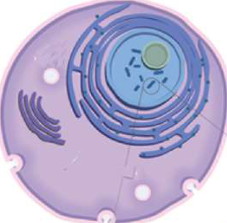
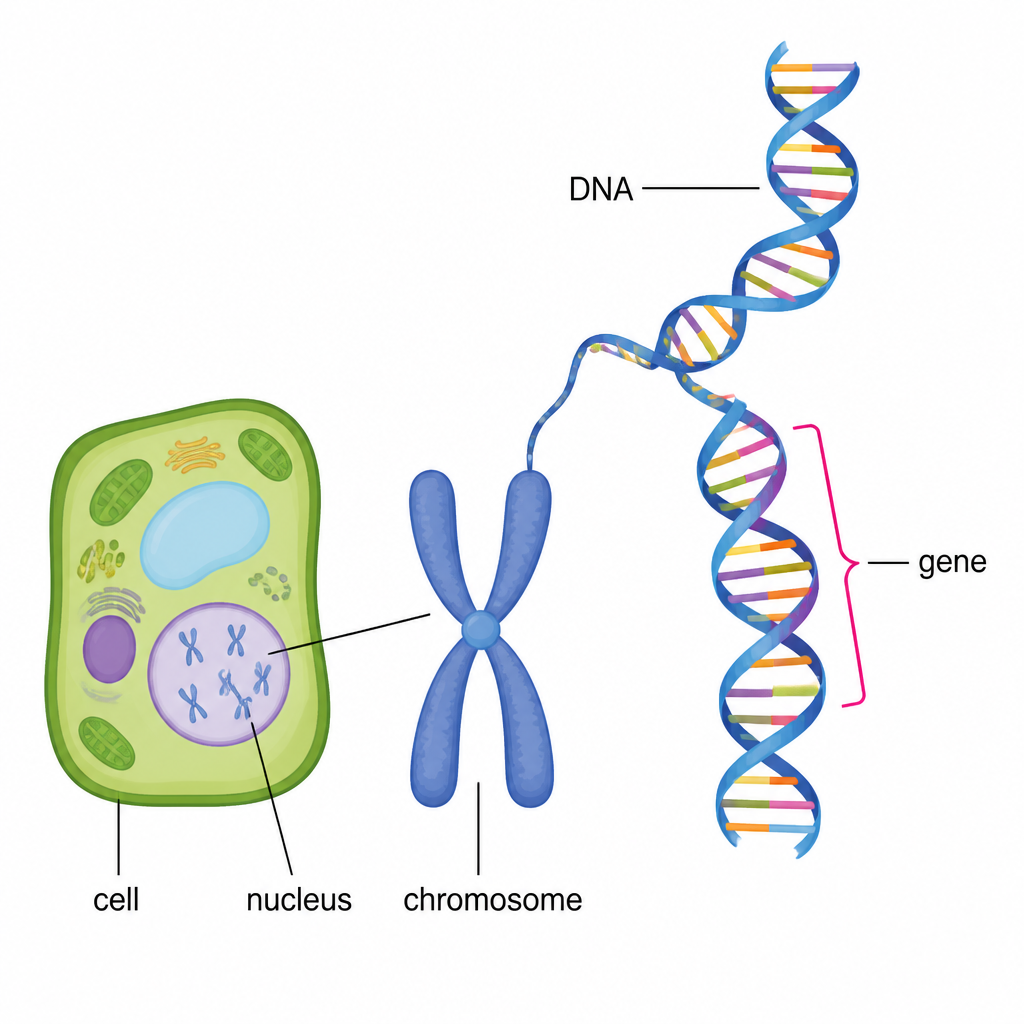
Zooming in from the whole body, the levels come in this order:
- Body: built from a very large number of cells.
- Cell: has a nucleus as its control centre.
- Nucleus: holds the chromosomes.
- Chromosome: a coiled thread made of DNA and protein.
- Gene: a small piece of that DNA that decides one particular character.
Chromatin Fibres Become Chromosomes
When a plant cell or an animal cell is seen through a powerful microscope, the nucleus seems to hold a network of very fine fibres. These are called chromatin fibres. When the cell is about to divide, these fibres coil up tightly. They become short, thick and prominent, and each one can now be seen on its own. These short, thickened fibres are called chromosomes.
Think of a long, thin strand of wool. Spread loosely across a table, it is hard to see and impossible to count. Wind it tightly into a short rope and it is easy to see and easy to move. A cell winds up its chromatin in the same way before it divides, so that every chromosome can be handed out neatly to the new cells.
Chromatin fibres: the network of very fine fibres spread through the nucleus of a cell that is not dividing.
Chromosome: a thread-like structure in the nucleus, made of DNA and histone protein, which becomes short, thick and clearly visible during cell division and carries many genes.
Every chromosome is made of two materials. The first is DNA, the molecule that stores hereditary information. The second is histone protein, around which the DNA is wound like thread on a spool. A great many genes lie one after another along the length of each chromosome.
Structure of a Chromosome
Seen just before a cell divides, a chromosome has roughly the shape of the letter X. It has two main parts: the chromatids and the centromere.
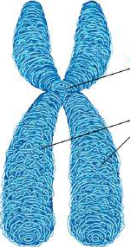
Chromatid: one of the two arms of a chromosome.
Sister chromatids: the two identical copies found in a replicated chromosome.
Centromere: the knot-like part of a chromosome where the two chromatids are joined.
Why does a chromosome have two identical chromatids? Before a cell divides, its DNA makes a copy of itself, so every chromosome is doubled. The two copies stay held together at the centromere. When the cell divides, they are pulled apart and one goes into each new cell. This is how both new cells receive exactly the same information.
Gene
Gene: the smallest fragment of DNA in a chromosome which codes for, or represents, a specific character of an organism.
If a chromosome were a long book, a gene would be one sentence in it that says one thing. The colour of the eyes, curly or straight hair, and whether the earlobe hangs free or is attached are each controlled by genes. A single chromosome carries a very large number of genes.
Genes do three main jobs:
- They carry hereditary characteristics from parents to offspring. This is why a child looks like its parents.
- Each gene decides one particular character of the organism.
- They help in evolution through processes such as mutation and genetic recombination.
A mutation is a sudden change in a gene. In genetic recombination, the genes that come from the mother and the father are mixed in new ways. Both of these bring new combinations of characters into the offspring, and over a very long time such differences are what evolution works on.
Types of Chromosomes
Based on the job they do, chromosomes are of two types: somatic chromosomes, also called autosomes, and sex chromosomes.
Somatic chromosomes or autosomes: the chromosomes that determine the physical characteristics of an individual. In each pair, both members have the same morphology.
Sex chromosomes or heterosomes: the chromosomes that determine the sex of an individual. The members of the pair differ in structure.
Morphology means shape and structure. The two chromosomes in each pair of autosomes look like twins. Sex chromosomes are named by the letters X and Y. In a male cell the two are clearly unlike each other: X is long and Y is much shorter. Because the members of this pair differ, they are called heterosomes, which means different bodies.
| Basis | Autosomes | Sex chromosomes | |
| Function | Determine physical characteristics | Determine sex | |
| Members of a pair | Same shape and structure | Different in structure | |
| Other name | Somatic chromosomes | Heterosomes | |
| Number in a human cell | 22 pairs, that is 44 | 1 pair, that is 2 | |
| How they are named | Numbers 1 to 22 | XX or XY |
Number of Chromosomes
In any one species, the number of chromosomes is constant. It changes, however, from one species to another. Human beings have 46 chromosomes in a body cell, while gorillas have 48. A dog has 78. So a larger number of chromosomes does not mean a larger or more complex animal.
The number of chromosomes is usually expressed in pairs. A human cell has 23 pairs of chromosomes. There is a reason for saying it this way: one set of 23 chromosomes came from the father in the sperm, and the other set of 23 came from the mother in the ovum. So in every pair, one member is the father's and the other is the mother's.
A picture of all the chromosomes of a cell, arranged in matching pairs and in order of size, is called a karyotype. A human karyotype shows the autosome pairs numbered 1 to 22 and then one pair of sex chromosomes, which is XY in a male and XX in a female.
Diploid and Haploid
Ordinary body cells carry two sets of chromosomes, but gametes such as sperm and ovum carry only one set. The number of chromosomes in one set is written as n.
Diploid (2n): having two sets of chromosomes. The somatic cells of the body are diploid.
Haploid (n): having only one set of chromosomes. Gametes, that is sperm and ovum, are haploid.
In humans one set has 23 chromosomes. So a human somatic cell has:
\[ 2n = 2 \times 23 = 46 \]
and a human gamete has:
\[ n = 1 \times 23 = 23 \]
Why must gametes be haploid? At fertilization a sperm and an ovum join. If each carried 46 chromosomes, the baby would have 92, and the number would double in every generation. Because each carries only 23, joining them gives \( 23 + 23 = 46 \), and the baby has the correct human number again.
Sex Determination in Humans
The genes on chromosomes decide the characteristics of a living being. In the same way, the genes on the sex chromosomes decide whether a fetus becomes male or female.
Sex determination: the process by which male and female sexes are separated because of the genes present in the sex chromosomes of an organism.
A human body cell has 23 pairs of chromosomes in all. Of these, 22 pairs are autosomes and 1 pair is the sex chromosome pair. A male cell has the sex chromosomes XY, and a female cell has XX. So a male cell is written as 44+XY and a female cell as 44+XX.
During the reproductive years, the diploid germ cells (2n = 2 × 23) in the testes and ovaries divide by meiosis to produce haploid gametes (n = 23): sperm in males and ova in females. The whole process can be followed step by step.
Step 1: The mother cell in the male reproductive organ, the testis, carries:
\[ 44 + \mathrm{XY} \]
Step 2: Meiosis halves the number and separates X from Y, so two kinds of sperm are formed:
\[ (22 + \mathrm{X}), \; (22 + \mathrm{Y}) \]
Step 3: The mother cell in the female reproductive organ, the ovary, carries:
\[ 44 + \mathrm{XX} \]
Step 4: Meiosis in this cell gives ova of only one kind, because both sex chromosomes are X:
\[ 22 + \mathrm{X} \]
Step 5: Joining a sperm that carries X with the ovum gives a female child, a daughter:
\[ (22 + \mathrm{X}) + (22 + \mathrm{X}) = 44 + \mathrm{XX} \]
Step 6: Joining a sperm that carries Y with the ovum gives a male child, a son:
\[ (22 + \mathrm{Y}) + (22 + \mathrm{X}) = 44 + \mathrm{XY} \]
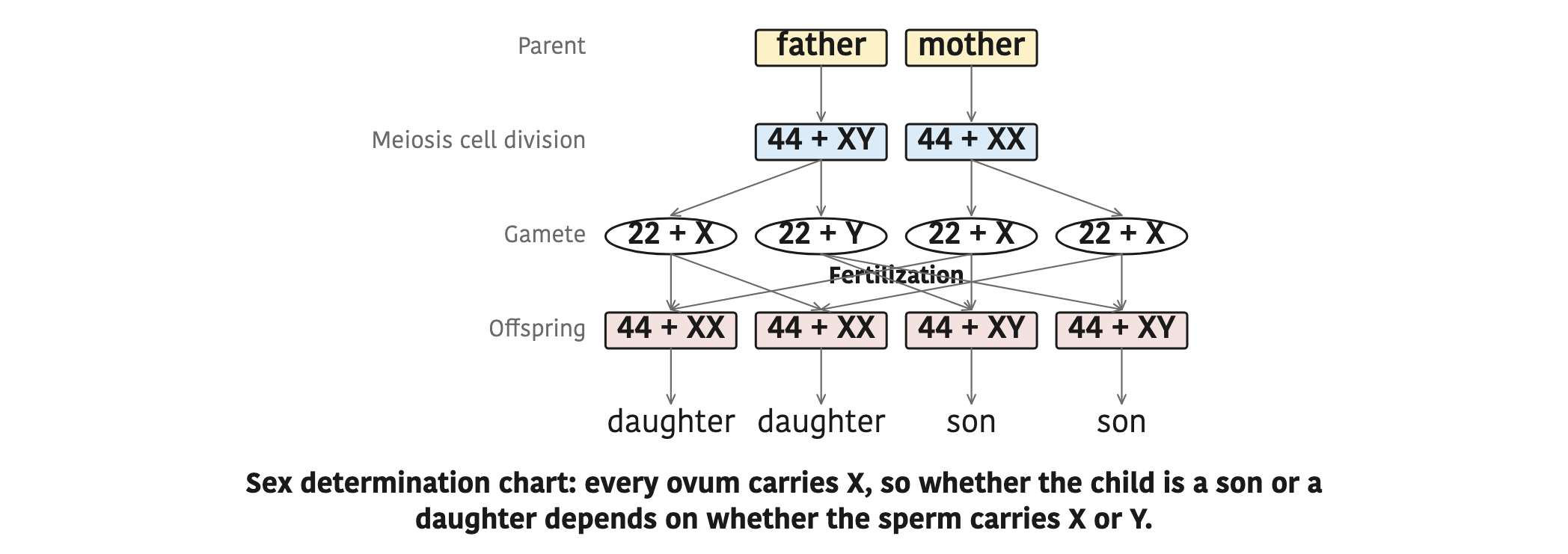
This shows that the mother's ovum can only ever give an X. The father's sperm can give either X or Y. So it is the male who plays the main role in deciding the sex of the child.
Blaming a mother for giving birth only to daughters is wrong. Her ovum always carries X. Whether the baby is a son or a daughter depends on whether the sperm that reaches the ovum carries X or Y, and nobody chooses which sperm that will be.
Son or Daughter: an Equal Chance
Of all the sperm a man produces, half carry X and half carry Y. The ova are all alike. The table shows the four possible meetings.
| Sperm | Ovum | Child's cell | Child |
| 22+X | 22+X | 44+XX | Daughter |
| 22+X | 22+X | 44+XX | Daughter |
| 22+Y | 22+X | 44+XY | Son |
| 22+Y | 22+X | 44+XY | Son |
Step 1: Two of the four possible meetings give a daughter, so the chance of a daughter is:
\[ \frac{2}{4} \times 100\% = 50\% \]
Step 2: The other two meetings give a son, so the chance of a son is:
\[ \frac{2}{4} \times 100\% = 50\% \]
In every pregnancy the chance of a son is 50% and the chance of a daughter is 50%, because half the sperm carry X and half carry Y.
A 50% chance does not mean that out of two children one will be a son and one a daughter. Every pregnancy starts fresh. Even after two sons, the chance that the next child is a daughter is still 50%. This is why some families have only sons and others only daughters.
The full lesson is waiting for you
The notes are free to read in full. A free account opens the rest of the practice, and tracks your progress and confidence score for every subject. Presentations and videos need approval from Learn Yeti.