Heredity: Why Young Ones Resemble Their Parents
Every living being produces young ones of its own kind. A cow gives birth to a calf, a mango seed grows into a mango tree and a hen's egg hatches into a chick. This is how each kind of living being keeps going from one generation to the next. But the young ones are not just the same kind as their parents. They also carry many of their parents' particular characters. A girl may have her father's curly hair and her mother's eye colour. Still, no two members of a family are exactly alike. Brothers and sisters look similar, but each of them has some qualities that differ from the others.
Parents pass their characters to their offspring in both sexual and asexual reproduction. The carriers of these characters are genes. Genes are found in the chromosomes inside the nucleus of a cell. Each gene carries one specific characteristic of the organism. That is how the qualities of the father and the mother reach their children.
Heredity: the phenomenon in which the characters of parents are transferred to their young ones. Characters passed on in this way are called hereditary characters.
Gene: a unit in the chromosomes of the nucleus that carries a specific characteristic of an organism and passes it from one generation to the next.
Genetics and Gregor Johann Mendel
Genetics: the branch of biology that deals with the study of genes, heredity and variation. Genetic engineering and medical genetics are two of its sub-branches.
The first scientist to state the laws of genetics was Gregor Johann Mendel. He was born on 22 July 1822 in Austria, and he is called the father of genetics. Mendel grew pea plants in his garden and carried out many experiments on them. He wanted to prove that hereditary characters really do pass from parents to offspring, and to find the rules they follow. His findings and laws are together known as Mendelism.
Seven Pairs of Contrasting Characters in the Pea Plant
Some characters appear in two clearly opposite forms, with nothing in between. A pea plant is either tall or dwarf. Its seed is either round or wrinkled. Two opposite forms like these make a pair of contrasting characters. Mendel chose seven such pairs in the pea plant. In each pair, one form showed up in the next generation and the other stayed hidden. The form that showed up is called dominant, and the hidden form is called recessive.
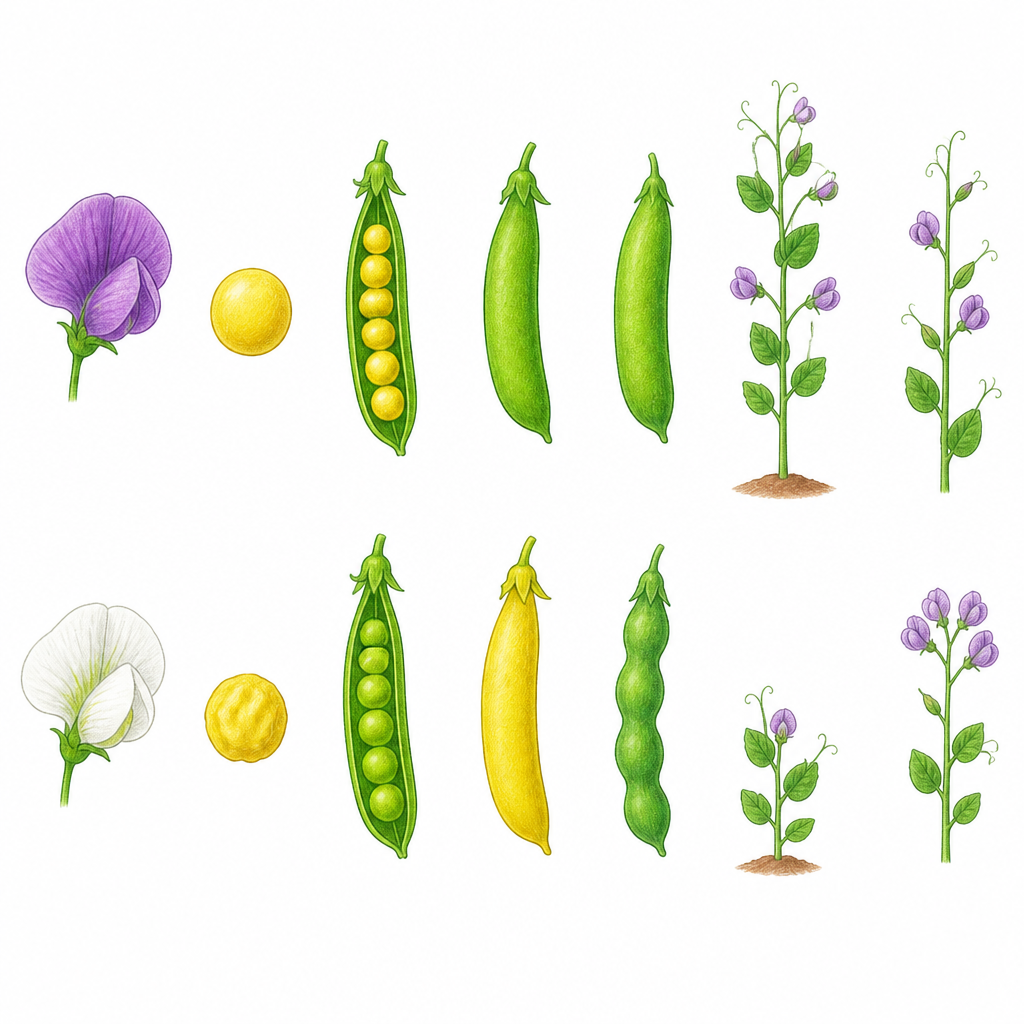
| Character | Dominant form | Recessive form |
| Height of plant | Tall (TT) | Dwarf (tt) |
| Position of flower | Axial (AA) | Terminal (aa) |
| Colour of pod | Green (GG) | Yellow (gg) |
| Shape of pod | Inflated (II) | Constricted (ii) |
| Shape of seed | Round (RR) | Wrinkled (rr) |
| Colour of flower | Purple (RR) | White (rr) |
| Colour of seed | Yellow (YY) | Green (yy) |
Some of these words need a picture in the mind. Axial flowers grow along the stem, where the leaves join it. Terminal flowers grow only at the tip of the stem. An inflated pod is full and swollen. A constricted pod is pinched in between the seeds. The letters next to each form are symbols for its genes. A capital letter stands for the dominant form and a small letter for the recessive form. Each plant has two letters because it carries two genes for every character.
A letter is only a label for one pair of characters. The same letter can be used for two different pairs, as R is used here for both round seed and purple flower. So always say which character you mean before you write its letters.
Why Mendel Chose the Pea Plant
A plant used for this kind of study must breed in a way the scientist can control, and it must give many results quickly. The pea plant does both. Mendel chose it for these reasons:
- Pea plants are bisexual and their flowers stay closed, so they naturally self-pollinate.
- Cross-pollination can also be done by hand whenever it is needed.
- Their life cycle is short, so each new generation is produced quickly.
- They have many pairs of contrasting characters.
- Each plant produces many seeds at once, so there are many offspring to count.
- They are easy to cultivate.
Method of Mendel's Experiment
Mendel studied each of the seven pairs separately, one pair at a time. He sorted every offspring according to the character he was studying. To study height, he took pure tall plants and pure dwarf plants and cross-pollinated them.
Pure and hybrid: a pure plant carries two genes of the same kind for a character, like TT or tt, and gives only its own kind when self-pollinated. A hybrid carries one gene of each contrasting kind, like Tt.
\[ TT \times tt \rightarrow Tt \]
He grew the seeds from this cross. The plants that grew from them formed the first filial generation, written F1. Every F1 plant was tall. No dwarf plant appeared at all. Mendel repeated the experiment with the other six pairs and got the same kind of result each time. Only one character of the pair was expressed in the F1 generation.
First filial generation (F1): the plants grown from the seeds produced by crossing the two parent plants.
Dominant character: of a pair of contrasting characters, the one that is expressed in the first filial generation.
Recessive character: of a pair of contrasting characters, the one that stays hidden in the first filial generation.
The Second and Third Generations
Next, Mendel let the F1 hybrids self-pollinate. The plants grown from their seeds form the second filial generation, F2. This time both tall and dwarf plants appeared. The dwarf character, hidden in F1, came back. Of the F2 plants, 75% were tall and 25% were dwarf.
\[ Tt \times Tt \rightarrow TT,\ Tt,\ Tt,\ tt \]
Mendel did not stop there. He self-pollinated each kind of F2 plant to get a third generation, F3. The pure tall F2 plants gave only pure tall offspring. The pure dwarf F2 plants gave only pure dwarf offspring. The hybrid tall F2 plants behaved like their F1 parents and again gave 75% tall and 25% dwarf plants. So the F2 tall plants were not all the same inside. For every one pure tall plant there were two hybrid tall plants.
A tall plant is not always pure. TT and Tt plants look exactly alike. You can only tell them apart from the offspring they produce: a pure tall plant never gives a dwarf plant, but a hybrid tall plant can.
Results of Mendel's Experiment
Mendel's results for height can be put in three short statements:
- (a) Pure tall plants produced only tall plants.
- (b) Hybrid tall plants produced tall and dwarf plants in the ratio 3:1.
- (c) Pure dwarf plants produced only dwarf plants.
Phenotypic Ratio and Genotypic Ratio
When you look at an F2 plant, you see only one thing: tall or dwarf. But inside, a tall plant may be TT or Tt. So every plant can be described in two ways. One is by what it looks like. The other is by the genes it carries.
Phenotypic character: the character of an organism that is seen externally, such as tall or dwarf.
Genotypic character: the genetic constitution or genetic makeup of an organism, such as TT, Tt or tt.
| Genotype | What the plant looks like | How many out of 4 |
| TT | Tall (pure tall) | 1 |
| Tt | Tall (hybrid tall) | 2 |
| tt | Dwarf (pure dwarf) | 1 |
In the F2 generation of Mendel's experiment, phenotypic ratio is tall : dwarf = 3 : 1, and genotypic ratio is pure tall : hybrid tall : pure dwarf = 1 : 2 : 1.
The two ratios describe the same four plants. The 1 and the 2 of the genotypic ratio join together to make the 3 of the phenotypic ratio, because pure tall and hybrid tall plants both look tall.
Monohybrid Cross and Dihybrid Cross
Monohybrid cross: a cross between two pure plants or organisms in which only one pair of contrasting characters is considered.
Dihybrid cross: a cross between two pure plants or organisms in which two pairs of contrasting characters are considered together.
The tall and dwarf experiment is a monohybrid cross, because only height is followed. Crossing a pure tall pea plant with a pure dwarf one gives 100% hybrid plants in F1. If Mendel had followed height and seed shape together, for example by crossing a pure tall plant with round seeds (TTRR) and a pure dwarf plant with wrinkled seeds (ttrr), that would be a dihybrid cross.
Laws of Mendel
From his experiments, Mendel stated three laws of inheritance:
- Law of dominance
- Law of purity of gametes, also called the law of segregation
- Law of independent assortment
The first two laws come straight from the tall and dwarf experiment you have just followed.
Law of Dominance
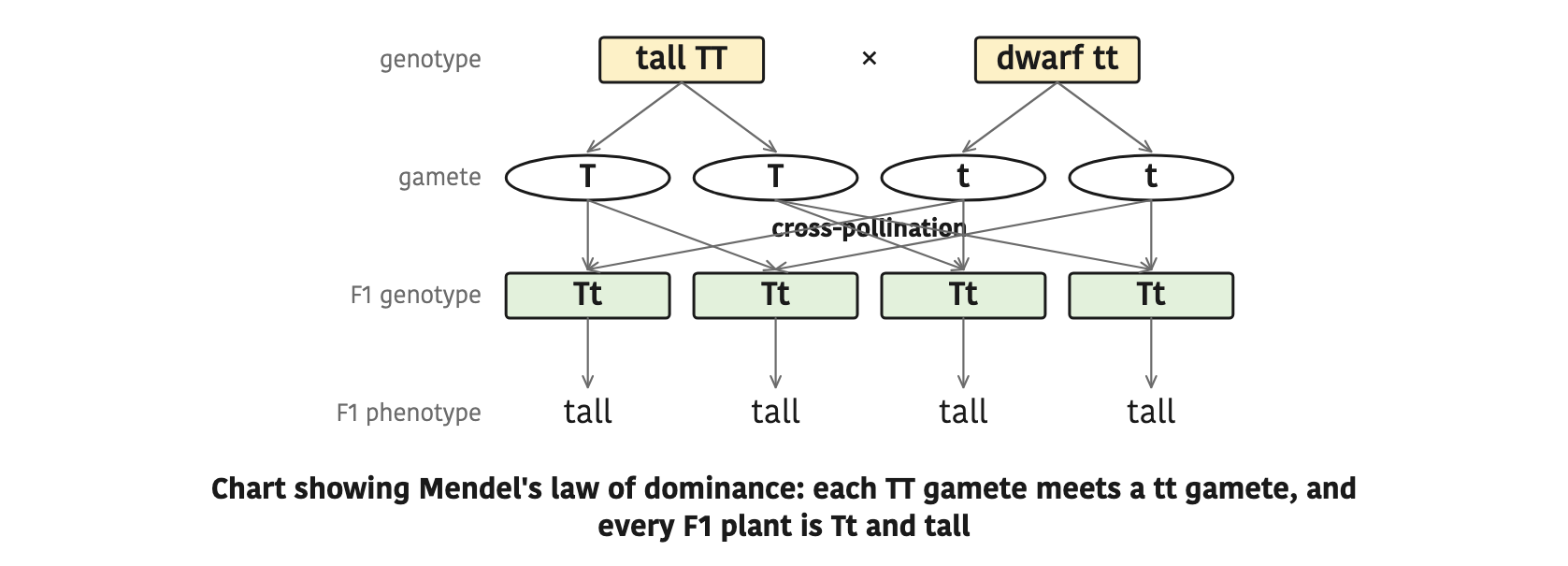
Law of dominance: when two pure individuals with a pair of contrasting characters are crossed, only one character is expressed externally in the F1 generation. The expressed character is dominant and the hidden one is recessive.
The cross of pure tall with pure dwarf shows this law gene by gene.
Step 1: The parents being crossed are:
\[ TT \times tt \]
Step 2: Every gamete of the pure tall parent gets one T:
\[ TT \rightarrow T,\ T \]
Step 3: Every gamete of the pure dwarf parent gets one t:
\[ tt \rightarrow t,\ t \]
Step 4: Cross-pollination joins a T gamete with a t gamete, so every F1 plant gets:
\[ T + t \rightarrow Tt \]
All four F1 plants are Tt, and all of them look tall. The t gene is present in every one of them, but it has no effect on how they look. Tall is the dominant character and dwarf is the recessive character.
Dominance in Guinea Pigs
The law of dominance holds in animals too. A guinea pig is a small furry animal, and its coat can be black or white. When a pure black guinea pig (BB) is crossed with a pure white guinea pig (bb), every young one in F1 is a hybrid, Bb. All of them have black coats. Black colour is the dominant character and white colour is the recessive character.
\[ BB \times bb \rightarrow Bb \]
Law of Purity of Gametes
Inside an F1 hybrid, the genes T and t sit side by side. They do not mix, and neither one changes the other. Each stays pure, exactly as it was when it came from its parent. When the hybrid forms gametes by meiosis cell division, the two genes of the pair separate. Each gamete receives only one of them, either T or t, never both. So every gamete is pure.
Law of purity of gametes (law of segregation): the two different characters in a hybrid stay pure without losing their originality. During gamete formation they separate, so each gamete receives only one pure character.
Self-pollination of the F1 hybrids shows the law at work.
Step 1: The two F1 hybrids being crossed are:
\[ Tt \times Tt \]
Step 2: The genes separate, so each hybrid forms two kinds of gamete:
\[ Tt \rightarrow T,\ t \]
Step 3: Joining every gamete of one parent with every gamete of the other gives:
\[ TT,\ Tt,\ Tt,\ tt \]
Step 4: TT and Tt plants are tall and the tt plant is dwarf, so tall and dwarf plants appear in the ratio 3:1.
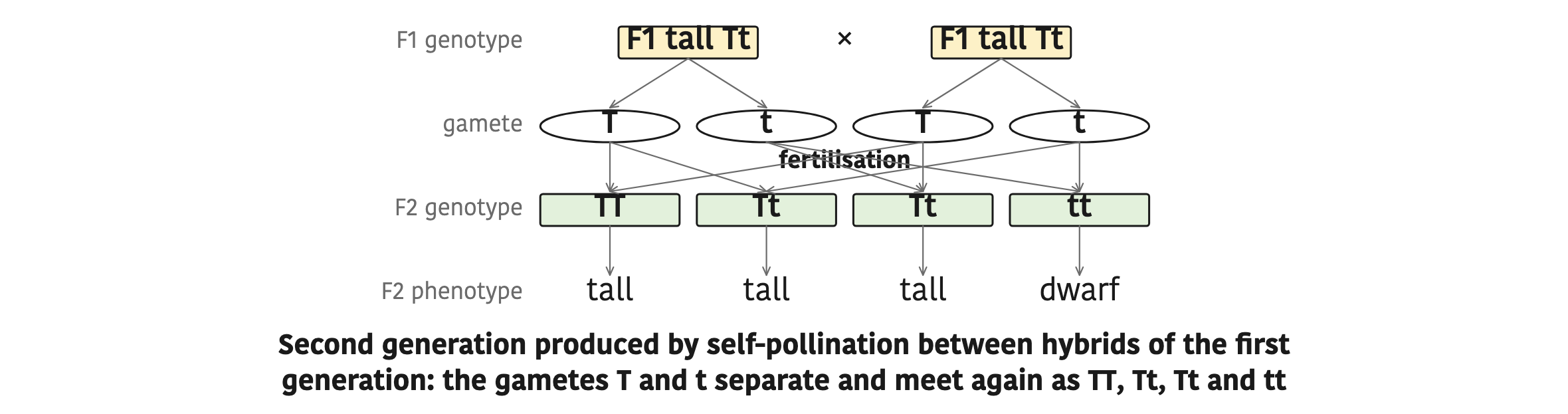
The dwarf plant in F2 is the proof. The t gene was hidden in every F1 plant, yet it came out unchanged. Two pure t gametes met, and a fully dwarf plant grew. If the genes had blended inside the hybrid, a dwarf plant could never have appeared again.
Black and White Guinea Pigs in the Second Generation
The guinea pigs follow the same pattern. When the hybrid black F1 guinea pigs (Bb) are crossed with each other, 75% of their young ones are black and 25% are white. The white coat, hidden in F1, returns. The phenotypic ratio is black : white = 3 : 1. The genotypic ratio is pure black : hybrid black : pure white = 1 : 2 : 1.
\[ Bb \times Bb \rightarrow BB,\ Bb,\ Bb,\ bb \]
The full lesson is waiting for you
The notes are free to read in full. A free account opens the rest of the practice, and tracks your progress and confidence score for every subject. Presentations and videos need approval from Learn Yeti.