What Athletics Is
Walking, running, jumping and throwing are natural human actions. A small child who has just learnt to walk soon starts to run, jumps across a ditch on the way to school and throws a stone as far as it will go. We keep doing these things all our lives. When the same actions are done at a fixed place, inside a marked boundary, against the clock and under agreed rules, they stop being play and become a sport. That sport is athletics.
Athletics: walking, running, jumping and throwing done at a fixed place, within a fixed boundary and time, and under fixed rules.
Athletics is also called track and field. The track is the running path, where races of different lengths are run. The field is the ground where the jumping and throwing events are held. A footballer runs, a volleyball player jumps and a cricketer throws, so almost every other game stands on running, jumping and throwing. This is why athletics is called the base of all sports.
Track and field: the track is the running path; the field is the ground where the jumping and throwing events take place.
How Athletics Grew Around the World
Athletics began in Greece, and from there its influence slowly spread to other countries. As an organised contest it is traced back to 776 BC. Because it was so old and so popular, athletics was included in the very first modern Olympic Games, held in 1896. Since then the Olympic Games have been held every four years, and athletics events have always been a compulsory part of them.
Even with such a long history, a single body to run athletics by the same rules across the world came much later. The International Amateur Athletics Federation was founded only in 1912.
Athletics in Nepal
In Nepal, athletics grew informally from the time of the Shah kings. There were races in which the winner became king, and contests in throwing stones, throwing flat stones and jumping. A custom in which a race decided who would take the throne shows how highly running was valued. These contests did not follow written rules set by any organisation, so this stage is called informal development.
Formal development began only after the Nepal Athletics Association was founded in 1951. In that same year, 1951, the first Asian Games were held in New Delhi, the capital of India. Nepal sent athletes to them to represent the country, and with that Nepal took its first step into sport at the international level.
| Year | Event |
| 776 BC | Athletics begins as an international contest |
| 1896 | Athletics included in the first Olympic Games |
| 1912 | International Amateur Athletics Federation founded |
| 1951 | Nepal Athletics Association founded; Nepal takes part in the first Asian Games in New Delhi |
The Three Types of Athletics
Athletics contains many events. They are grouped into three types, according to the main thing the body does in each:
- Running: covering a set distance on the track as fast as possible
- Jumping: clearing as long or as high a distance as possible
- Throwing: sending an object as far as possible
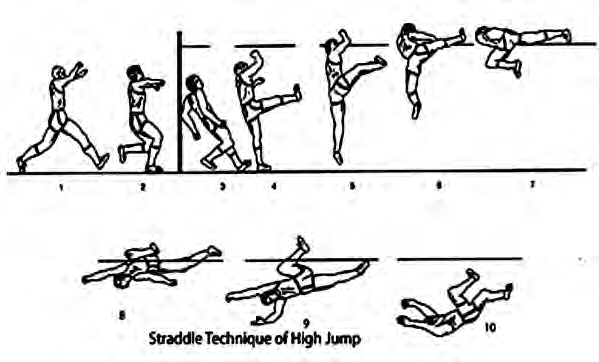
Running
The first of the three types is running. In a race every runner covers the same distance, so the clock decides who wins.
Running (a race): getting from a fixed starting place to a set finishing place in the least possible time.
Races differ in their distance and in whether anything stands in the runner's way. The main kinds of running competition are:
- (a) Short distance race
- (b) Middle distance race
- (c) Long distance race
- (d) Hurdle race
- (e) Relay race
- (f) Steeplechase
Two of these, the long distance race and the relay race, are explained in detail below.
Long Distance Race
The long distance races are the 3000 m, the 5000 m, the 10,000 m and the marathon (42.195 km). To feel how long these are, picture a 400 m track. A 3000 m race is seven and a half laps of it, and a 10,000 m race is 25 full laps. The marathon is more than four times longer again.
Long distance race: a race such as the 3000 m, 5000 m, 10,000 m or the marathon (42.195 km), which needs endurance more than speed.
In these races endurance matters more than speed. Endurance is the body's ability to keep going for a long time even when it is tired. A 100 m runner can run flat out from start to finish, but a runner who tries that in a 10,000 m race will be exhausted within a few laps and fall behind. So a long distance runner must control their pace for the whole race and keep it going right to the end. That ability is not built in a day or two. Success in these races comes only from regular, continuous practice.
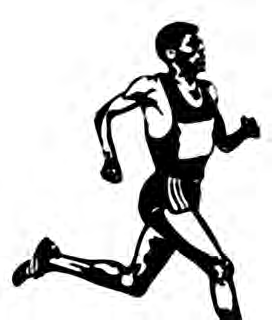
Tips for Long Distance Running
To run a long distance well and stay free of injury, a runner should keep these points in mind:
- Warm up the body well before the race begins. Warm muscles stretch easily.
- Be alert and fit, in mind as well as in body.
- Be confident, strong and full of endurance.
- Do not set off at top speed. A runner who spends all their energy early has nothing left for the last laps.
- Keep the stride long and even, so that every step is about the same length.
- Do not sit down as soon as the race is over.
Never start a long race without warming up, and never drop down to sit the moment it ends. The heart is still beating fast after the race, so let the body slow down gradually.
Rules of Running
For a race to be fair, every runner follows the same rules. A race is started with three commands, and at each one the runner does the following:
- Before the race begins, stand 3 m behind the starting line.
- On the command "On your mark", come to the starting line and lean the body forward, without touching the line.
- On the command "Get set", raise the back upward.
- On the command "Go", start running.
If a runner leaves the line before the sound of "Go", the race is cancelled and started again. If the same runner does this up to two times, that runner is put out of the competition.
Once the race is under way, these rules apply. A lane here means the strip of track marked off by lines for one runner.
- A runner may not leave their own lane until one full round has been run in it.
- No one may push or obstruct another runner during the race.
- A runner has covered the distance only when the whole body has crossed the finish line.
- The runner who covers the set distance in the least time, while keeping to the rules, is the winner.
Relay Race
Of all the running competitions, the relay race is the only team race. In every other race a runner wins or loses alone, but in a relay each team has 4 runners who win or lose together. The usual relay events are the 4 × 100 m and the 4 × 400 m. In a 4 × 100 m relay each of the four runners runs 100 m, so the team covers 400 m in all. In a 4 × 400 m relay each runner runs 400 m, and the team covers 1600 m.
Relay race: a team race of 4 runners, in which each runner covers their distance and then hands the baton to the next.
A relay race goes like this:
- The first runner of each team holds the baton.
- After covering their distance, the first runner passes the baton to the second runner.
- In the same way the second runner passes it to the third, and the third to the fourth.
- The race ends when the fourth runner has covered the set distance.
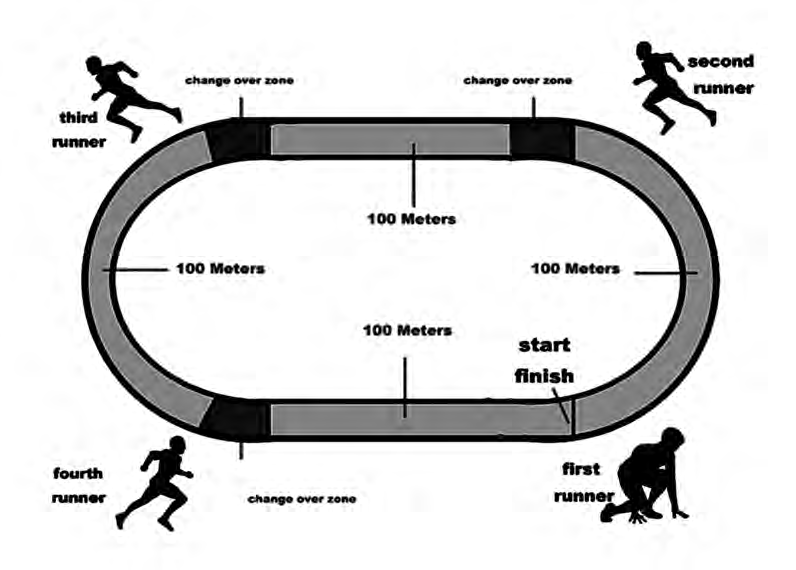
The team that covers the set distance fastest wins. That is why the baton change needs special care. A team of four fast runners can still lose if they fumble the change or drop the baton. Inside the handover zone, once the baton has passed to the next runner, the runner who gave it steps off the running path, and the one who took it runs their own distance.
Suggestions for Relay Running
- Warm up the body well before running.
- In the 4 × 100 m relay there is a 20 m baton handover zone, and the baton must be caught in a balanced, steady way inside that zone.
- Practise the method of passing the baton thoroughly.
- As in other races, listen to the first starting signal with full concentration.
- While running, lean the body forward just as in a 100 m race.
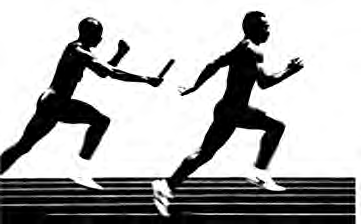
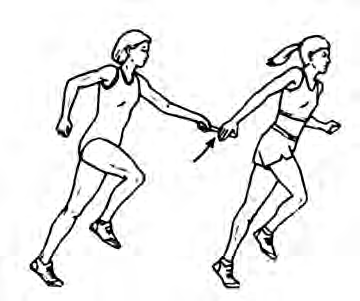
There are two common ways of passing the baton. In both, the runner in front stretches a hand back without looking round, and the incoming runner brings the baton to that hand. The difference lies in which way the receiver's palm faces and from which direction the baton arrives.
Upsweep technique: the baton is pushed upward to pass it. The incoming runner holds the lower end of the baton, while the receiver keeps the hand open with four fingers on one side and the thumb on the other, grips the baton in the gap between them and runs.
Downsweep technique: the receiver turns the palm upward, and the incoming runner places the baton down onto that palm.
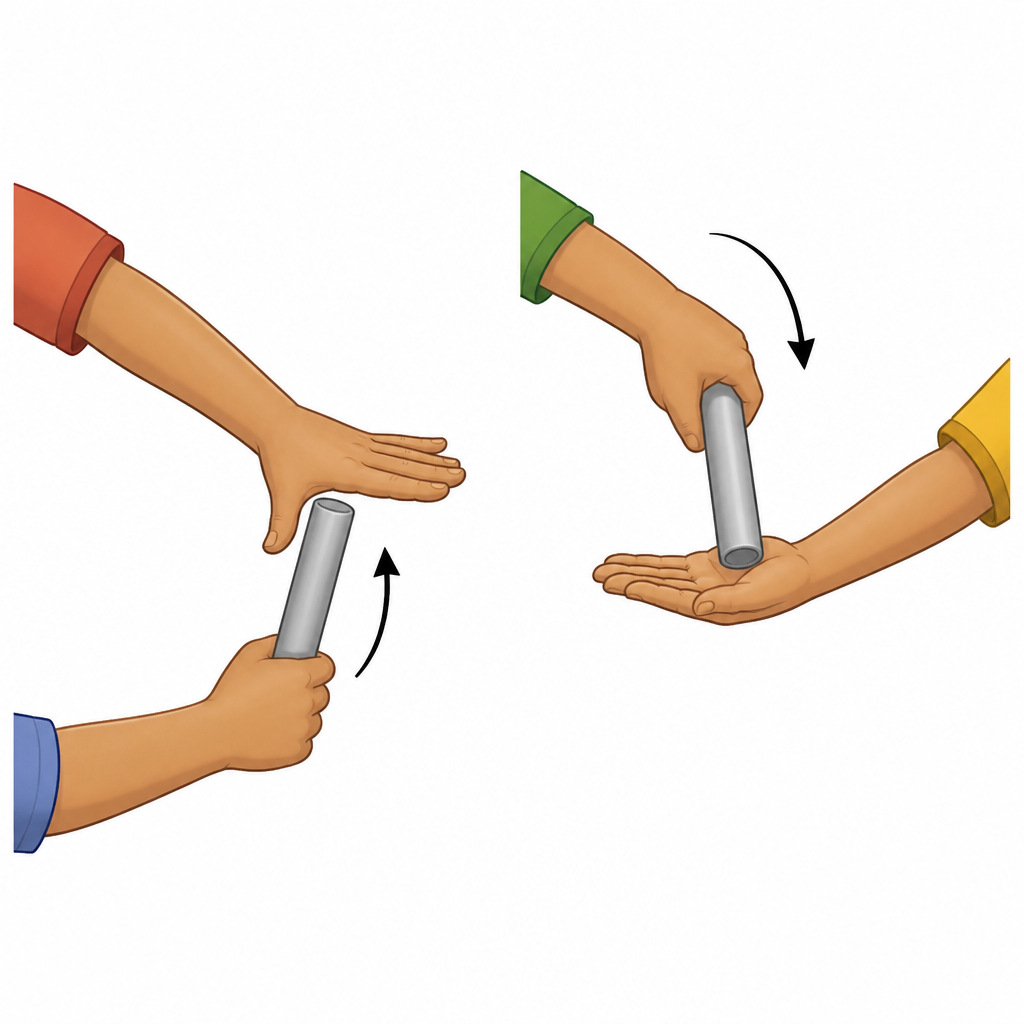
| Point | Upsweep technique | Downsweep technique |
| Receiver's hand | Open, four fingers on one side and thumb on the other | Palm turned upward |
| How the baton arrives | Pushed up from below | Placed down from above |
| Where the giver holds it | By the lower end | So as to lay it on the palm |
The Baton
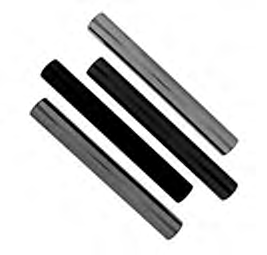
A relay race uses a kind of short stick called a baton. This one stick travels through the hands of all four runners to the finish line. So that every team is equal, its size is fixed as follows:
Baton: the stick of fixed size that is handed from one runner to the next in a relay race.
| Measurement | Value |
| Length of the baton | 30 cm |
| Circumference of the baton | 12 cm |
| Weight of the baton | 50 grams |
A length of 30 cm is about the same as a long school ruler. With a circumference of 12 cm it sits easily in a closed hand, and at 50 grams it is light to carry at full speed.
Rules of Relay Race
- (a) Every runner must wear a chest number.
- (b) Before the race starts, all runners must be ready in position, with the first runner holding the baton.
- (c) No runner may touch or cross the starting line before the command "Go".
- (d) If the baton falls during the pass, the runner who dropped it must pick it up.
- (e) Behind the starting line there is a 20 m stretch divided into two parts of 10 m each. The rear 10 m is the speed increase zone and the front 10 m is the baton handover zone.
- (f) No one may obstruct anyone during the race.
- (g) In the 4 × 100 m relay no runner may change lanes, while in the 4 × 400 m relay the first runner stays in their own lane and the other runners may run from any lane.
- (h) In the 4 × 400 m relay, a runner who needs to overtake another must do so only from the right side.
Look closely at the 20 m in rule (e). As the first runner comes running in, the second runner uses the rear 10 m to build up speed, then takes the baton in the front 10 m and runs on. If the baton were taken from a standing start, the incoming runner would have to brake sharply and time would be lost. The speed increase zone brings both runners to nearly the same speed, so the baton passes smoothly.
Speed increase zone: the rear 10 m of the 20 m stretch behind the starting line, where the receiving runner builds up speed.
Take over zone: the stretch in which the receiver speeds up over the rear 10 m and takes the baton in the front 10 m. It is also called the baton handover zone.
| Point | 4 × 100 m relay | 4 × 400 m relay |
| Distance per runner | 100 m | 400 m |
| Team's total distance | 400 m | 1600 m |
| Lanes | No runner may change lanes | First runner in own lane, the rest in any lane |
| Overtaking | Does not arise, since lanes are kept | Only from the right side |
If the baton is dropped, a teammate may not pick it up for you. The runner who dropped it must pick it up and carry on.
The full lesson is waiting for you
The notes are free to read in full. A free account opens the rest of the practice, and tracks your progress and confidence score for every subject. Presentations and videos need approval from Learn Yeti.