Who Runs an Athletics Competition
Think of your school's annual sports day. In a single morning there may be a 100 m race, a relay, the high jump, the long jump and the shot put, all going on at once in different corners of the ground. Someone has to start each race. Someone has to note every runner's time, measure every jump and every throw, and decide who came first. And if a team feels it has been treated unfairly, someone has to listen and decide. The people who do all this work are called officials.
Official: a person given the duty of organising, supervising or judging part of an athletics competition so that it runs by the rules.
A large competition may need dozens of officials. If all of them tried to do everything, nobody would know who was responsible for what. So when an athletics competition is organised, the officials are divided into four main groups, and each group is given its own duties in running the competition.
The Four Groups of Officials
- 1. Management officials
- 2. Jury of appeals
- 3. Competition officials
- 4. Additional officials
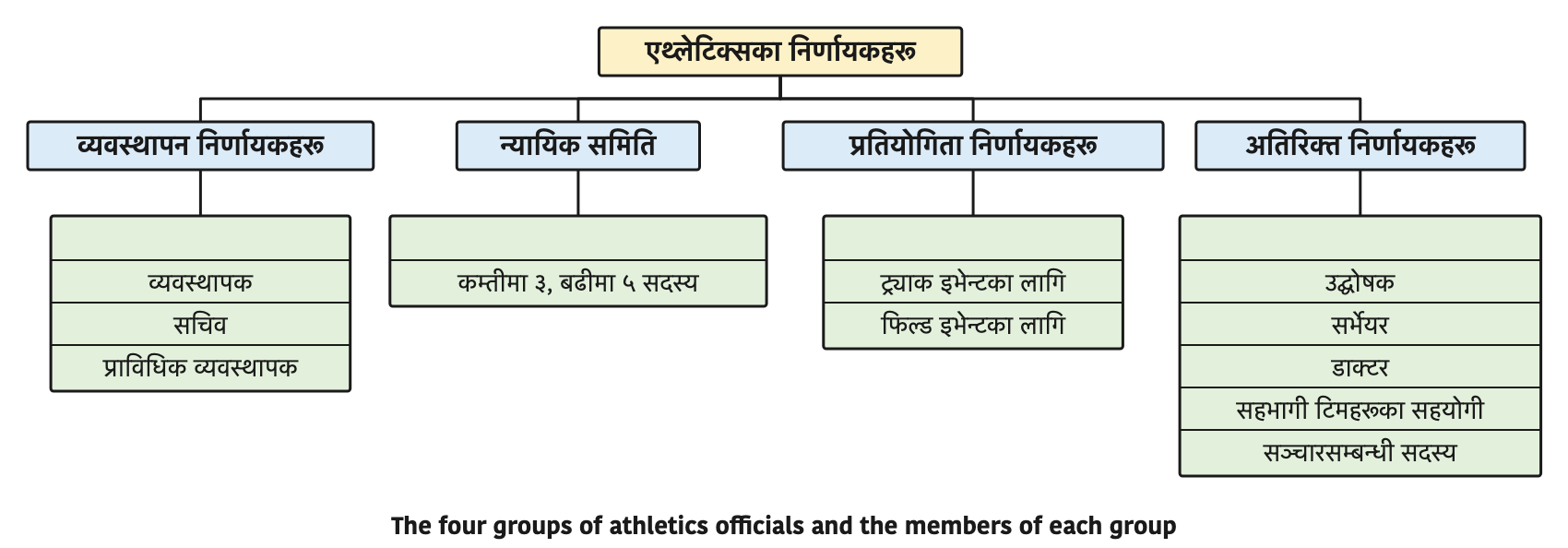
An easy way to hold the four groups in mind is to ask what each one looks after. The management officials plan and prepare the whole competition. The jury of appeals listens to complaints and gives fair decisions. The competition officials actually run each event on the track and in the field. The additional officials support everyone else, so that the competition runs smoothly and people outside the ground also learn the results.
Management prepares, competition officials run the events, the jury of appeals settles complaints, and additional officials support. Each group does a job the others do not do.
1. Management Officials
The management officials are a small team of exactly three members: the manager, the secretary and the technical manager. Their work begins long before the first race and ends only when the last result has been written into the records.
Manager: the official whose main job is to arrange every aspect of organising all the athletics events within the fixed time.
The manager looks at the competition as a whole. Which event happens on which day, at what time and in what order? When does registration close? When are the medals given out? If the programme starts running late, it is the manager who has to bring it back on schedule.
Secretary: the official responsible for supervising all the administrative and financial matters of the competition and for keeping its records.
The secretary looks after the paperwork and the money. Entry forms from schools, letters to teams, the budget, bills for equipment and the official record of results all pass through the secretary's hands. If a question comes up later about who won or how much was spent, the secretary's records give the answer.
Technical manager: the official who takes responsibility for preparing a suitable track and field for the competition.
Before the competition begins, the technical manager makes sure the lanes on the track are properly marked, the landing areas for the jumps are ready, the throwing circle is in place and the equipment is safe and meets the rules. However good the other officials are, a race on a wrongly marked track cannot be fair.
2. Jury of Appeals
The jury of appeals is a committee of at least three and at most five members. Its work begins when something goes wrong.
Jury of appeals: a committee of at least three and at most five members that examines, investigates and analyses the complaints of participating teams against irregular or biased acts during a competition, and gives a decision that is correct, impartial and acceptable to everyone.
While a competition is going on, irregular or unfair things can happen. A runner may be pushed, a result may be written down wrongly, or a decision may seem to favour one team. When this happens, a participating team can bring a complaint, a written application or a request for justice to the jury of appeals. The jury then works through it like this:
- It receives the complaint, written application or request for justice from the team.
- It looks carefully into what happened.
- It investigates, gathering the facts by asking the officials who saw the incident.
- It analyses the facts it has found.
- It gives a conclusion, justice or decision that is correct, impartial and acceptable to everyone.
Suppose that in a 4 × 100 m relay one team says a runner from another lane cut across in front of their runner. The team hands in a written application. The jury hears from the umpires who were watching that bend, weighs what both teams say, and then decides whether the result stands or must change. Because the jury was not itself running the race, it can decide without taking sides.
The jury of appeals does not start races, keep time or measure jumps. It only examines complaints and gives decisions. Its size is not one fixed number either: it has at least three and at most five members, while the management officials always number exactly three.
3. Competition Officials
These are the officials the spectators actually see at work. Their main job is to hold the competitions in the different areas of all the athletics events, in the pits and on the track, and to conduct them in the correct way. A race and a field event need very different kinds of watching, so the competition officials are arranged differently for each.
Competition officials: the officials whose main job is to hold and properly conduct the competitions in the different areas of all athletics events, both in the pits and on the track.
(a) For Track Events
A track event is a race. For track events, the competition officials are these:
| Official | How many | What the official does |
| Referee | one | makes sure the event follows the rules and decides any dispute that arises in it |
| Judges | more than four | decide the order in which the runners reach the finish line |
| Timekeepers | more than three | record each runner's time with stopwatches |
| Umpires | more than four | stand beside the track and watch for runners leaving their lane or blocking others |
| Starter and assistants | one or more | give the starting commands, start the race and call the runners back after a false start |
| Lap scorers | more than four | count the laps each runner completes in a long race |
| Marshal | one | keeps the competition area in order and keeps out people who should not be there |
| Measuring judges | some | take the measurements the event needs |
Picture an 800 m race on a 400 m track. The starter and assistants get the runners ready and start the race. Umpires on the bends watch that nobody is pushed. The lap scorers count two laps for every runner. At the finish the judges decide the order in which the runners arrive, while the timekeepers stop their watches. If any dispute arises, the referee decides it. All the while, the marshal keeps the track clear and orderly.
(b) For Field Events
Field events are the jumps and the throws, such as the long jump, the high jump and the shot put. There is no finish line to watch here. Instead, every attempt has to be checked and measured. For field events the competition officials are one referee, more than four judges, some record keepers and one marshal.
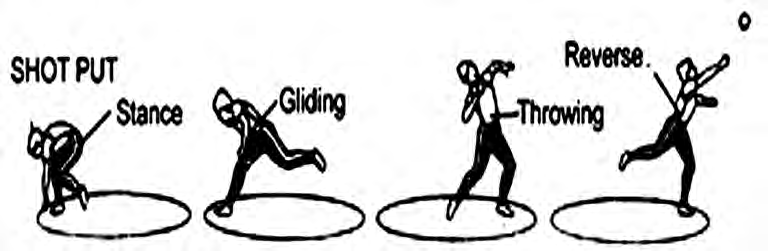
In the shot put, for example, the judges watch that the throw is made from inside the circle by the rules, and then measure it. The record keepers write the distance of every attempt against the athlete's name, so that the best throw can be found at the end. The referee settles any disagreement, and the marshal keeps other people out of the landing area, which also keeps them safe. So track officials mostly watch the order and the time, while field officials check and measure each attempt.
4. Additional Officials
The additional officials do not decide who wins. Without them, though, a competition would be confusing and unsafe, and nobody outside the ground would hear about it. The additional officials are these members:
- (a) Announcer: tells athletes and spectators over the loudspeaker which event is next, who is taking part and what the results are.
- (b) Surveyor: checks that the measurements and markings of the track and field are accurate.
- (c) Doctor: treats any athlete who is injured or falls ill, straight away.
- (d) Steward: helps the participating teams, guiding them to the right place at the right time.
- (e) One or more members who prepare reports and news and work with the media, the press and newspapers.
If an athlete twists an ankle on landing in the long jump, the doctor is there within moments. At the end of the day the announcer reads out the final results, and the member in charge of the media sends the news to the newspapers, so that people who were not at the ground also learn who won.
The Four Groups at a Glance
| Group | Members | Main work |
| Management officials | manager, secretary and technical manager (3 in all) | organise the whole competition, keep administrative and financial records, prepare the track and field |
| Jury of appeals | at least 3, at most 5 | examine complaints and give impartial decisions |
| Competition officials | referee, judges, timekeepers, umpires, starter, lap scorers, marshal, measuring judges, record keepers | run each event on the track and in the pits |
| Additional officials | announcer, surveyor, doctor, steward, media members | announce, check measurements, treat injuries, help teams, prepare news |
A competition is fair only when every group does its own job well. A perfectly marked track is wasted if the timekeepers are careless, and the best race of the day can be spoiled if nobody listens to a genuine complaint.
The full lesson is waiting for you
The notes are free to read in full. A free account opens the rest of the practice, and tracks your progress and confidence score for every subject. Presentations and videos need approval from Learn Yeti.