What the High Jump Is
The high jump is one of the most important and popular jumping events in athletics. In some jumping events the question is how far a player can go. In the high jump the question is how high. The jumper runs in from a marked area, pushes off the ground with one foot and tries to pass over a bar set at a fixed height without touching it.
High jump: an athletics event in which the player runs within a fixed area, lifts the body as high as possible and crosses over a height that has been set.
A fixed stretch of ground is kept for running in. At the jumping place a pole stands at each end, and a light bar called the crossbar rests across the two poles at a chosen height. The jumper must go over this crossbar and come down on the far side into a sand pit or onto a mat. Each time the crossbar is raised it becomes harder to clear, and the player who clears the highest bar wins.
Styles of High Jump
Not every jumper crosses the bar in the same way. Jumpers differ in how they turn the body after the run, which part of the body goes over the bar first, and how they come down. Each of these ways is called a style. The styles of high jump are:
- (a) Scissors style
- (b) Western roll
- (c) Eastern style
- (d) Straddle style
- (e) Fosbury flop style
Of all these styles, the straddle style and the Fosbury flop are counted as the two main ones.
The Straddle Style
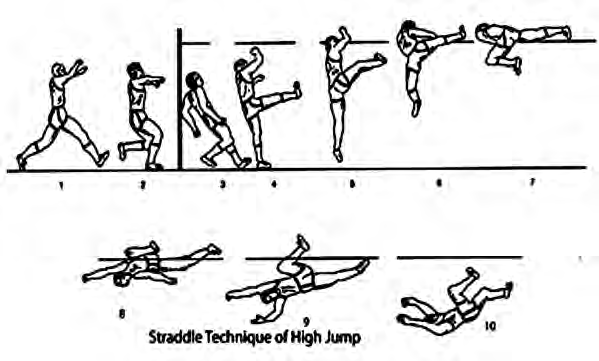
In the straddle style the jumper crosses the bar lying face down. The jumper runs in from the marked area and, at the take-off, pushes the ground away with one foot. The other leg, the one that did not push, is swung over the crossbar first, and the pushing leg is pulled over after it. While crossing, the body lies face down along the length of the bar. To land, the jumper rolls over the shoulder, using the upper back to take the fall, and ends lying on the ground.
The straddle jump can be followed in this order:
- (a) Run towards the bar from the marked area.
- (b) At the take-off, push the ground hard with one foot.
- (c) Swing the opposite leg over the bar first.
- (d) Turn the body face down over the bar.
- (e) Pull the trailing leg over to clear the bar.
- (f) Land by rolling over the shoulder on the upper back.
The Fosbury Flop
Besides the straddle, the high jump can be done in the Eastern style, the Western roll, the scissors style and the Fosbury flop. Of these, the Fosbury flop has been proved to let a jumper clear a greater height than the others. That is why it is the style used in competitions today.
In the Fosbury flop the jumper runs towards the bar, takes off from one foot and twists in the air so that the back faces the bar. The head and shoulders go over first, the hips are lifted high, and the legs are flicked up and over last. The jumper then comes down on the back and shoulders. So in the straddle the jumper faces the bar, while in the flop the jumper's back is to the bar.
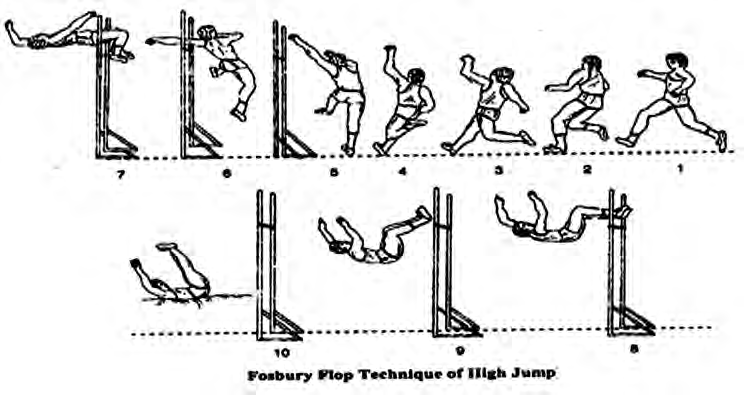
In the Fosbury flop you land on your back and shoulders, so practise it only onto a thick mat, never into a sand pit or onto hard ground.
| Point | Straddle style | Fosbury flop |
| Body over the bar | Face down, facing the bar | Face up, back to the bar |
| First part over the bar | The leg that did not push off | Head and shoulders |
| Landing | Rolling over the shoulder | On the back and shoulders on a mat |
| Use today | One of the two main styles | Clears greater heights, used in competitions today |
What a High Jump Needs
Four things are needed for a high jump: a place to land, a place to run, two upright poles and the crossbar that rests on them. Their measurements are fixed so that every player in a competition has the same chance. The table below puts all these measurements in one place.
| Requirement | Measurement |
| (a) Landing area | Length 5 metres, width 4 metres |
| (b) Runway | Usually a radius of 15 to 20 metres from the centre of the base line of the sand pit |
| (c) Uprights | Gap between them at most 4.02 metres and at least 3.66 metres, placed about 10 centimetres in front of the pit or mat |
| (d) Crossbar | Length 3.64 to 4 metres, weight less than 2 kilograms |
The Landing Area and the Runway
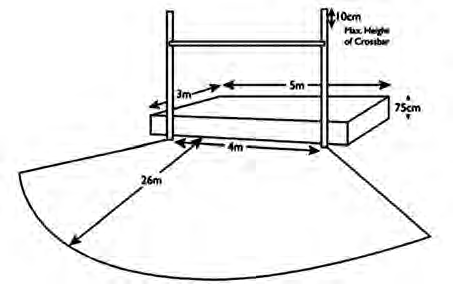
Landing area: the mat, or the pit filled with sand, that the jumper comes down on after clearing the bar. It is 5 metres long and 4 metres wide.
For the landing area a mat is laid, or a pit of the same size is dug and filled with sand, 5 metres long and 4 metres wide. The jumpers land only on this mat or in this sand pit. A soft landing place takes the shock of the fall, so the jumper is protected from injury.
Runway: the curved, fan-shaped area in front of the landing area where the jumpers run in before they jump.
The runway is marked out as a curve with its centre at the middle of the base line of the sand pit, usually with a radius of 15 to 20 metres. This gives it a fan shape, so a jumper can run in from the side on a curve as well as straight ahead. Competitors must run only from this runway. Big competition grounds sometimes make this area larger, so a drawing of one may show a bigger measurement, but the usual size is 15 to 20 metres.
The Uprights and the Crossbar
Uprights: the two poles of wood, iron or another metal that hold up the crossbar. They stand about 10 centimetres in front of the sand pit or mat.
The gap between the two uprights is at most 4.02 metres and at least 3.66 metres. Each upright carries a clip to hold the crossbar, and the two clips are set at exactly the same height. Level clips keep the bar from sloping, so every player jumps over exactly the same height. As the competition goes on, the clips are moved up to raise the bar.
Crossbar: the bar laid across the clips of the two uprights, which the jumper must pass over without touching.
The crossbar may be triangular, square or rectangular in shape. Its length is 3.64 to 4 metres and it weighs less than 2 kilograms. Because it is so light, even a small touch from the jumper's body knocks it down. That is what makes it easy to judge a jump: if the bar stays up the jump counts, and if it falls it does not.
The gap between the uprights (at least 3.66 metres, at most 4.02 metres) and the length of the crossbar (3.64 to 4 metres) are two different measurements. Do not swap them in an exam answer.
The Five Skills of the High Jump
The high jump can be done in several styles, but whichever style a jumper uses, success depends on regular practice and on using the right skills. One jump can be broken into five parts, which follow each other in a single smooth movement:
- (a) The approach
- (b) The take-off
- (c) The flight
- (d) The clearance
- (e) The landing
An easy way to hold the order: run in, push off, rise, get over, come down.
The Approach and the Take-off
Approach: the run from a fixed starting point up to the moment of the take-off.
A long run is not needed for the high jump. A long run builds speed, but here the jumper has to go up, not forward. For an effective approach, the take-off should come at the seventh step. Starting from the same spot and running the same seven steps every time puts the take-off foot in exactly the right place.
Take-off: the push off the ground with one foot at the end of the approach, rising towards the bar at an angle of about 40°.
The take-off matters just as much as the approach. It is always made from one foot, never from both. At this moment the speed of the run is turned into an upward jump, and the jumper rises towards the bar at an angle of about 40°.
The Flight, the Clearance and the Landing
Flight: the stage from the end of the take-off until the jumper reaches the top of the bar.
The flight is the third stage of the high jump. It is the lifting of the arms, legs and body in the air after the take-off. The jumper is no longer touching the ground, so the push from the take-off is what carries the body up, while the jumper sets the arms and legs ready to go over the bar.
Clearance: the skill of getting over the bar successfully without touching it.
Clearance is the most important skill of all. If any part of the body, arms or legs touches the bar, the bar falls, and a jump with a fallen bar does not count. So competitors use different styles, such as the straddle and the Fosbury flop, to clear the bar without touching it.
Landing: coming down to the ground after the clearance.
Landing is the last skill of the jump. The jumper comes down on the mat or in the sand pit, rolling over the shoulder in the straddle and landing on the back and shoulders in the Fosbury flop. Landing the right way prevents injury and keeps the jumper fit for the next attempt.
The Rules of the High Jump
Fourteen rules are followed so that a high jump competition is fair and every player gets an equal chance:
- (1) Before the competition starts, the judge must tell all players the starting height and how much the bar will be raised after each round.
- (2) Players must jump in turn, in the order the officials call their names.
- (3) No player may run in from outside the marked area.
- (4) The take-off must be made from one foot only.
- (5) Once the competition has begun, no one may practise at the competition site.
- (6) Players may put down check marks and a mark for their take-off at the site.
- (7) The uprights may not be moved or changed during the competition.
- (8) If the uprights seem to be wrongly placed, they may be changed only after a round has been completed.
- (9) A player may skip the lowest height and jump only at a higher one, but such a jump must be made in one go.
- (10) In every round the players must be told the height of the crossbar.
- (11) A player may not touch or step on the landing area before crossing the bar.
- (12) In one round each player may try at most three times. A player who fails all three times is out.
- (13) The crossbar must not fall while it is being crossed.
- (14) If at the end two or more players have cleared the same height, the one who cleared it in fewer attempts is declared the winner.
Here is how rule 14 works. Sita and Rina both clear 1.35 metres, and neither can clear the next height. Sita cleared 1.35 metres on her first attempt, but Rina needed her third attempt. Their heights are equal, but Sita cleared it in fewer attempts, so Sita is the winner.
A bar knocked off by the body as it goes over still counts as falling during the jump, so that attempt fails. An attempt also fails if the player touches the landing area before crossing the bar.
The full lesson is waiting for you
The notes are free to read in full. A free account opens the rest of the practice, and tracks your progress and confidence score for every subject. Presentations and videos need approval from Learn Yeti.