Throwing Events and Their Four Kinds
Athletics is not only running and jumping. Throwing is an important part of it too. In a throwing event, the athlete stands inside a marked area and sends an object as far as possible while obeying a fixed set of rules. The athlete whose object travels the farthest by a legal throw wins. Strength alone is not enough. A good thrower also needs correct technique, speed and balance, because a long throw made by breaking a rule is simply not counted.
Throwing: a sport in which an object is thrown as far as possible while staying within fixed rules and a fixed boundary.
There are four throwing events in athletics. Each uses a different object and a different way of throwing it:
- Shot put: a heavy iron ball is pushed away from beside the neck.
- Javelin throw: a long spear with a pointed tip is thrown after a run up.
- Hammer throw: a metal ball fixed to a wire with a handle is swung round and released.
- Discus throw: a flat, plate shaped disc is thrown while the athlete spins.
Of these four, the shot put is the one taught in detail here: its equipment, its measurements, its skills and its rules.
Shot Put
Shot put: a sport in which a round iron object of a fixed weight is thrown, according to the rules, from within a fixed boundary.
The word put here means push. A shot putter does not swing the arm and hurl the ball the way a cricket ball is bowled. The shot is held against the neck and driven forward with the force of the whole body, from the legs up to the hand. Four basic pieces of equipment and facilities are needed for the event, and each one has fixed measurements:
- (a) The shot: the metal ball that is thrown.
- (b) The throwing circle: the round area the athlete throws from.
- (c) The throwing sector: the area between two lines where the shot must land.
- (d) The stop board: a curved board fixed at the front edge of the circle.
The Shot and Its Weight
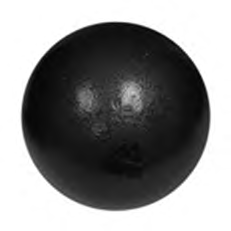
The shot is a solid ball made of iron or another metal. Men and women do not use the same shot. Each has its own weight, fixed by the rules.
| Athlete | Weight of the shot |
| Men | 7.260 kg to 7.285 kg |
| Women | 4.005 kg to 4.025 kg |
The weight is given as a narrow range rather than one exact number, because metal balls cannot all be made to exactly the same weight. Only a shot that falls inside this range is accepted in a competition. The men's shot is about 3.25 kg heavier than the women's. Lift one for the first time and you soon understand why the push has to come from the legs and body and not from the arm alone.
The Throwing Circle and Sector
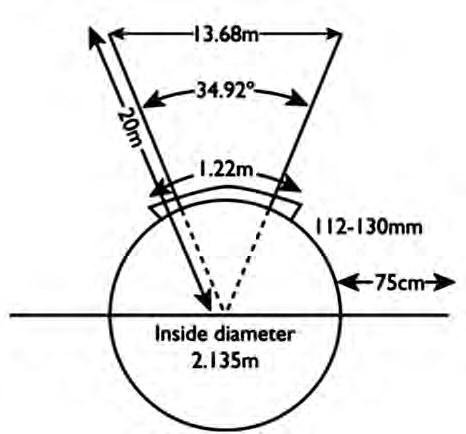
The athlete throws from inside a circle marked on the ground. The inside diameter of this circle is 2.135 m. A straight line is drawn across the middle of the circle, and it extends 75 cm beyond the circle on each side. From the centre of the circle, two straight lines spread out forwards. The angle between them is 34.92°, and the ground between them is the throwing sector. In the diagram these lines are drawn 20 m long, and at that point they are 13.68 m apart. At the front edge of the circle, between the two sector lines, sits the stop board, 1.22 m long.
| Part | Measurement |
| Inside diameter of the circle | 2.135 m |
| Line extending outside the circle on each side | 75 cm |
| Angle between the two sector lines | 34.92° |
| Length of each sector line | 20 m |
| Distance between the lines at 20 m | 13.68 m |
| Length of the stop board | 1.22 m |
The circle is the thrower's place and the sector is the shot's place. The thrower must stay inside the circle, and the shot must land inside the sector.
The shot is a heavy iron ball and can cause serious injury. Nobody may stand or walk in the throwing sector while someone is throwing. When returning a shot, carry it or roll it along the ground. Never throw it back towards another person.
Measurements of the Stop Board
The stop board is curved to follow the front edge of the circle and is fixed there. As its name suggests, it stops the thrower, who is still moving forward after the throw, from carrying on out of the circle. Its length, breadth and height are all fixed:
| Measurement | Value |
| Length | 1.22 m (+ 0.01 m) |
| Breadth | 11.2 cm to 11.6 cm |
| Height | 9.8 cm to 10.2 cm |
Your foot may touch the inner side of the stop board while you throw. You may not step over the board or touch any line of the circle. Many good throws are lost to exactly this mistake.
Skills of Shot Put
A shot put is over in two or three seconds, yet it is built from five skills joined one after another. The main skills come in this order:
- (a) Holding
- (b) Stance
- (c) Gliding
- (d) Throwing
- (e) Reverse
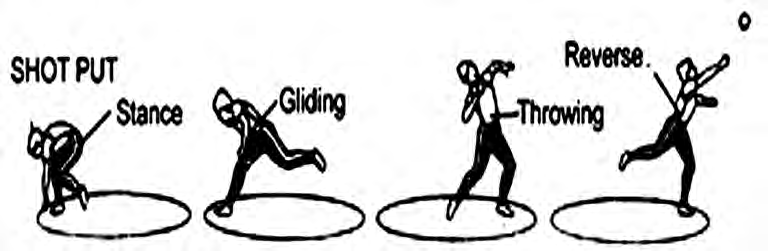
Holding carries on through every stage, which is why the shot stays tucked at the neck in each position until the moment it is released. Each skill is explained on its own below.
Holding
Holding: gripping the shot correctly in one hand, inside the ring, ready to throw it into the fixed area.
The shot is not sunk into the middle of the palm. It rests where the fingers join the palm, with the fingers spread a little behind it. The hand then brings the shot up and presses it into the neck, between the chin and the collarbone, with the elbow slightly raised. The shot must never be taken back behind the shoulder.
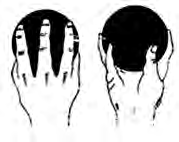
The shot is always pushed from the neck. Taken behind the shoulder, the push becomes a sling, and the rules do not allow that.
Stance
Stance: the starting position, in which the upper body is bent a little backwards, the body's weight rests on the foot on the same side as the hand holding the shot, and the other foot is placed forward with only its toe touching the ground.
Take a right handed thrower as an example. The shot is in the right hand, so the whole body weight sits on the right foot. The left foot is placed forward, but only its toe rests lightly on the ground. The upper body leans a little backwards. The loaded right leg is now like a pressed spring, storing force for what comes next. A left handed thrower does the same thing on the opposite side.
Gliding
Gliding: moving the hands, feet and body forward little by little, while keeping the body balanced, to get into position to throw the shot.
In the glide, the thrower moves from the stance at the back of the circle towards the front. Hands, feet and body travel forward together, smoothly and without a jerk, almost like sliding. The circle is small, so this movement is short and controlled. If balance is lost, the thrower may step out of the circle or touch a line. In the picture below, positions 1 to 6 show the thrower crouched and moving forward, and positions 7 to 10 show the thrower rising and pushing the shot away.
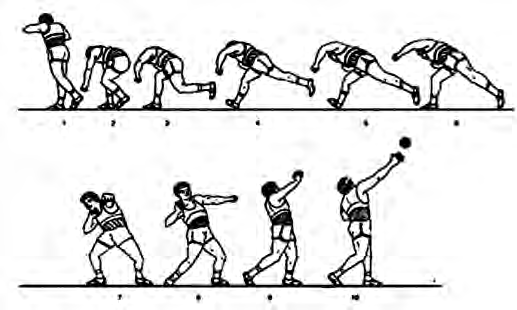
Throwing the Shot
Throwing: pushing the shot as far forward as possible into the marked sector.
As soon as the glide ends, the force stored in the back leg travels upwards. The legs straighten, the hips and chest turn to face the front, and finally the arm drives the shot forward and upward from the neck. The fingers give the last flick as it leaves the hand. The shot must land inside the sector between the two lines. A shot that lands outside them does not count, however far it went.
Reverse
Reverse: after the shot has been thrown with a strong thrust, turning or switching back so that the body stays balanced.
Even after the shot has gone, the body wants to keep travelling forward. In the reverse, the thrower switches the feet and turns back, bringing the body to a stop. Without it, the thrower could go over the stop board and out of the circle, and then even a great throw becomes a foul. So the reverse does two jobs: it stops the thrower falling, and it saves the throw.
Rules of Shot Put
The rules of shot put keep a competition fair and safe. They are as follows:
- (a) The order in which competitors throw is decided by drawing lots.
- (b) Once the order is fixed, a competitor must come forward to throw within 1.30 minutes of being called.
- (c) If there are 8 competitors or fewer, each gets 6 throws. If there are more than 8, each gets 3 throws.
- (d) While throwing, the competitor must not step over the stop board or touch any line, but may touch the inner side of the board.
- (e) After the throw, the competitor must stand still in place.
- (f) The shot must not be taken behind the shoulder during the throw.
- (g) The shot must be thrown from inside the circle.
- (h) The shot must land inside the marked sector.
- (i) The competitor must not leave the circle until the shot has landed.
- (j) Once the competition has started, nobody may practise on the competition ground.
- (k) A valid throw must be measured straight away.
- (l) The throw is measured from the inner edge of the stop board to the nearest mark the shot made on the ground.
- (m) No gloves may be worn on the hand while throwing.
- (n) The shot must rest where the fingers join the palm.
- (o) First, second and third places are decided by each competitor's best throw out of the 3 or 6 attempts.
Many throwers step out of the circle the moment the shot leaves their hand. You must stay inside the circle until the shot has landed, or the throw will not count.
How a Throw Is Measured and the Winner Decided
When the shot lands it leaves a mark on the ground. A valid throw is measured straight away, from the inner edge of the stop board to the nearest mark the shot made, not to the spot where it finally rolled to a stop. Out of all a competitor's valid throws, only the single longest one becomes that competitor's result.
Example: a school competition has 10 competitors. Since there are more than 8, each competitor gets 3 throws. The throws of three of them are shown below. A throw that touched a line or landed outside the sector is marked as a foul.
| Athlete | First | Second | Third | Best |
| Sita | 8.40 m | foul | 8.95 m | 8.95 m |
| Ramesh | 9.10 m | 8.70 m | foul | 9.10 m |
| Anil | foul | 8.60 m | 8.80 m | 8.80 m |
Comparing only the best throws, Ramesh is first with 9.10 m, Sita is second with 8.95 m and Anil is third with 8.80 m. The three throws are never added together or averaged.
In shot put, one best valid throw decides a competitor's place. A foul throw is never counted, however long it was.
The full lesson is waiting for you
The notes are free to read in full. A free account opens the rest of the practice, and tracks your progress and confidence score for every subject. Presentations and videos need approval from Learn Yeti.