Jumping and Its Four Kinds
Everyone has jumped at some time: over a ditch, over a skipping rope, or in a contest with friends to see who can land farthest. Every jump rests on the same idea. You use the speed of your run and the push of your legs to lift your body into the air. In athletics this everyday skill becomes a proper event, with fixed rules, and every jump is measured and recorded.
Jumping: the athletic event in which a player jumps to clear as long a distance or as great a height as possible, successfully.
Every jump is judged either by how far the athlete travels or by how high the athlete gets. On that basis, jumping is divided into four main kinds:
- (a) High jump: clearing a set height
- (b) Long jump: covering as much distance as possible in one leap
- (c) Triple jump: covering as much distance as possible in three linked movements
- (d) Pole vault: clearing a height with the help of a long pole
Two of these are about height and two are about distance. The class 10 course covers only two of the four: the triple jump and the high jump. The triple jump is a distance event, so the easiest way to understand it is to compare it with the long jump.
What the Triple Jump Is
The triple jump begins and ends like the long jump. The athlete sprints down a runway and tries to land as far away as possible in a sandy landing area. The difference is in the middle. A long jumper leaves the take-off board and reaches the pit in a single leap. A triple jumper leaves the take-off board and covers the distance in three movements, one straight after another, with no pause between them. The word triple simply means three.
Triple jump: the event in which an athlete runs down the runway and, from the take-off board, makes a hop, then a step, then a jump, to land as far away as possible in the landing area.
Hop-step-jump: another name for the triple jump, made from the names of its three movements in the order they are done.
| Feature | Long jump | Triple jump |
| Start | A sprint along the runway | A sprint along the runway |
| After the take-off board | One leap | Three movements: hop, step and jump |
| Finish | Landing in the landing area | Landing in the landing area |
| What is measured | Distance | Distance |
The Hop, the Step and the Jump
The whole skill of the triple jump is knowing which foot meets the ground in each movement. The athlete always does the hop first, then the step, and the jump last. Follow an athlete who takes off from the right foot:
- Hop: at the take-off board the right foot pushes off, and the athlete comes down on that same right foot. The foot that takes off is the foot that lands.
- Step: the athlete then takes a long stride and comes down on the opposite foot, the left.
- Jump: finally the left foot pushes off, the athlete flies through the air and lands as far away as possible in the landing area.
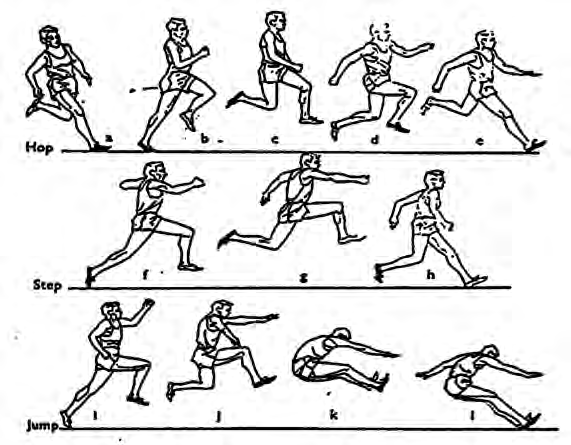
In the top row the athlete comes down again on the take-off foot. In the middle row the athlete strides out and lands on the other foot. In the bottom row the athlete swings both legs forward in the air and drops into the pit. The footprints below show where each foot meets the ground.
An easy way to hold the foot pattern: right, right, left, pit. For an athlete who takes off from the left foot, it is left, left, right, pit.
The three movements must fit together smoothly, and only then does the athlete travel far. A hop that goes too high brings the athlete down hard, the speed is lost and the step becomes short. A short step leaves too little speed for the jump. So the speed gained on the runway has to be carried through all three movements in one steady rhythm.
The mistake beginners make most is landing the hop on the other foot. If the take-off was from the right foot, the hop must land on the right foot too. Change feet and it becomes a step, not a hop, and the hop, step, jump pattern is broken.
Basic Requirements and Measurements
A triple jump needs three things: a runway to build speed on, a take-off board to start the movements from, and a landing area to finish in. Their sizes are fixed, so that wherever the event is held, every athlete competes under the same conditions.
Landing area: the sand-filled pit the athlete lands in after the jump.
Runway: the straight track the athlete sprints along to build speed before reaching the take-off board.
| Part | Length | Width |
| Landing area | 9 m | 2.75 m |
| Runway | 40 to 45 m | 1.22 m |
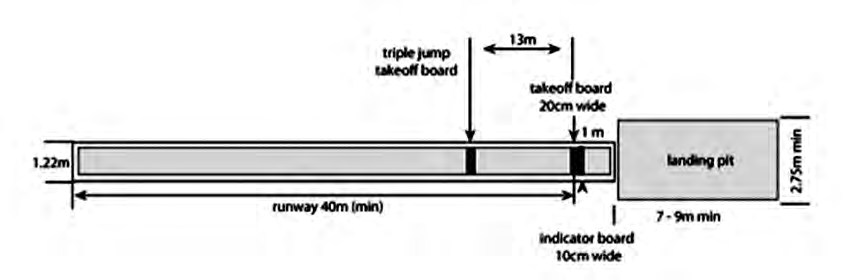
The plan marks the runway 1.22 m wide. A size marked min is the smallest allowed, so the runway must be at least 40 m long. Two boards sit on the runway. The one labelled triple jump takeoff board, far back from the pit, is the board used in the triple jump. The other board, close to the pit, is for the long jump, where the athlete must reach the pit in one leap.
The Take-off Board
Take-off board: the board set into the runway from which the athlete begins the hop, step and jump. It lies 9 to 13 metres before the landing area.
In the long jump the board is close to the pit, because the athlete has to reach the sand in one leap. In the triple jump the hop and the step both land on the runway, and only the jump ends in the pit. If the board were close to the pit, the athlete would already be in the sand after the hop or the step. That is why the take-off board is placed 9 to 13 metres before the landing area. The hop, step and jump all start from this board.
The hop begins from the foot that strikes the board. Take off well before the board and distance is wasted; step past it and the jump breaks the rules. So the run-up has to be practised until the take-off foot lands exactly on the board.
Rules of the Triple Jump
The rules of the triple jump make a competition fair and give every athlete the same chance:
- (a) To take part, an athlete must first register their name with the organiser within the given time.
- (b) The order in which the athletes jump is decided by drawing lots.
- (c) If there are 8 athletes or fewer, each gets 6 jumps. If there are more than 8, each gets 3 jumps.
- (d) Once the competition has started, athletes are not allowed to practise at the venue.
- (e) While jumping, an athlete must not step beyond the take-off board.
- (f) The athlete must run along the set runway before jumping.
- (g) If, after landing, the athlete walks back out through the landing area, that jump is cancelled.
- (h) The athlete must land inside the landing area.
- (i) The landing is measured from the rearmost point touched by any part of the body.
- (j) Every jump of every athlete must be counted and recorded.
- (k) Within the fixed number of jumps, the athlete who jumps farthest is the winner.
Drawing lots: choosing an order by picking folded slips of paper with names on them, so that nobody's preference decides who goes first.
Stepping past the take-off board, landing outside the landing area, and walking back out through the pit after landing are the three faults that waste an otherwise good jump. After landing, always walk out of the pit forwards.
The Rules at Work: an Example
At a school sports meet, 10 athletes registered for the triple jump on time. The jumping order was decided by drawing lots. Since there were more than 8 athletes, each one had 3 jumps. Here are the results of three of them:
| Athlete | First jump | Second jump | Third jump | Best |
| Sunita | 9.15 m | Foul (stepped past the board) | 9.40 m | 9.40 m |
| Ramesh | 9.55 m | 9.30 m | Cancelled (walked back through the pit) | 9.55 m |
| Pasang | 8.90 m | 9.50 m | 9.20 m | 9.50 m |
On his second jump Pasang's feet landed at 9.80 m, but he lost balance and his hand touched the sand behind them, at 9.50 m. The landing is measured from the rearmost point any part of the body touches, so his jump was recorded as 9.50 m.
Every jump of every athlete has been recorded, including the ones that were cancelled. The winner is not found by adding the three jumps together. Within the fixed number of jumps, the athlete whose single best jump is farthest wins. Ramesh's 9.55 m is the longest, so Ramesh comes first, Pasang second and Sunita third. Had only 6 athletes registered, each would have had 6 jumps instead of 3.
The full lesson is waiting for you
The notes are free to read in full. A free account opens the rest of the practice, and tracks your progress and confidence score for every subject. Presentations and videos need approval from Learn Yeti.