Energy comes from food
Every living thing needs energy to run its life processes, and that energy comes from food. Green plants prepare their own food by photosynthesis. Animals have no chlorophyll in their bodies, so they cannot make food for themselves. They get their food from producers, that is from plants, either directly or indirectly.
On land, insects such as grasshoppers eat grass and tiny plants like phytoplankton. Birds and frogs stay alive by eating those insects. In water, a fish eats small water creatures, and then a snake or a heron eats the fish. Depending on their surroundings, organisms keep getting the food they need from different sources. In this way a relationship forms between autotrophs, which make their own food, and heterotrophs, which take food from others. In an ecosystem, each time one organism eats another, energy is transferred, and that is exactly how a food chain begins.
The food chain
The plants and animals of an ecosystem depend on one another for their nutrition. When one organism eats another, the energy held in the eaten organism passes into the eater. This sequence starts at a producer and runs in a single direction, all the way up to the topmost consumer.
A food chain is the process by which energy is transferred in one single direction, from the producer up to the highest ranked consumer, through the sequence of eating others and being eaten in turn.
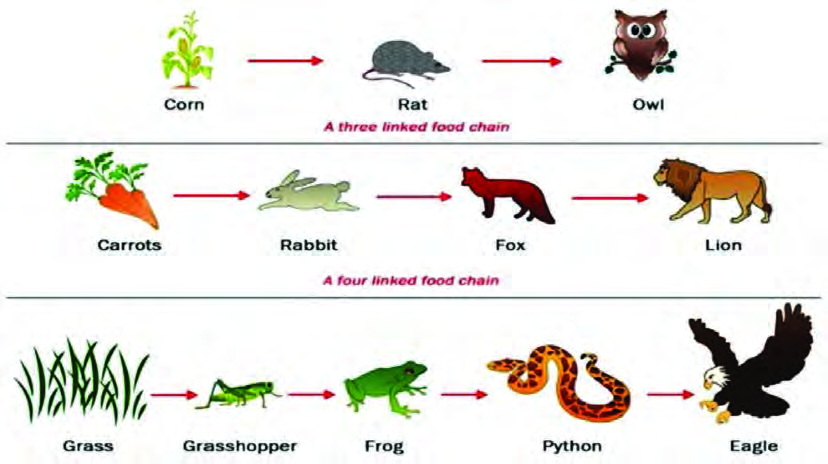
A land ecosystem holds food chains of different lengths. A rat eats corn and an owl eats the rat, so that is a chain of three links. A rabbit eats carrots, a fox eats the rabbit and a lion eats the fox, which makes a chain of four links. In the same way, a grasshopper eats grass, a frog eats the grasshopper, a python eats the frog and an eagle eats the python, giving a chain of five links. Each arrow shows where the energy is going.
In a food chain the arrow is drawn from the organism that is eaten towards the organism that eats it, because the arrow shows the direction in which energy moves. Many students make the mistake of pointing the arrow at the food. The arrow goes from the grass to the grasshopper, never from the grasshopper to the grass.
Trophic levels
In plants, solar energy stays stored as fixed energy. That is why plants are the primary source of energy for every kind of organism, and they are called the first trophic level. When a primary consumer eats a producer, the energy held in the producer is transferred into the primary consumer, so primary consumers are called the second trophic level. In this order, energy keeps moving up to higher and higher trophic levels.
Each step of a food chain at which energy passes from one organism to the next is called a trophic level. These levels begin at the producer and are transferred upward through the consumers.
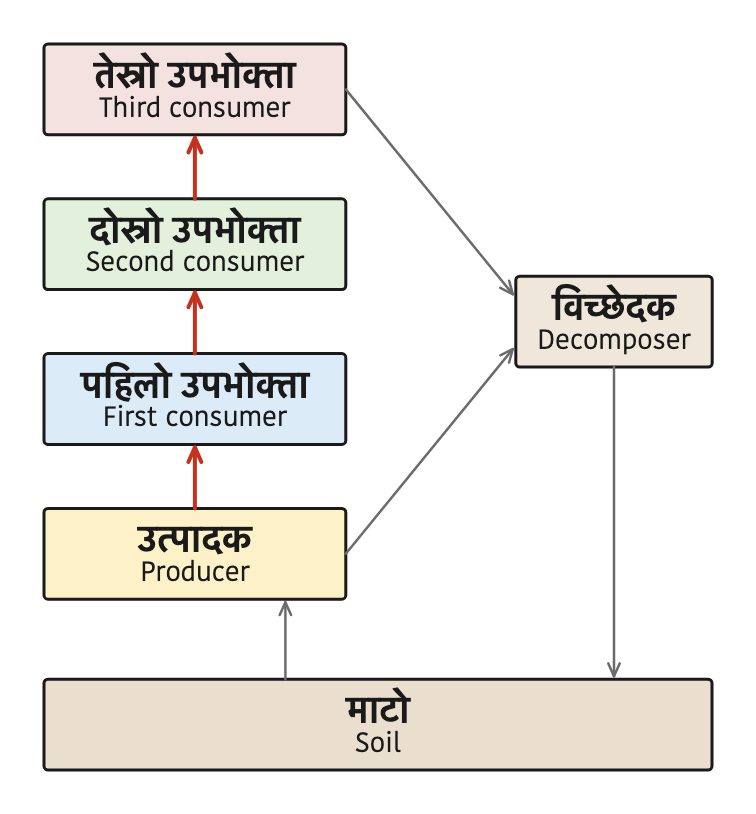
Now split the chains above into levels. Corn, carrots and grass are producers, so they sit at the first trophic level. The rat, the rabbit and the grasshopper live by eating producers, so they are first consumers and they form the second trophic level. The owl, the fox and the frog live by eating first consumers, so they are second consumers and they form the third trophic level. Organisms that eat second consumers are third consumers, and they form the fourth trophic level. In this order, the trophic levels keep rising.
| Trophic level | Who belongs here | Examples |
| First level | Producers | Corn, carrots, grass |
| Second level | First consumers | Rat, rabbit, grasshopper |
| Third level | Second consumers | Owl, fox, frog |
| Fourth level | Third consumers | Lion, python |
| Fifth level | Fourth consumers | Eagle |
Decomposers complete the chain
What happens to the bodies of the producers and consumers of a food chain after they die? Decomposers rot those dead organisms and mix them into the soil. Through its roots, a plant absorbs those substances from the soil, takes them in as food, and converts them into energy once again. Because of the work of decomposers the chain does not simply break off and vanish, since the materials held in dead organisms return to the producers.
Energy flows in one direction only, from the producer to the topmost consumer, but the materials of dead organisms are rotted by decomposers and travel back through the soil into the plants.
The food web
In an ecosystem, food chains of three to five trophic levels keep forming. When many food chains in the same place join and become interlinked with one another, a complex network is formed, and this network is called a food web. A food web is stable in nature, because in a web the consumers have many sources from which they can get food. For example, a consumer of an upper level takes many consumers of the lower levels as its food. A food chain is really a mutual relationship of food and energy.
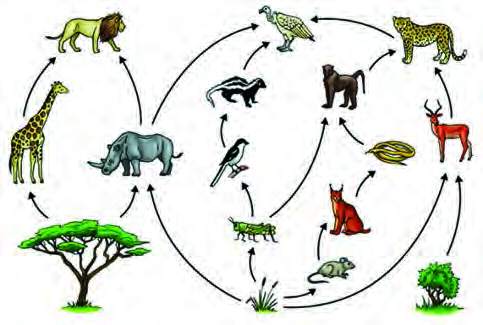
Follow the paths inside the web. The path from grass to a bird to a hawk is a food chain of three levels, while the path from grass to a grasshopper to a frog to a snake to a hawk is a food chain of five levels. Grasshoppers live by eating grass, a bird eats the grasshopper, and a frog eats grasshoppers too. In this way the pattern of many organisms depending on the same animal for food repeats again and again, and a complex web is formed.
A food web is the process by which energy is transferred in many directions in an ecosystem, from the producers up to the consumers of the highest ranks, through the sequence of eating others and being eaten in turn.
Food chain and food web compared
| Food chain | Food web |
| It is a single straight sequence of organisms. | It is many food chains interlinked into a network. |
| Energy is transferred in one direction only. | Energy is transferred in many directions. |
| A consumer has a limited source of food. | A consumer has many sources of food. |
| If one organism disappears, the chain can easily break. | A food web is stable in nature. |
The full lesson is waiting for you
The notes are free to read in full. A free account opens the rest of the practice, and tracks your progress and confidence score for every subject. Presentations and videos need approval from Learn Yeti.