Living and Non-living Things Around Us
Wherever we look, we see many kinds of things. Some of them are living and some are non-living. Living things range from microorganisms too small for the eye to see, all the way up to human beings, and they include both animals and plants. A maize plant in a field, a bird in the sky, an earthworm in the soil and the bacteria in curd are all living. Along with them, non-living things such as soil, air, water and light are also present in the environment. These non-living things are not alive themselves, yet no living thing can survive without them.
This raises a serious question. What do we call all of these things around us taken together as one whole? What kind of relationship exists among them? Searching for the answer leads us to the idea of an ecosystem. Before we reach the definition, let us look closely at two scenes from nature.
Two Scenes: Aquatic and Terrestrial Ecosystems
The first scene is on land. In the middle of a forest there is a pond. Around it stand trees, grass and colourful flowers. A rabbit grazes in the grass, a monkey sits in a tree, a peacock spreads its feathers, a deer has come to drink and a crocodile basks at the edge of the pond. Together with all of them, the sunlight, the soil, the stones, the air and the water are there too. A scene like this, built on land such as a forest or grassland, is an example of a terrestrial ecosystem.
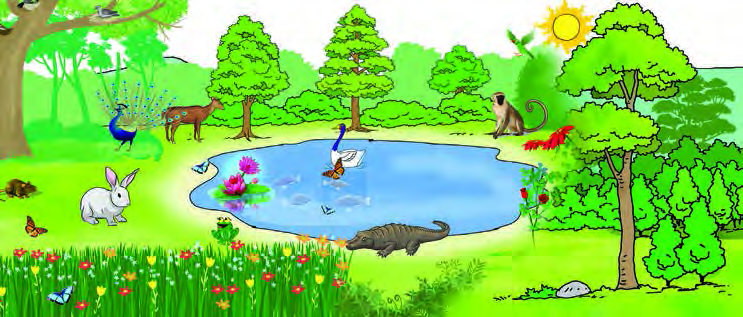
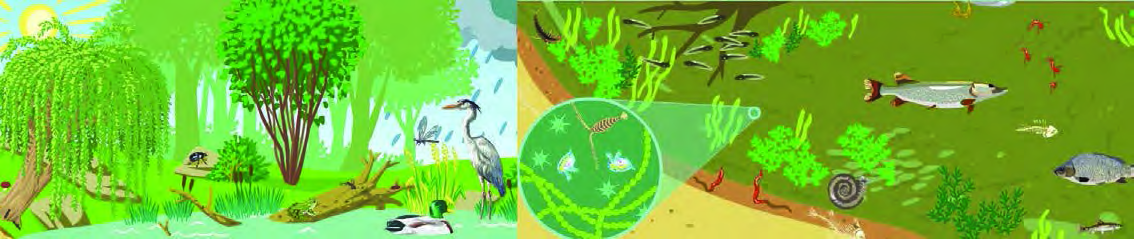
The second scene is inside water. At the edge of a river or pond, a heron and ducks are searching for food. Inside the water live fish of many sizes, snails, worm-like creatures and even microorganisms the eye cannot see. Aquatic plants grow in the soil of the bed, and light reaches down into the water. A scene like this, built in water, is an example of an aquatic ecosystem.
The place is different in these two scenes and the living things are different, but the pattern is the same. Both have living things, both have non-living things such as soil, water, air and light, and in both the two kinds of things depend on each other. That dependence is the heart of this topic.
The Cycle Running in Nature
Green plants take water and mineral salts from the soil and carbon dioxide from the atmosphere. In the presence of sunlight, they make their own food in the chlorophyll of their leaves. Animals then consume the food that plants have prepared. A rabbit eats grass, a deer eats leaves, and in this way the food made by plants reaches the animals.
To breathe, living things take oxygen from the environment and release carbon dioxide gas. Plants use that same carbon dioxide to make food again. In a pond, the water hyacinth and other aquatic plants also absorb the substances they need from the pond water and the soil. When all these organisms die, decomposers rot their bodies, which break down into tiny molecules, and plants absorb those molecules once more.
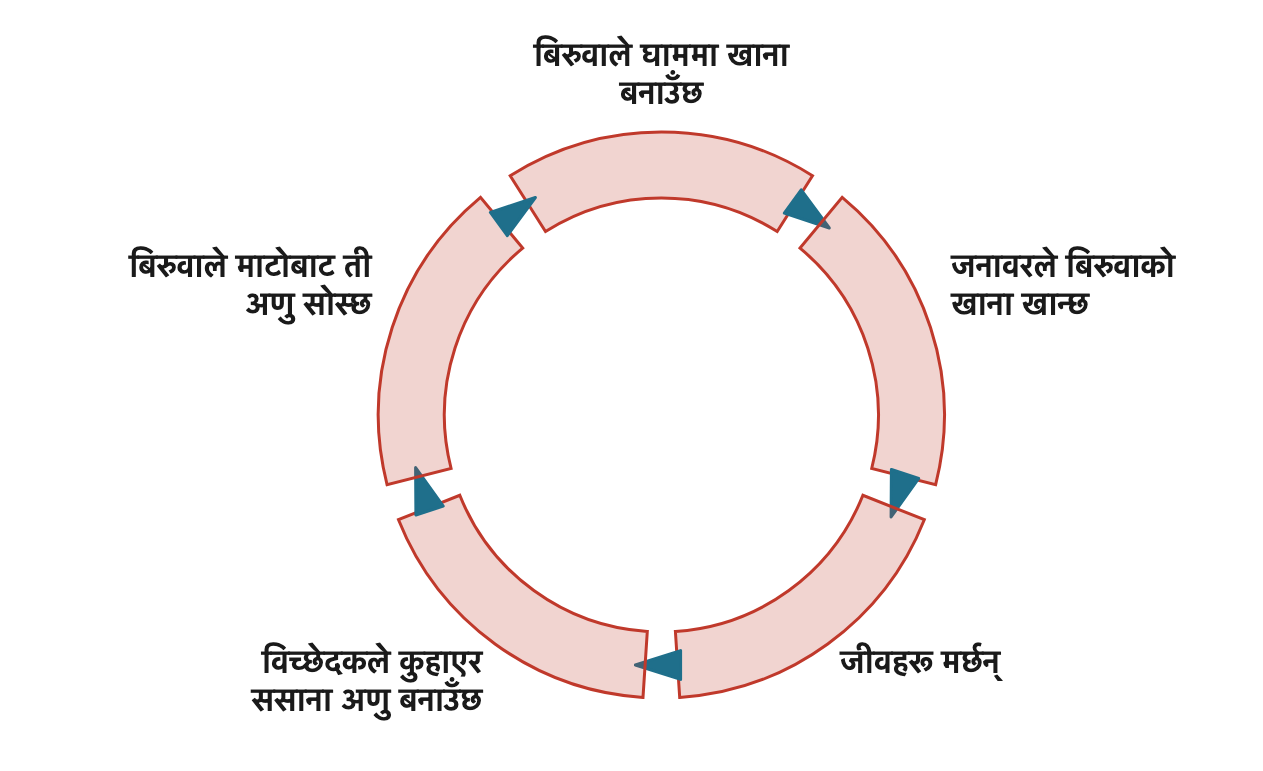
In this way a cycle keeps running in the environment, and inside that cycle the animals, the plants and the environment are all interrelated. The living and non-living things of the environment are connected to one another, and animals and plants also depend on each other.
A group of living beings that share one common environment and depend on one another is called a community. The interrelation between such a complete community and its physical environment keeps operating continuously.
Environment and Ecosystem
Living things together with the light, heat, water, soil and air around them make up the environment. The elements of the environment and the living things are related either directly or indirectly. The heat of the sun reaches a plant directly, while a mineral salt in the soil dissolves in water and reaches an animal indirectly.
The continuous and permanent interrelation that keeps running between the living things of the environment and the physical environment is called an ecosystem.
The branch of science that studies ecosystems is called ecology.
The British ecologist A.G. Tansley first developed the concept of the ecosystem in 1935 AD.
Environment and ecosystem are not the same thing. The environment is the whole made up of living things and the light, heat, water, soil and air around them. An ecosystem is the continuous interrelation running between the living things and that environment. Many students lose marks by swapping these two words in an exam.
Biotic and Abiotic Elements
Biotic elements and abiotic elements are the main parts of an ecosystem. They are also called the living and non-living factor elements that affect the ecosystem. The biotic side includes the different kinds of living things such as plants, human beings, animals, birds and microorganisms, and taken together these are called the community. The abiotic side includes the different kinds of non-living things and physical elements such as soil, light, air, water and humidity.
| Side | What it includes | Examples |
| Biotic side | The different kinds of living things, together called the community | Plants, human beings, animals and birds, microorganisms |
| Abiotic side | The non-living things and physical elements | Soil, light, air, water, humidity |
Exchange of Energy and Balance
Between the biotic and abiotic sides of an ecosystem, a kind of energy and other materials keep being exchanged continuously. The energy of the sun reaches the plants, passes from plants to animals, returns to the soil through decomposers after the animals die, and is taken up from the soil by plants once again. Water, gases and mineral salts also keep moving from one side to the other in the same way.
It is this flow of energy that keeps an ecosystem in balance. As long as the exchange keeps running, the ecosystem stays balanced.
The full lesson is waiting for you
The notes are free to read in full. A free account opens the rest of the practice, and tracks your progress and confidence score for every subject. Presentations and videos need approval from Learn Yeti.