An Ecosystem Has Two Kinds of Components
Look closely at a pond, a forest, a field or a stream near your home and you will find two kinds of things there. On one side are living things such as plants, insects, birds and fish. On the other side are non living things such as sunlight, air, water and soil. Every ecosystem, whatever its size, is built from these two kinds of components: abiotic and biotic. The two kinds depend on each other and are connected to each other. A plant needs sunlight, water and soil to grow, and an animal needs the food that plants make and the oxygen of the air to stay alive. Remove any one component and every other component feels the loss.
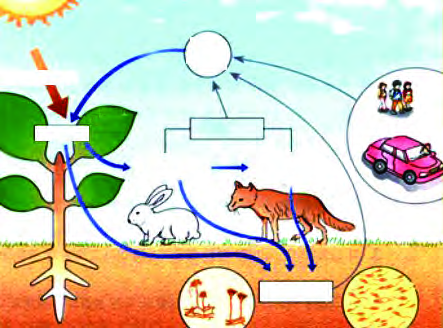
The abiotic and biotic components of an ecosystem depend on each other. A change in one component affects the whole system.
Abiotic Components
The non living things that can influence the ecosystem of a place are called abiotic components.
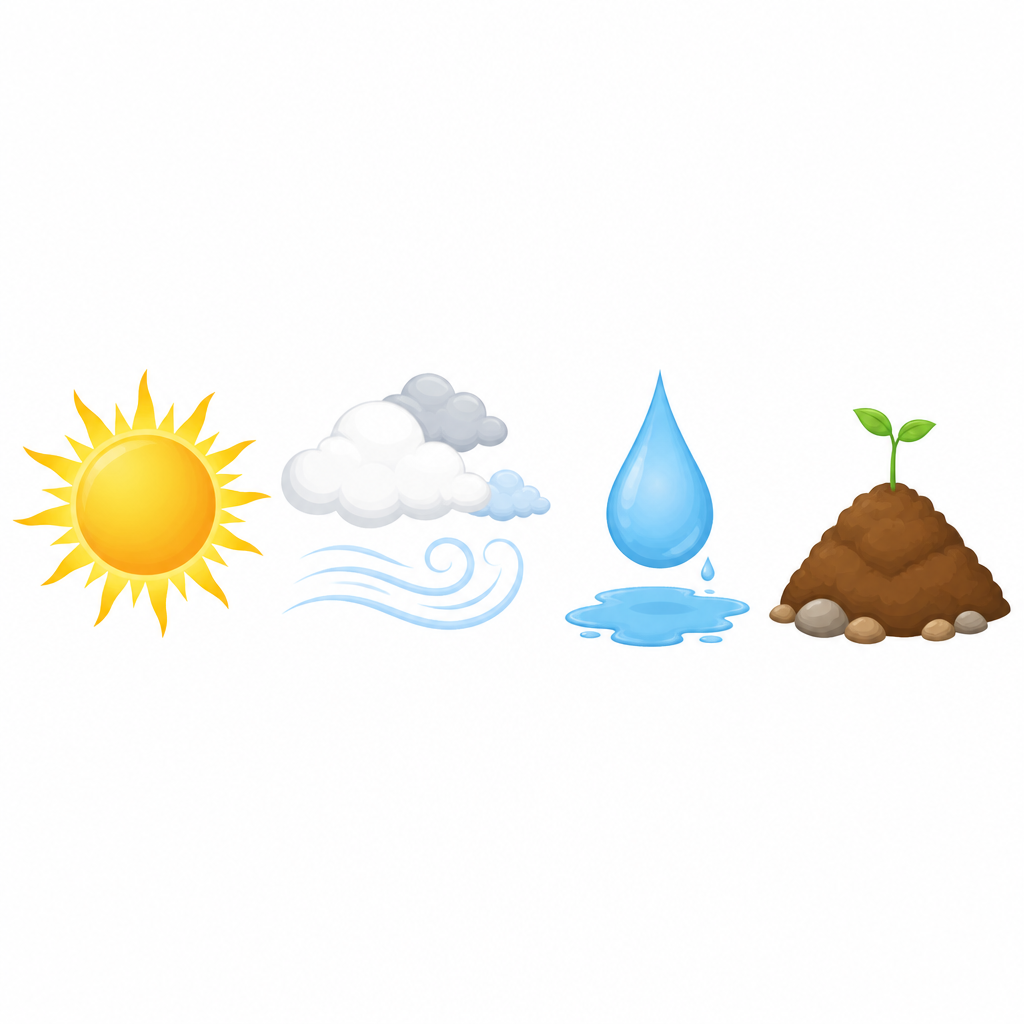
The abiotic components include air, solar energy, temperature, soil, water, humidity and similar non living factors. Though these things are not alive themselves, the life of every living thing rests on them. The abiotic components and the biotic components depend on each other and stay connected to each other. Let us look at four of the main abiotic components in detail.
Air
The atmosphere holds many kinds of gases: nitrogen, oxygen, carbon dioxide and water vapour among them. When green plants make their food they take in carbon dioxide and give out oxygen. When humans, plants and other living things breathe, they do the opposite: they take in oxygen and give out carbon dioxide. In this way the air itself keeps a working relationship going between animals and plants, because each keeps supplying the gas the other needs.
Plants also need the element nitrogen to make chlorophyll, the green pigment with whose help they prepare food by photosynthesis. The nitrogen of the atmosphere is changed into soluble nitrate compounds, and the roots of plants absorb these from the soil. The water vapour held in the atmosphere creates humidity and plays an important part in the water cycle. For all these reasons, air is an essential component of the ecosystem that nothing living can do without.
Solar Energy
Light and heat energy reach the Earth from the sun, and both play an important part in the life of every living thing. In the presence of solar energy, plants prepare their own food by photosynthesis, and every other living thing depends on that food. For geographical reasons, solar energy does not reach every place equally. Because of this, different places differ in their climate, in how much rain they receive and in how much food they can produce, so different places carry different animals and plants. The heat received from the sun helps keep the temperature of the atmosphere balanced, which makes the life processes of organisms run smoothly. Different kinds of plants grow in different places according to the temperature there. The sun's heat also plays an important part in keeping the water cycle going.
Water
Water is an absolutely necessary component for animals and plants. Plants need water for photosynthesis, and both animals and plants need water to build their own bodies. Humans, farm animals, birds and other creatures use the water of ponds, lakes, wells, waterfalls, rivers and the sea for their daily life. The body of every animal and plant holds a fixed amount of water, and living things keep that amount topped up either through the food they eat or by absorbing water directly. The many biochemical processes that run inside a body, such as metabolism, also need water, and different organisms need different amounts of it. In places where there is no water, life becomes very hard for both animals and plants.
Soil
Soil is another important abiotic component. Soil holds mineral elements, organic matter, microorganisms and chemical elements such as nitrogen, phosphorus and potassium, all of which plants need. Plants draw water and minerals from the ground, and these substances help the plants to grow and develop. The grain, green vegetables, fruit, grass and other things that plants produce are then eaten by humans and other animals according to their needs. The soil is also the home ground of humans and of a great many other living things, so life quite literally stands on it.
Biotic Components
The plants, animals, fungi, bacteria and microscopic organisms present in an ecosystem are called its biotic components. The biotic components together make up the living community of that place.
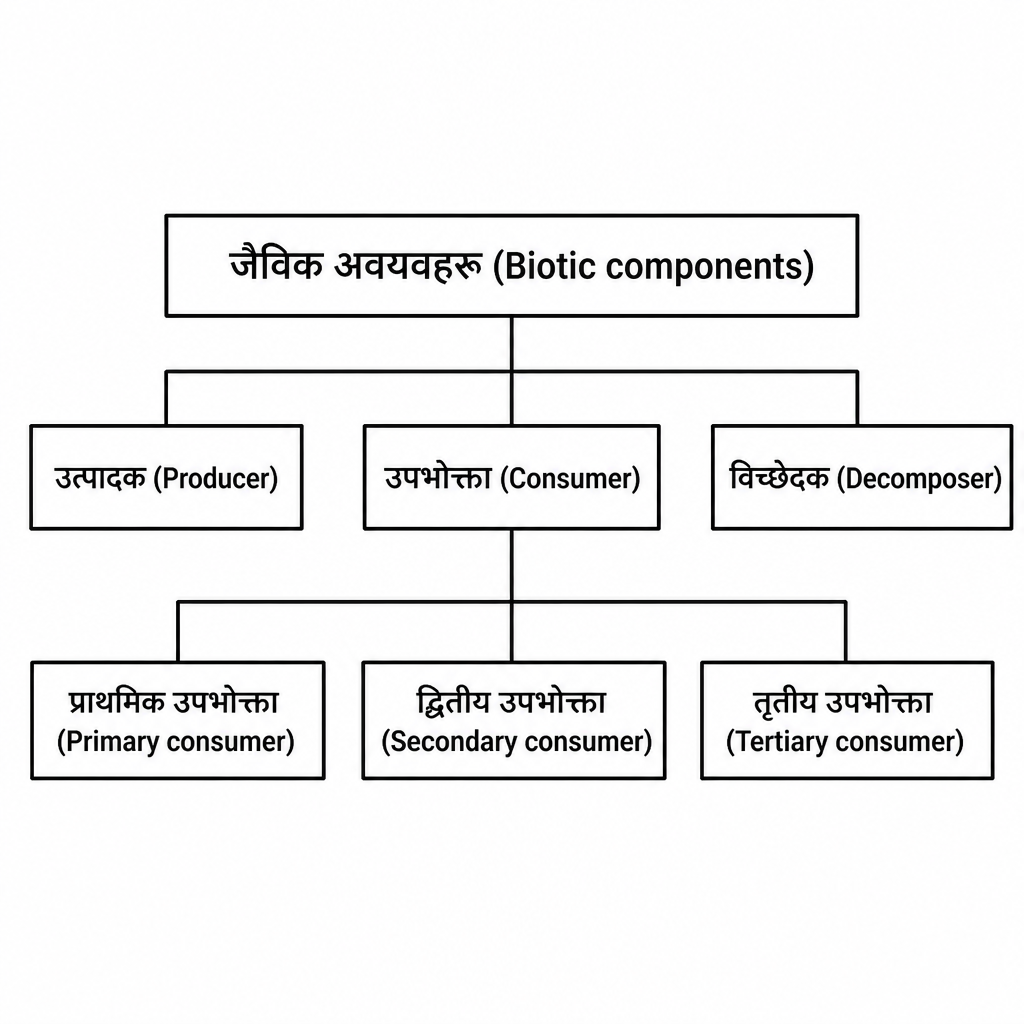
All these living things stay connected to one another. The relationships within a living community affect the surrounding environment, and at the same time every organism is itself affected, both directly and indirectly. Living things build relationships with one another for food, for shelter and for movement, whatever the situation. The living community includes producers, consumers and decomposers. On the basis of how energy flows through the ecosystem, the living community is classified into these three groups.
Producers
Chlorophyll bearing unicellular organisms, multicellular organisms and plants that prepare their own food are called producers.
Cyanobacteria and diatoms are examples of phytoplankton, the microscopic producers of water. Producers make food by photosynthesis. In the food making process a producer uses solar energy or chemical energy to turn abiotic matter into biotic matter, and the food made this way is then consumed by the organisms of the levels above. Producers do not depend on any other living thing for their food, so they are also called autotrophs, meaning self feeders. The phytoplankton of a pond, algae, grasses and every kind of green plant are producers. In most ecosystems, producers outnumber every other group.
Consumers
The organisms of a living community that depend on producers for their food are called consumers.
On the basis of what they eat, consumers are divided into the following three groups.
| Group | What it eats | Examples |
| Primary consumer | Plants only | Zooplankton, insects, grasshoppers, rabbits, cows, buffaloes, deer |
| Secondary consumer | Primary consumers | Small fish, jackals, frogs |
| Tertiary consumer | Secondary consumers | Tigers, lions, whales, crocodiles |
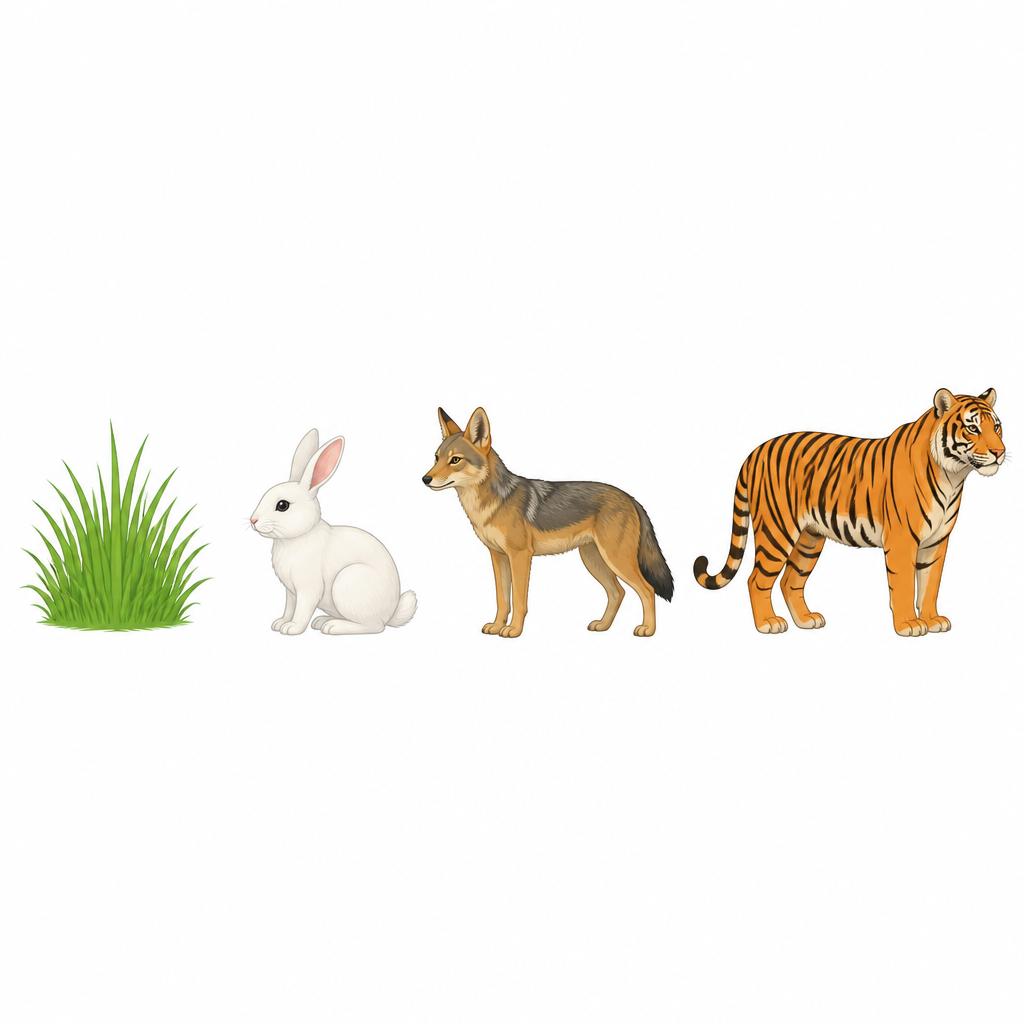
The living things that depend only on plants for food are the primary consumers, and these organisms are herbivores. The living things that depend on primary consumers for their food are the secondary consumers, and the living things that survive by eating secondary consumers are the tertiary consumers. Tertiary consumers are the top level carnivores of the ecosystem. A rabbit that eats grass is a primary consumer, a jackal that eats the rabbit is a secondary consumer, and a tiger that can eat even an animal like the jackal is a tertiary consumer.
A consumer's level is fixed by what it eats, not by its size. A frog is small, yet it eats insects, so it is a secondary consumer. A buffalo is large, yet it eats grass, so it is still a primary consumer.
Decomposers
The bacteria, fungi and microorganisms that rot and dissolve the bodies of dead organisms, turn them into simple molecules and mix them into the soil are called decomposers.
The bacteria, fungi and microorganisms living in the soil are the decomposers. These tiny organisms break the bodies of dead animals and plants into simple molecules, mix them into the soil and so keep the environment clean. Because they clear away the dead in this way, they are called nature's natural scavengers. The nutrients that decomposers mix into the soil are absorbed again by plants through their roots. So the journey of energy and matter that begins with the producers does not end at the decomposers; it returns through the soil to the producers once more.
The full lesson is waiting for you
The notes are free to read in full. A free account opens the rest of the practice, and tracks your progress and confidence score for every subject. Presentations and videos need approval from Learn Yeti.