Classifying Ecosystems
Wherever living things and nonliving things act on one another, an ecosystem has formed. Ecosystems are classified by where they form, and that gives two main groups: terrestrial ecosystems and aquatic ecosystems. Ecosystems that form on land include the grassland ecosystem, the forest ecosystem and the desert ecosystem. Ecosystems that form in water include the pond ecosystem, the lake ecosystem and the sea ecosystem. This topic takes one example from each group and studies it closely: the grassland and the pond.
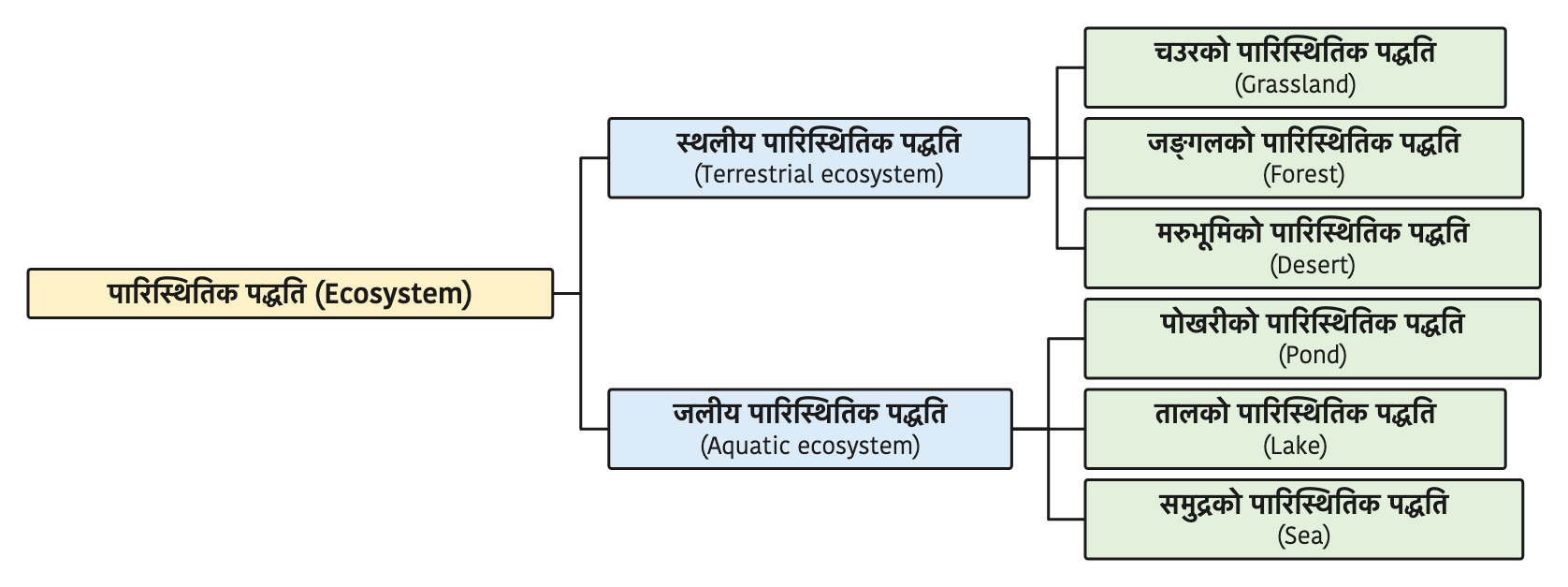
Terrestrial Ecosystems
An ecosystem formed by the interrelationship between the abiotic and biotic elements found on land is called a terrestrial ecosystem.
One third of the Earth is covered by land. The ecosystem of any piece of land is shaped by the climate and the landform of that place. Because climate and landform are not spread evenly over the Earth, different places develop different ecosystems, so the system on a cold mountain slope and the system on a warm plain are never the same. Terrestrial ecosystems include the grassland ecosystem, the forest ecosystem and the desert ecosystem. Of these, the grassland is described here.
The Grassland Ecosystem
The ecosystem formed in open plains and grass fields by the interrelationship between biotic and abiotic elements is the grassland ecosystem.
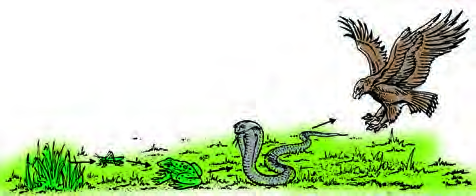
Abiotic Factors of the Grassland
The abiotic factors of the grassland ecosystem are air, soil, minerals, solar energy, humidity and water. Of all these, the factor most essential to plants is water. Plants use water and the carbon dioxide they take from the air to make their own food in the presence of solar energy. Every living thing in this system breathes: it takes oxygen from the air and gives out carbon dioxide, so nothing here can live without air.
Soil is the shelter of all the organisms of the grassland. The mineral salts in the soil dissolve in water, and the roots of plants absorb them along with that water. In this way the abiotic factors of the grassland stay linked with the biotic ones and help keep the whole ecosystem balanced.
Biotic Factors of the Grassland
The plants and the animals living in the grassland are its biotic factors. These biotic factors are divided into three groups: producers, consumers and decomposers.
Producer: an organism that makes its own food is a producer. The green grasses and plants of the grassland are its producers. All autotrophs are producers.
Producers make their own food with the help of water, carbon dioxide and solar energy. The organisms that depend on them are the consumers, and consumers are placed in three levels according to what they eat.
| Consumer level | What it eats | Grassland examples |
| Primary consumer | Green grasses and other plants | Insects, grasshoppers, earthworms, rabbits, deer |
| Secondary consumer | Primary consumers | Frogs, birds, jackals, wolves |
| Tertiary consumer | Secondary consumers | Snakes, tigers, leopards, lions |
All herbivores are primary consumers. Some animals at the secondary level are omnivores, which means they eat both plants and animals. Tertiary consumers are often physically strong carnivores, such as the tiger and the lion.
Decomposer: an organism that rots the bodies of dead organisms, turns them into simple molecules and mixes them into the soil is a decomposer. Bacteria and fungi are examples of decomposers.
When the producers and the consumers of the grassland die, the bacteria and fungi living there rot their dead bodies, turn them into simple molecules and mix those molecules into the soil. The roots of plants then absorb those simple molecules again. In this way the materials of food keep moving in a circle, from the soil into the plants and from the plants back into the soil.
Aquatic Ecosystems
An ecosystem formed by the interrelationship between the biotic and abiotic elements found in water is called an aquatic ecosystem.
Different sources of water differ in their structure and condition. A small pond and a vast sea do not share the same depth, the same temperature or the same kind of water, so each holds its own kinds of plants and animals. Aquatic ecosystems include the ecosystems of ponds, rivers, seas, lakes and wetlands. Of these many aquatic systems, the pond ecosystem is described here.
The Pond Ecosystem
The interrelationship between the biotic and abiotic elements found in a pond is called the pond ecosystem.
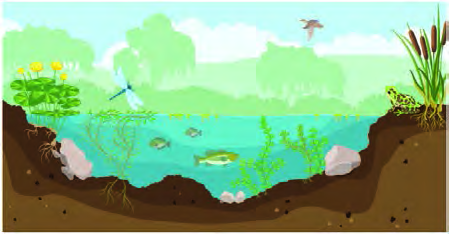
Abiotic Components of the Pond
The abiotic components of the pond ecosystem are minerals, water, soil, light, heat, oxygen, carbon dioxide gas and nitrogen. Several of these stay dissolved in the water itself. Fish breathe by taking in the oxygen dissolved in the water. Rays of light reach right down to the bottom of the pond, so the plants of the pond can use the dissolved carbon dioxide together with the water to make their food. Besides this, the plants absorb the nitrate salts present in the pond.
The organisms of the pond depend on its abiotic components to eat and to survive, and every organism depends on the others. This interdependence of living and nonliving things is exactly what makes the pond a complete ecosystem.
Biotic Components of the Pond
The biotic components of the pond fall into the same three groups. The green plants of the pond are its producers. The insects, small fish, frogs, big fish and snakes that live by eating are its consumers, and bacteria are its decomposers.
The algae growing in the pond, such as Volvox, Chlamydomonas and Closterium, are producers. Green plants such as the phytoplankton, Pistia and Hydrilla prepare their food from solar energy.
The microscopic plants found in water are called phytoplankton.
The organisms that live by eating the producers are called consumers. Consumers are heterotrophs, and for their food they depend directly on the producers. The herbivorous organisms of the water, which live by eating the producers, are called primary consumers. They survive by eating the microscopic plants of the pond. The small fish, tadpoles and worms of the pond are primary consumers too.
The tiny water animals that live by eating the microscopic plants are called zooplankton. Cyclops, Daphnia, beetles and molluscs are examples.
An organism that lives by eating the primary consumers is a secondary consumer. The frogs, crabs and big fish that live by eating the small fish of the pond are its secondary consumers. If a snake also lives around the pond, it survives by eating the frogs, and so the snake is taken as a tertiary consumer.
Which consumer an organism is depends on what it eats, not on its name. A deer eating grass is a primary consumer, while a snake eating a frog in the same place is a tertiary consumer. So never memorise animal names as levels; ask what the animal is eating.
When the producers and the consumers of the pond die, the microscopic organisms living there, bacteria and fungi, rot and decay the dead bodies. These decomposers then turn the dead organisms into simple molecules and mix them into the soil. The plants of the pond absorb those materials from the soil again. In this way the process runs on without stopping.
Grassland and Pond Compared
The grassland forms on land and the pond forms in water, yet both systems are built the same way: on a base of abiotic elements stand producers, three levels of consumers and decomposers. The only difference is which organisms play each role.
| Role | In the grassland | In the pond |
| Producer | Green grasses and plants | Algae such as Volvox, phytoplankton, Hydrilla |
| Primary consumer | Grasshoppers, rabbits, deer | Zooplankton, small fish, tadpoles |
| Secondary consumer | Frogs, birds, jackals, wolves | Frogs, crabs, big fish |
| Tertiary consumer | Snakes, tigers, leopards, lions | Snakes |
| Decomposer | Bacteria, fungi | Bacteria, fungi |
The full lesson is waiting for you
The notes are free to read in full. A free account opens the rest of the practice, and tracks your progress and confidence score for every subject. Presentations and videos need approval from Learn Yeti.