How the Modern Table Is Laid Out
At first sight the modern periodic table looks like a big chart of empty boxes. The elements are placed in those boxes in the increasing order of their atomic numbers, and the boxes are not arranged carelessly. Read the table downwards and every element in one column turns out to have similar properties. Read the same table across and every element in one row turns out to have properties that keep changing step by step. These two ways of reading the table are what we call groups and periods.
Group: the vertical column of the modern periodic table in which elements with similar properties are placed is called a group.
Period: the horizontal row of the modern periodic table in which elements with gradually changing properties are placed is called a period.
The modern periodic table has 18 groups and 7 periods.
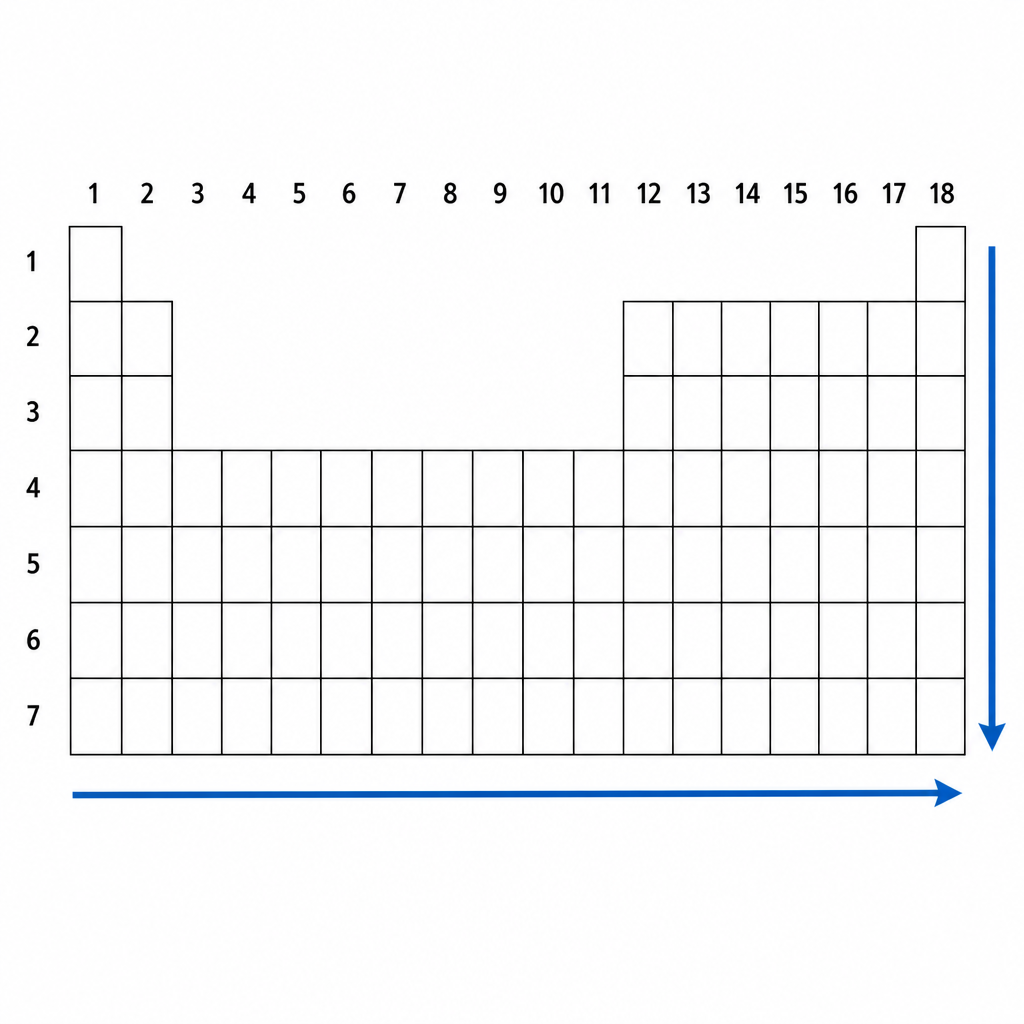
An element's address in the table is complete only when both its group and its period are named. Sodium has the electron configuration 2,8,1. It has three shells, so sodium sits in period 3. It has a single electron in its outermost shell, so it sits in group 1. A useful rule falls out of this. The period number tells you how many shells the atoms of that row have, and the group tells you about the state of the outermost shell.
What Elements in the Same Group Share
Group 1 holds lithium, sodium and potassium one below the other. Lithium has the electron configuration 2,1, sodium has 2,8,1 and potassium has 2,8,8,1. The three of them do not have the same number of shells. Lithium has two, sodium has three and potassium has four. Yet all three carry exactly one electron in the outermost shell.
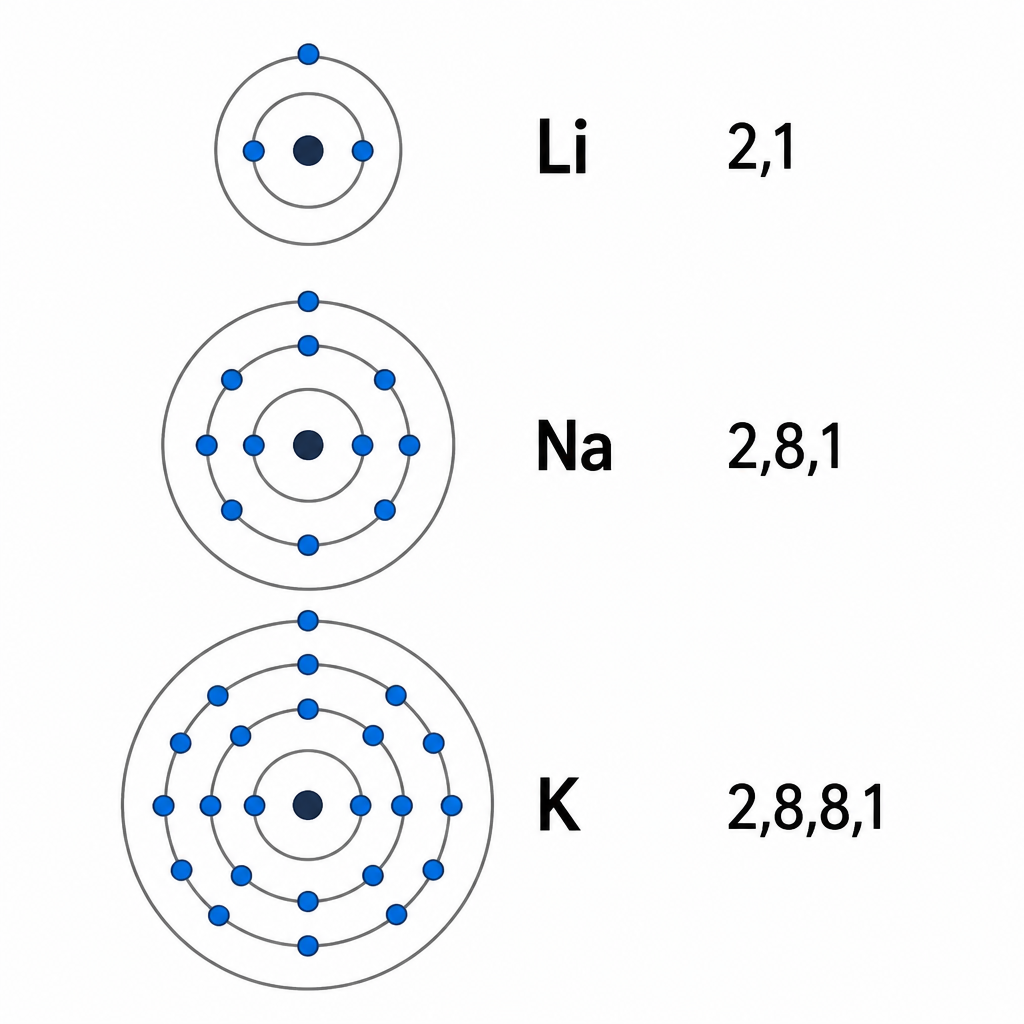
It is the electrons of the outermost shell that take part in chemical reactions. Because these three elements have the same outermost shell, they behave in the same way. All three are shiny, soft metals, all three react with water, and all three have a valency of 1. That is exactly what it means to say that elements in one group have similar chemical and physical properties.
Valency: the number that shows the combining capacity of one atom of an element with atoms of another element is called its valency. It is decided by the number of electrons in the outermost shell.
Going Down a Group
Not everything stays the same inside one group. Each step downwards adds one more shell. With every new shell the outermost electron sits further from the nucleus, so the size of the atom keeps growing. The further that outer electron gets from the nucleus, the weaker the pull holding it, and the easier it becomes for the atom to let it go.
| Property | Going down the group | Reason |
| Number of shells | Increases | One shell is added at each period |
| Atomic size | Increases | Adding shells makes the atom bigger |
| Outermost electrons | Stay the same | This is why the properties stay alike |
| Valency | Stays the same | Because the outer electron count does not change |
| Electron giving ability or metallic character | Increases | The outer electron moves further from the nucleus |
| Electron taking ability or non metallic character | Decreases | A bigger atom cannot pull an extra electron strongly |
Do not write that the number of outermost electrons also increases as you go down a group. What increases going down is the number of shells. The number of electrons in the outermost shell stays the same, and that sameness is the very thing that makes one group's elements alike.
What Elements in the Same Period Share
Period 2 holds eight elements in one row, from lithium to neon. It begins with lithium at 2,1 and moves through beryllium 2,2, boron 2,3 and carbon 2,4 all the way to neon at 2,8. Every one of these eight atoms has only two shells. That is what it means to say the elements of one period have an equal number of shells. What differs is the outermost shell, where the electron count rises by one at every step.
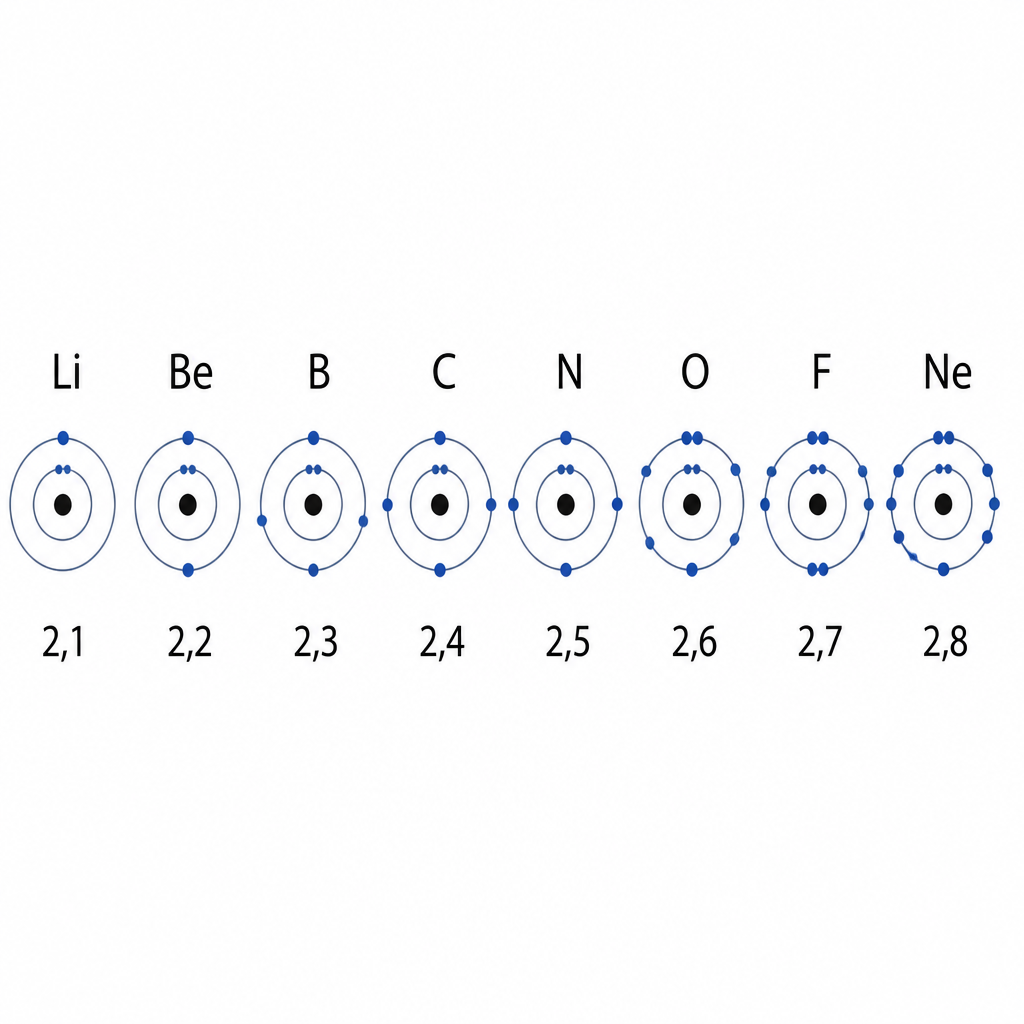
Once the outermost electrons differ, the valency differs too. Lithium has a valency of 1, beryllium 2, boron 3 and carbon 4. This is why the chemical and physical properties of the elements in one period keep changing step by step. The left hand end of the row is a soft metal, and by the time you reach the right hand end the element is a non metal.
Going Across a Period
Walk across period 3 from sodium to argon and the number of shells stays at three the whole way. But one more proton is added to the nucleus at every step, so the positive charge of the nucleus keeps growing. With the same number of shells and a stronger positive charge, the electrons are pulled in more tightly. This is why the atomic size keeps shrinking from left to right.
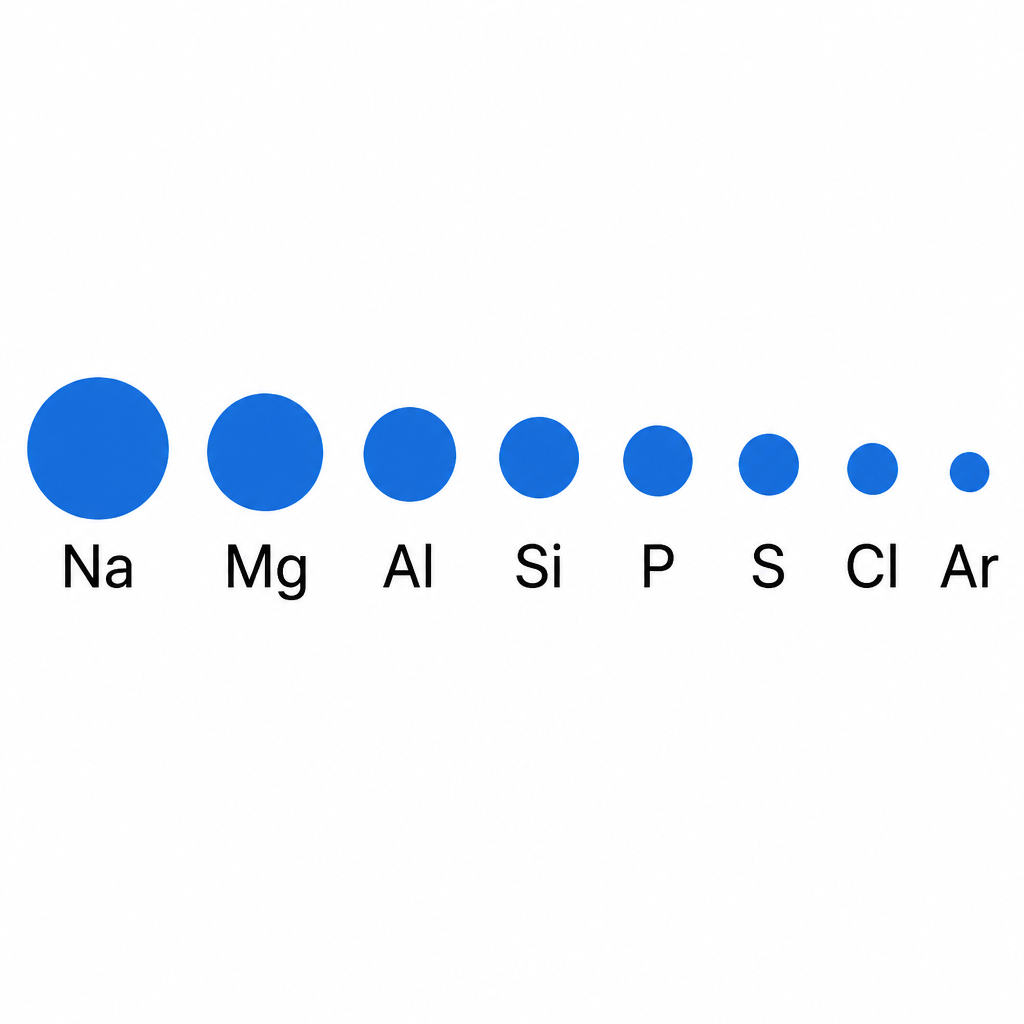
In a smaller atom the outermost electron sits closer to the nucleus and is harder to give away. So as you move from left to right the electron giving ability, that is the metallic character, keeps falling, while the electron taking ability, that is the non metallic character, keeps rising. This is the exact opposite of what happens going down a group.
| Property | Going left to right | Reason |
| Number of shells | Stays equal | The period does not change |
| Outermost electrons | Rise one by one | The atomic number rises one by one |
| Atomic size | Decreases | The nuclear charge pulls the electrons inward |
| Valency | Keeps differing | Because the outer electron count differs |
| Metallic character | Decreases | Giving up an electron gets harder |
| Non metallic character | Increases | The ability to take electrons grows |
Group and Period Side by Side
Group and period are two directions of the same table, and each tells a different story. One shows what elements have in common, the other shows how they change step by step. The comparison below keeps the two apart.
| Basis | Group | Period |
| Direction in the table | Vertical column | Horizontal row |
| How many | 18 | 7 |
| Number of shells | Different | Equal |
| Outermost electrons | Equal | Different |
| Valency | Same | Different |
| Properties | Similar | Change step by step |
| Atomic size | Grows going down | Shrinks going right |
Build It and See for Yourself
These changes settle in the mind much faster once you build them with your own hands. The materials lying around at home are enough for the work below.
- Using thread, cotton, wool or thin metal wire, build the atomic structures of lithium, sodium and potassium of group 1 and place them one below the other.
- Look closely at what you have built and measure for yourself how a shell is added and the atom grows wider at each step downwards.
- In the same way build the structures of the period 3 elements, lay them in a row from left to right, and count how the outermost electrons rise by one each time.
- Using wood, thermocol or cardboard, build a model of the modern periodic table with 18 vertical columns and 7 horizontal rows, and show it to the class.
A thin metal wire leaves a very sharp point when it is cut. Bend the cut end over so it cannot prick a hand or an eye, and never put the wire in your mouth.
The full lesson is waiting for you
The notes are free to read in full. A free account opens the rest of the practice, and tracks your progress and confidence score for every subject. Presentations and videos need approval from Learn Yeti.