Putting Like Things in One Place
In a grocery shop the rice and the lentils sit in one section, the soap and the washing powder in another, and the pencils and notebooks on a shelf of their own. If every item were piled together, finding one bar of soap would take half an hour. Write down the names of at least twenty things you can see around you. Read the list twice and try to recall it, and several names will slip away. Now sort those same things by a shared property into cooking pots, writing materials, food and clothing, and try again. This time the list is far easier to hold in the mind.
Sorting things by a property they share is what we call classification. The same method is used on the elements. Once the elements are classified, studying them becomes easy, it becomes quick, and what is learnt stays in the memory for a long time.
Classification: putting things or elements that share the same properties into one group, and those with different properties into another group, is called classification.
Why Elements Had to Be Classified
As science developed, more and more elements were discovered. While the elements were few, each one could be studied on its own. As the number grew, remembering and studying the properties of every element separately became harder and harder. So scientists began to feel the need to classify the elements, keeping those with similar properties in one place and those with different properties in another.
Classifying the elements in this way produced a table, and that table is called the periodic table. Several kinds of periodic table were developed one after another, and out of that line of work came the modern periodic table.
The Modern Periodic Table
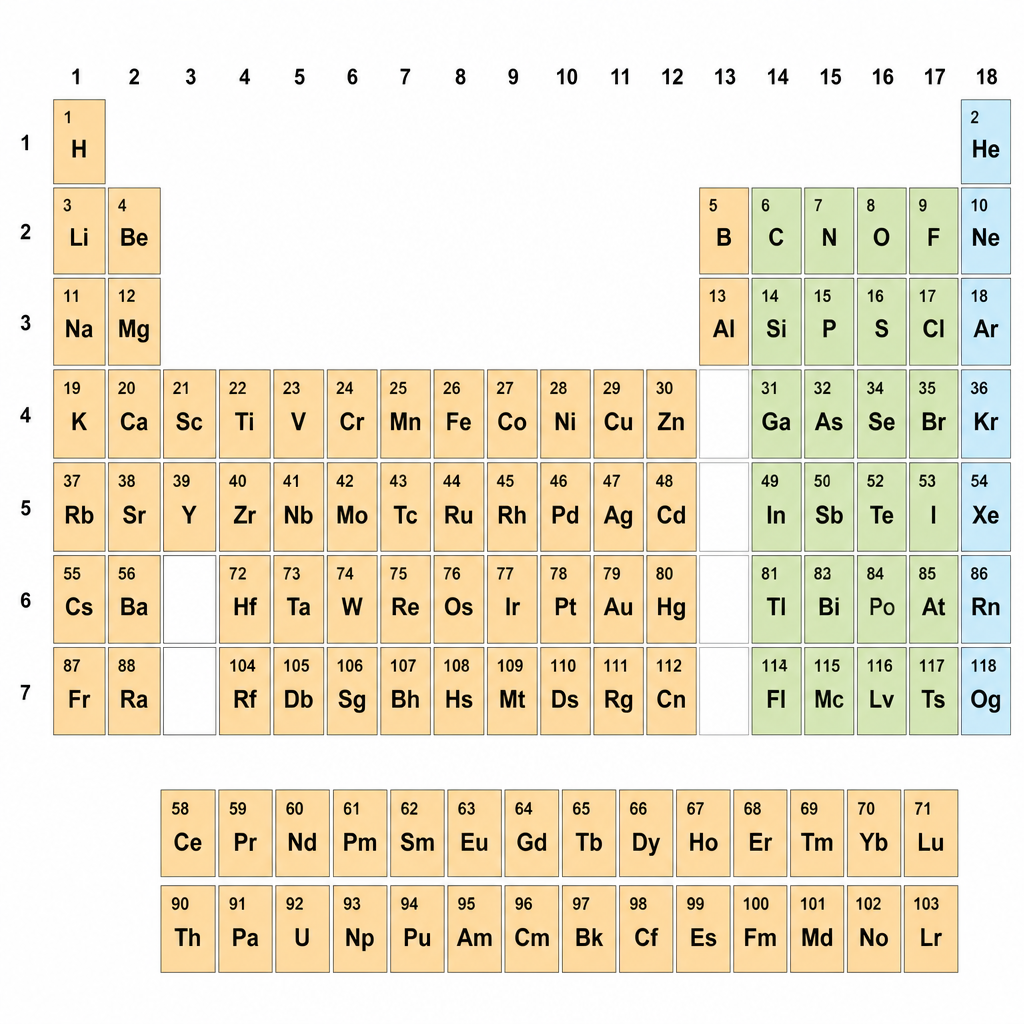
While the elements were being sorted out, many scientists tried to classify them in their own ways. The modern periodic table that Henry Moseley built in 1913 is taken to be the most scientific and the simplest classification made so far. Because everyone accepted it, this is the table used in scientific work today.
Moseley arranged the elements in order of their increasing atomic number. Arranged that way, elements with similar properties fell into the same vertical column, while elements whose properties changed step by step fell along a horizontal row. He found that after a fixed interval the same properties appeared again. He gave this repeating behaviour the name periodic function, and it was from this study that he stated the modern periodic law.
Periodic function: the way the properties of the elements appear again after a fixed interval as the atomic number goes on increasing is called a periodic function.
In the modern periodic table every element has a box of its own, and that box carries the element's atomic number and its symbol. Two long rows are set apart below the main body of the table. They are drawn down there only so that the chart fits on a page; they belong to the table just as much as the rest.

The Modern Periodic Law
Modern periodic law: the physical and chemical properties of the elements are a periodic function of their atomic numbers.
The same law can be said in another way. As the atomic number of the elements increases, their physical and chemical properties keep changing, and after a certain interval the same property comes round again. That is why the elements standing in one vertical column of the table have properties that resemble one another.
Both the modern periodic table and the modern periodic law are built on the atomic number, not on the atomic mass. Do not swap these two terms when you write an answer.
Where Hydrogen Sits
Hydrogen has only one electron in its outermost shell. Having a single electron in the outermost shell is the mark of the elements of group 1, so hydrogen is placed in group 1 of the modern periodic table. Hydrogen does not, however, show the metallic properties that the other elements of group 1 show. Lithium and sodium are shiny solid metals, while hydrogen is a gas.
Hydrogen sitting in group 1 does not make hydrogen a metal. It shares the place, not the properties.
Where the Metals Sit
Elements that give away electrons during a chemical reaction are called metals. Metals are good conductors of heat and electricity. An element with 1 to 3 electrons in its outermost shell shows its reactivity by giving those electrons away. In the modern periodic table the metals lie in groups 1 to 13.
Metal: an element that gives away electrons during a chemical reaction is called a metal.
The elements of group 1 have a single electron in the outermost shell, so they lose that one electron easily to reach a stable state. For this reason the elements of this group are called highly reactive metals, and they are also known as alkali metals. The elements of group 2 are called alkaline earth metals.
Where the Non-metals Sit
Elements that take in electrons during a chemical reaction are called non-metals. Non-metals are poor conductors of heat and electricity. An element with 5 to 7 electrons in its outermost shell shows its reactivity by taking electrons in. In the modern periodic table the elements of groups 15, 16 and 17 have the properties of non-metals.
Non-metal: an element that takes in electrons during a chemical reaction is called a non-metal.
The elements of group 17 have seven electrons in their outermost shell, so they take in one electron easily to reach a stable state. The elements of this group are therefore called highly reactive non-metals, and they are also known as halogens.
Where the Inert Gases Sit
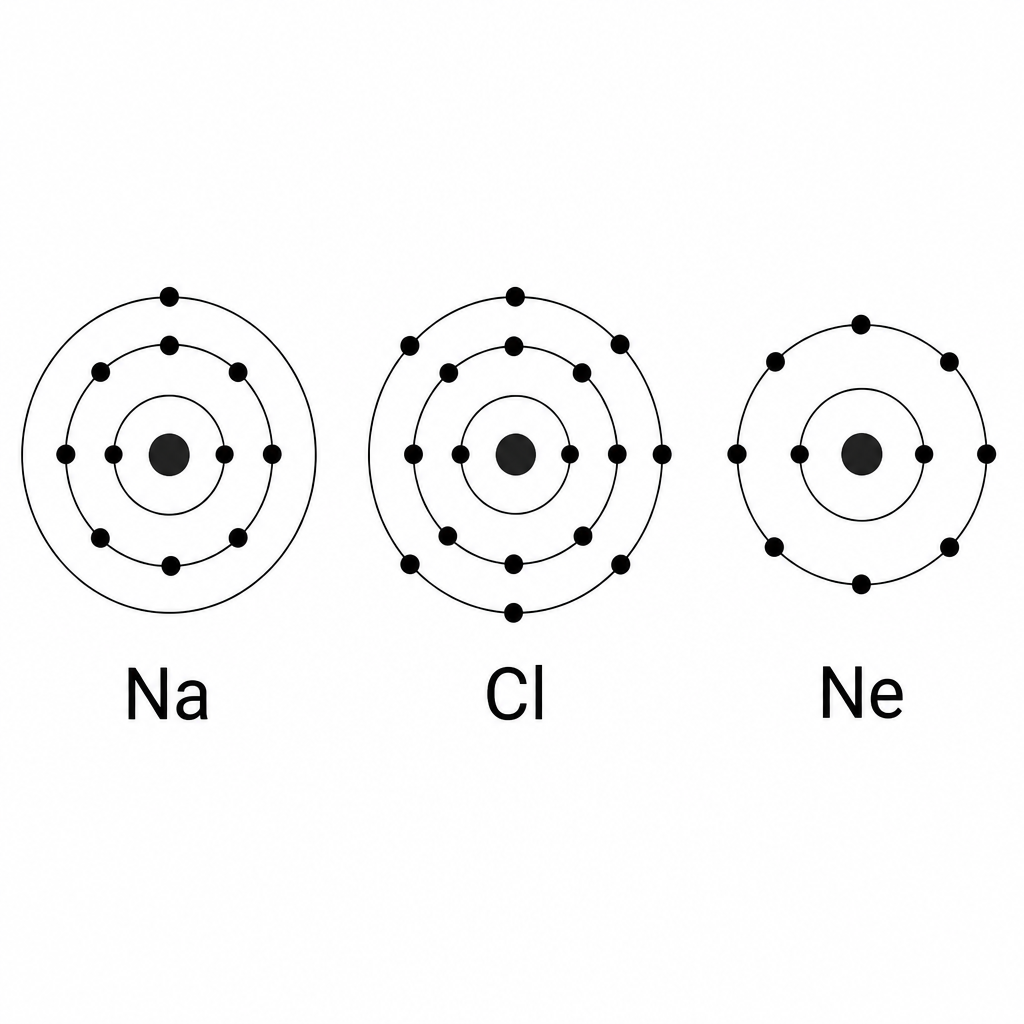
An element that neither takes in nor gives away electrons, and that does not take part in chemical reactions, is called an inert gas. An element with two electrons in its outermost shell, as helium has, or with eight electrons, as neon and argon have, does neither of those things, because such an element has already reached a stable state. The inert gases are placed in group 18 of the modern periodic table.
Inert gas: an element that neither gives nor takes electrons and does not take part in chemical reactions is called an inert gas.
Telling the Three Apart
Look at those three sections together and one thing decides everything: the number of electrons in the outermost shell. That number settles whether an element gives electrons away, takes them in, or does neither, and so it settles where the element stands in the table.
| Property | Metal | Non-metal | Inert gas |
| Electrons in the outermost shell | 1 to 3 | 5 to 7 | 2 in helium, 8 in the others |
| In a chemical reaction | Gives electrons away | Takes electrons in | Neither gives nor takes |
| Group in the periodic table | Groups 1 to 13 | Groups 15, 16 and 17 | Group 18 |
| Name of the highly reactive family | Alkali metals (group 1) | Halogens (group 17) | None |
Groups and Periods
In the modern periodic table the vertical column that holds elements of similar properties is called a group, and the horizontal row that holds elements whose properties differ step by step is called a period. The modern periodic table has 18 groups and 7 periods. Once you know which group an element falls in, you can say a great deal about its properties.
Group: the vertical column of the modern periodic table that holds elements of similar properties is called a group. The table has 18 groups.
Period: the horizontal row of the modern periodic table that holds elements whose properties change step by step is called a period. The table has 7 periods.
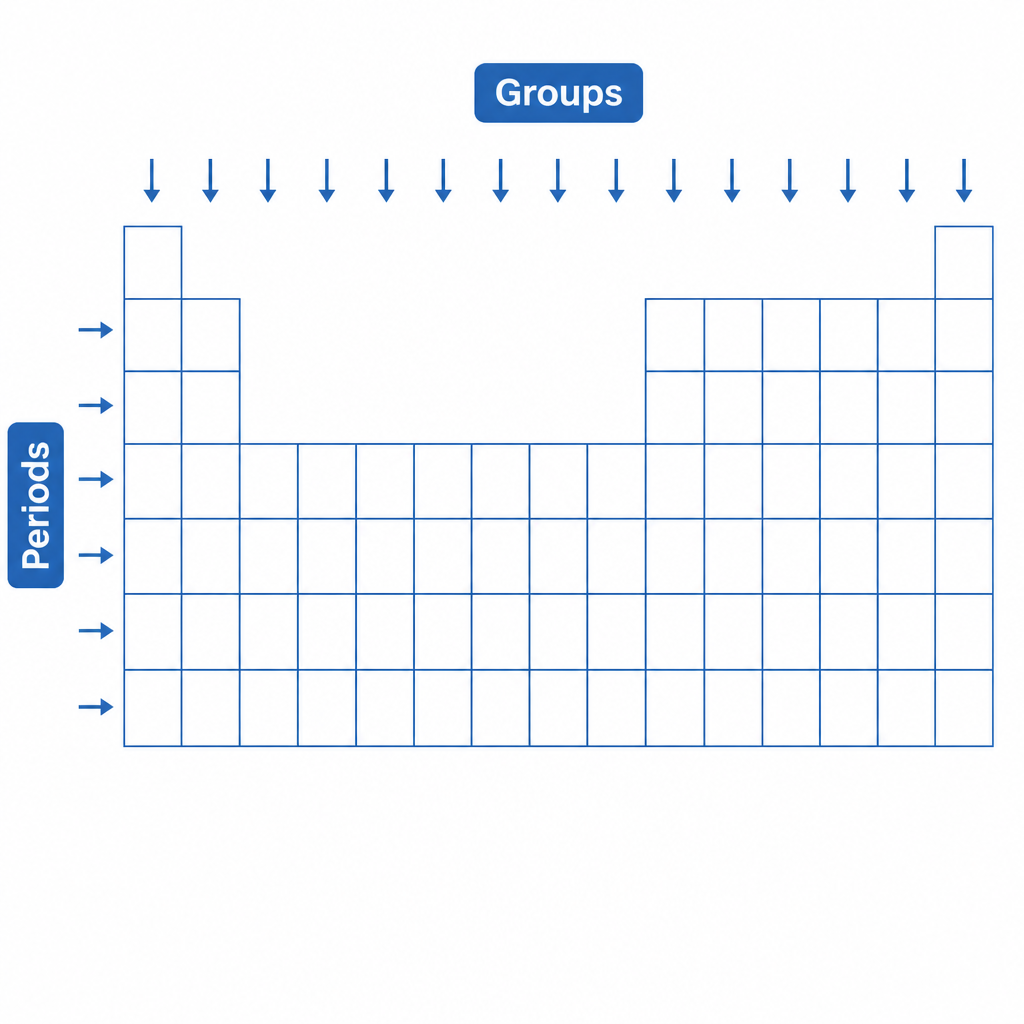
Up and down is a group, across is a period. There are 18 groups and 7 periods.
Try It Yourself
The periodic table sticks in the mind when you fill one in with your own hands rather than when you only read about it. Work through the following once.
- Draw an empty periodic table on a sheet of chart paper, marking the boxes of the vertical columns and the horizontal rows clearly.
- On small slips of paper write the symbols of the elements from hydrogen up to calcium, clearly, one symbol on each slip.
- Following the order of atomic number, place each slip in its correct box in the empty table.
- Check the places you chose against a complete periodic table and see where you went wrong.
- Now give your classmates the names hydrogen, helium, lithium and so on up to calcium, in order of atomic number.
- Draw the empty table on the ground with chalk and let each classmate stand in the box that belongs to them.
- Let the classmates standing in group 1 discuss why they belong to that group and present the reason to everyone, and let each of the other groups do the same.
The full lesson is waiting for you
The notes are free to read in full. A free account opens the rest of the practice, and tracks your progress and confidence score for every subject. Presentations and videos need approval from Learn Yeti.