Changes That Happen Around Us
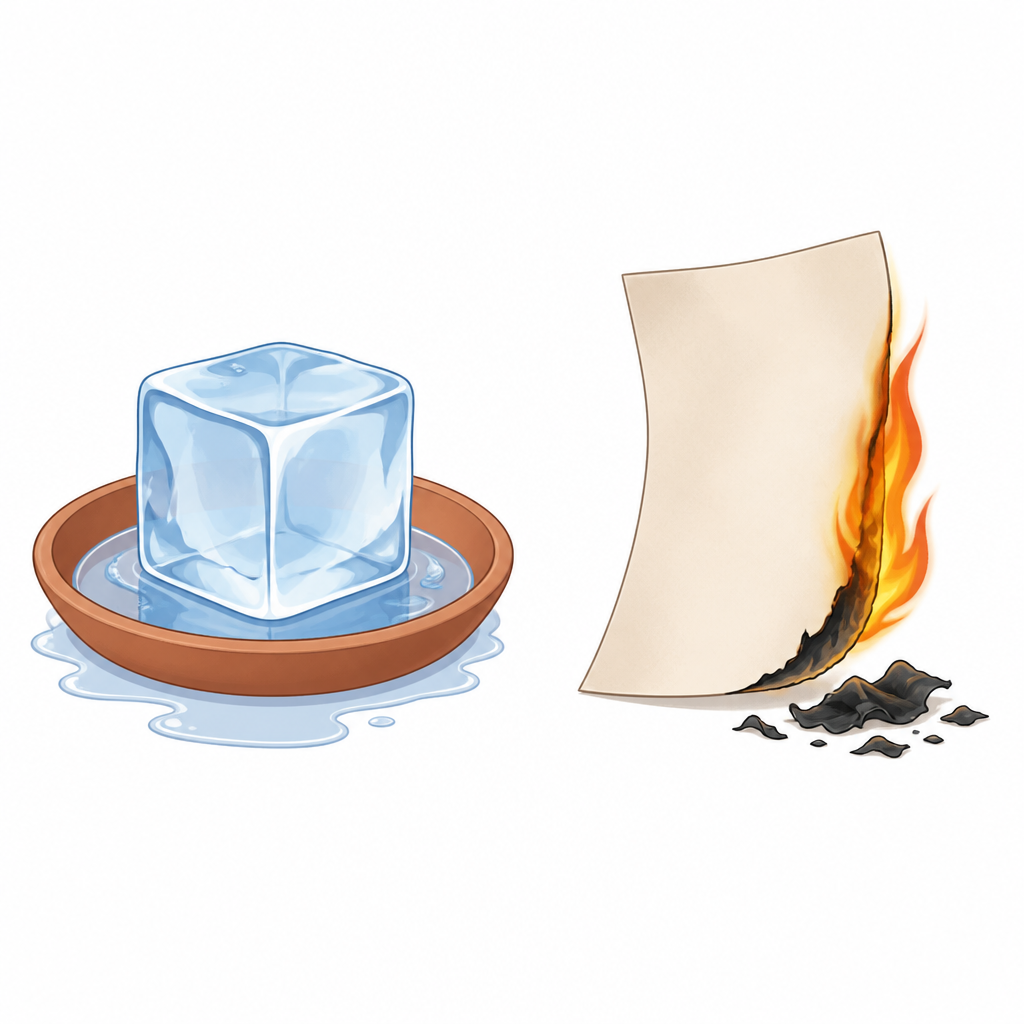
Something is changing around us at every moment. Ice left in a dish melts, water on a stove boils away as steam, a stick of chalk falls and breaks into pieces. One thing is the same in all of these changes. Only the shape or the state of the substance has altered, while what the substance is made of stays exactly as it was. Melted ice is still water, and cooling that water gives ice again. Broken chalk is still chalk.
Physical change: a change that does not alter the inner properties of a substance, and which can be turned back into the earlier state, is called a physical change.
Chemical Change and Chemical Reaction
Now look at a different kind of change. Paper that is set alight turns into ash and smoke, and no amount of care will turn that ash and smoke back into paper. Iron left damp grows a layer of rust in a few days, and the rust cannot be turned back into bright iron. Milk that has set into curd never becomes milk again. Here the substance has not merely changed its shape. The substance itself has become something new.
Chemical change: a change that alters the inner properties of a substance, and which cannot be turned back into the earlier state, is called a chemical change.
What actually happens inside a substance during a chemical change? Substances are built out of atoms. During a chemical change the atoms of the substances join together, break apart and change places with one another. Joining means separate atoms coming together and sticking as one group. Breaking apart means atoms that were held together coming loose. Changing places means an atom of one substance swapping its partner with an atom of another substance. Because the atoms end up arranged in a new way, a new substance is formed.
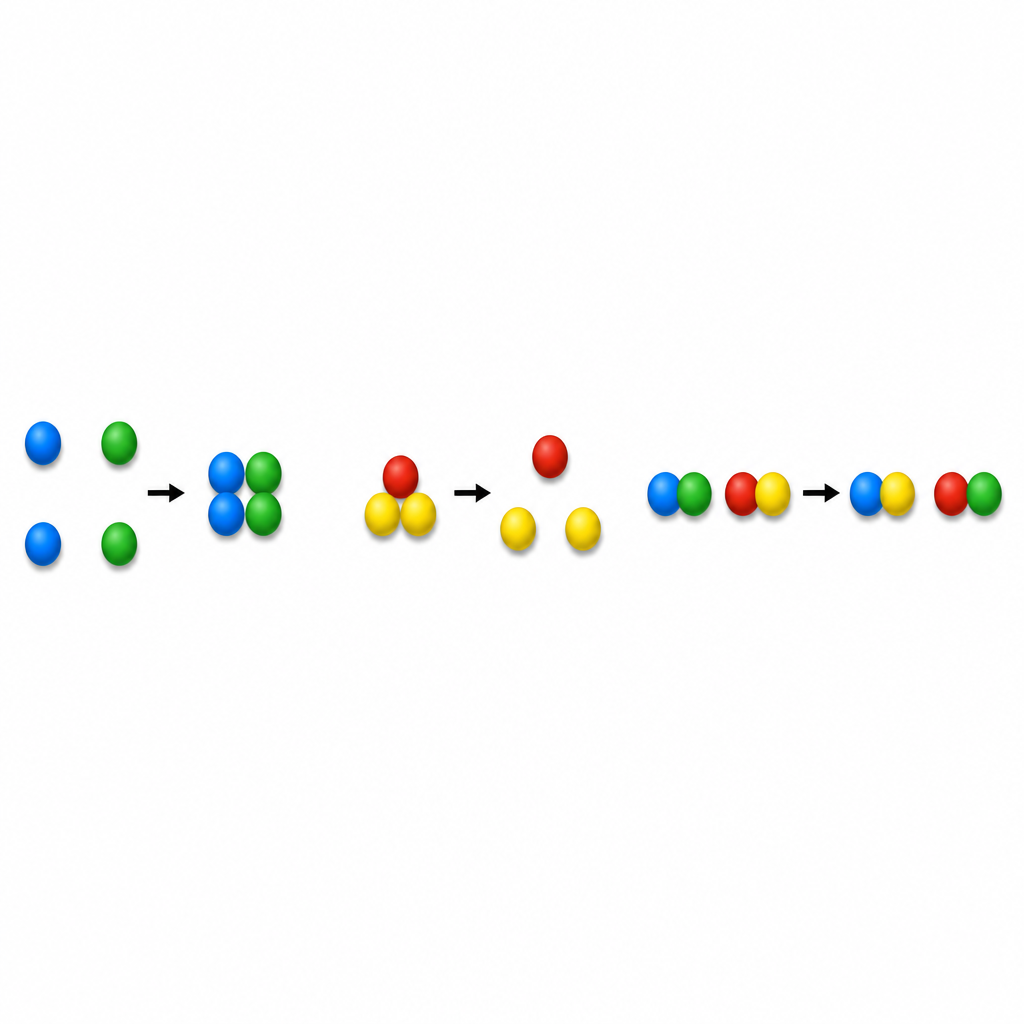
Chemical reaction: the process in which atoms join, come apart and change places during a chemical change, so that new substances are formed, is called a chemical reaction.
| Basis | Physical change | Chemical change |
| Inner properties | Stay the same | Change |
| New substance | Is not formed | Is formed |
| Turning it back | Possible | Not possible |
| Example | Ice melting | Paper burning |
The Chemical Equation
Describing a chemical reaction in a long sentence every single time is slow and clumsy. So chemists write it in a short, fixed form instead. A chemical reaction can be expressed through an equation, and that is what a chemical equation is. Reading one tells you at a glance which substances went in and which substances came out.
Chemical equation: the way of writing a chemical reaction in the form of an equation is called a chemical equation.
Reactants and Products
Every chemical reaction has two kinds of substance in it. First, the substances that take part in the reaction. Second, the substances that are formed once the reaction is over. A chemical equation puts these two kinds in two different places, and the place itself tells you which is which.
Reactants: the substances that take part in a chemical reaction are called reactants. They are written on the left side of the equation.
Products: the substances that are formed after a chemical reaction are called products. They are written on the right side of the equation.
An arrow is placed between the reactants and the products. That arrow is the sign that a chemical change has taken place. It always points from left to right, because the change runs from the reactants towards the products. The same substance does not appear on both sides of one equation, because the products are different substances from the reactants.
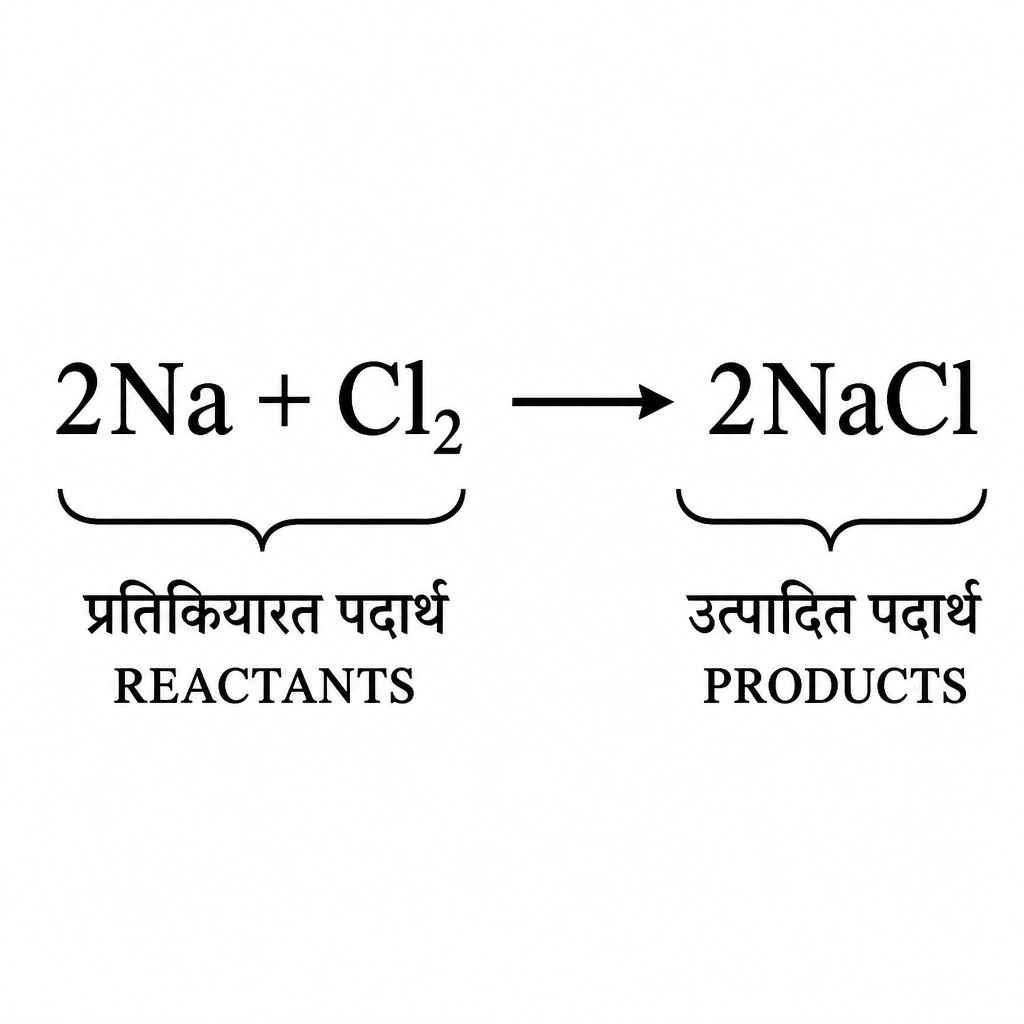
Read the arrow as the word "gives", never as "equals". Sodium + chlorine → sodium chloride is read as sodium and chlorine give sodium chloride.
Word Equations
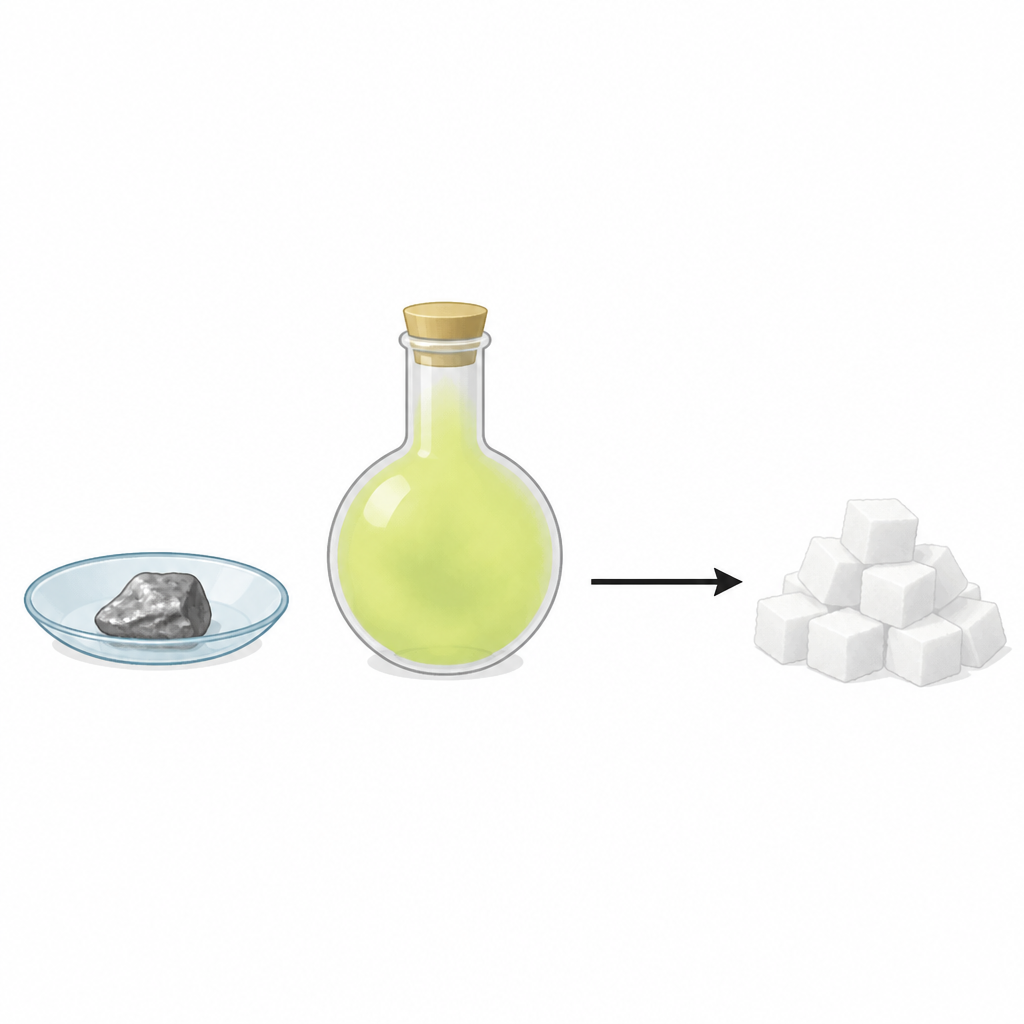
A chemical reaction can be written out in words. The names of the substances are written as they are, with a plus sign between them and an arrow in the middle. The reaction in which sodium and chlorine give sodium chloride, for example, can be shown as sodium + chlorine → sodium chloride. Writing it this way shows at one glance which substance stands on which side, but it says nothing at all about how many atoms are inside each substance.
Word equation: a chemical equation expressed in words is called a word equation.
Formula Equations
A chemical equation can also be written using the symbols of the elements or the molecular formulae of the compounds. Instead of the name of a substance, its symbol is written. The symbol of sodium is Na, the molecular formula of chlorine is \( \mathrm{Cl}_2 \), and the formula of sodium chloride is NaCl. So the word equation above can be written in symbols like this:
\[ \mathrm{Na} + \mathrm{Cl}_2 \rightarrow \mathrm{NaCl} \]
Formula equation: a chemical equation expressed in formulae is called a formula equation.
Balanced Chemical Equations
Look carefully at the formula equation above. There are two chlorine atoms on the left, but only one chlorine atom on the right. Where did the other one go? In a chemical reaction atoms are neither made nor lost, only rearranged. So the number of atoms of each element on the left of a formula equation must equal the number on the right.
To make the numbers equal, suitable numbers are written in front of the elements or compounds on the left and on the right. Writing 2 in front of sodium chloride gives two chlorine atoms on the right as well, and then sodium has to be matched by writing 2 in front of sodium on the left:
\[ 2\mathrm{Na} + \mathrm{Cl}_2 \rightarrow 2\mathrm{NaCl} \]
Balanced chemical equation: a formula equation in which the number of atoms of each element is the same on the left and on the right is called a balanced chemical equation.
Never change a number written inside a formula while balancing. Turning water into \( \mathrm{H}_2\mathrm{O}_2 \) to make the oxygen match is wrong, because \( \mathrm{H}_2\mathrm{O}_2 \) is not water at all but a different substance. Balancing allows numbers only in front of a formula.
Balancing a Formula Equation Step by Step
Hydrogen and oxygen together give water. Its word equation is hydrogen + oxygen → water. Let us take that as far as a balanced formula equation.
Step 1: Write the formula of each substance and join the two sides with an arrow:
\[ \mathrm{H}_2 + \mathrm{O}_2 \rightarrow \mathrm{H}_2\mathrm{O} \]
Step 2: Count the atoms on each side. The left has 2 hydrogen atoms and 2 oxygen atoms, while the right has 2 hydrogen atoms and only 1 oxygen atom. Oxygen does not match.
Step 3: Write 2 in front of water on the right so that oxygen matches:
\[ \mathrm{H}_2 + \mathrm{O}_2 \rightarrow 2\mathrm{H}_2\mathrm{O} \]
Step 4: The right now holds 4 hydrogen atoms while the left holds only 2. Write 2 in front of hydrogen on the left:
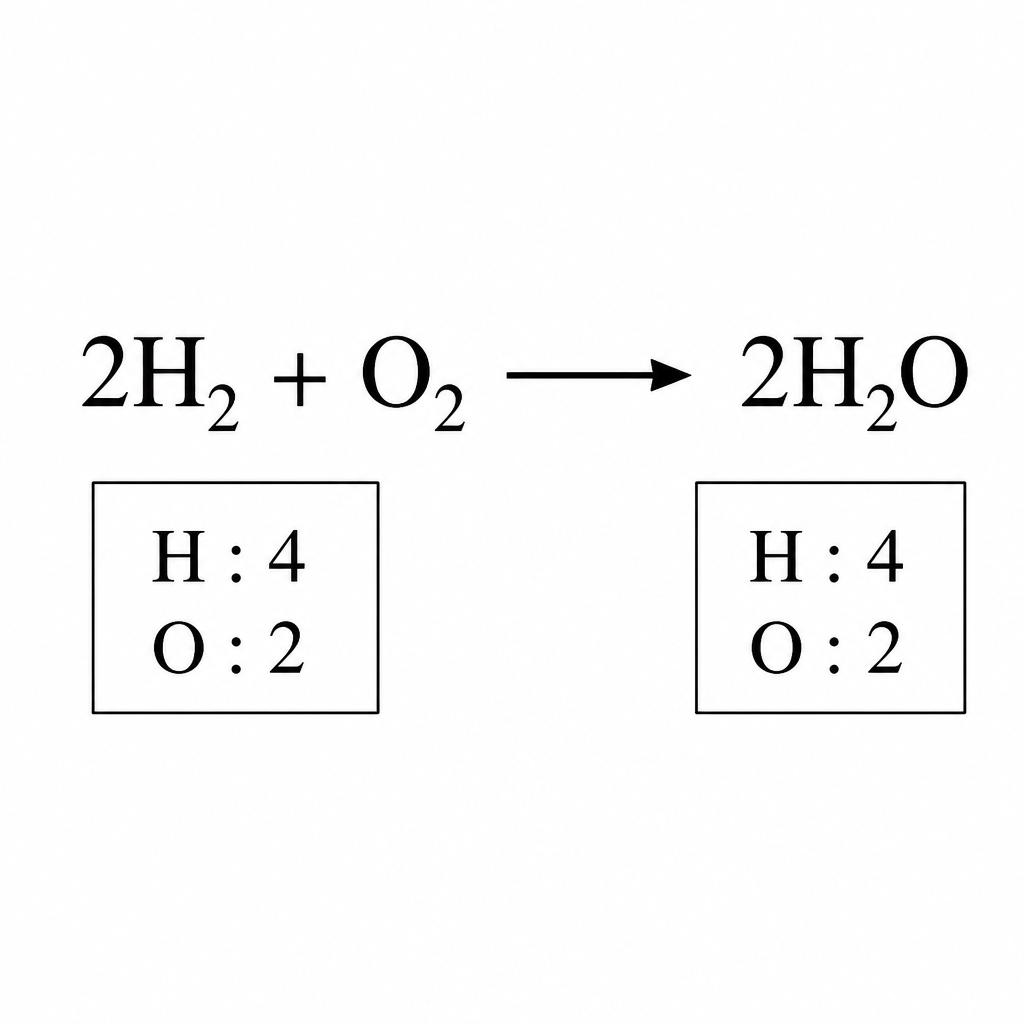
\[ 2\mathrm{H}_2 + \mathrm{O}_2 \rightarrow 2\mathrm{H}_2\mathrm{O} \]
Step 5: Count once more. Both sides now hold 4 hydrogen atoms and 2 oxygen atoms. The equation is balanced.
What must match is the number of atoms of each element, not the number of substances. In \( 2\mathrm{H}_2 + \mathrm{O}_2 \rightarrow 2\mathrm{H}_2\mathrm{O} \) the left has three molecules and the right has two, yet the atoms tally on both sides, so it is balanced.
More Balanced Equations
A few chemical reactions are set out below in both forms, as a word equation and as a balanced formula equation. In every line the substances on the left are the reactants and those on the right are the products.
| Word equation | Balanced formula equation |
| sodium + chlorine → sodium chloride | \( 2\mathrm{Na} + \mathrm{Cl}_2 \rightarrow 2\mathrm{NaCl} \) |
| nitrogen + hydrogen → ammonia | \( \mathrm{N}_2 + 3\mathrm{H}_2 \rightarrow 2\mathrm{NH}_3 \) |
| calcium carbonate → calcium oxide + carbon dioxide | \( \mathrm{CaCO}_3 \rightarrow \mathrm{CaO} + \mathrm{CO}_2 \) |
| zinc + hydrochloric acid → zinc chloride + hydrogen | \( \mathrm{Zn} + 2\mathrm{HCl} \rightarrow \mathrm{ZnCl}_2 + \mathrm{H}_2 \) |
In the calcium carbonate equation there is a single substance on the left and two on the right. That shows how one substance can break apart into two new ones. In the zinc equation, zinc has changed places with hydrogen, and out of that exchange come zinc chloride and hydrogen gas.
The full lesson is waiting for you
The notes are free to read in full. A free account opens the rest of the practice, and tracks your progress and confidence score for every subject. Presentations and videos need approval from Learn Yeti.