Mass, Volume and Matter
All around us there are things such as a bag, a book, a pen, a pencil, a desk, water and air. Every one of them takes up some room, and every one of them contains some amount of material. The room a thing takes up is called its volume. The amount of material packed inside it is called its mass. Anything that has both mass and volume is called matter.
Not everything around us is matter, though. We feel heat, we see light, we hear sound and we notice a shadow, yet not one of these has mass and not one of them takes up room. So none of them is matter. To decide whether something is matter, only two questions have to be asked. Does it have mass? Does it take up space? If the answer to both is yes, the thing is matter.
Matter: anything that has both mass and volume is called matter.
| Has mass and volume | Has neither mass nor volume |
| A book | Heat |
| Water | Light |
| Air | Sound |
| A desk | A shadow |


Kinds of Matter
Matter is of two kinds, pure and impure. Elements and compounds are pure matter. A pure substance contains only one kind of particle, as iron, oxygen and water do. Mixtures of different substances are impure matter. In a mixture two or more substances are simply mixed together and each keeps its own properties, as in a mixture of sand and sugar.
Besides this, the matter around us is found in three states: solid, liquid and gas. These three are called the states of matter.
Solid: a book, a stone, iron
Liquid: water, milk, oil
Gas: air, oxygen, cooking gas
The Atom
Matter is built from atoms of one kind or of several kinds. The smallest particle of an element that takes part in a chemical reaction is called an atom. An atom is so tiny that it cannot be seen with the naked eye. An element is made of atoms that are all of the same kind. A piece of gold contains only gold atoms, and a copper wire contains only copper atoms.
Atom: the smallest particle of an element that takes part in a chemical reaction is called an atom.
When a chemical reaction takes place, it is the atoms of the elements that take part in it. The atom of one element is different from the atom of another element. It is the structure of the atom that fixes the chemical and physical properties of the element. That is why the answer to questions like why iron is hard and strong, or why oxygen is a gas, is found in the way their atoms are built.
The Structure of an Atom
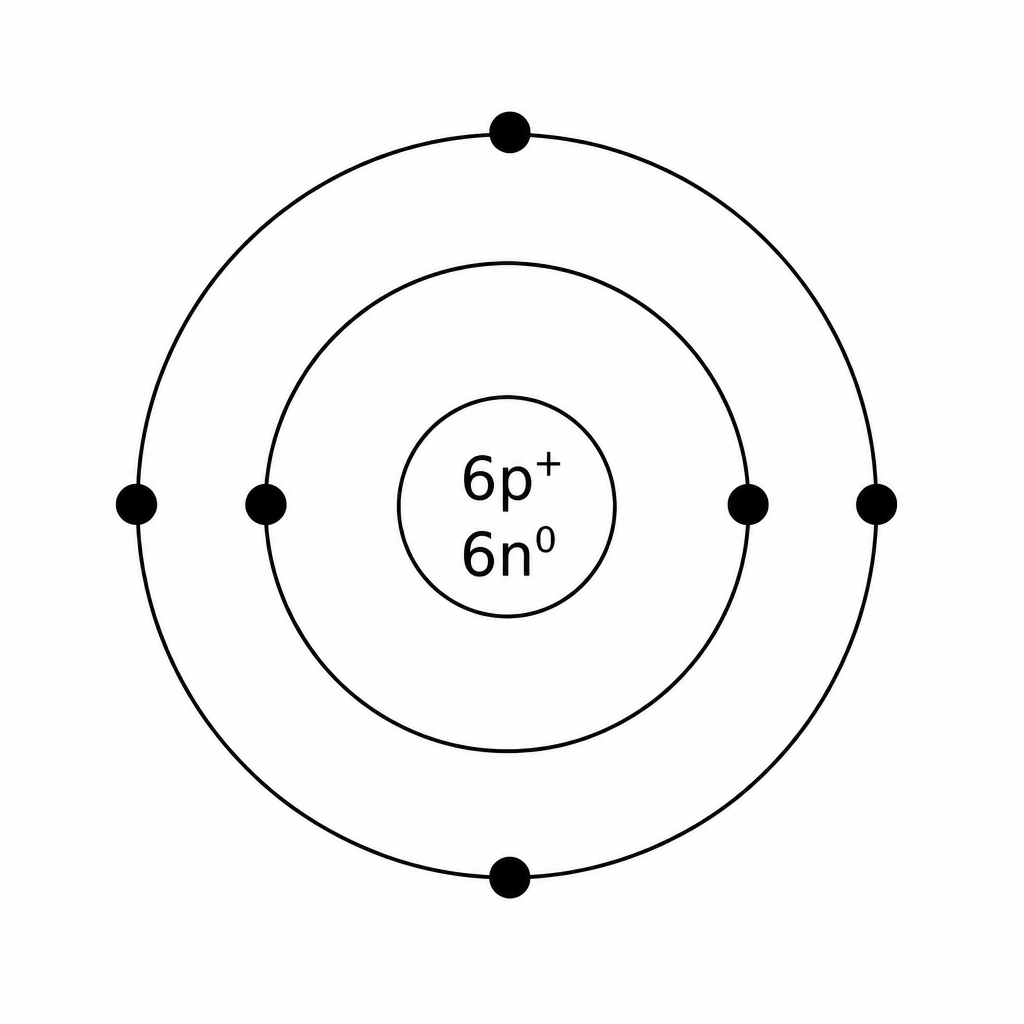
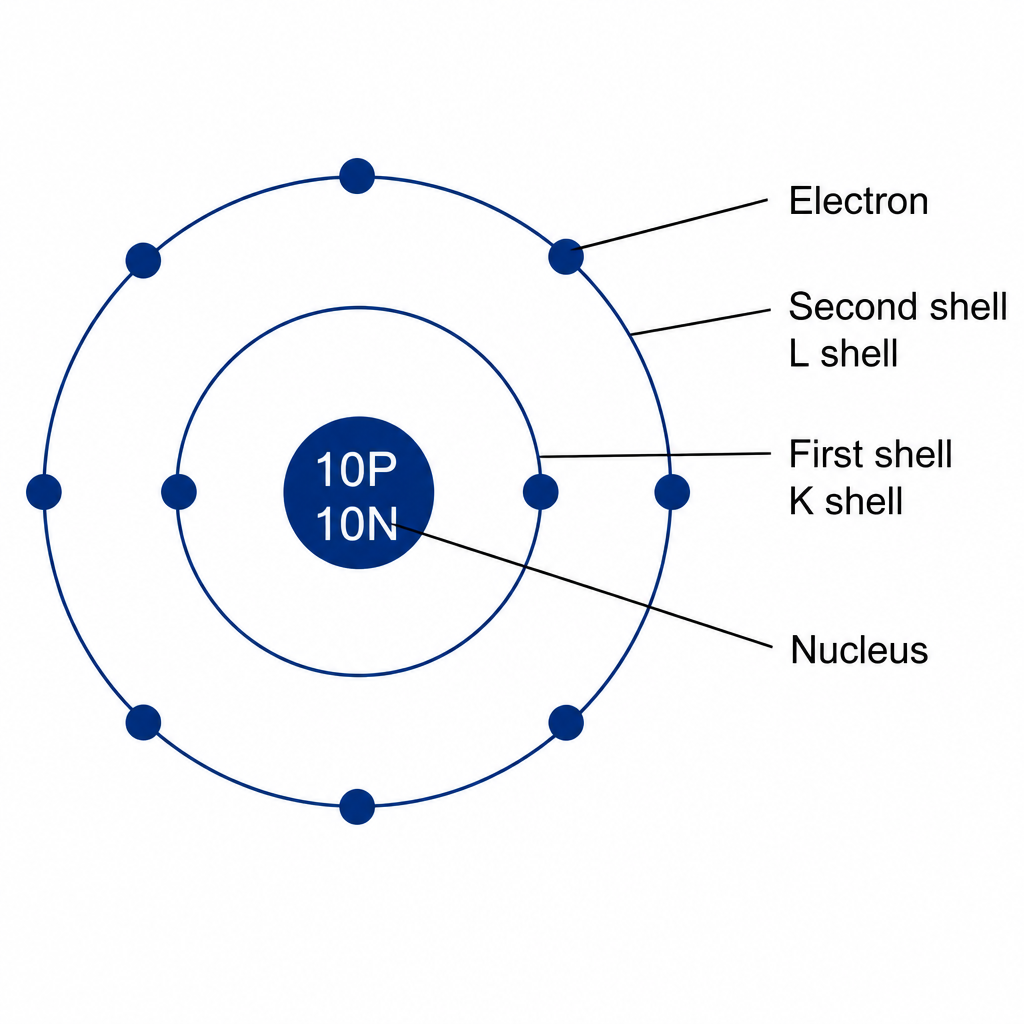
An atom is built from three sub-atomic particles. Two kinds of sub-atomic particle sit in the central part of the atom. That central part is called the nucleus. Around the nucleus the third kind of particle keeps moving along a fixed path of its own. Such a fixed path is called a shell or an orbit.
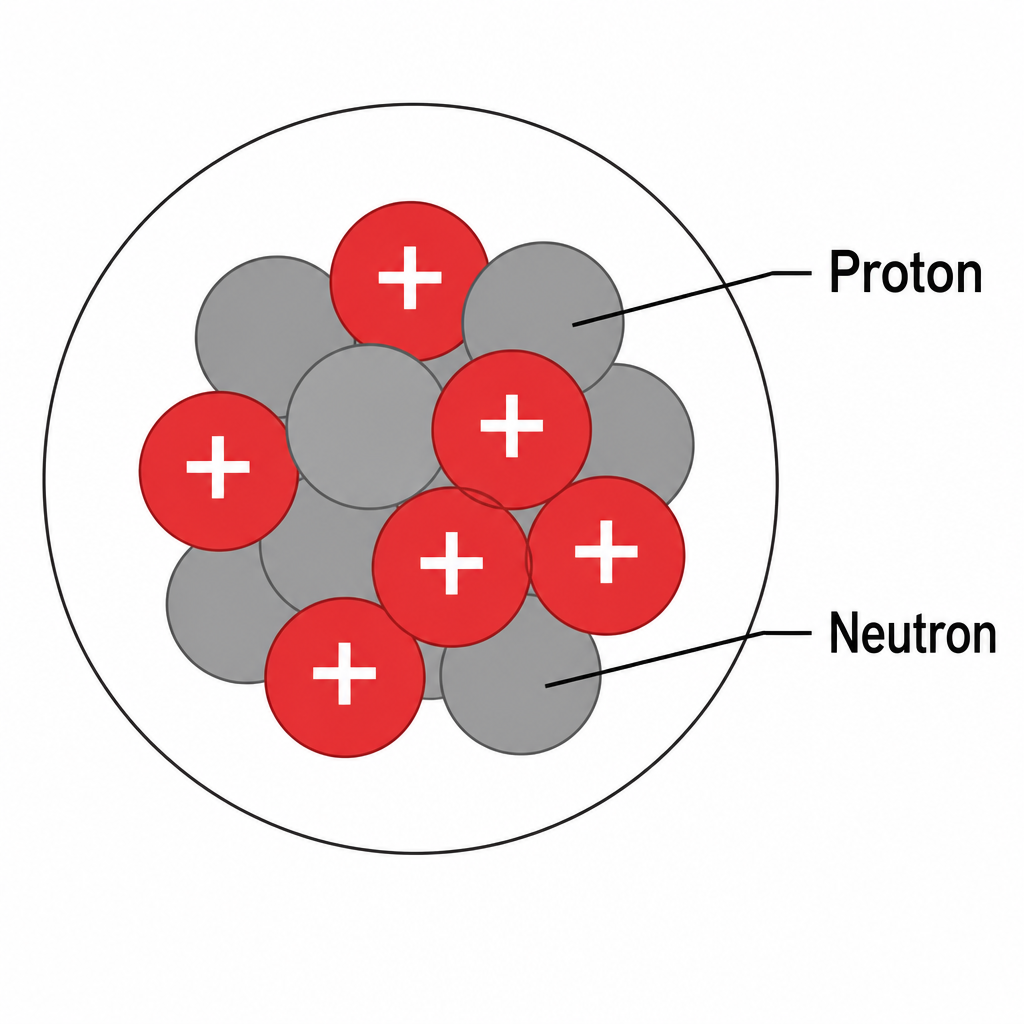
The sub-atomic particles inside the nucleus are the proton and the neutron, while the sub-atomic particle that moves around the nucleus is the electron. This makes the picture of an atom easy to hold in the mind. At the centre sits a small but heavy nucleus, and around it, in a much wider space, electrons keep going round on their fixed circular paths.
Nucleus: the central part of an atom is called the nucleus. It holds the protons and the neutrons.
Shell or orbit: the fixed path along which an electron moves round the nucleus is called a shell or an orbit.
The Proton
The positively charged sub-atomic particle that sits in the nucleus of an atom is called a proton. It is shown by the symbol \( p^{+} \). The mass of one proton is equal to the mass of one hydrogen atom. The mass of one proton is taken as 1 atomic mass unit, written amu.
Proton: the positively charged sub-atomic particle found in the nucleus, written \( p^{+} \), with a mass of 1 amu.
The Neutron
The sub-atomic particle in the nucleus that carries no charge at all is called a neutron. It is shown by the symbol \( n^{o} \). The mass of one proton is equal to the mass of one neutron, so the mass of one neutron is also taken as 1 atomic mass unit, amu.
Neutron: the sub-atomic particle found in the nucleus that carries no charge, written \( n^{o} \), with a mass of 1 amu.
The Electron
The negatively charged sub-atomic particle that keeps moving round the nucleus along a fixed path is called an electron. It is shown by the symbol \( e^{-} \). The mass of an electron is very much smaller than the mass of a proton or a neutron. About 1837 electrons together weigh as much as a single proton, so the mass of one electron is \( \frac{1}{1837} \) amu.
Electron: the negatively charged sub-atomic particle that moves round the nucleus in a shell, written \( e^{-} \), with a mass of \( \frac{1}{1837} \) amu.
The Three Particles Compared
Setting the three sub-atomic particles side by side makes the differences between them clear. Three things have to be compared: where the particle is found, what charge it carries, and how much it weighs.
| Sub-atomic particle | Symbol | Where it is found | Charge | Mass |
| Proton | \( p^{+} \) | Nucleus | Positive | 1 amu |
| Neutron | \( n^{o} \) | Nucleus | No charge | 1 amu |
| Electron | \( e^{-} \) | Shell or orbit | Negative | \( \frac{1}{1837} \) amu |
The First Twenty Elements and Their Particles
Every element has an atomic number. That number tells how many protons sit in the nucleus of one atom of the element. In a neutral atom the positive charge and the negative charge must balance, so the number of electrons is the same as the number of protons. The number of neutrons is a separate count, and it is not always the same as the number of protons.
Atomic number: the number of protons in the nucleus of an atom is called the atomic number of that element.
| Atomic number | Element | Symbol | Protons | Neutrons | Electrons |
| 1 | Hydrogen | H | 1 | 0 | 1 |
| 2 | Helium | He | 2 | 2 | 2 |
| 3 | Lithium | Li | 3 | 4 | 3 |
| 4 | Beryllium | Be | 4 | 5 | 4 |
| 5 | Boron | B | 5 | 6 | 5 |
| 6 | Carbon | C | 6 | 6 | 6 |
| 7 | Nitrogen | N | 7 | 7 | 7 |
| 8 | Oxygen | O | 8 | 8 | 8 |
| 9 | Fluorine | F | 9 | 10 | 9 |
| 10 | Neon | Ne | 10 | 10 | 10 |
| 11 | Sodium | Na | 11 | 12 | 11 |
| 12 | Magnesium | Mg | 12 | 12 | 12 |
| 13 | Aluminium | Al | 13 | 14 | 13 |
| 14 | Silicon | Si | 14 | 14 | 14 |
| 15 | Phosphorus | P | 15 | 16 | 15 |
| 16 | Sulphur | S | 16 | 16 | 16 |
| 17 | Chlorine | Cl | 17 | 18 | 17 |
| 18 | Argon | Ar | 18 | 22 | 18 |
| 19 | Potassium | K | 19 | 20 | 19 |
| 20 | Calcium | Ca | 20 | 20 | 20 |
Do not assume that the number of neutrons always matches the number of protons. Hydrogen has 1 proton and no neutron at all, and argon has 18 protons but 22 neutrons. It is only the proton count and the electron count that match.
Bohr and Bury's 2n² Rule
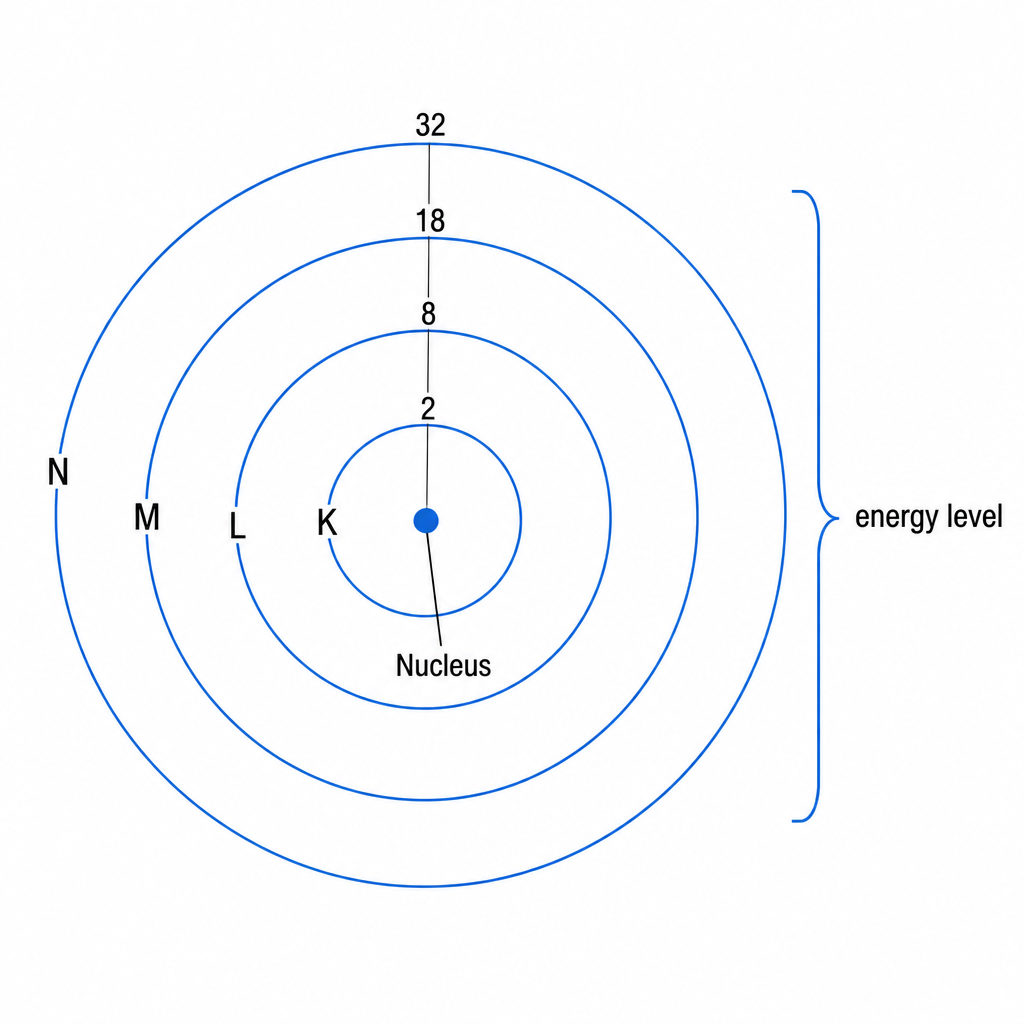
Nitrogen has 7 electrons. Are all seven of them in one shell, or are they spread over different shells? The rule that answers this question is Bohr and Bury's 2n² rule. The electrons in the atom of any element sit in shells. The shell nearest the nucleus is called the K shell, and the shells after it are called L, M and N in turn. A shell is also called an energy level. The K shell is the first energy level of the atom, and the second, third and fourth energy levels are the L, M and N shells.
Bohr and Bury's 2n² rule: the rule that tells how many electrons stay in each shell of an atom is called Bohr and Bury's 2n² rule, where n is the number of the shell.
\[ 2n^2 \]
By this rule the K shell holds 2 electrons. In the same way the L, M and N shells hold 8, 18 and 32 electrons.
Filling the Shells with Electrons
The numbers 2, 8, 18 and 32 do not have to be memorised. Each one comes out of \( 2n^2 \) by putting in the number of the shell.
Step 1: The number of electrons the first shell (K shell, n = 1) can hold:
\[ 2n^2 = 2 \times 1^2 = 2 \]
Step 2: The number of electrons the second shell (L shell, n = 2) can hold:
\[ 2n^2 = 2 \times 2^2 = 8 \]
Step 3: The number of electrons the third shell (M shell, n = 3) can hold:
\[ 2n^2 = 2 \times 3^2 = 18 \]
Step 4: The number of electrons the fourth shell (N shell, n = 4) can hold:
\[ 2n^2 = 2 \times 4^2 = 32 \]
To write the electron arrangement of an element, the shells are filled from the inside outward. The arrangement of sulphur is worked out like this.
Step 1: The atomic number of sulphur is 16. In a neutral atom the number of electrons equals the number of protons:
\[ e = p = 16 \]
Step 2: The K shell is filled first. The electrons it holds:
\[ 2 \times 1^2 = 2 \]
Step 3: The electrons left after the K shell is full:
\[ 16 - 2 = 14 \]
Step 4: Next the L shell is filled. The electrons it holds:
\[ 2 \times 2^2 = 8 \]
Step 5: The electrons left after the L shell is full:
\[ 14 - 8 = 6 \]
Step 6: The remaining 6 electrons go into the M shell. So the electron arrangement of sulphur is:
\[ 2, 8, 6 \]
An electron arrangement always starts from the inside. First K, then L, then M, then N. No shell in the middle is left empty while an outer shell is being filled.
Reading an Atomic Structure Diagram
The structure of an element's atom is shown as a diagram. At the centre is a small circle for the nucleus with the symbol of the element written in it. The rings drawn around it are the shells, and the dots on those rings are the electrons. Counting the dots from the inside outward gives the electron arrangement of that element.


The rule \( 2n^2 \) only gives the largest number of electrons a shell can hold. The outermost shell never carries more than 8 electrons. That is why the arrangement of potassium is 2.8.8.1 and not 2.8.9.
The full lesson is waiting for you
The notes are free to read in full. A free account opens the rest of the practice, and tracks your progress and confidence score for every subject. Presentations and videos need approval from Learn Yeti.