Where an Atom Keeps Its Weight
An atom keeps a nucleus at its centre, and the protons and neutrons sit inside it. The electrons stay outside the nucleus, moving around it in shells. These three subatomic particles do not weigh the same. One proton has a mass of about 1 amu, one neutron also has a mass of about 1 amu, but one electron has a mass of only \( \frac{1}{1836} \) amu. To match the weight of a single proton you would need 1836 electrons put together. So almost the whole weight of an atom is packed inside its nucleus, and that is where the counting of weight begins.
amu (atomic mass unit): the unit used to weigh a mass as tiny as an atom. One proton, or one neutron, has a mass of about 1 amu.
The weight of an atom is really the weight of its nucleus. The electrons moving outside weigh so little that they drop out of the counting.
Atomic Weight of Elements
The number of protons in the nucleus of an element added to the number of neutrons in that same nucleus is called the atomic weight of the element. Magnesium, for example, has 12 protons and 12 neutrons in its nucleus. The two counts added together give 24, and 24 amu is the atomic weight of magnesium. So only two pieces of information are ever needed for an atomic weight: how many protons there are, and how many neutrons there are.
Atomic weight: the number of protons in the nucleus of an element added to the number of neutrons in that nucleus.
Atomic weight of an element = number of protons + number of neutrons
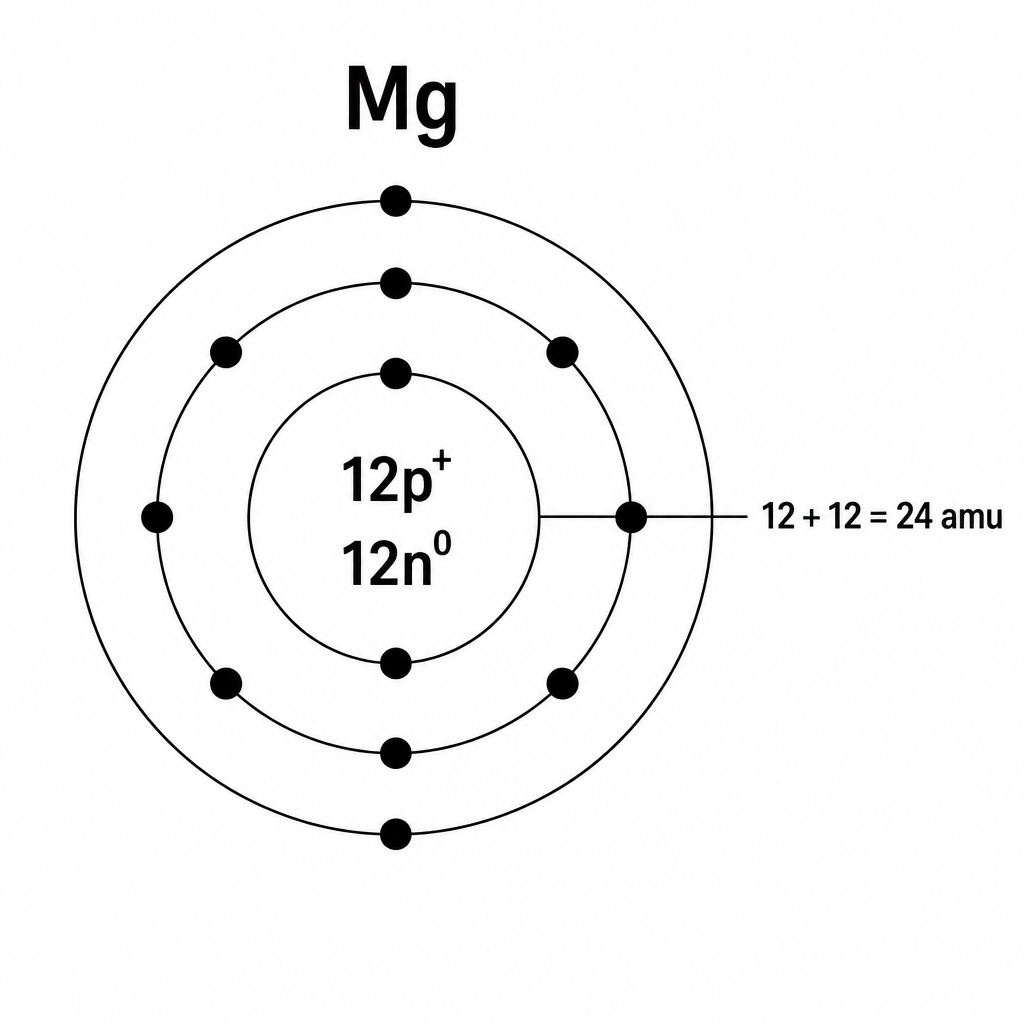
Here is one worked example. If calcium has 20 protons and 20 neutrons, what is its atomic weight?
Step 1: The two given counts are written as a sum:
\[ 20 + 20 \]
Step 2: Adding the two counts gives:
\[ 20 + 20 = 40 \]
Step 3: Written with its unit, the atomic weight of calcium is:
\[ 40 \ \text{amu} \]
Why Electrons Are Left Out
An atom has three subatomic particles, the proton, the neutron and the electron, yet only the protons and the neutrons are added when an atomic weight is worked out. The reason is mass, not charge. An electron is 1836 times lighter than a proton, so even all 12 electrons of a magnesium atom together add far less than 1 amu. An addition that small does not turn 24 into 25. The electron mass is therefore left out to keep the counting simple and workable.
Two Different Atoms, One Atomic Weight
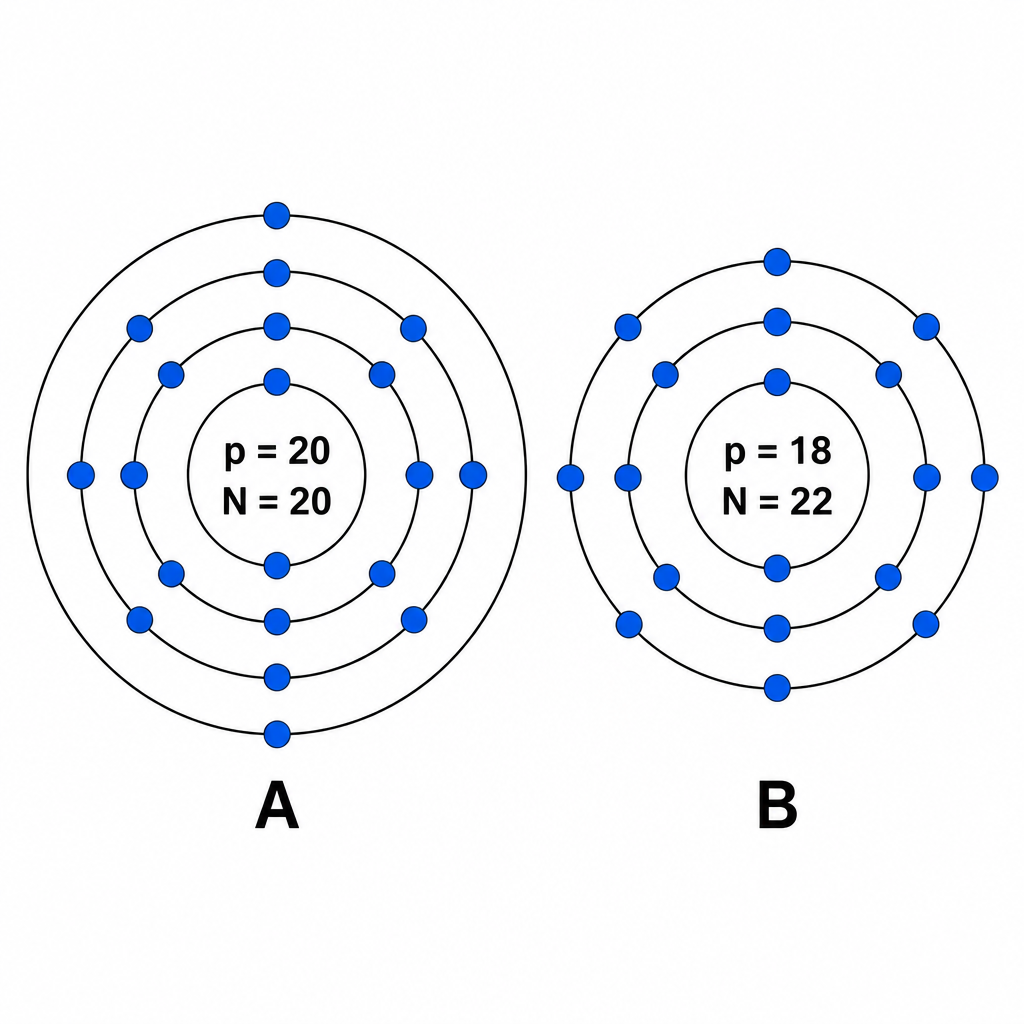
Two atoms can share the same atomic weight and still be different elements. Compare the two atoms below. Both add up to 40, but one carries 20 protons while the other carries only 18. It is the proton count that decides which element an atom belongs to, so the atom with 20 protons is calcium and the atom with 18 protons is argon.
| Detail | Atom A | Atom B |
| Number of protons | 20 | 18 |
| Number of neutrons | 20 | 22 |
| Atomic weight | 40 amu | 40 amu |
| Name of the element | Calcium | Argon |
Molecular Weight of a Molecule
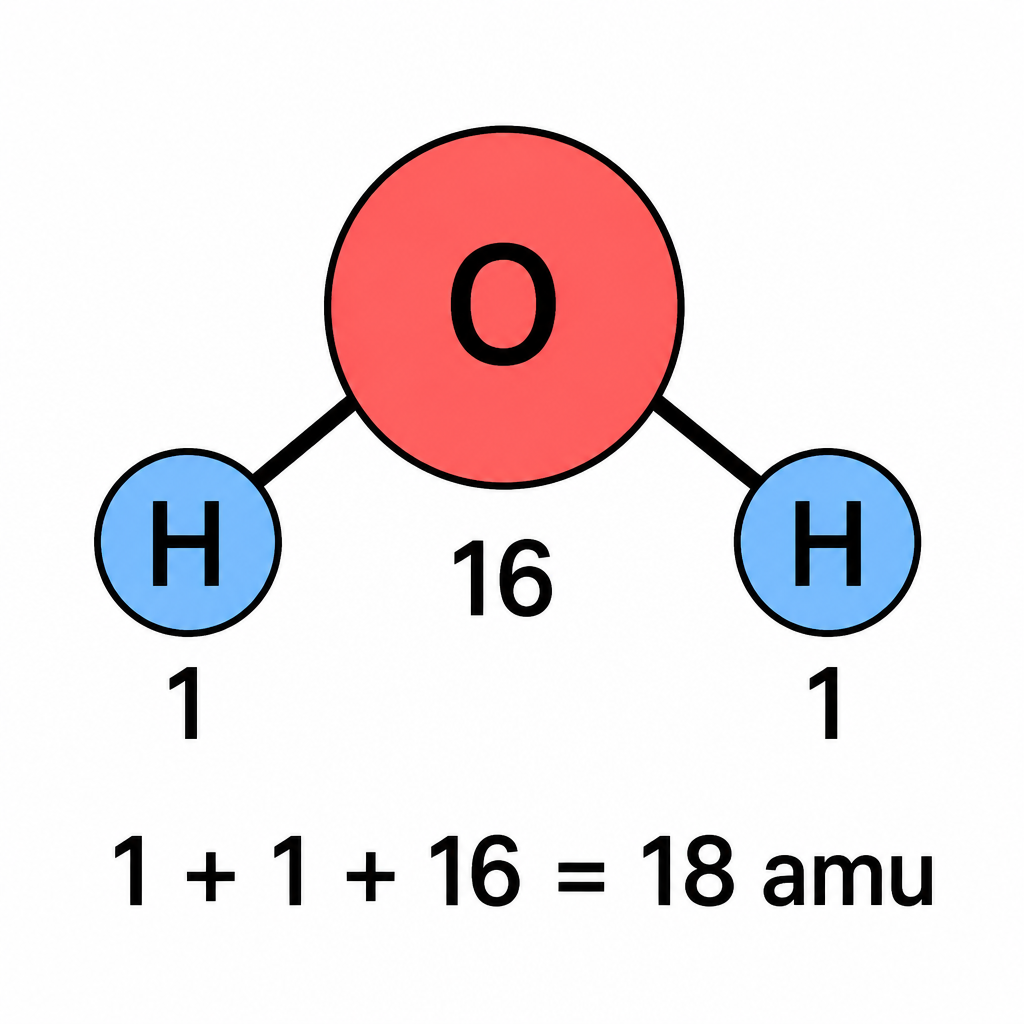
The molecular weight of an element or a compound is the sum of the atomic weights of all the atoms present in one molecule of it. Water, for example, has the molecular formula \( \mathrm{H_2O} \). That tells you one molecule of water holds two hydrogen atoms and one oxygen atom. The atomic weight of hydrogen is 1 and the atomic weight of oxygen is 16. The two hydrogen atoms give 1 and 1, which is 2, and adding the 16 of oxygen gives 18. So the molecular weight of water is 18 amu.
Molecular weight: the sum of the atomic weights of all the atoms present in one molecule of an element or a compound.
Finding a Molecular Weight Step by Step
Finding a molecular weight starts with reading the molecular formula. The small number written after a symbol tells you how many of that atom are in the molecule, and when no number is written there is just one such atom. After that the work is only multiplying and adding.
- Write down the molecular formula of the compound.
- Count how many atoms of each element the formula holds.
- Multiply the atomic weight of each element by the number of its atoms.
- Add all those products together.
- Write the unit amu after the total you get.
Work through calcium carbonate the same way. Its molecular formula is \( \mathrm{CaCO_3} \), so one molecule holds one calcium atom, one carbon atom and three oxygen atoms.
Step 1: The molecular weight is set out from the formula as:
\[ \mathrm{Ca} + \mathrm{C} + 3 \times \mathrm{O} \]
Step 2: Putting in the atomic weight of each element gives:
\[ 40 \times 1 + 12 \times 1 + 16 \times 3 \]
Step 3: Doing the multiplication first:
\[ 40 + 12 + 48 \]
Step 4: Adding them gives the answer with its unit:
\[ 40 + 12 + 48 = 100 \ \text{amu} \]
The small number written after a symbol belongs to that one symbol alone. In \( \mathrm{CaCO_3} \) the 3 counts only the oxygen atoms, not the calcium or the carbon. Never multiply the whole total by that 3.
Atomic Weights You Will Use
A few atomic weights come back again and again in this work, so they are collected below. Knowing them by heart makes practice questions much quicker.
| Element | Symbol | Atomic weight |
| Hydrogen | H | 1 |
| Carbon | C | 12 |
| Oxygen | O | 16 |
| Sodium | Na | 23 |
| Magnesium | Mg | 24 |
| Sulphur | S | 32 |
| Chlorine | Cl | 35 |
| Potassium | K | 39 |
| Calcium | Ca | 40 |
| Argon | Ar | 40 |
Atomic Weight and Molecular Weight Side by Side
These two terms sound alike, but they weigh different things. One gives the weight of a single atom, the other gives the weight of a whole molecule.
| Basis | Atomic weight | Molecular weight |
| Weight of what | One atom | One molecule |
| How it is found | By adding the protons and the neutrons | By adding the atomic weights of all the atoms in the molecule |
| What you need | The make up of the nucleus | The molecular formula |
| Example | Oxygen = 16 amu | Water = 18 amu |
| Unit | amu | amu |
Both atomic weight and molecular weight carry the unit amu. An answer left as a bare number, with no unit after it, counts as incomplete.
The full lesson is waiting for you
The notes are free to read in full. A free account opens the rest of the practice, and tracks your progress and confidence score for every subject. Presentations and videos need approval from Learn Yeti.