What a Salt Is
When an acid and a base are mixed together, each one loses the property that makes it what it is. The sour nature of the acid goes away, the slippery and bitter nature of the base goes away, and two new substances take their place. One of them is water, and the other one is called a salt. The table salt used in the kitchen is exactly such a salt. When measured amounts of hydrochloric acid and sodium hydroxide are mixed, sodium chloride and water are produced.
\[ \text{HCl} + \text{NaOH} \rightarrow \text{NaCl} + \text{H}_2\text{O} \]
Salt: the neutral compound that is formed after the chemical reaction between an acid and a base is called a salt.
Not every salt, however, turns out to be neutral. Depending on the nature of the acid and the base that made it, a salt can also be acidic or basic. Here the word nature means whether the acid or the base is a strong one or a weak one. Hydrochloric acid and sulphuric acid are strong acids, while carbonic acid is a weak acid. Sodium hydroxide and calcium hydroxide are strong bases, while ammonium hydroxide is a weak base. Which of the two partners is strong and which is weak is what decides the character of the salt that forms.
The Three Kinds of Salt
Salts are mainly of three kinds. Each kind is recognised by the pair of acid and base that produced it, so it is worth building the habit of asking, the moment a salt is named, which acid and which base it came from.
Neutral salts: the salt formed after the chemical reaction of a strong acid with a strong base, or of a weak acid with a weak base, is called a neutral salt. Sodium chloride \( (\text{NaCl}) \) is a neutral salt.
Acidic salts: the salt formed after the chemical reaction of a strong acid with a weak base is called an acidic salt. Ammonium chloride \( (\text{NH}_4\text{Cl}) \) is an example of an acidic salt.
Basic salts: the salt formed after the chemical reaction of a strong base with a weak acid is called a basic salt. Sodium carbonate \( (\text{Na}_2\text{CO}_3) \) is a basic salt.
| Kind of salt | The pair that makes it | Example |
| Neutral salt | Strong acid with strong base, or weak acid with weak base | Sodium chloride \( \text{NaCl} \) |
| Acidic salt | Strong acid with weak base | Ammonium chloride \( \text{NH}_4\text{Cl} \) |
| Basic salt | Strong base with weak acid | Sodium carbonate \( \text{Na}_2\text{CO}_3 \) |
The salt leans towards whichever partner is the strong one. A salt made from a strong acid and a weak base is acidic, not basic. Many students write these two the wrong way round.
The Physical Properties of Salts
To get to know the physical properties of salts, take a little table salt and a little copper sulphate, and carry out the following jobs one after another. After each job, write down in your own words what you saw, keeping the entries in a table.
- Taste the table salt, or look carefully at the copper sulphate.
- Dissolve a little table salt or copper sulphate in water.
- Dip red litmus into the solution of table salt or copper sulphate.
- Dip blue litmus into the solution of table salt or copper sulphate.
- Mix a little methyl orange with the table salt or copper sulphate solution.
- Mix a little phenolphthalein with the table salt or copper sulphate solution.
Only the table salt from the kitchen may be tasted. Copper sulphate is poisonous, so never taste it, and never put any laboratory chemical in your mouth. Wash your hands with soap and water when the work is over.
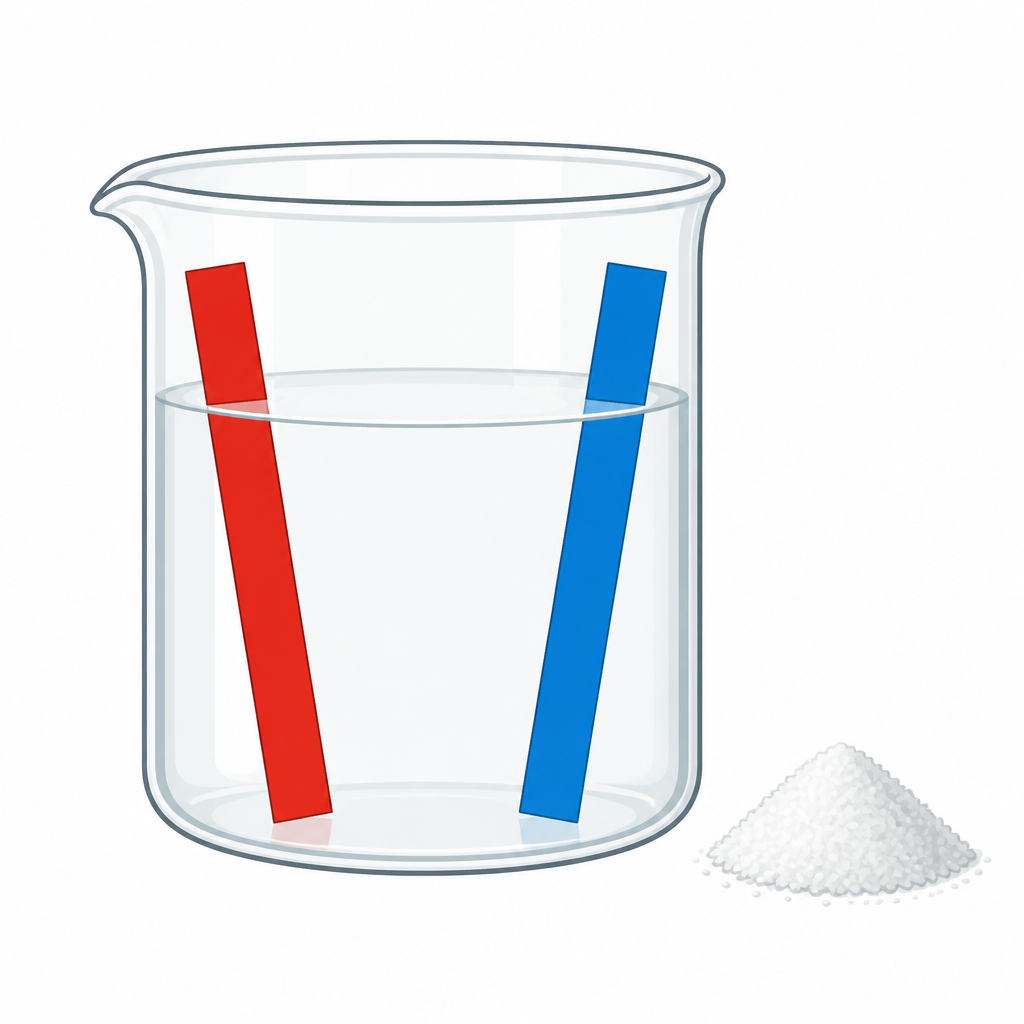
These jobs bring out the physical properties of salts, which are as follows.
- Table salt is salty, but most salts are tasteless and some of them are bitter.
- Salts are generally soluble in water.
- Most salts are colourless or white, while some of them are coloured.
- A salt gives no reaction with indicators.
- Salts have high boiling points and high melting points.
Copper sulphate is blue and ferrous sulphate is green. These two examples do not spoil the general statement that most salts are white; they show that some salts are coloured.
The Chemical Properties of Salts
(a) Ionisation on dissolving in water. When a salt dissolves in water it gives the positive ion of the metal and the negative ion of the non metal. When sodium chloride dissolves in water, sodium ions and chloride ions are formed.
\[ \text{NaCl} \rightleftharpoons \text{Na}^+ + \text{Cl}^- \]
Ionisation: the process in which a salt, on dissolving in water, separates and turns into positive and negative ions is called ionisation.
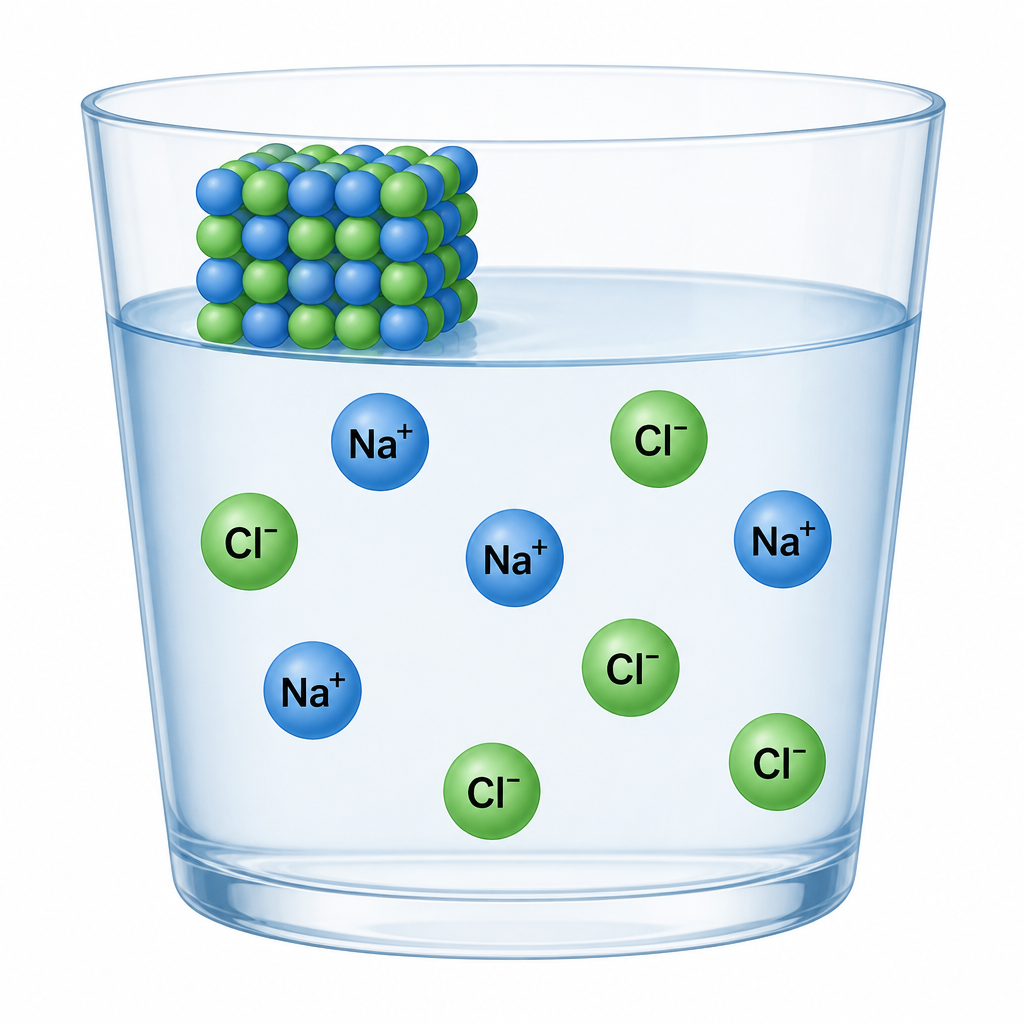
(b) Chemical reaction with an acid. Sometimes a salt reacts with an acid and makes a new salt and a new acid. The reaction between sulphuric acid and sodium chloride gives sodium sulphate and hydrochloric acid.
\[ \text{H}_2\text{SO}_4 + 2\text{NaCl} \rightarrow \text{Na}_2\text{SO}_4 + 2\text{HCl} \]
(c) Chemical reaction with a base. Sometimes a salt reacts with a base and gives a new salt and a base. The reaction between ammonium chloride and calcium hydroxide gives calcium chloride, ammonia gas and water.
\[ \begin{aligned} 2\text{NH}_4\text{Cl} + \text{Ca(OH)}_2 \rightarrow \\ \text{CaCl}_2 + 2\text{NH}_3 + 2\text{H}_2\text{O} \end{aligned} \]
Ammonia gas has a very sharp smell and it can sting the nose and the eyes. While doing this reaction, never point the open mouth of the test tube towards anybody, and if the smell has to be taken, fan the air towards yourself from a distance.
Displacement: One Metal Pushes Another Out
The fourth chemical property of salts can be understood by watching it happen. For this a test tube, some copper sulphate and some iron filings are needed. The aim is simply this: to observe with your own eyes the chemical reaction in which a more reactive metal displaces the less reactive metal present in a salt.
- Take copper sulphate solution in a test tube, filling it about half way.
- Now put a little iron filings into it.
- After some time, watch carefully what happens to the colour of the solution and to the iron filings.
- Write your conclusion on the basis of what you observed.
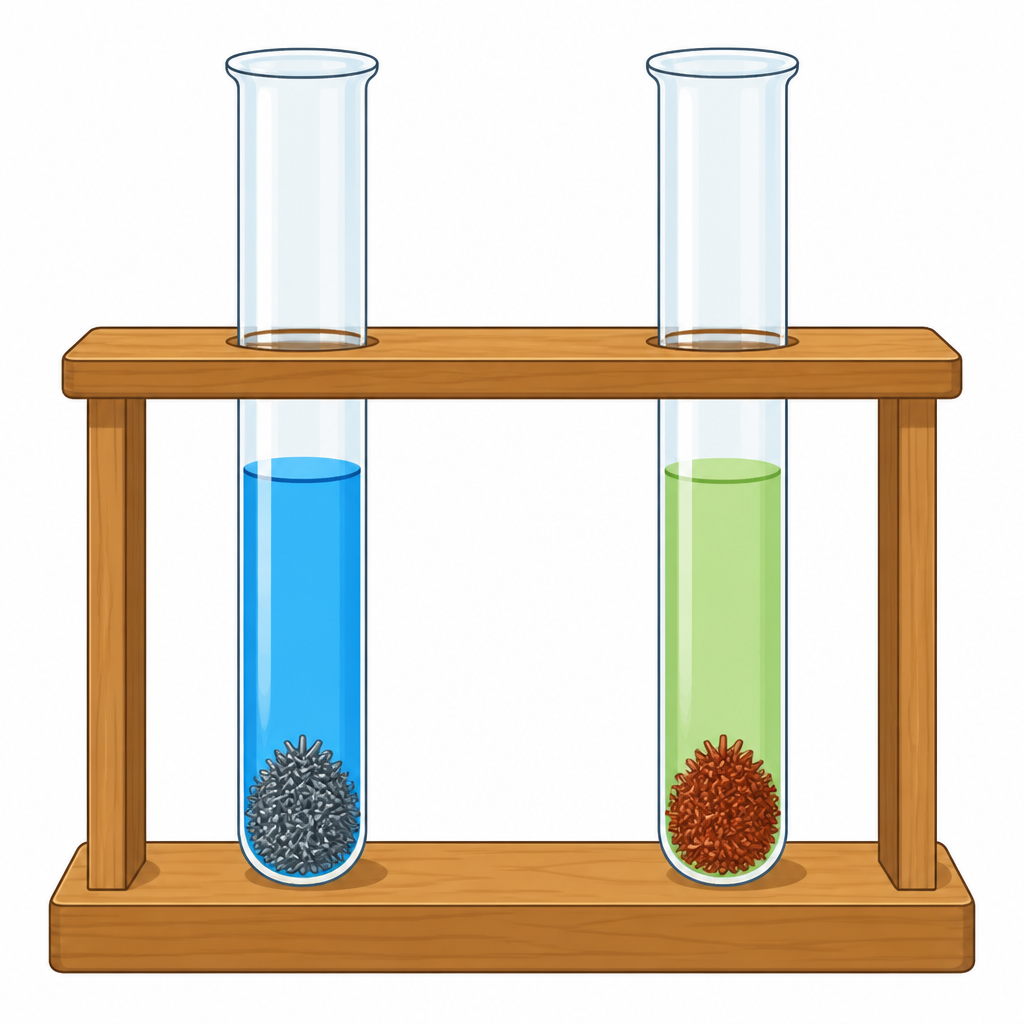
The blue solution slowly turns green and a reddish brown layer appears on the iron filings. Iron is a more reactive metal than copper, so the iron pushes the copper out of the copper sulphate and joins the sulphate itself. The green colour belongs to the newly formed ferrous sulphate, and the reddish brown material is the copper that has been set free.
Displacement reaction: the reaction in which a more reactive metal displaces the less reactive metal present in a salt and makes a new salt is called a displacement reaction.
\[ \text{CuSO}_4 + \text{Fe} \rightarrow \text{FeSO}_4 + \text{Cu} \]
If it is done the other way round, with copper powder put into ferrous sulphate solution, nothing happens. Copper is less reactive than iron, so it cannot push the iron out.
Everyday Salts and Their Uses
Salts are not substances that stay inside a laboratory. Their work reaches the kitchen, the washing place, the factory and the medicine shop. The three best known salts and the jobs they do are given below.
| Salt | Uses |
| Table salt (sodium chloride) | To make food tasty; to store food for a long time; to produce chemicals such as sodium hydroxide, sodium carbonate and baking soda in industry |
| Sodium carbonate, also called washing soda | For cleaning; to remove the permanent hardness of water; to produce glass, paper and soap in industry |
| Sodium bicarbonate, also called baking soda | To make baking powder; to make antacid; to make fire control equipment |
Table salt does more than give food a taste. Salt put into meat or pickle draws water out, so germs cannot grow and the food lasts a long time. Washing soda removes the calcium and magnesium salts dissolved in water, which is why soap lathers properly in water treated with it. Baking soda neutralises the extra acid in the stomach, and that is why it is put into antacid medicine.
The full lesson is waiting for you
The notes are free to read in full. A free account opens the rest of the practice, and tracks your progress and confidence score for every subject. Presentations and videos need approval from Learn Yeti.