What a Base Is
The oxides and hydroxides of metals are called bases. Sodium oxide, sodium hydroxide, potassium oxide, potassium hydroxide and magnesium oxide are all examples of bases. Every one of these compounds begins with a metal. When oxygen joins that metal the compound is a metal oxide, and when a hydroxide group joins it the compound is a metal hydroxide. So the first question to ask about any compound is whether a metal is present in it, because a base always carries one.
Base: the oxides and the hydroxides of metals are called bases.
- Sodium oxide \( \mathrm{Na_2O} \)
- Sodium hydroxide \( \mathrm{NaOH} \)
- Potassium oxide \( \mathrm{K_2O} \)
- Potassium hydroxide \( \mathrm{KOH} \)
- Magnesium oxide \( \mathrm{MgO} \)
Not every metal oxide dissolves in water. Some dissolve readily and disappear into the water, while others simply sink and stay at the bottom of the vessel. This single difference, dissolving or not dissolving, splits bases into two groups that behave quite differently in the laboratory.
Alkali: a Base That Dissolves in Water
A base that dissolves in water is called an alkali. When an alkali dissolves it releases hydroxide ions into the water. Sodium hydroxide and potassium hydroxide are alkalis, because both dissolve and both fill the solution with hydroxide ions. Magnesium oxide, on the other hand, does not dissolve in water, so it is a base but it is not an alkali.
Alkali: a base that dissolves in water is called an alkali. An alkali releases hydroxide ions when it dissolves in water.
Every alkali is a base, but every base is not an alkali. Magnesium oxide is a base and yet it is not an alkali, because it will not dissolve in water. Swapping these two words is one of the easiest marks to lose in an examination.
Strong and Weak Alkalis
Alkalis are divided into strong and weak according to the number of hydroxide ions they release in water. A strong alkali gives a large number of hydroxide ions when it dissolves, while a weak alkali gives only a few. Sodium hydroxide and potassium hydroxide are strong alkalis, and ammonium hydroxide is a weak alkali.
Strong alkali: an alkali that releases a large number of hydroxide ions when it dissolves in water.
Weak alkali: an alkali that releases only a small number of hydroxide ions when it dissolves in water.
| Kind of alkali | Hydroxide ions released in water | Examples |
| Strong alkali | Many | Sodium hydroxide, potassium hydroxide |
| Weak alkali | Few | Ammonium hydroxide |
Physical Properties of a Base
You do not need a laboratory chemical to meet the physical properties of a base. Wood ash stirred into water gives a solution that is itself alkaline, and that solution shows every property a base has. Make ash water in the order below and watch what happens at each stage.
- Put a little wood ash in a glass, add water and stir it well.
- Let the mixture settle for a while, then pour the clear water on top into a second glass.
- Rub a drop of that ash water between your fingers.
- Touch a very small amount to the tip of your tongue and note the taste.
- Dip a strip of red litmus paper into the ash water.
- Now dip a strip of blue litmus paper into the same water.
- Add two drops of methyl orange to a little of the ash water.
- Add two drops of phenolphthalein to another small portion of the ash water.
Comparing what you saw at each stage with what your classmates saw gives the full list of the physical properties of a base.
- A base turns red litmus paper blue.
- Blue litmus paper stays blue in a base.
- Most bases taste bitter and astringent.
- A base feels slippery, like soap solution.
- A base turns methyl orange yellow.
- A base turns phenolphthalein pink.
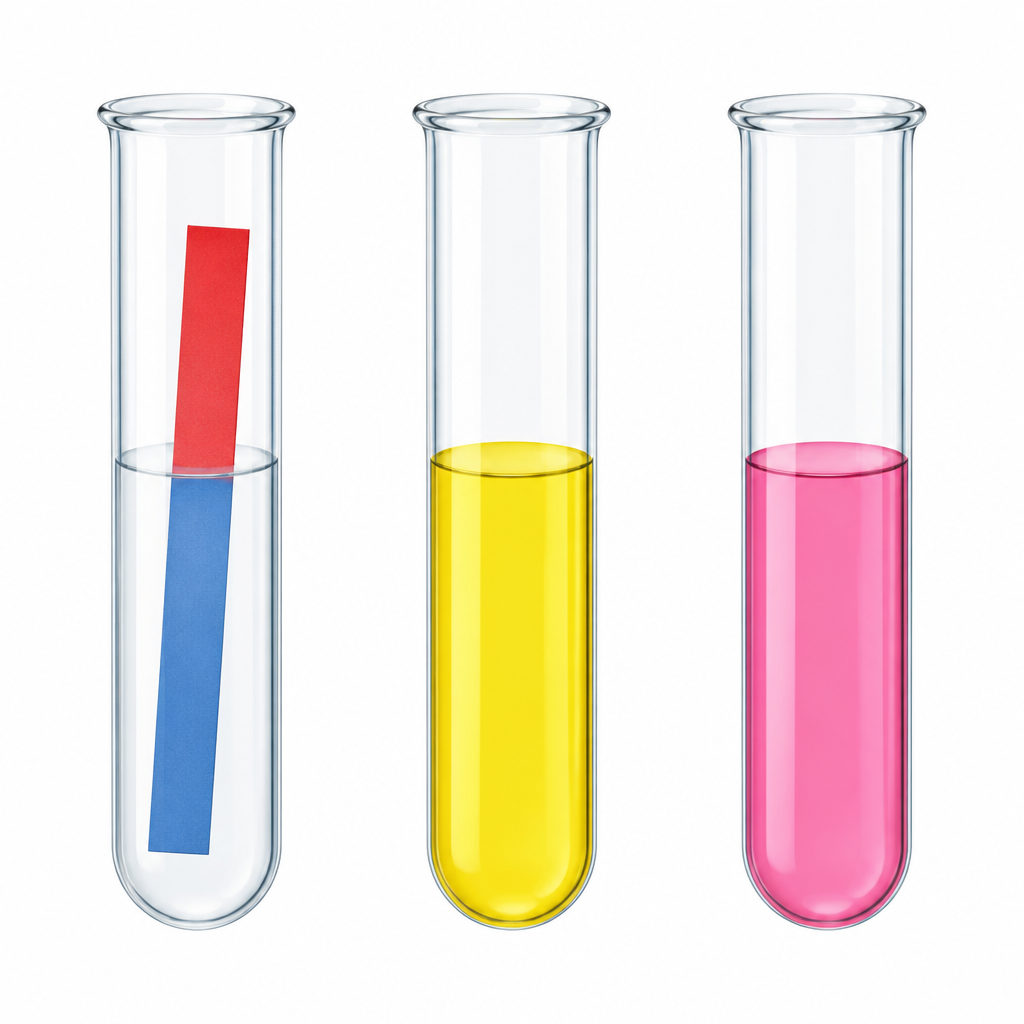
Ash water aside, no alkali in a laboratory may ever be tasted. Sodium hydroxide and potassium hydroxide burn the skin and can badly damage the eyes. Lift a strong alkali with tongs, and wash your hands after the work.
Chemical Properties of a Base
(a) Ionisation in water. A base dissolving in water ionises and gives hydroxide ions. Sodium hydroxide dissolving in water separates into sodium ions and hydroxide ions:
\[ \mathrm{NaOH} \rightleftharpoons \mathrm{Na}^{+} + \mathrm{OH}^{-} \]
That hydroxide ion is the signature of a base. Every colour change listed above happens because these ions are present in the solution.
(b) Reaction with an ammonium salt. A base reacts with an ammonium salt and produces ammonia gas. When sodium hydroxide is added to ammonium sulphate, the products are sodium sulphate, ammonia and water:
\[ (\mathrm{NH_4})_2\mathrm{SO_4} + 2\mathrm{NaOH} \longrightarrow \]
\[ \mathrm{Na_2SO_4} + 2\mathrm{NH_3} + \mathrm{H_2O} \]
Whether ammonia has actually been made is settled with a strip of moist red litmus paper. Work through the steps below and test it yourself.
- Take a little dilute ammonium sulphate in a dry test tube.
- Add a little sodium hydroxide to it.
- Watch carefully what happens inside the test tube.
- Hold a moist red litmus paper close to the mouth of the test tube and look at its colour.
If the moist red litmus turns blue, ammonia gas is certainly coming out of the tube, because ammonia dissolving in the water on the paper makes an alkaline solution.
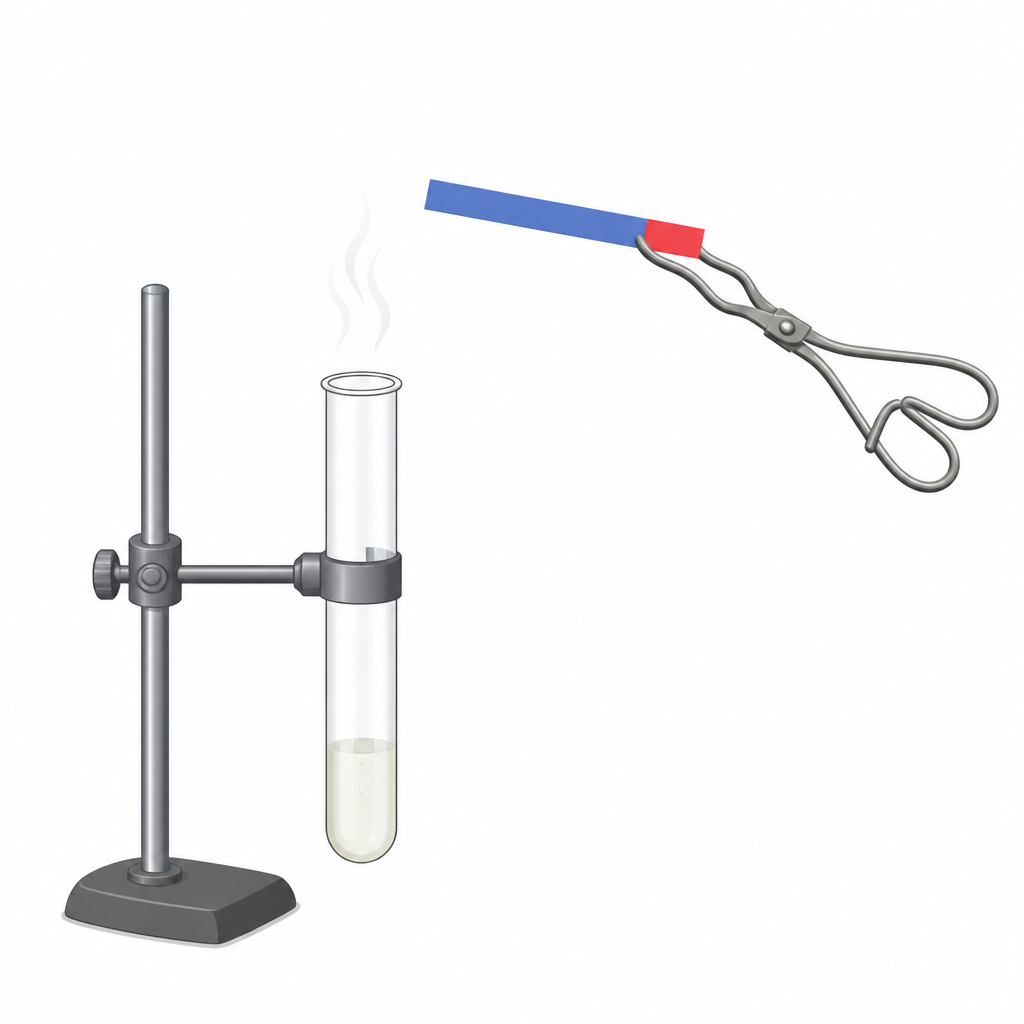
Never turn the mouth of the test tube towards yourself or towards a classmate. Do not hold your nose over the tube and breathe in the ammonia; fan a little of the gas towards you with your hand instead.
Reaction With an Acid and Neutralisation
(c) Reaction with an acid. A base reacts with an acid and gives a salt and water. This reaction is also called a neutralisation reaction. When potassium hydroxide is added to sulphuric acid, potassium sulphate and water are formed:
\[ \mathrm{H_2SO_4} + \mathrm{KOH} \rightarrow \mathrm{K_2SO_4} + \mathrm{H_2O} \]
Neutralisation reaction: the reaction between an acid and a base that produces a salt and water is called a neutralisation reaction.
In a neutralisation both properties disappear at once: the acid loses its acidity and the base loses its alkalinity. Dipping litmus paper into the mixture afterwards shows no colour change at all, and that is the proof.
All three chemical properties in one line: with water a base gives hydroxide ions, with an ammonium salt it gives ammonia gas, and with an acid it gives a salt and water.
Uses of Bases
Bases are not shut inside a laboratory. The cement a house is built with, the soap used for washing, the paper written on and the fertiliser spread on a field are all made with the help of a base. The common bases and their uses are set out below.
| Base | Uses |
| Calcium hydroxide | Making cement. Making bleaching powder. Using as a white primer before a house is painted, that is, whitewashing. Reducing the acidity of soil. |
| Magnesium hydroxide | Using as a medicine for gastritis. |
| Sodium hydroxide | Producing soap, cloth and paper. Refining petroleum products. |
| Ammonium hydroxide | Using as a reagent in the laboratory. Making chemical fertiliser. Making rayon cloth, plastic and dye. |
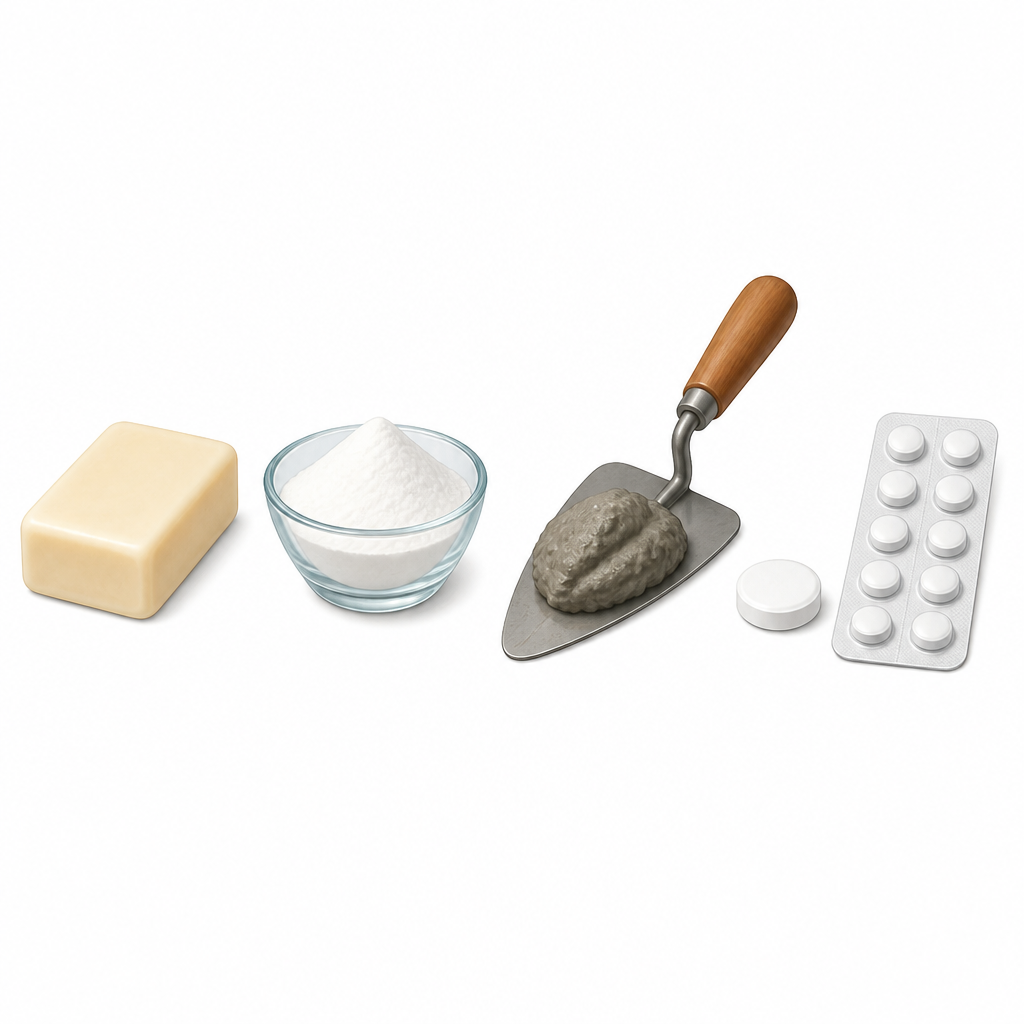
Calcium hydroxide lowering the acidity of soil is itself a neutralisation. Lime spread over sour soil cancels the acid in it, and the crop then grows well. A dose of magnesium hydroxide taken for gastritis does exactly the same job inside the stomach, cancelling the extra acid that caused the burning.
The full lesson is waiting for you
The notes are free to read in full. A free account opens the rest of the practice, and tracks your progress and confidence score for every subject. Presentations and videos need approval from Learn Yeti.