When Factory Smoke Reaches the Sky
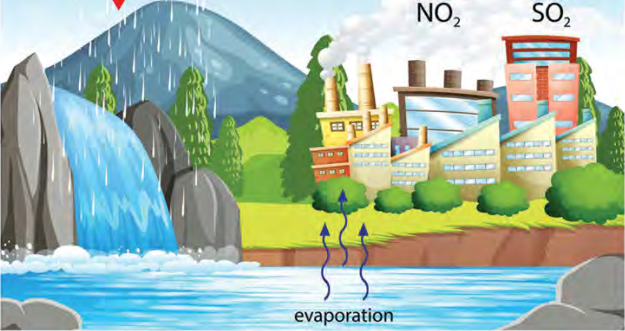
Smoke rises from factory chimneys all day long. Once it reaches the sky it seems to disappear, but it does not. Inside that smoke are gases such as sulphur dioxide and nitrogen dioxide. The eye cannot see them, yet they float in the air above us. At the same moment, water from the lake, the river and the wet soil below is turning into vapour and rising too. Higher up, the two meet in the same place.
These oxides react chemically with the tiny droplets of water vapour, and acid is formed right inside the cloud. Later that acid-carrying water falls back down as rain. What left the chimney therefore travels in a circle and returns to our own rivers, fields, roofs and stone temples. That circle is the main idea of this lesson.
What Acid Rain Is
Rain that comes down with acids formed in the air by various causes mixed into the rainwater is called acid rain.
One thing needs care here. Ready made acid does not fall out of the sky. The acid is made inside the cloud itself, and the rainwater then carries it down to the surface of the earth. This is why acid rain looks exactly like ordinary rain. The difference is not in its colour but in the property of the water.
Why Ordinary Rain Is Already Slightly Acidic
Rainwater is normally acidic anyway. The reason is carbon dioxide, a gas that is always present in the air. Carbon dioxide reacts chemically with water to make carbonic acid, and that acid comes down to the surface of the earth along with the rainwater.
\[ \text{CO}_2 + \text{H}_2\text{O} \rightarrow \text{H}_2\text{CO}_3 \]
Rain that falls this way has a pH value of about 6, which is not particularly harmful. Fields, rivers and living things receive water like this all the time. But if stronger acids besides this one come down with the rainwater, the pH value of the rain falls to about 3 or even lower. Water with a pH value that low is harmful to animals and plants.

The smaller the pH number, the stronger the acid. So rainwater at pH 3 is many times more strongly acidic than rainwater at pH 6.
Not every shower is acid rain. Ordinary rain is slightly acidic too, but it does no harm. Only rain in which strong acids have mixed and pushed the pH value far down is called acid rain.
Two Ways Acids Form in the Air
Acids are formed in the air by two means. Both work in the same way. First the oxides of sulphur and nitrogen reach the atmosphere, then those oxides react chemically with the water particles in the air, and acids are made. The only difference is where the oxides came from in the first place.
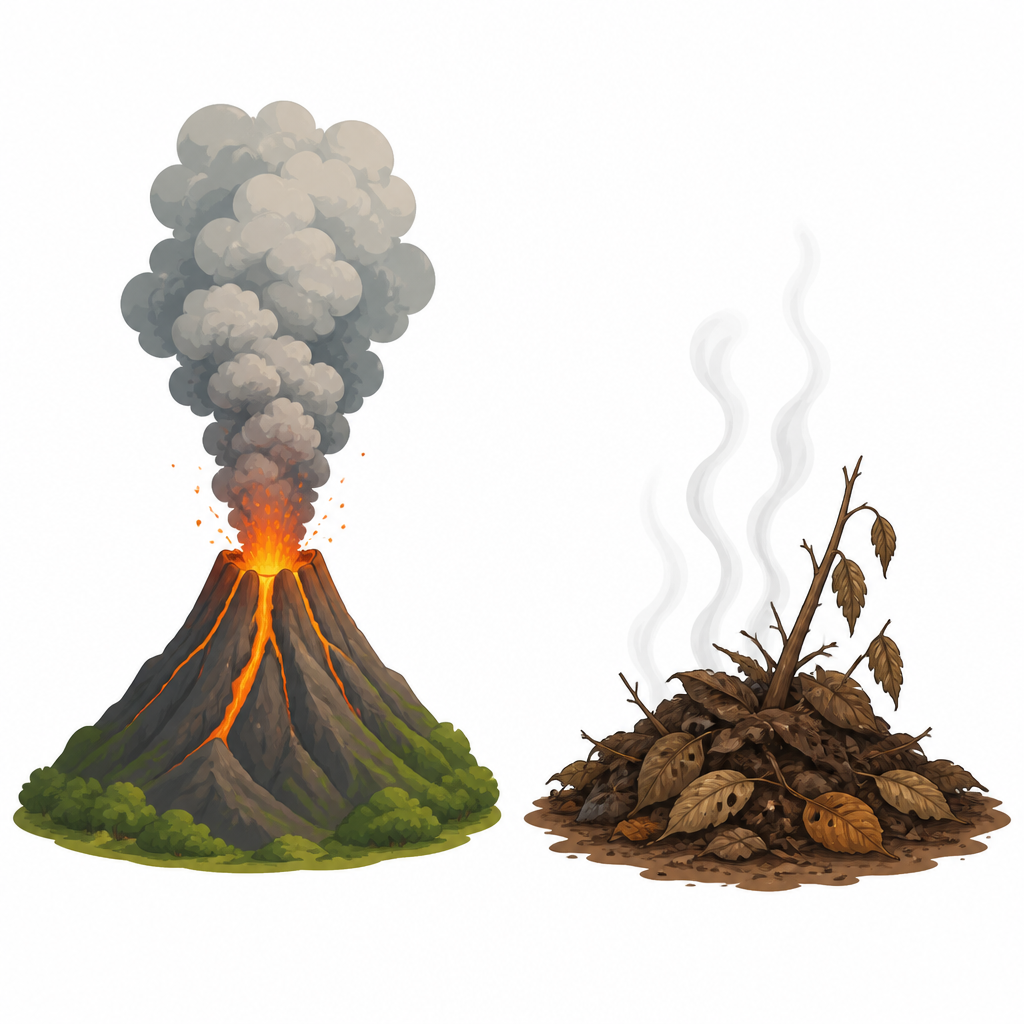
Natural sources: animals and plants rotting, and volcanoes erupting
Human made sources: smoke from burning fossil fuels, from vehicles and from factories
Acids from Natural Sources
Natural events such as the rotting of animals and plants, and the eruption of volcanoes, send oxides of nitrogen and sulphur up into the atmosphere. Those oxides react chemically with the water particles in the atmosphere and form acids such as sulphuric acid and nitric acid. These acids mix with the rainwater and fall on the surface of the earth. People cannot stop acid made in this way, but the amount is small, so the damage is small as well.
Acids from Human Activity
Most acid rain happens because of what people do. The smoke given off by burning fossil fuels, the smoke from vehicles, and the chemical laden smoke from factories and industries all contain oxides of nitrogen and sulphur. These oxides go up into the atmosphere, react chemically with the water particles there and form acids such as sulphuric acid, nitric acid and carbonic acid, which then fall to the surface of the earth with the rain.
Which acid comes from which oxide is set out below. These names are worth learning, because a question may give you the oxide and ask for the acid.
| Oxide | Acid formed | Main source |
| Sulphur dioxide \( \text{SO}_2 \) | Sulphuric acid \( \text{H}_2\text{SO}_4 \) | Smoke from burning coal and fossil fuels, volcanoes |
| Nitrogen dioxide \( \text{NO}_2 \) | Nitric acid \( \text{HNO}_3 \) | Smoke from vehicles and factories |
| Carbon dioxide \( \text{CO}_2 \) | Carbonic acid \( \text{H}_2\text{CO}_3 \) | A gas always present in the air |
Testing Whether the Rain Is Acidic
You cannot tell acid rain by looking at it. An indicator is needed. With litmus or any other indicator you can find out whether rainwater is acidic, alkaline or neutral. You can carry out the test yourself in the way given below.
- Put a clean, dry container out in the open and collect rainwater in it.
- Dip a piece of blue litmus paper into the collected water and watch its colour.
- Dip a piece of red litmus paper into the same water in the same way.
- If the blue litmus turns red, the water is acidic. If neither piece changes colour, the water is neutral.
- Test tap water or well water the same way, compare the two results and discuss them in class.
Never taste the rainwater you have collected to find out whether it is acidic. The test is done with an indicator and with nothing else.

What Acid Rain Does to the Environment
Rainwater is one of the main parts of the environment. Living things need water to survive, and rainwater is the chief source that refills the water on earth. So when acid laden water falls on the ground, it has a direct effect on the living things there and on the other parts of the environment. The main effects are these.
- Acid rain makes the water of rivers, lakes and ponds acidic, and that is harmful to the animals living in the water.
- Acid rain damages the leaves of plants and it also lowers the quality of the soil.
- If acid rain goes on for a long time, a whole forest can be destroyed.
- Acid rain also destroys monasteries, temples, rest houses and statues of archaeological importance.

When the quality of the soil falls, plants no longer get the minerals they need, so crop yields in a place that keeps receiving acid rain drop year after year. On old heritage made of stone and marble the acid reacts directly, and the surface is eaten away little by little.

How Acid Rain Can Be Prevented
The root of acid rain is the sulphur and nitrogen oxides that reach the air. Fewer of those oxides means less acid. That is why every measure below is about keeping smoke out of the air.
- Reduce the use of fossil fuels.
- Use renewable sources of energy such as hydroelectricity and solar energy so that air pollution is reduced.
- Keep industries and factories away from residential areas.
Students have a part to play as well. Walking or cycling short distances, not burning rubbish, planting trees and persuading the family to use cleaner fuel are small acts, but they all push in the same direction.
The full lesson is waiting for you
The notes are free to read in full. A free account opens the rest of the practice, and tracks your progress and confidence score for every subject. Presentations and videos need approval from Learn Yeti.