Soap Foam Tells the Two Waters Apart
Tap water, well water, water from a hand pump and rain water all look the same in a glass. The eye cannot tell them apart. But once soap is stirred into them, the difference shows itself. In one sample a single pinch of soap raises a thick head of foam, while in another the same pinch of soap gives almost no foam at all. This small test tells us an important property of the water.
You can run this test in the classroom yourself. Work through the following steps in order.
- Collect water from different sources and pour each sample into its own beaker.
- Write down where each sample came from and stick the label on that beaker.
- Put one pinch of soap powder, or two drops of liquid soap, into every sample.
- Stir every beaker for the same length of time and in the same way.
- Observe which beaker gave plenty of foam and which gave very little, then discuss what you found with the class.
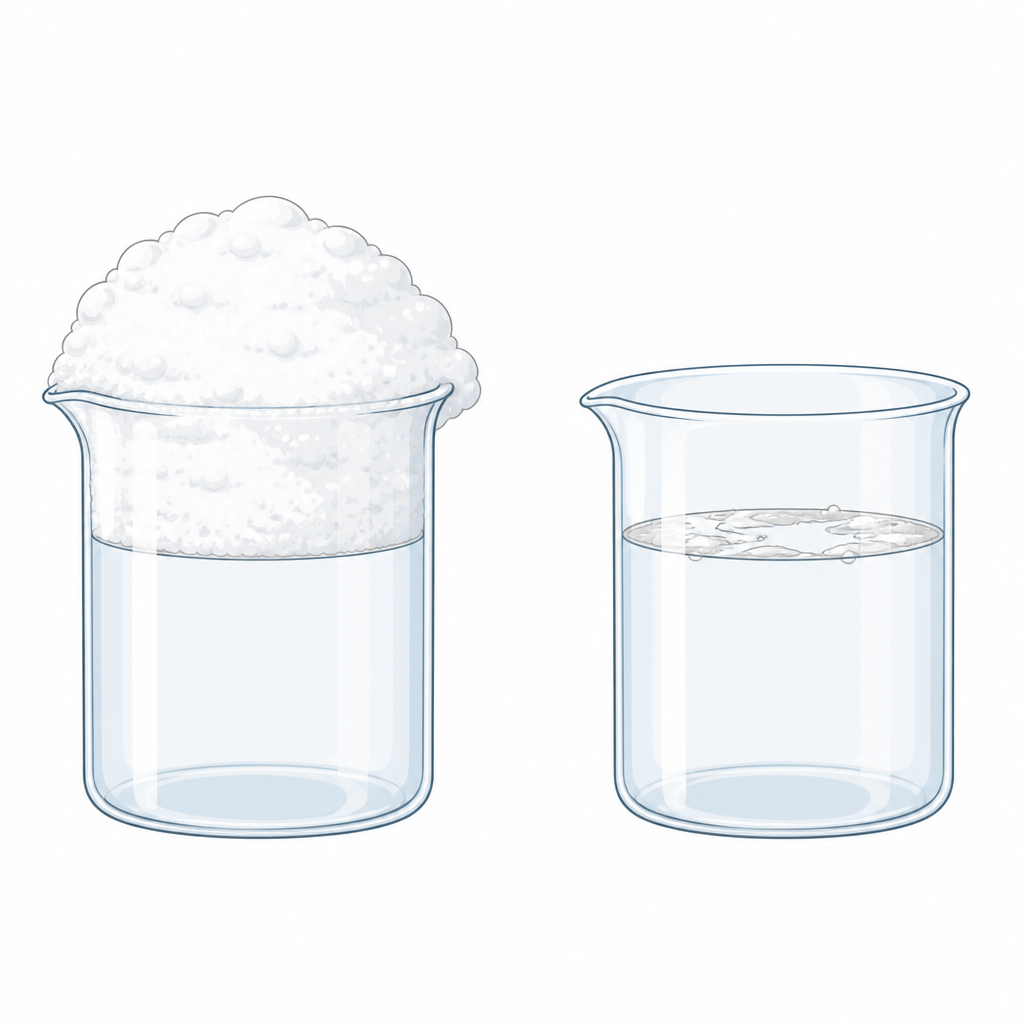
Different substances stay dissolved in water, salts above all, and because of them one sample lathers freely while another hardly lathers at all. Water that gives plenty of foam is called soft water, and water that gives only a little foam is called hard water. Surface water, such as the water of rivers, streams and ponds, is usually soft, while underground water from wells and hand pumps is usually hard. So the way water behaves with soap divides all water into two kinds, soft water and hard water.
If soap lathers easily the water is soft. If it refuses to lather the water is hard.
Soft Water
Soft water: water in which no soluble salts of calcium and magnesium are dissolved is called soft water.
Soap lathers well in soft water. Rain water, boiled water and surface water are usually soft. Rain water falls straight out of the sky and never gets the chance to dissolve salts out of the soil, which is why it is the softest water of all. Because soap gives so much lather in soft water, a good deal of water is then needed to rinse that lather away.
Hard Water
Hard water: water in which soluble salts of calcium and magnesium are dissolved is called hard water.
Hard water carries dissolved sulphate, chloride and bicarbonate salts of calcium and magnesium, and because of them soap gives no lather. Clothes washed again and again in hard water slowly turn dull, and a white substance starts collecting inside water pipes. Underground water is particularly hard, because as it seeps down through soil and layers of rock it dissolves the salts it meets along the way. The hardness of water is of two kinds.
| Basis | Soft water | Hard water |
| Dissolved salts | No calcium or magnesium salts | Sulphates, chlorides and bicarbonates of calcium and magnesium |
| Behaviour with soap | A little soap gives plenty of foam | Soap gives no foam |
| Usual source | Rain water, boiled water, surface water | Underground water from wells and hand pumps |
| When clothes are washed | Clothes come out clean | Clothes slowly become dull |
Hard water is not dirty water or muddy water. A glass of hard water can look perfectly clear and clean. Hardness is about the calcium and magnesium salts dissolved in the water, not about dirt floating in it.
Temporary Hardness of Water
Temporary hardness of water: when bicarbonate salts of calcium and magnesium are dissolved in water, that water is said to have temporary hardness.
This kind of hardness is called temporary because a simple treatment is enough to remove it. Temporary hardness can be taken out either by boiling the water or by using calcium hydroxide, which is the chemical name of lime water. Both methods do the same job, which is to turn the dissolved bicarbonate salts into a carbonate that cannot stay dissolved.
Ways of Removing Temporary Hardness
There are two ways of removing temporary hardness. The first is boiling the water and the second is the Clark method. In both of them the insoluble carbonate that forms is separated out by filtering.
Boiling
Temporary hardness can be removed by boiling. On boiling, the dissolved bicarbonate salts of calcium and magnesium change into insoluble carbonates, and these are separated from the water by filtering. The white layer that settles at the bottom of a kettle at home is exactly this insoluble carbonate.
Clark Method
Clark method: the method of removing the temporary hardness of water by using calcium hydroxide, that is lime water, is called the Clark method.
In this method calcium hydroxide is mixed into the water in just the right amount. The calcium hydroxide turns the dissolved bicarbonate salts of calcium and magnesium into insoluble carbonates, which settle at the bottom of the vessel and can then be separated by filtering. The amount matters here, because lime water added beyond what is needed simply stays behind in the water itself.
Testing Whether the Hardness Has Gone
Whether those two methods really work can be checked with the soap test again. The purpose of this test is to remove the temporary hardness of water.
Materials needed: well water, a beaker, test tubes, a Bunsen burner or a spirit lamp, calcium hydroxide and soap.
- Pour a sample of well water into three test tubes.
- Put a little soap powder into the first test tube and shake it.
- Boil the sample in the second test tube, then put a little soap powder in and shake it.
- Put a little calcium hydroxide into the third test tube, then add a little soap powder and shake it.
- Now observe which of the three test tubes gave the most foam, and draw your conclusion.
When you heat water in a test tube, never point the open end towards yourself or towards anyone else. Hold the tube with a holder and do not touch the hot glass with your hand. Never taste the water used in the test.
Permanent Hardness of Water
Permanent hardness of water: when sulphate and chloride salts of calcium and magnesium are dissolved in water, that water is said to have permanent hardness.
These salts do not leave the water even when it is boiled, and that is why this kind of hardness is called permanent. The permanent hardness of water can be removed by using washing soda or by using zeolite.
Boiling is not a cure for every kind of hardness. Boiling removes only the temporary hardness caused by bicarbonates. Permanent hardness caused by sulphates and chlorides stays in the water however long it is boiled.
Ways of Removing Permanent Hardness
Two methods are used for removing permanent hardness as well. The first uses washing soda and the second is the Permutit method.
Using Washing Soda
Washing soda turns the dissolved sulphate and chloride salts of calcium and magnesium into insoluble carbonates, which are then separated out by filtering. That is why, in places where the water is hard, a little soda is mixed into the water before the clothes are washed.
The Permutit Method
Permutit method: the method of removing the permanent hardness of water by using zeolite is called the Permutit method.
In this method the layers inside a tall tank are arranged from the bottom upwards as gravel, then coarse sand, then sodium zeolite. When hard water is sent in from the top, the calcium and magnesium ions in the water displace the sodium of the sodium zeolite, the hardness of the water is removed and the water becomes soft. The water leaving the outlet at the bottom is soft water. After some time the zeolite stops working, and a solution of common salt is then sent through it so that it can be used again.
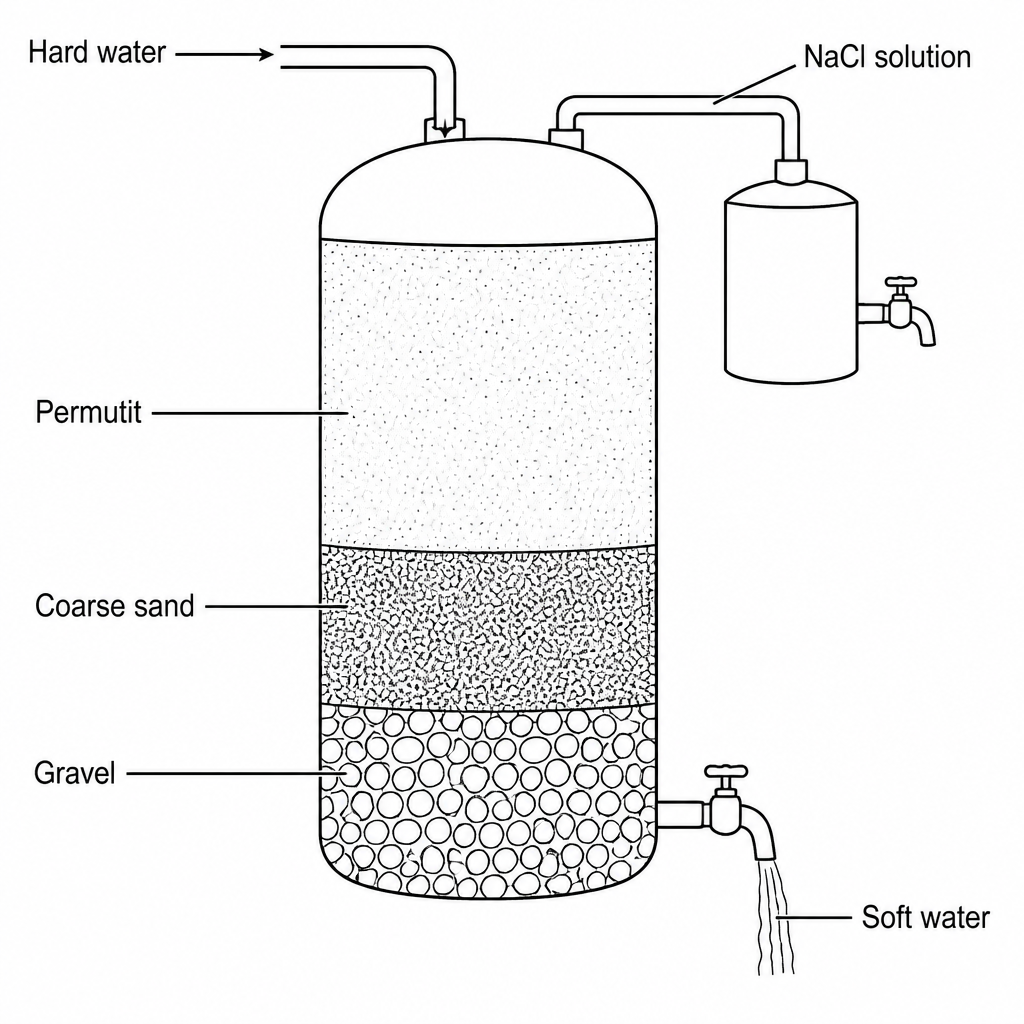
The Two Kinds of Hardness Side by Side
| Basis | Temporary hardness | Permanent hardness |
| Salts that cause it | Bicarbonates of calcium and magnesium | Sulphates and chlorides of calcium and magnesium |
| On boiling | The hardness goes away | The hardness stays |
| Ways of removing it | Boiling, the Clark method | Washing soda, the Permutit method |
| Substance used | Calcium hydroxide, that is lime water | Washing soda or sodium zeolite |
The full lesson is waiting for you
The notes are free to read in full. A free account opens the rest of the practice, and tracks your progress and confidence score for every subject. Presentations and videos need approval from Learn Yeti.