Why Wild Animals Become Rare
Nepal is home to a remarkable range of wild animals, from the snow leopard on high Himalayan slopes to the Gangetic dolphin in the rivers of the Terai. All the animal life of a place is called its fauna. Over the years, the numbers of many of these animals have fallen sharply. Some have become rare, some are endangered, and some have already disappeared from places where they once lived.
The causes are of two kinds. Some are natural, such as floods, landslides and disease. Others are human-induced, and today these are by far the bigger threat. The main causes that push fauna towards extinction are:
- Change in the ecosystem: when the plants, water or other animals that an animal depends on change, it can no longer survive in that place.
- Destruction of habitat: forests are cut, grasslands are ploughed and wetlands are drained to make room for farms, roads and settlements.
- Adverse effects on the environment: polluted air, water and soil, and a changing climate, harm animals and the food they eat.
- Poaching and illegal trade: animals are killed for their skin, horn, bones, scales or meat, and their body parts are smuggled and sold.
Illegal hunting and trade often cross national borders, so they need a strong legal answer. To control them, the Government of Nepal has implemented the Control of International Trade of Endangered Wild Fauna and Flora Act, 2073. This Act controls the trade of endangered wild animals and plants, and of products made from them, between Nepal and other countries.
Wildlife conservation: the protection, care and wise management of wild animals and their habitats, so that their numbers stay healthy and they do not become extinct.
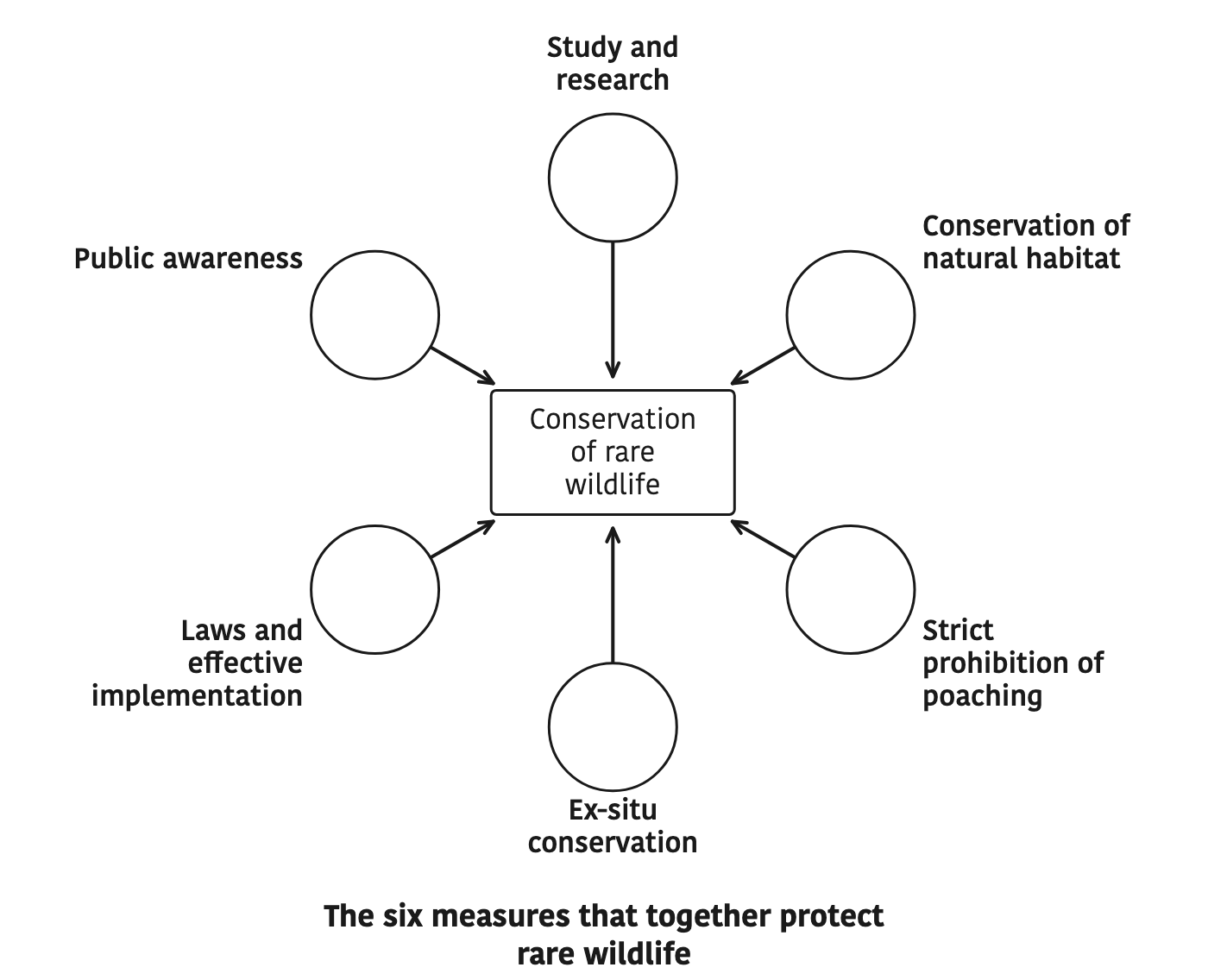
Saving rare fauna takes more than one action. Six measures are used together: study and research, conservation of natural habitat, strict prohibition of poaching, ex-situ conservation, laws with effective implementation, and public awareness. Each is explained in its own section below.
Study and Research
Nobody can protect an animal well without first knowing it. Extensive study and research must be carried out to find the exact status of rare animals and birds and of the nature and ecosystem they live in. Researchers look for answers to questions like these: How many of these animals are left? Where exactly do they live? What do they eat, and when do they breed? What is killing them?
The answers decide what to do next. In Nepal, tigers and one-horned rhinoceros are counted at regular intervals. Cameras fixed on forest trails photograph passing tigers, and each tiger can be recognised by its own pattern of stripes. If a count shows numbers falling in one area, the reason can be traced and action taken there first.
Research tells conservation where to act. Without it, effort and money go to the wrong place.
Conservation of Natural Habitat
Natural habitat: the natural place where an animal lives, finds its food, water and shelter, and breeds.
All animals and birds flourish in their own natural habitat. A rhinoceros needs tall grassland and marshes. A red panda needs cool forests full of bamboo. A Gangetic dolphin needs deep, clean rivers. Take the habitat away and the animal cannot survive, however well it is guarded.
So the natural environment, such as forests, streams, watersheds and pasture lands, should be protected for the conservation of rare flora and fauna. Protecting one habitat protects every plant and animal living in it at the same time. Nepal sets aside national parks, wildlife reserves and conservation areas for this purpose. Koshi Tappu Wildlife Reserve, for example, protects the grasslands and river islands that are the last home of the wild water buffalo in Nepal.
Strict Prohibition of Poaching
Poaching: the illegal hunting, killing or capturing of wild animals.
The main reason behind the extinction of various fauna is illegal hunting and trade. Poachers kill rhinoceros for their horn, tigers for their skin and bones, pangolins for their scales and musk deer for their musk pod. These parts sell for high prices in illegal markets, so poaching goes on even where very few animals are left.
Therefore the rules made to control and prevent the hunting of endangered and rare animals and birds must be put into action strictly. In practice this means guards and soldiers patrolling inside the parks, checks at borders, and punishment for anyone caught hunting, carrying or selling wildlife parts. A ban protects animals only when it is enforced.
Managing Ex-situ Conservation
Ex-situ conservation: the conservation of a plant or animal outside its natural habitat, in a place made and managed by people, such as a zoo, an aquarium or a botanical garden. Ex-situ means off the site, away from the original home.
Sometimes an animal becomes so rare that it cannot survive in the wild on its own. Then some individuals are kept in a safe place outside their natural habitat. A suitable environment is created for them, with the right food, shelter and care, so that they can breed and their number can increase. Such places include zoos, aquariums, botanical gardens and similar habitats.
Nepal's gharial is a good example. Its eggs are collected from river banks and hatched at a breeding centre in Kasara, Chitwan, where the young gharials grow up safe from floods and predators. When they are large enough, they are released into rivers such as the Narayani and the Rapti. The Central Zoo in Jawalakhel, Lalitpur, also keeps rare animals and lets visitors learn about them.
A national park is not ex-situ conservation. The animals in a national park live in their own natural habitat. Ex-situ means the animal has been moved out of its natural home into a place such as a zoo or a breeding centre.
Provision of Laws and Their Effective Implementation
A rule written on paper saves nothing by itself. Suitable rules and laws for the conservation of rare wild animals and birds must be made and then effectively implemented. When laws are enforced, illegal activities such as hunting, trading in animal parts and destroying habitats are controlled, and rare animals can be protected.
Effective implementation needs three things working together: officials who enforce the law fairly, courts that punish offenders, and ordinary people who know what the law says. The Act of 2073 described above is one such law. It allows the government to control trade in endangered species and to punish those who break its rules.
Promoting Public Awareness
Wild animals often live close to villages. If local people see a rare animal only as a danger to their crops or cattle, guards and laws cannot protect it for long. So various programmes should be run to raise public awareness about:
- the importance of rare animals and birds
- the reasons for the decline in their number
- the conservation measures to be adopted and the benefits of conservation
- the participation of local people and the responsibility of the public
Such programmes can take many forms: school eco-clubs, street dramas, local radio shows, posters and meetings with community forest groups. When people living near a park earn from tourism and see the benefits of conservation for themselves, they become protectors of wildlife rather than a threat to it.
How the Six Measures Work Together
The six measures are not separate choices. Each one supports the others. Research shows where a species is in trouble. Habitat protection gives it a home. A ban on poaching keeps it alive. Ex-situ care builds its numbers when they are very low. Laws give the ban its force. Awareness brings local people onto the side of conservation.
| Measure | What it does | Example from Nepal |
| Study and research | Finds the exact status of animals and their ecosystem | Counting tigers with trail cameras |
| Conservation of natural habitat | Protects forests, streams, watersheds and pastures | Koshi Tappu Wildlife Reserve for the wild water buffalo |
| Strict prohibition of poaching | Stops illegal hunting and trade | Patrols against rhino horn smuggling |
| Ex-situ conservation | Increases numbers outside the natural habitat | Gharial breeding centre, Kasara |
| Laws and their implementation | Controls illegal activities through enforcement | The Act of 2073 on trade in endangered species |
| Public awareness | Makes people partners in conservation | School eco-clubs and local radio |
Protected Animals and Birds of Nepal
Some animals are in such danger that Nepal gives them special protection by law. Hunting, killing, capturing or trading any of them is strictly forbidden. Nepal protects 27 species of mammals, 9 species of birds and 3 species of reptiles, which makes 39 protected species in all.
Protected animals: wild animals and birds that the law of a country specially protects, so that hunting, killing or trading them is a punishable offence.
The 27 protected mammals are:
- Pigmy Hog
- Red Panda
- Black buck
- Gaur Bison
- Wild yak
- Wild water buffalo
- Grey Wolf
- Hispid hare
- Swamp deer
- Asiatic wild elephant
- Lynx
- Striped Hyena
- Assamese Monkey
- Indian Pangolin
- Chinese Pangolin
- Himalayan musk deer
- Clouded leopard
- Great Tibetan sheep
- Bengal Tiger
- Snow Leopard
- Tibetan Antelope
- Gangetic Dolphin
- Leopard cat
- Spotted Linsang
- One-horned Rhinoceros
- Four-horned Antelope
- Brown Bear
The 9 protected birds are:
- Great hornbill
- Cheer pheasant
- White stork
- Black stork
- Sarus crane
- Bengal florican
- Impeyan pheasant
- Lesser florican
- Crimson horned pheasant
The 3 protected reptiles are:
- Gharial
- Asiatic rock Python
- Golden monitor lizard
Many of these animals, such as the one-horned rhinoceros and the Bengal tiger, have grown in number in Nepal because all six measures were applied to them together.
The full lesson is waiting for you
The notes are free to read in full. A free account opens the rest of the practice, and tracks your progress and confidence score for every subject. Presentations and videos need approval from Learn Yeti.