Two Kinds of Causes
The climate of a place is its usual pattern of weather over many years. When that pattern shifts over a long period, we call it climate change. So what pushes the climate to change? Some of the pushes come from nature itself: the sun, the surface of the earth and volcanoes. Others come from what people do: running power stations, building factories, cutting forests and driving vehicles. For this reason the causes of climate change are classified into two groups: natural causes and human-induced causes.
Natural cause: an event that happens in nature without any human action, such as a change in solar activity, a change in the reflectivity of the earth or a volcanic eruption, and that brings a change in climate.
Human-induced cause: an activity carried out by people, such as burning fuels, running industries or cutting forests, that increases greenhouse gases in the atmosphere and so brings a change in climate.
The effects of climate change do not fall equally on everyone. Many families in Nepal depend directly on natural resources for their living: farmers who wait for the monsoon rain, herders who need pasture, and households that bring firewood and fodder from the forest. Poverty, illiteracy and social inequality leave such communities with fewer ways to adjust when conditions change. So the livelihoods of communities that depend on natural resources are considered more sensitive to the impact of climate change.
Natural Causes
Nature was changing the climate long before any factory was built. Various natural events influence the environment, and some of them release greenhouse gases on their own. When such events upset the balance of the energy reaching the earth and the gases in its atmosphere, the climate changes too. Three natural causes are important: solar activities, change in the reflectivity of the earth, and volcanic eruptions.
Solar Activities
The sun produces its energy by thermonuclear fusion reactions. In these reactions light nuclei join together to form heavier ones and give out an enormous amount of energy. The rate of these reactions does not stay exactly the same. When the rate changes, the energy produced in the sun changes as well, and so does the intensity of the solar radiation that falls on the surface of the earth.
Think of sitting beside a fire on a winter evening. When the flame grows you feel warmer, and when it dies down you feel cooler, even though you have not moved at all. The earth sits in front of the sun in the same way. More solar radiation warms the ground and the air, and less radiation lets them cool. Such changes affect the weather, and when they continue over a long time, these variations in solar activity play a role in climate change.
Change in the Reflectivity of the Earth
When sunlight reaches the earth, part of it is sent back towards space and the rest is absorbed. How much is sent back depends on the nature of the earth's surface and of its atmosphere. About 70% of the solar radiation that reaches the earth is absorbed, and the rest is reflected.
Reflectivity: the ability of a surface to send back the light that falls on it. White, shiny surfaces have high reflectivity; dark, rough surfaces have low reflectivity.
Fresh snow is white, so it reflects a large part of the sunlight. That is why a snowfield dazzles your eyes. Dark rock, soil and deep water absorb much more of it. Now picture snow melting on a Himalayan slope. The dark rock underneath is uncovered, it absorbs more heat, and the snow beside it melts even faster. In this way the absorbed energy brings natural changes to the surface of the earth, such as the melting of ice.
The absorbed energy also drives evaporation. Water from seas, rivers and other water sources evaporates and becomes water vapour, and water vapour is one of the greenhouse gases. When the amount of light and heat from the sun on the earth's surface rises or falls, the rate of evaporation rises or falls with it. This changes the amount of water vapour in the air, and so changes how much heat the atmosphere holds.
Volcanic Eruption
Volcanoes have played a noticeable role in the earth's climate. During an eruption a volcano throws out more than molten rock. It also releases various gases, including carbon dioxide, together with aerosols.
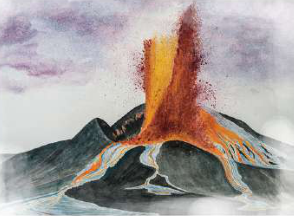
Aerosols: very tiny particles of solid or liquid, such as fine ash, dust or droplets, that stay floating in the air for a long time.
The two things a volcano releases work in opposite directions, and this is what makes volcanoes interesting:
- Cooling for a short time: the gases and aerosols spread high up into the upper layer of the atmosphere and block solar radiation for some time. Less sunlight reaches the ground, so the earth's surface becomes cold.
- Warming for a long time: the greenhouse gases released, such as carbon dioxide, remain in the atmosphere for a long time. They trap the solar radiation and increase the temperature of the earth.
Do not write that a volcanic eruption only heats the earth, or only cools it. The aerosols cool the surface for a while by blocking sunlight, and the greenhouse gases warm the earth for a long time by trapping heat. A full answer needs both.
Human-induced Causes
Natural causes have always been at work, but in the last few centuries human activities have become the bigger push. Many things people do produce greenhouse gases in abundance. These gases collect as a thick layer above the earth's surface. Sunlight passes down through this layer easily, but the heat given off by the warmed ground cannot escape easily. So the layer traps solar heat, and the temperature of the earth rises. Four human-induced causes are important: production of greenhouse gases, industrialization, deforestation, and burning of fossil fuels.
Fossil fuels: fuels formed over millions of years from the buried remains of plants and animals, such as coal, mineral oil and natural gas. Burning them releases carbon dioxide.
Production of Greenhouse Gases
To produce heat energy and electrical energy, large energy production centres burn fossil fuels like coal, mineral oil and natural gas. This burning releases a tremendous amount of harmful gases, and greenhouse gases are among them. Every plume of smoke rising from a power station's tall chimneys thickens the layer that traps heat. So this process also contributes to the increase in the temperature of the earth's surface.
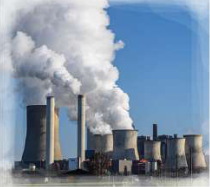
When a coal-burning power station runs all night to keep a city's lights on, the carbon in that coal ends up in the air as carbon dioxide. Every unit of electricity wasted means more fuel burnt in stations like this.
Industrialization
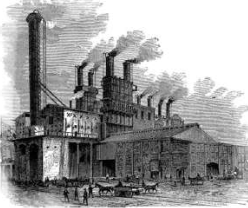
Industrialization: the setting up and growth of industries, where goods are made in large quantities in factories.
Different types of industries are set up to produce cement, steel, electrical appliances, plastics, clothes and other materials. Fossil fuels are used to run many of them: kilns that bake cement, furnaces that melt steel, boilers that drive the machines. The gases released by the combustion of these fuels pollute the environment and also play a role in climate change. The more industries grow, the more fuel they burn and the more gas they release.
Deforestation
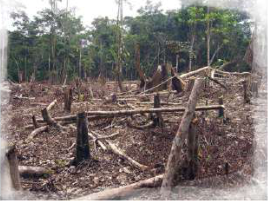
Deforestation: the cutting down and clearing of forests for roads, settlements, farming or other uses.
Forests are being cut down in an uncontrolled manner for the construction of roads, for human settlements and for cultivation. When a new road is dug along a hillside, for example, the trees on the slope are felled, and the carbon dioxide those trees were taking in every day is no longer taken in by anything.
Green plants take in carbon dioxide from the air to prepare their food by photosynthesis. That carbon is stored in the trunks, branches, roots and leaves. This is why the forest is the main storage site of the carbon emitted into the environment. Deforestation reduces the amount of carbon dioxide consumed by plants, so more of it stays in the air. As a result the amount of greenhouse gases in the environment increases, and global warming increases.
Burning of Fossil Fuels
Fossil fuels such as petrol and diesel are used in most vehicles, like cars, buses, planes, ships and trucks. When these fuels burn in an engine, harmful gases as well as greenhouse gases are released, mainly carbon dioxide. These gases pollute the environment and also increase the temperature of the earth. On a busy city road at rush hour, hundreds of engines run at the same time, so these emissions add up very quickly.
Production of greenhouse gases and burning of fossil fuels both involve burning coal, oil or gas. The difference is where the burning happens: in energy production centres making heat and electricity for the first, and in vehicles carrying people and goods for the second.
Natural and Human Causes Side by Side
| Cause | Type | How it changes the climate |
| Solar activities | Natural | A change in the sun's energy changes the radiation reaching the earth |
| Change in reflectivity | Natural | Absorbed sunlight melts ice and changes evaporation |
| Volcanic eruption | Natural | Aerosols cool for a while; carbon dioxide warms for a long time |
| Production of greenhouse gases | Human-induced | Energy centres burn fuel and release gases |
| Industrialization | Human-induced | Industries burn fuel, polluting the air and adding gases |
| Deforestation | Human-induced | Fewer trees remain to take in carbon dioxide |
| Burning of fossil fuels | Human-induced | Vehicles release mainly carbon dioxide |
The human causes all lead back to one thing: more carbon dioxide and other greenhouse gases in the air. Either we burn fuels that add these gases, or we cut down the forests that remove them.
The full lesson is waiting for you
The notes are free to read in full. A free account opens the rest of the practice, and tracks your progress and confidence score for every subject. Presentations and videos need approval from Learn Yeti.