Living Things and the Environment They Need
Walk around your school or your village and count the kinds of living things you see: trees, grasses, birds, insects, frogs, cattle and many more. Each of them survives only when its surroundings stay in good condition. A fish needs clean water. A bird needs trees to nest in. A bee needs flowers to feed on. So if we want these organisms to go on living, we have to keep their environment and their habitats healthy. A habitat is simply the natural home where an organism finds its food, water and shelter.
In the name of modernization and industrialization, people have built factories, cleared forests and burnt huge amounts of fuel in vehicles and machines. These human activities are changing the conditions of the atmosphere over the Earth's surface, and this is changing the climate. Climate change affects the shelter and the survival of organisms both directly and indirectly. It acts directly when a long drought dries out a plant and kills it. It acts indirectly when the plant a butterfly feeds on disappears, and the butterfly then disappears with it.
Because of natural causes and human activities acting together, many animals and plants are becoming fewer in number, and some have already reached extinction. A species that is extinct has not a single member left alive anywhere on Earth, so it can never come back. Organisms whose numbers have become very small are called rare, and Nepal is home to many rare species of plants and animals. Protecting them is our responsibility. If we fail, the children of future generations will only read about these plants and animals and will never be able to see them or use them.
Looking Closely at Wildlife
The pictures below bring together some of the animals that this unit is about: a tiger, a one-horned rhinoceros, a tortoise, a honeybee and a killer whale. As you look at each one, ask yourself three questions. Where does it live? Is its number growing or shrinking? What would happen to people if it disappeared?
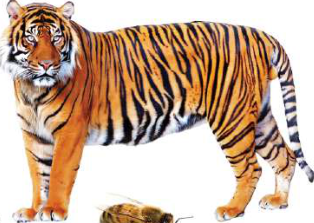
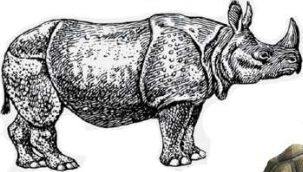
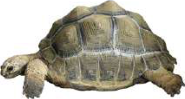
The tiger and the rhinoceros are two of the best known rare animals of Nepal. Both live in the forests and grasslands of the Terai, in protected areas such as Chitwan National Park and Bardiya National Park. In the past their numbers fell badly because of hunting and loss of habitat, and they recovered only because people chose to protect them. The honeybee looks ordinary, but it carries pollen between the flowers of many food crops, so fewer bees means less fruit and less grain on our plates. The killer whale lives in the ocean, thousands of kilometres from Nepal, yet warming seas threaten it as well. Climate change is not the problem of one country or one animal. It reaches living things everywhere, and people are among those living things.
Medicinal Plants
Some plants contain substances that help the body recover from illness. Since ancient times, people in Nepal and elsewhere have used such plants to treat many physical problems of the body, such as coughs, fever, wounds and stomach pain. Holy basil, neem, turmeric, ginger and aloe vera are familiar examples that grow in many Nepali homes and gardens.
Medicinal plants: plants that have medicinal properties and have been used as medicine since ancient times to solve various physical complications of the body.

Many of Nepal's valuable medicinal plants grow in the high hills and mountains, where the air stays cool. When the climate warms, the cool zone these plants need slowly moves higher up the slopes. A plant that cannot move up with it loses the only place where it can grow. So medicinal plants give us one more reason to care about climate change: when they disappear, the knowledge and the medicine they carry disappear with them.
What Climate Means
When you say "it is sunny and warm today" or "it rained all night", you are talking about the weather. Weather is the condition of the air at a place over a short time: a few hours, a day, or a week. Climate is different. It is what you get when you look at the weather of a place year after year and find its usual pattern.
Climate: the average weather pattern for a long time, typically about 30 years, in a certain geographical area.
Because climate is an average over so many years, the climate of a place generally stays similar. Kathmandu may have one unusually hot day or one unusually wet week, but that does not change its climate. Very small natural changes on the Earth do not change climate either. However, human activities release different types of greenhouse gases into the air, and these gases have changed the climate of the whole world. As a result, the weather patterns of many regions have changed a lot.
Weather and Climate Compared
| Point | Weather | Climate |
| Time it covers | A few hours, a day or a week | About 30 years or more |
| What it describes | The condition of the air right now | The average pattern of weather |
| How often it changes | Often, even within one day | Stays similar for a long time |
| Example | It rained heavily in Pokhara today. | Pokhara gets heavy rain every monsoon. |
One cold winter or one very hot summer does not prove or disprove climate change. Climate is judged from the pattern of about 30 years, so a single season tells you about the weather, not the climate.
What Climate Change Is
Even without people, the climate rises and falls a little over very long periods. This is its natural up and down. On top of this natural variation, the Earth's climate has been changing gradually in recent times, because the mixture of gases in the atmosphere has been altered by direct and indirect human activities. Burning coal, petrol and diesel adds gases to the air directly. Cutting down forests does it indirectly, because fewer trees are left to take carbon dioxide out of the air.
Climate change: the process of change in climate in a particular place over a long interval of time, due to the unstable nature and various human activities.
Overall, climate change is a change in the statistical magnitude of the weather over a long period of time. The long-term averages themselves shift: the usual temperature, the usual rainfall, the usual snowfall.
During climate change, the regular cycle of weather of a place is disturbed. Farmers who always planted rice when the monsoon arrived in a certain week now find the rain coming late or stopping early. Winters bring less snow than they used to. Heavy rain pours down in a few days instead of being spread over the whole season, so there are floods one month and dry fields the next.
A Global Problem, and Where Nepal Stands
Climate change is a serious global problem, and developing countries are more affected by it than developed ones. A developed country has more money to build strong flood defences, store water and help its farmers when a harvest fails. In a developing country, a larger share of people live directly on farming, forests and rivers, so when the weather pattern breaks, their food and income break with it.
Nepal's contribution to greenhouse gas emission is negligible, which means it is so small that it hardly counts in the world total. Yet Nepal is at a high risk of the harmful effects of climate change. Its mountains hold snow and glaciers that feed its rivers, most of its farming depends on the monsoon, and its steep slopes turn heavy rain quickly into floods and landslides. Nepal suffers from a problem it did very little to create.
Signs of Climate Change in Nepal
Climate change is not something that may happen to Nepal one day. It is already being experienced here, and the evidence can be listed:
- The temperature of Nepal has been increasing at the rate of 0.06°C every year. At this rate, in 30 years the rise adds up to \( 0.06 \times 30 = 1.8 \) °C.
- Water sources such as rivers, lakes and springs are drying up every year.
- The volume of water flowing in rivers is decreasing.
- There is also a real chance of floods caused by glacial lake outbursts.
- The heights of mountains are decreasing because their snow is melting.
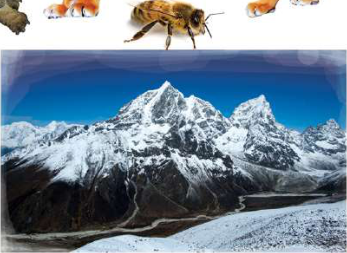
A glacial lake forms when ice at the end of a glacier melts and the water collects behind a natural wall of loose rock, gravel and ice. As more ice melts, the lake grows and presses harder on that wall. If the wall gives way, the whole lake rushes down the valley in minutes, sweeping away bridges, fields and houses far below. The melting that feeds these lakes is the same melting that is lowering the snow line on our mountains. Taken together, these facts show that climate change has a negative impact in Nepal as well.
How Scientists Study Climate Change
Nobody can see climate change in a single day, so scientists around the world study it by collecting evidence over many years. They use three main sources:
- Weather data: daily records of temperature, rainfall and snowfall kept by weather stations over decades.
- Satellite images: photographs taken from space that show how much snow, ice and forest covers a region in different years.
- Research reports: studies of the places that have been affected by climate change, describing what has changed and how people are coping.
Comparing a satellite image of a Himalayan glacier from twenty years ago with one taken this year shows at a glance how far the ice has pulled back. When the weather records, the pictures from space and the reports from villages all point the same way, scientists can say with confidence that the climate is changing.
The full lesson is waiting for you
The notes are free to read in full. A free account opens the rest of the practice, and tracks your progress and confidence score for every subject. Presentations and videos need approval from Learn Yeti.