The heart feeds itself through the coronary arteries
Every minute of your life, blood keeps arriving at the heart from different parts of the body, and the heart keeps pumping it out again to the organs. This work never stops. But the heart is itself a muscle, and a working muscle needs food and oxygen. The heart does not take these straight from the blood flowing through its chambers. Instead, it has its own blood vessels spread over its outer surface, called the coronary arteries. They carry pure, oxygen-rich blood into the heart muscle.
Coronary artery: the artery that supplies pure (oxygenated) blood to the tissues of the heart itself.
As long as the coronary arteries stay open and smooth on the inside, the heart muscle gets everything it needs. The trouble begins when one of them becomes narrow or blocked.
What a heart attack is
Sometimes the flow of blood to the heart tissues is suddenly reduced or completely blocked. The muscle beyond the blockage gets no oxygen, so the heart cannot do its work properly and the person feels extreme difficulty. This condition is called a heart attack. It is a serious, emergency condition.
Heart attack: a serious emergency condition in which the flow of blood to the heart tissues is suddenly reduced or blocked, so the heart cannot do its work properly.
Why does the blood flow get blocked? Usually because of fat. When extra fat or cholesterol is deposited on the inner wall of a coronary artery, layer upon layer, the space inside the artery becomes narrower. Such a deposit of fat or cholesterol is called plaque. Think of a water pipe that slowly collects dirt on its inside: water still flows, but less and less of it gets through.
Plaque: a deposit of fat or cholesterol on the inner wall of an artery.
Sometimes a plaque breaks down, and blood clots form at the broken place. These clots are called thrombi; a single clot is a thrombus. A thrombus can block the artery completely, or it can travel on and block the tiny capillaries. The heart tissue fed by that vessel is starved of oxygen and gets damaged.
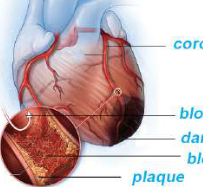
Myocardial infarction: another name for a heart attack. Myo means muscle, cardial means of the heart, and infarction means the death of tissue that gets no blood.
A heart attack is a problem of the heart's own blood supply: fat builds up as plaque, the coronary artery narrows or is blocked by a clot, and heart muscle is damaged for lack of oxygen. That is why immediate treatment is needed to save the person's life.
Risk factors of heart attack
A risk factor is anything that makes a heart attack more likely. Having one does not mean a person will surely have a heart attack, but the more risk factors a person has, the greater the chance. The main risk factors are set out in the table below.
| Risk factor | How it raises the risk |
| Age | Males above 45 years and females above 55 years are at greater risk of heart attack than young people. |
| Consumption of tobacco products | Chewing tobacco and its products and smoking cigarettes are causes of heart attack. |
| High blood pressure or hypertension | A person whose blood pressure stays high for a long time is at risk of heart attack. |
| High cholesterol and triglycerides | Bad cholesterol deposits on the inner wall of arteries, narrows them and resists blood flow. High levels of triglycerides in the blood also raise the risk. |
| Diabetes | This disorder, in which the blood sugar level rises in the body, also increases the risk. |
| Family history | If heart attacks run in someone's family, that person is also at risk. |
| Lack of regular exercise and unhealthy diet | Eating foods with much trans-fat, salt, sugar, animal fat and processed food, with no regular exercise, increases the risk. |
| Stressful life | Emotional stress, such as excessive anger or excessive negative thinking, also increases the risk. |
| Consumption of illegal drugs | Taking drugs like cocaine and amphetamines as stimulants affects the coronary artery and increases the chance of a heart attack. |
Hypertension: the condition in which blood pressure stays high for a long time; also called high blood pressure.
Diabetes: a disorder in which the blood sugar level increases in the body.
Look at the table again. Age and family history cannot be changed by anyone. But tobacco, drugs, diet, exercise and stress depend on the way a person lives, and high blood pressure and diabetes can be treated and managed. This means most of the risk of a heart attack is in our own hands.
Symptoms of a heart attack
The symptoms of a heart attack vary from person to person. The general symptoms are:
- Sudden pain and discomfort in the centre of the chest, which slowly spreads to the shoulder, hand, neck, jaw and sometimes the stomach.
- Cold sweat, fatigue and shortness of breath.
- Headache or sudden dizziness, and nausea (a feeling of wanting to vomit).
Some people have a heart attack suddenly, with no earlier sign. Most people, however, get warning signs a few hours, days or weeks before. The commonest is a regular discomfort or pressure in the chest that does not go away even after taking a rest. These are the early symptoms, and the discomfort is caused by too little blood reaching the heart tissues.
Chest discomfort or pressure that keeps coming back and does not ease with rest can be an early sign of a heart attack. Do not ignore it; the person should be seen by a doctor.
Preventive measures
Because most risk factors come from the way we live, a heart attack can very often be prevented. The preventive measures are:
- Maintain a healthy lifestyle.
- Do not consume alcohol, and give up smoking.
- Keep a healthy body weight.
- Eat a healthy and balanced diet.
- Exercise regularly.
- Manage stress.
- Treat and manage high blood pressure and diabetes, because both increase the risk of heart attack.
- Go for regular health check-ups.
Each measure answers one of the risk factors. Giving up smoking removes the tobacco risk, a balanced diet and exercise keep cholesterol and weight under control, and managing stress answers a stressful life. Habits formed at your age, such as playing outdoors, eating less junk food and never starting tobacco, protect the heart for the rest of your life.
Diagnosis of heart attack
To find out whether a person has had a heart attack, doctors first check the blood pressure, pulse and body temperature. Then they carry out overall tests related to the heart and the heartbeat. A heart attack is tested using these techniques:
- Electrocardiogram: records the electrical activity of the heart as a line on paper or a screen.
- Blood test: looks for the changes that appear in the blood when heart muscle is damaged.
- Echo: uses sound waves to show a moving picture of the heart.
- Angiography: an X-ray test that shows blockages in blood vessels.
- CT coronary angiogram: a CT scan of the coronary arteries.
- MRI: uses magnets to take detailed pictures of the heart.
Angiography
Angiography is a type of fluoroscopy X-ray used to test for blockages in blood vessels. On an ordinary X-ray, blood vessels are not seen clearly. So in angiography, a special dye called contrast medium is injected into the blood. The dye travels with the blood and highlights its flow on the X-ray, giving a clear view of any narrowed or blocked place in a vessel. The X-ray image formed in angiography is called an angiogram.
Angiography: a type of fluoroscopy X-ray used, with the help of a contrast medium, to test for blockages in blood vessels.
Contrast medium: a special dye injected into the blood so that blood flow shows up clearly on an X-ray.
Angiogram: the X-ray image formed in angiography.
Angiography and angioplasty sound alike but do different jobs. Angiography is a test that shows where a blockage is. Angioplasty is a treatment that opens the blockage. The angiogram is the picture that angiography produces.
Treatment of a heart attack
During a heart attack, many tissues of the heart are destroyed every minute. So immediate treatment is essential to restore the blood flow and the oxygen level. For this, the patient needs an immediate supply of oxygen and must be taken to hospital at once, where the doctors' instructions are followed.
A heart attack is an emergency. Take the patient to hospital immediately, because every minute of delay destroys more heart tissue.
The treatment of a heart attack depends especially on whether the blood flow is partly or completely blocked. Where angiogram and angioplasty equipment is not available, doctors start treatment with blood thinners, medicines that make it harder for clots to form and grow. Where the equipment is available, a procedure is done to open the blocked artery. The two main procedures used to open blocked arteries are coronary angioplasty with stenting, and coronary artery bypass surgery.
Coronary angioplasty and stenting
This medical procedure opens a clogged coronary artery of the heart without opening the chest. It is also called percutaneous coronary intervention (PCI); percutaneous means through the skin. It is done like this:
- A cardiologist puts a long, thin, flexible tube called a catheter into a blood vessel of the hand or leg.
- The catheter is guided through the blood vessels to the narrowed artery of the heart.
- The narrowed part is opened up, and a stent is usually placed there.
- The stent holds the artery wide so that blood can flow freely again.
A stent is a small tube made of metal mesh. It helps to open narrowed or blocked blood vessels and improves blood flow. Many stents are coated with a medicine, which lowers the chance of the artery narrowing again.
Catheter: a long, thin, flexible tube passed through a blood vessel up to the heart.
Stent: a small metal mesh tube placed inside a narrowed or blocked blood vessel to keep it open.
Coronary angioplasty: the procedure that opens a clogged coronary artery using a catheter; also called percutaneous coronary intervention (PCI).
Coronary artery bypass surgery
Sometimes, instead of clearing a blocked road, doctors build a new road around it. This is coronary artery bypass surgery, also called open-heart surgery. It is the emergency surgical procedure adopted during a heart attack. A healthy blood vessel is taken from the leg and used to make a new pathway that carries blood around the narrow coronary artery to the heart muscle. This new vessel is called a bypass graft. The heart tissues then get nutrients and oxygen-rich blood through the new pathway.
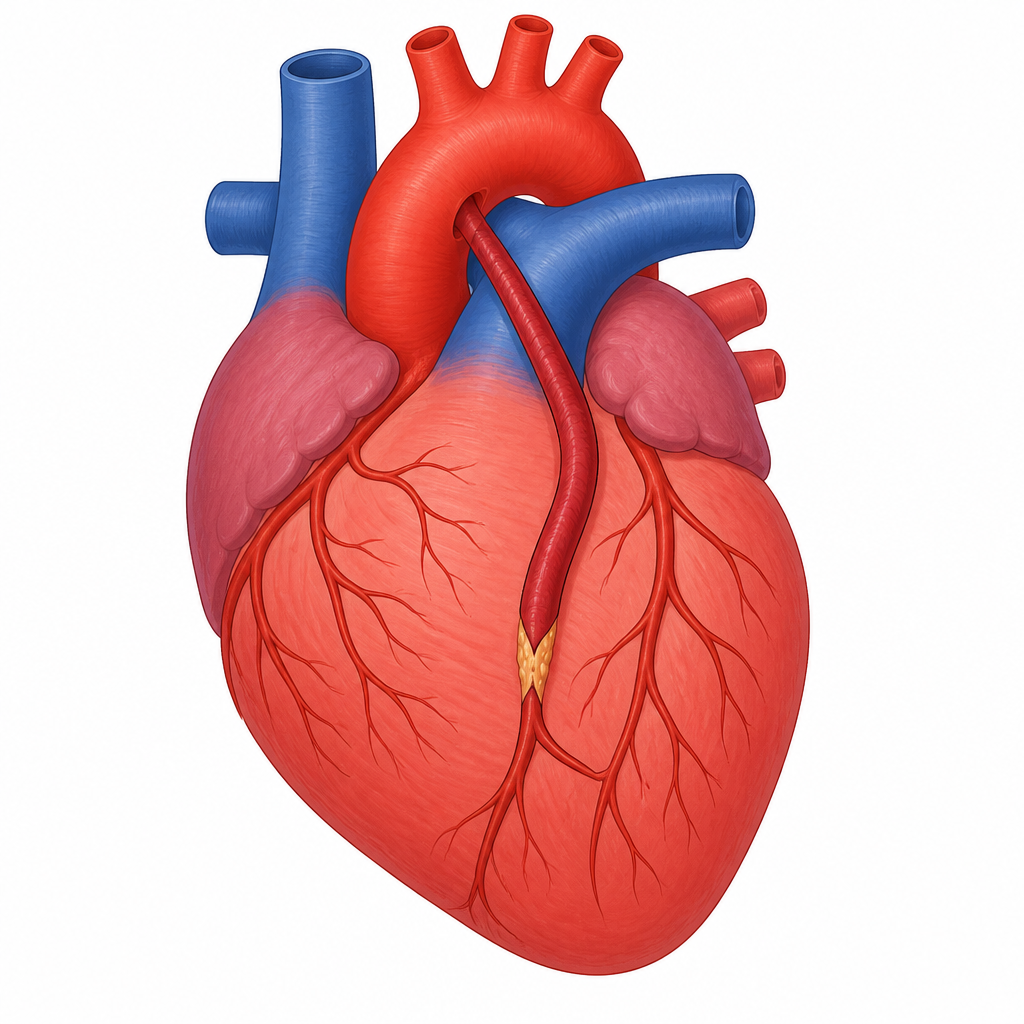
Coronary artery bypass surgery: open-heart surgery in which a healthy blood vessel from the leg is used to make a new pathway around a blocked coronary artery, so blood reaches the heart muscle.
| Point | Angioplasty and stenting | Bypass surgery |
| What is done | The narrowed artery is opened from inside | A new pathway is made around the blockage |
| What is used | A catheter and a stent | A healthy blood vessel from the leg |
| Other name | Percutaneous coronary intervention (PCI) | Open-heart surgery |
| Is the chest opened? | No; the catheter enters through a vessel of the hand or leg | Yes |
The full lesson is waiting for you
The notes are free to read in full. A free account opens the rest of the practice, and tracks your progress and confidence score for every subject. Presentations and videos need approval from Learn Yeti.