Why blood is not the same in everyone
Everyone's blood looks red, and everyone's blood is made of red blood cells, white blood cells, platelets and plasma. Even so, blood taken from one person cannot always be given safely to another. The reason is found on the outer surface of the red blood cells. Tiny chemical markers sit there, and not every person carries the same ones. The markers a person's red blood cells carry decide that person's blood group.
A blood group is not something you choose, and it does not change as you grow older. Human blood grouping is based on inheritance: the antigens a person's red blood cells carry are passed on from parents to children, in the same way as the shape of a nose or the colour of the eyes. This is why brothers and sisters often share a blood group, although not always.
Many people do not know their own blood group until they suddenly need it: before an operation, after an accident, or on the day they go to donate blood. If the blood groups of everyone in a class are written on one chart, it quickly becomes clear which groups are common among ordinary people and which are rare.
Blood group: the type of a person's blood, decided by the presence or absence of antigens on the surface of their red blood cells.
Antigens on the red blood cell
The red blood cells of human blood carry various types of antigens. For blood grouping, the two that matter most are antigen A and antigen B, both found on the surface of the red blood cell. A person's red blood cells may carry antigen A only, antigen B only, both of them, or neither of them. There are exactly four possibilities, and so there are four main blood groups.
Antigen: a special chemical substance on the surface of a red blood cell that marks which group that blood belongs to.
Apart from antigen A and antigen B, the red blood cell may also carry a third antigen called the D antigen. It is also known as the Rhesus factor, or Rh factor for short. Antigens A and B sort blood into four groups, and the D antigen then makes each of those groups either positive or negative.
The four blood groups: A, B, AB and O
Looking only at whether antigen A and antigen B are present, human blood is sorted into four groups: type A, type B, type AB and type O. The name of each group simply tells you which antigens it carries, which makes them easy to remember.
| Blood group | Antigen on the surface of the RBC |
| Type A | Antigen A only |
| Type B | Antigen B only |
| Type AB | Both antigen A and antigen B |
| Type O | Neither antigen A nor antigen B |
Type O blood carries neither antigen A nor antigen B, while type AB carries both. Blood group O is the most common blood group in the world.
Group O is not "zero blood" or weak blood. It only means the red blood cells carry no antigen A and no antigen B. In the same way, AB is not two people's blood mixed together. It is one person's blood whose red blood cells carry both antigens.
The Rh factor: positive and negative blood groups
The word positive or negative after a blood group refers to the D antigen. It is called the Rhesus factor because it was first studied in the blood of rhesus monkeys. If the Rh factor is present on the red blood cells, the blood group is positive. If it is absent, the blood group is negative. The two are written with +ve and -ve, as in A+ve or O-ve.
Rh factor (D antigen or Rhesus factor): an antigen that may be present on the surface of the red blood cell; its presence or absence decides whether a blood group is positive or negative.
Positive blood group: blood whose red blood cells carry the Rh factor. Negative blood group: blood whose red blood cells do not carry the Rh factor.
A few examples make this clear. If a person's blood group is A+ve, their red blood cells carry both antigen A and the Rh factor. B-ve blood carries antigen B but no Rh factor. If a person's blood contains no antigens at all, no A, no B and no D, their blood group is O-ve.
Here positive and negative do not mean good or bad, and they have nothing to do with having a disease. They only tell you whether the Rh factor is there. A person with a negative blood group is just as healthy as anyone else.
The eight blood groups together
Each of the four groups A, B, AB and O can be either positive or negative. Combining the four groups with the Rh factor therefore gives eight blood groups in all. When a person states their blood group, they give the full name, such as B+ve or AB-ve.
| Blood group | Antigen A | Antigen B | Rh (D) factor |
| A+ve | Present | Absent | Present |
| A-ve | Present | Absent | Absent |
| B+ve | Absent | Present | Present |
| B-ve | Absent | Present | Absent |
| AB+ve | Present | Present | Present |
| AB-ve | Present | Present | Absent |
| O+ve | Absent | Absent | Present |
| O-ve | Absent | Absent | Absent |
A blood group's name answers three questions: Is antigen A there? Is antigen B there? Is the Rh factor there? AB+ve has all three, and O-ve has none.
Reading a blood group test
At a health post or laboratory, a health worker places three drops of a person's blood side by side on a glass slide. A testing liquid for antigen A is mixed into the first drop, one for antigen B into the second, and one for the D antigen into the third. If the red blood cells carry that antigen, they stick together into tiny clumps and the drop looks grainy and spotted. If they do not carry it, the drop stays smooth and evenly red.
To read the result:
- Look at the drop marked A. If it is grainy, antigen A is present.
- Look at the drop marked B. If it is grainy, antigen B is present.
- If A and B are both smooth, the group is O. If both are grainy, the group is AB.
- Look at the drop marked D. Grainy means the blood is positive; smooth means it is negative.
- Put the letters and the sign together to write the full group, such as B-ve.
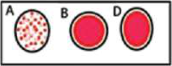
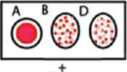
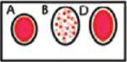
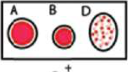
For example, suppose a test shows the A and D drops grainy and the B drop smooth. That person's red blood cells carry antigen A and the Rh factor, but not antigen B. Their blood group is therefore A+ve.
Why blood groups are matched before a transfusion
Blood transfusion: the process of passing blood from a healthy person, the donor, into the blood vessels of another person, the patient.
A patient who has lost a lot of blood in an accident, has had a major operation, or has too little blood may need blood from someone else. Blood cannot be taken from just anyone, though. If a patient is given blood that does not match their blood type, the red blood cells clump together inside the patient's blood vessels. This intra-venous clumping can block the vessels, and it can be fatal.
Compatible blood: donor blood that does not cause clumping when it is given to the patient.
For this reason, a hospital carries out these checks in order before any transfusion:
- The patient's blood group is tested and confirmed.
- The donor's blood group is tested as well.
- A little of the patient's blood and the donor's blood is mixed to see whether any clumping appears, so that the two are known to be compatible.
- Only when they are found compatible is the blood given.
Blood must never be given or received without testing the blood groups first. A transfusion is always done by trained health workers in a hospital or blood bank, never at home.
Knowing your own blood group is useful, but before a transfusion the hospital always tests again. A blood group that is only remembered or written on a card is never relied on by itself.
The full lesson is waiting for you
The notes are free to read in full. A free account opens the rest of the practice, and tracks your progress and confidence score for every subject. Presentations and videos need approval from Learn Yeti.