How Substances Travel Around the Body
Imagine a grandfather who has pain in his knees. The doctor gives him tablets, he swallows them, and after a few days the pain becomes less. The tablet went down into his stomach, yet it helped his knees. Something must have carried the medicine from the stomach all the way to the knee joints. That something is blood, and the body system that moves blood around is the blood circulatory system. Its main organ is the heart.
The human body has several organ systems, and each one does its own job. The digestive system breaks food down into simple, soluble forms such as glucose. But glucose sitting in the intestine is of no use to a muscle cell in the leg or a nerve cell in the brain. It has to be delivered. The circulatory system does this delivery. In the same way it carries oxygen, medicines and hormones from one part of the body to another. So blood circulation plays the main role in transporting substances in the human body.
Blood is made of blood corpuscles and plasma. It always flows in one direction round the body. What keeps it moving is the pumping of the heart. Every beat squeezes blood out with force, and this force creates pressure inside the vessels.
Blood pressure: the pressure created by the pumping action of the heart. It pushes blood along the vessels and can be felt in an artery.
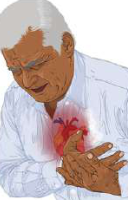
Blood pressure can sometimes rise above normal for various reasons. High blood pressure, and cholesterol building up on the walls of the arteries and the heart, are behind many heart problems. A person with a serious heart problem may suddenly feel a crushing pain in the chest. Doctors today have modern ways of treating such problems, for example angioplasty and open heart bypass surgery.
Human blood is also sorted into groups. There are four blood groups, A, B, AB and O, and each of them can be Rh positive or Rh negative. So there are eight blood groups altogether.
The Blood Circulatory System
The blood circulatory system is one of the nine systems of the human body. It is also linked with the other systems, because every one of them depends on what blood brings to it or takes away from it. Its chief organ is the heart. The heart collects the blood coming back from the various parts of the body and pumps it out again. The pumped blood flows through blood vessels until it reaches every cell.
Blood circulatory system: the organ system that carries blood to every cell of the body. Its main parts are the heart, the blood vessels and the blood.
On its journey blood does two jobs at once. It delivers nutrients and the oxygen we breathe in to all the cells. It also collects the carbon dioxide made in the cells and takes it to the lungs, and takes other wastes to the excretory organs.
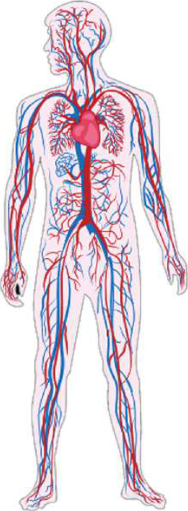
- Heart: the muscular organ that pumps the blood.
- Blood vessels: the tubes blood flows through, reaching every part of the body.
- Blood: the fluid that carries substances from place to place.
Blood in the Body
The body of a healthy adult holds about 5.5 litres of blood. Blood carries essential nutrients, oxygen, hormones and similar substances to all the cells of the body. It also carries unnecessary and harmful wastes to the excretory organs.
Blood is alkaline in nature. Its pH value ranges from 7.35 to 7.45. A pH of 7 is neutral, and anything above 7 is alkaline. Since the pH of blood is only a little above 7, blood is slightly alkaline.
A healthy adult has about 5.5 litres of blood, and its pH is 7.35 to 7.45, so blood is slightly alkaline.
What Blood Is Made Of
Blood: the red-coloured connective tissue that is a thick fluid, made of plasma and blood cells.
Blood looks like one simple red liquid, but it has two parts. About 55% of it is a liquid called plasma, and about 45% is blood cells floating in that liquid. Blood cells are also called blood corpuscles. Blood contains three types of them: red blood cells, white blood cells and platelets.
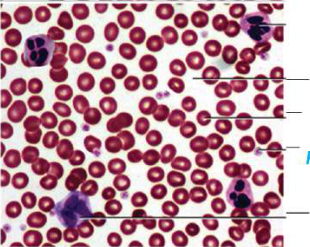
A thin smear of blood seen under a compound microscope shows all these parts together. Red blood cells are by far the most numerous. White blood cells are few but much larger. Platelets are the smallest of all. The spaces between them are filled with plasma.
Plasma
If blood is kept from clotting and left standing in a tube for a while, it slowly separates into two layers. The heavier cells settle at the bottom and a water-like liquid collects on top. This liquid is plasma. It makes up 55% of the total volume of blood.
Plasma: the pale yellow, transparent liquid part of blood, making up 55% of the total blood volume.
Plasma is 80% to 90% water. The remaining 10% to 20% is dissolved substances such as carbohydrates, proteins, fats and salts. In addition, three types of proteins are found in plasma: albumen, globulin and fibrinogen.
Functions of Plasma
- It regulates the amount of water in the blood.
- It transports nutrients and unnecessary wastes from one place to another.
- It transports enzymes and hormones secreted by glands to various parts of the body.
- The fibrinogen in plasma helps in the clotting of blood.
- It regulates the temperature of the body.
- It maintains the chemical composition of blood and its pH.
- When fibrinogen is removed from plasma, the liquid left is serum, which is used to diagnose various diseases.
Serum: plasma from which fibrinogen has been removed. It is tested to diagnose diseases.
Red Blood Cells
Red blood cells (erythrocytes): red-coloured, biconcave, round blood cells that have no nucleus.
Biconcave means that both flat faces of the cell curve inward. So the cell is thick at its rim and thin in the middle, rather like a round sweet pressed with a thumb from both sides.
Haemoglobin: the pigment in red blood cells that makes blood red. It is made up of iron and a protein called globin.
The iron in haemoglobin is responsible for carrying plenty of oxygen to the cells. Haemoglobin also carries the carbon dioxide produced by the cells to the lungs. Haemoglobin combines with oxygen to form oxy-haemoglobin, and with carbon dioxide to form carboxy-haemoglobin.
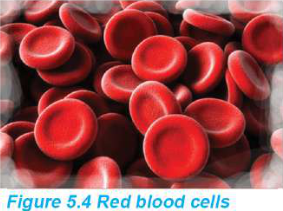
One cubic millimetre of blood contains about 45 lakhs to 50 lakhs red blood cells. Their life span is 90 to 120 days. About 20 lakhs red blood cells are formed every second, and the same number are destroyed.
Red blood cells are formed in the bone marrow of spongy bone and destroyed in the liver and spleen. This formation and destruction goes on throughout life. The iron released when old red blood cells break down is used again.
A shortage of red blood cells in the blood leads to a disease called anaemia. An anaemic person feels tired even after a short walk, because their cells are not getting enough oxygen. Similarly, too many red blood cells in the blood cause a disease called polycythemia.
White Blood Cells
White blood cells (leucocytes): blood cells with no definite shape, larger than red blood cells, which have a nucleus but no haemoglobin.
White blood cells have a nucleus and the other parts of a cell. Because they have no haemoglobin, they are not red. They are of two types, depending on whether their cytoplasm has granules (non-living particles) in it: granular and non-granular.
Granular leucocytes: white blood cells whose cytoplasm contains granules (non-living particles). Neutrophil, eosinophil and basophil are granular leucocytes.
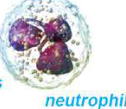

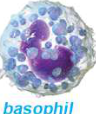
Non-granular leucocytes: white blood cells whose cytoplasm has no granules. Lymphocytes and monocytes are non-granular leucocytes.


The life span of white blood cells is about two weeks. One cubic millimetre of blood contains about 4 thousand to 11 thousand of them. They are formed in the bone marrow and destroyed in the spleen.
White blood cells fight the disease-causing germs that enter the body from outside and destroy them. That is why they are called the soldiers of the human body. They increase the body's immunity, its power to resist disease.
When the number of white blood cells rises abnormally, they start destroying other blood cells. This results in leukemia, or blood cancer. An abnormal fall in the number of white blood cells leads to a disease called leukopenia.
Leukemia and leukopenia both concern white blood cells, but they are opposites. In leukemia the white cells increase abnormally; in leukopenia they decrease. Link the ending 'penia' with 'too few' to keep them apart.
Platelets
Platelets: the smallest, round, non-nucleated microscopic blood cells in the human body, which help blood to clot.
One cubic millimetre of blood contains about 2 to 4 lakhs platelets. They are formed in the red bone marrow. Their life span is only about 2 to 3 days, and they too are destroyed in the spleen.
When the body is cut or injured, platelets combine with fibrinogen from the plasma to clot the blood. The clot seals the wound and the bleeding stops.
If the platelet count becomes low, blood will not clot even in small wounds or cuts. This is called haemophilia. An abnormal increase of platelets in blood results in thrombocytosis, which causes heart attack and stroke.
Too Many or Too Few Blood Cells
Each kind of blood cell must stay within its normal range. Too few of it causes one disease, and too many causes another.
| Blood cell | Too few | Too many |
| Red blood cells | Anaemia: the person feels tired even after a short walk | Polycythemia |
| White blood cells | Leukopenia | Leukemia (blood cancer): the extra white cells destroy other blood cells |
| Platelets | Haemophilia: blood does not clot even in small cuts | Thrombocytosis: can cause heart attack and stroke |
The Three Blood Cells Side by Side
| Feature | Red blood cells | White blood cells | Platelets |
| Shape | Round, biconcave | No definite shape, larger than red cells | Round, the smallest |
| Nucleus | Absent | Present | Absent |
| Number per cubic millimetre | 45 lakhs to 50 lakhs | 4 thousand to 11 thousand | 2 lakhs to 4 lakhs |
| Life span | 90 to 120 days | About two weeks | About 2 to 3 days |
| Formed in | Bone marrow of spongy bone | Bone marrow | Red bone marrow |
| Destroyed in | Liver and spleen | Spleen | Spleen |
| Main job | Carry oxygen and carbon dioxide | Fight germs and build immunity | Clot blood at cuts |
Oxygen is carried by the haemoglobin inside red blood cells, not by plasma and not by white blood cells. White blood cells have a nucleus but no haemoglobin. Red blood cells have haemoglobin but no nucleus.
Functions of Blood
All the parts of blood work together to do three main jobs for the body: transportation, regulation and protection.
- Transportation: blood carries oxygen and carbon dioxide to the places where they are needed. It also carries nutrients, enzymes, hormones and other essential substances from one part of the body to the others.
- Regulation: blood regulates the temperature of the human body. It also keeps the amount of water, salts and similar substances in the body constant.
- Protection: white blood cells protect us from various infectious diseases by fighting germs. Platelets help to stop bleeding at injuries and cuts. Antibodies, which maintain the immunity of the body, are also produced in the blood.
An easy way to hold the three jobs of blood: it carries things (transportation), keeps the body balanced (regulation) and defends the body (protection).
The full lesson is waiting for you
The notes are free to read in full. A free account opens the rest of the practice, and tracks your progress and confidence score for every subject. Presentations and videos need approval from Learn Yeti.