Why cleaning needs chemicals
The dirt on our hands, plates and clothes is rarely just dust. Most of it is held in a thin film of oil or grease that comes from food, sweat and our own skin. Oil and water do not mix, so a greasy plate rinsed in plain water stays greasy. To clean properly we need a substance that can hold on to oil and also mix with water. Then, when we rinse, the water carries the oil and the dirt away with it.
The two substances we use most for this job are soap and detergent. Both clean, but they are made from different raw materials, they behave differently in hard water, and they affect the soil and water around us in very different ways. Those three differences are the heart of this topic.
What soap is
Soap: the sodium or potassium salts of long chain fatty acids are called soap.
Take that definition one piece at a time. A fatty acid is a kind of acid found in fats and oils. Long chain means that its molecule has a long row of carbon atoms joined one after another, often sixteen or eighteen of them. When such an acid combines with sodium or potassium it forms a salt, and that salt is soap. Sodium stearate, made from animal fat, is a well known example.
Soaps made with sodium are hard, so they are pressed into the bars we use for washing clothes and for bathing. Soaps made with potassium are soft, and they are used in liquid soaps and shaving creams.
Raw materials for making soap
Soap is generally made from three raw materials:
- Animal fat or vegetable oil, such as olive oil, coconut oil or cotton seed oil
- Sodium hydroxide, a strong alkali, also known as caustic soda
- Sodium chloride, which is common salt
The oil or fat supplies the fatty acid part of the soap. Sodium hydroxide supplies the sodium. Common salt does not become part of the soap at all. Its job comes at the end, when it helps the finished soap separate from the rest of the mixture.
Saponification
To make soap, vegetable oil or animal fat is heated with sodium hydroxide and sodium chloride. In the presence of the alkali, the oil reacts with water and breaks apart. A reaction in which a substance is split by water like this is called hydrolysis. The oil breaks into two products: soap and glycerol.
Saponification: the process of making soap by the hydrolysis of vegetable oil or animal fat with an alkali.
vegetable oil or animal fat + sodium hydroxide → soap + glycerol
Glycerol is also called glycerin. It is a thick, slightly sweet liquid, and it is not waste. It is used in skin creams, medicines and cosmetics, which is why some soaps are sold as glycerin soap.
Making soap in the laboratory
Saponification can be carried out in a school laboratory with simple equipment. Oil and sodium hydroxide solution are mixed in a beaker, heated, and stirred with a glass rod. After a while the mixture thickens into a paste. Salt is then added. Soap does not dissolve well in salty water, so it separates out and floats on top as a solid crust, while the glycerol stays dissolved in the liquid below.
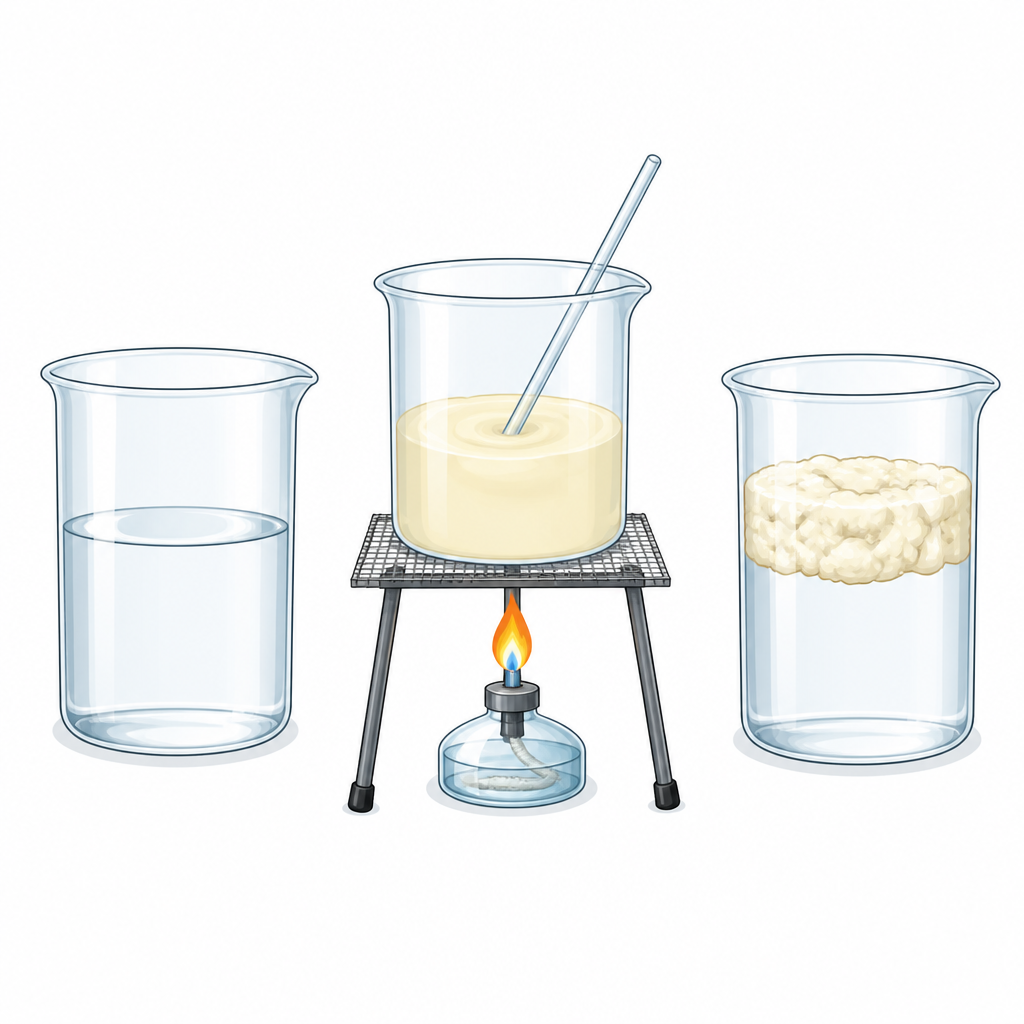
Each thing you see during the experiment tells you something:
- The mixture turning into a thick paste on heating shows that saponification is taking place.
- Adding salt to the paste makes the soap come out of the solution.
- When the mixture is filtered, the solid left on the filter paper, called the residue, is the soap.
- The liquid that passes through the paper, called the filtrate, contains glycerin.
- Poured into a vessel of any shape and left untouched for a day, the soap sets hard in that shape.
Sodium hydroxide burns skin and can blind an eye. Do this experiment only with a teacher present, wear gloves and eye protection, and wash off any splash at once with plenty of water. Soap made in a school laboratory may still contain leftover alkali, so do not use it on your body.
Why soap does not work well in hard water
Water that forms lather easily with soap is soft water. The water of many wells, springs and taps flows through rocks and soil and picks up dissolved salts of calcium and magnesium. Such water is hard water, and soap does not lather easily in it.
When soap is added to hard water, the calcium and magnesium react with it and form a sticky, off-white solid that does not dissolve in water. This solid is called scum. It floats on the water and clings to the bucket, the cloth and the skin. Two things go wrong. First, all the soap used up in making scum is wasted, so a lot of soap is gone before any lather appears. Second, the scum sticks to clothes and leaves them dull and stiff. So soap is not an efficient cleaner in hard water.
Soap and the environment
Soap has one big advantage. It is made from natural fats and oils, so bacteria and other tiny living things in soil and water can break it down into simple, harmless substances. Even when washing water reaches a stream or a field, the soap in it is soon broken down. So soap is biodegradable, and it does not cause chemical pollution.
Biodegradable: a substance that microorganisms in nature can break down into simple, harmless substances.
Detergent, the soapless soap
Detergent: a chemical substance obtained from hydrocarbons, more soluble in water than soap, and used to clean clothes. It is also known as soapless soap.
A detergent cleans clothes just as soap does, which is why the word soap appears in its name. But it is not made by saponification of fats and oils. It is made from hydrocarbons, which come mainly from petroleum, so its chemical nature is different from that of soap. The name soapless soap says exactly this: it does the work of soap without being soap.
Detergent has two practical advantages. It dissolves in water more easily than soap. And it can be used in hard water as well, because it does not form scum with calcium and magnesium. That is why washing powder cleans well in places with hard water, where a bar of soap struggles.
Some examples of detergents are:
- Sodium lauryl sulphate, found in shampoos and toothpaste
- Alkyl benzene sulphonate, widely used in washing powders
- Sodium pyrophosphate, added to washing powders
Detergents come in powder or liquid form. Most of the perfumed soaps sold in the market are also made from petroleum rather than natural oils, so although they are called soap, their nature is closer to that of a detergent.
Harmful effects of detergents
Detergent is a man-made chemical, and microorganisms cannot break it down. So it is non-biodegradable. When washing water flows into drains, rivers and fields, the detergent goes with it and stays there for a long time. In this way it causes chemical pollution.
Non-biodegradable: a substance that microorganisms cannot break down, so it stays in soil and water for a long time.
Heavy and long use of detergents causes these problems:
- Skin irritation or even skin burn, especially on hands that wash clothes often
- Soil pollution, when washing water soaks into fields
- Water pollution, when washing water reaches rivers, ponds and lakes
- Fading of the colour of clothes after long use
Using only as much detergent as the wash needs, and rinsing clothes well, reduces both the harm to skin and the amount of detergent reaching rivers.
Soap and detergent compared
| Feature | Soap | Detergent |
| Made from | Animal fat or vegetable oil | Hydrocarbons, mainly from petroleum |
| Chemical nature | Sodium or potassium salts of long chain fatty acids | Different from soap, a man-made chemical |
| Solubility in water | Less soluble | More soluble |
| In hard water | Forms scum, cleans poorly | Forms no scum, cleans well |
| Effect on environment | Biodegradable, no chemical pollution | Non-biodegradable, causes chemical pollution |
| Form | Mostly bars, also soft or liquid soap | Powder or liquid |
The full lesson is waiting for you
The notes are free to read in full. A free account opens the rest of the practice, and tracks your progress and confidence score for every subject. Presentations and videos need approval from Learn Yeti.