Insects, pests and the sprays we see around us
Walk past a vegetable field in Nepal during the growing season and you will very likely see a farmer with a tank on his back, spraying the crop. Cabbage, cauliflower, tomato, potato and mustard are all attacked by insects, caterpillars and diseases. A crop that insects eat before harvest means less food and less money for the family. To stop this loss, farmers spray chemicals that kill insects. Many people in villages call these sprays 'medicine', but they are really poisons.
You can find out for yourself which insecticides are used on the farms and kitchen gardens of your own locality. Three questions are worth asking about any spray. What good does it do for the farmer? What local methods did people use to keep pests away before it? And what harm can it cause?
Insecticide: a chemical used to kill or control harmful insects. It is one kind of pesticide.
When pesticide harms the farmer: cases from Nepal
On 15th Shrawan 2079 BS, The Kathmandu Post reported that a farmer in Haripur Municipality had been badly burnt on his back. He was spraying insecticide on his field from a tank he carried on his back. The tank leaked, and the chemical reached his skin. A substance strong enough to kill insects is strong enough to burn a human being.
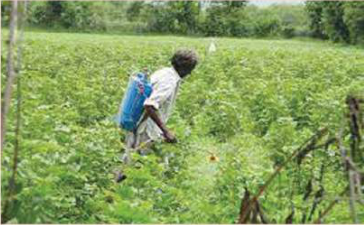
Pesticides are poisons. Do not touch, smell or taste them. Never spray without a mask, gloves and clothes that cover the whole body, and never carry a leaking tank on your back. Wash your hands and body with soap after any contact, and keep pesticide containers away from children and food.
A second example comes from Ghurkauli, the main vegetable-growing area of Hariban Municipality. A study there found that 22 people had already died of cancer. The number of people suffering from blood cancer and skin cancer is also higher in that area. In places that grow vegetables for the market, crops are sprayed again and again.
These are only a few examples from Nepal. In many regions of the country, pesticides are used on vegetables, fruits and other agricultural products in an excessive and unscientific way. Excessive use means using more than is needed. Unscientific use means using it without following the correct amount, the correct time and the rules of safety.
What is a pesticide?
The English word is made of two parts: 'pest' and '-cide', which means killer. So a pesticide is a pest killer. A pest is any living thing that harms our crops, stored grain, animals, health or buildings. Insects that chew leaves, rats that eat stored grain, weeds that take water and nutrients away from crops, and termites that eat wooden buildings are all pests.
Pest: any living thing that harms crops, stored food, animals, human health or buildings.
Pesticide: the poisonous substances used to remove, destroy, kill and control harmful pests from seeds, plants, trees, birds, animals, human health and construction areas are called pesticides.
This definition is wide. Pesticides are not used only in fields. They protect seeds before sowing, fruit trees, poultry and cattle, the health of people and buildings under construction. Killing mosquitoes that spread disease is an example of protecting human health. Treating the foundation of a house against termites is an example of protecting a construction area.
An insecticide is a pesticide aimed at insects. So every insecticide is a pesticide, but not every pesticide is an insecticide. Some pesticides kill weeds or rats instead.
Pesticide as defined by the Pesticide Management Act 2076
Because pesticides are poisons, Nepal controls them by law. The Pesticide Management Act 2076 (B.S.) gives the legal meaning of the word.
According to the Pesticide Management Act 2076 (B.S.), "pesticide" means any organic, vegetation, biological and chemical material which is used to protect plants, agricultural products, forest and forest products, living beings, livestock, human health, storage, packaging, and construction works from any harmful disease, insect, mite, nematode, weed grass, and rodents.
This long definition is easier to understand in three parts: what a pesticide can be made of, what it protects, and what it protects them from.
| Part of the definition | What the Act lists |
| What it can be made of | Organic, vegetation, biological and chemical material |
| What it protects | Plants, agricultural products, forest and forest products, living beings, livestock, human health, storage, packaging and construction works |
| What it protects them from | Harmful disease, insect, mite, nematode, weed grass and rodents |
Some pests on this list are very small. A mite is a tiny eight-legged creature related to spiders; mites suck the juice from the leaves of beans and tomatoes. A nematode is a very small worm that lives in soil and attacks plant roots. Rodents are gnawing animals such as rats and mice, which spoil stored grain and sacks.
The Act includes plant-based and biological materials, so a pesticide does not have to be a factory chemical. Pesticides made from chemical compounds in factories are called chemical pesticides, and most of the harm seen in Nepal comes from their overuse.
How pesticide use began and grew in Nepal
DDT was first imported to Nepal in 1952 AD, to control malaria. It was sprayed to kill the mosquitoes that spread the disease. So the first large use of a chemical pesticide in Nepal was to protect human health, not to protect crops.
Since then, pesticide use has spread to farms all over the country. At present, the average use of pesticides in Nepal is 396 grams per hectare. One hectare is the area of a piece of land 100 metres long and 100 metres wide:
\[ 100 \text{ m} \times 100 \text{ m} = 10\,000 \text{ m}^2 \]
That is a little larger than a football ground. So, on average, almost 400 grams of poison is put on a piece of land that size. This is only an average. In areas that grow vegetables, far more may be used.
Where the pesticide goes: soil and water
Not all the pesticide that is sprayed lands on insects. About 80% of the pesticides used get mixed into the soil. Once there, they take a long time to break down into harmless substances, so they stay in the soil for a long time.
How much pesticide reaches the soil of one hectare, on average? It can be worked out.
Step 1: The average amount of pesticide used on one hectare is:
\[ 396 \text{ g} \]
Step 2: Writing 80% of this amount as a fraction:
\[ \frac{80}{100} \times 396 \text{ g} \]
Step 3: Multiplying 80 by 396 and dividing by 100:
\[ \frac{31\,680}{100} \text{ g} = 316.8 \text{ g} \]
So about 317 g of the 396 g sprayed on each hectare ends up in the soil.
Two serious harms follow. First, the microorganisms in the soil are destroyed. Soil is full of tiny living things such as bacteria and fungi. They rot fallen leaves and dung into rich soil and release nutrients that plants need. When they die, the soil slowly loses its fertility.
Microorganisms: living things too small to be seen without a microscope, such as bacteria and fungi.
Second, there is a high risk of pollution of surface water and underground water. Rain washes pesticide from the fields into streams, rivers and ponds. Water that soaks down through the soil carries pesticide into underground water, which people draw up from wells and tube wells to drink. Fish, animals and people who drink that water then take in the poison.
- Surface water: water that flows or collects on the ground, such as streams, rivers, lakes and ponds.
- Underground water: water stored in the layers of soil and rock below the ground, which is drawn up through wells and tube wells.
Weighing the benefits against the harm
Pesticides are not simply good or simply bad. Used correctly, they save crops and control diseases such as malaria. Used in excess and without care, they burn farmers, raise the risk of diseases such as cancer, kill the life in the soil and poison water.
| Benefit | Harm |
| Crops are saved from insects and disease, so the harvest is larger | A leak or spray can burn the farmer's skin |
| Stored grain is protected from rats and insects | The risk of diseases such as blood and skin cancer rises |
| Mosquitoes that spread malaria are killed | Soil microorganisms are destroyed |
| Buildings are protected from termites | Surface and underground water are polluted |
Before chemical sprays arrived, farmers relied on local methods, and many still use them. Sprinkling wood ash on leaves, spraying water in which neem or chinaberry leaves have been soaked, using cow urine and picking insects off by hand are examples.
Nepal's problem is not that pesticides exist. It is that they are used excessively and unscientifically.
The full lesson is waiting for you
The notes are free to read in full. A free account opens the rest of the practice, and tracks your progress and confidence score for every subject. Presentations and videos need approval from Learn Yeti.