What Yoga Is
Most of us think of exercise as something for the body alone. Yet the mind also gets tired, worried and restless. Yoga is a practice that makes the body, the mind and the intellect healthy and strong at the same time. It needs no big playground and no costly equipment. A clean space, a little time and a regular habit are enough.
Yoga: Yoga is reaching complete joy by becoming aware of one's own existence and by developing the powers that lie within oneself.
This definition holds three ideas. Each one is worth understanding on its own:
- Awareness of one's existence: knowing clearly who you are and what state your body and mind are in right now.
- Developing the powers within: bringing out and growing the physical and mental abilities that are already hidden inside us.
- Complete joy: the deep contentment a person feels when the body is healthy, the mind is calm and life is in balance.
Yoga includes many kinds of exercises. The two main ones are postures and controlled breathing. In a posture, the body is held in a fixed position. In controlled breathing, breathing in and breathing out are done slowly and on purpose. The Sun Salutation taught below is one such yoga exercise, in which several postures are joined together and done one after another.
What Yoga Does Inside the Body
The first thing yoga does is make the nervous system active. The nervous system carries messages to every part of the body and controls it. When it works well, blood circulates properly through the body and new energy begins to build up. This is why a person usually feels fresh after yoga rather than worn out.
While doing postures and controlled breathing, the glands and muscles of the body go through these actions:
- Pulling and releasing: the muscle is stretched and then let go.
- Contraction: the muscle tightens and becomes shorter.
- Expansion: the muscle lengthens and spreads out.
- Relaxation: the tension goes and the muscle becomes loose.
These actions improve the health of the glands and muscles. The blood vessels also become healthy, both the arteries and the veins. Arteries carry blood from the heart to the rest of the body and veins bring it back, so when these vessels are healthy the whole body gains.
Postures and other yoga exercises also make the pancreas active. An active pancreas begins to produce insulin in the right amount. Insulin keeps the amount of sugar in the blood under control. For this reason, yoga helps to keep away diseases such as diabetes.
Yoga and the Digestive System, Lungs and Heart
The body gets energy from food only after the food has been properly digested. So the health of the whole body depends on the health of the digestive system. An unhealthy digestive system has been found to be the root cause of all diseases. Yoga makes the digestive system fully healthy, and as a result the whole body feels healthy, light and full of energy.
The health of the whole body depends on the digestive system. When digestion is healthy, the body feels light and lively.
During yoga, the lungs fill completely with fresh air. This keeps the lungs healthy and gives relief from asthma, breathing trouble and allergies. The lungs and the heart work as a team. When fresh air reaches the lungs, the heart also gains strength. With regular yoga, a person can even find relief from a serious illness such as heart disease.
Yoga exercises also reduce body weight. As extra fat is lost, the body becomes healthy, firm and good looking.
| Part of the body | What yoga does to it |
| Nervous system | Becomes active, so blood circulates properly |
| Glands and muscles | Stretching, tightening, lengthening and relaxing improve their health |
| Arteries and veins | Become healthy |
| Pancreas | Becomes active and makes insulin in the right amount |
| Digestive system | Becomes fully healthy |
| Lungs | Fill with fresh air, giving relief from asthma, breathing trouble and allergies |
| Heart | Gains strength, and relief from heart disease becomes possible |
Growth in Every Direction
The benefits of yoga do not stop at the body. A person who follows the path of yoga grows in four ways:
- Physical growth: the body becomes healthy, strong and flexible.
- Mental growth: the mind becomes calm, and anger, fear and stress grow less.
- Intellectual growth: it becomes easier to concentrate and to think clearly.
- Spiritual growth: a person begins to understand themselves and the meaning of their life more deeply.
By growing physically, mentally, intellectually and spiritually, a person finally experiences complete joy. That complete joy is the final aim of yoga.
Getting Ready for the Sun Salutation
Sun Salutation: a yoga exercise of twelve positions done in a fixed order while facing east and offering a prayer to the Sun. Its Sanskrit name is Surya Namaskar, which means greeting the Sun.
The name itself tells you what it is: a greeting to the Sun. The Sun rises in the east, so this exercise is done facing east. Before beginning the twelve positions, the body and mind are prepared like this:
- Turn to face east.
- Stand straight with both feet together.
- Press both palms together in the gesture of greeting.
- Close your eyes and offer a prayer to the Sun.
After this, the twelve positions follow one after another. Each position begins directly from the one before it, so the body is not dropped or rested in between. When all twelve positions are complete, one round of the Sun Salutation is finished.
Positions One to Six: From Standing Down to the Floor
In the first six positions, the body moves slowly from standing upright down towards the floor. By the sixth position, several parts of the body are touching the ground.
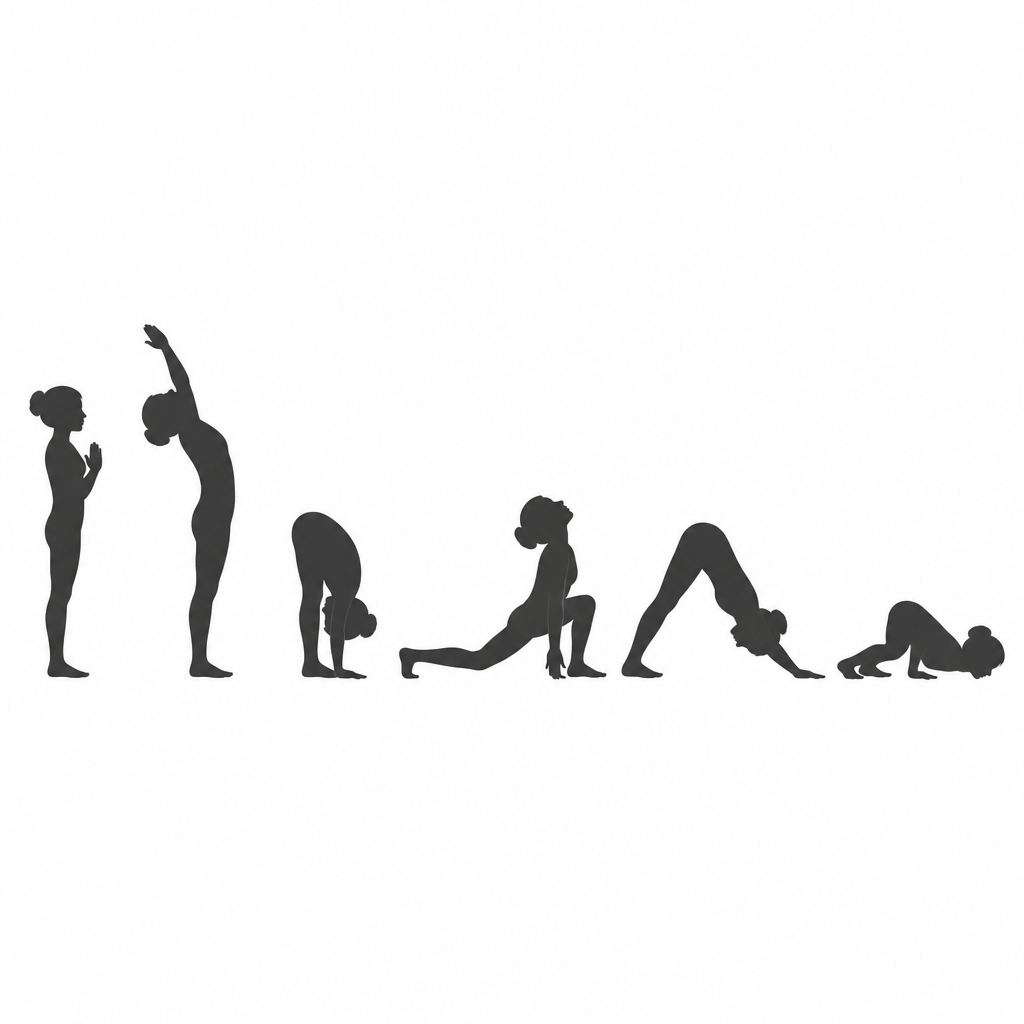
- First position: Stand straight, join both palms in front of the chest and hold the greeting.
- Second position: Raise the joined hands above the head, turn the palms towards the sky, and bend the upper body backwards and hold it there.
- Third position: Keeping the arms stretched, bend forward. Place the hands on the floor on either side of the feet and touch the knees with the head.
- Fourth position: Stretch the left leg back first, so that its knee touches the floor, with the palms pressing on the ground. Arch the back and look straight up at the sky.
- Fifth position: Take the right leg back as well, level with the left. Lift the back up into the shape of a mountain, tuck the head in between the two arms and look at the navel.
- Sixth position: Bend the knees and let the knees, the chest and the chin touch the floor, while the hips stay raised and do not touch the floor.
In the sixth position, lying flat on the stomach is wrong. Only the knees, the chest and the chin touch the floor. The hips stay raised.
Positions Seven to Twelve: Rising Back to Standing
Now the body rises slowly from the floor and returns to standing upright, just as it began.
- Seventh position: Raise the part of the body above the stomach, and bend the head and neck backwards.
- Eighth position: Come back into the mountain pose of the fifth position. Lift the back up like a mountain and fix the eyes on the navel.
- Ninth position: Bring the left leg forward and place the foot between the two hands, which are still pressing on the floor.
- Tenth position: Bring the right leg, which was stretched back, forward to join the left. As in the third position, touch the knees with the head, or try to, and keep the hands on the floor on either side of the feet.
- Eleventh position: Stretch both arms straight up. Turn the palms towards the sky, lean backwards and look up at the sky.
- Twelfth position: Stand straight, join the hands above the head, bring them down slowly to the chest and hold the greeting.
In the fourth position, the left leg goes back first. In the ninth position, it is again the left leg that comes forward first. The leg that went back first is the leg that comes forward first.
The Way Up Mirrors the Way Down
Twelve positions can seem hard to learn all at once. There is an easy pattern, though. The path the body takes down to the floor is the same path it takes back up, in reverse order. The sixth and seventh positions are the turning point in the middle, and the others repeat in pairs. Once you know the first six, the last six almost follow by themselves.
| Going down | Coming up | What both have in common |
| First | Twelfth | Standing straight with palms joined at the chest |
| Second | Eleventh | Arms up, palms to the sky, body leaning back |
| Third | Tenth | Bent forward, head to the knees, hands beside the feet |
| Fourth | Ninth | One leg stretched back, the other foot between the hands |
| Fifth | Eighth | Mountain pose: back raised like a mountain, eyes on the navel |
Mountain pose: the position in which both legs are stretched back, the back is lifted up like a mountain, and the head is tucked in between the arms to look at the navel. The fifth and eighth positions of the Sun Salutation are both the mountain pose.
The sixth and seventh are the turning point. The other positions pair up: first with twelfth, second with eleventh, third with tenth, fourth with ninth, and fifth with eighth.
How Often to Practise
One Sun Salutation is made up of 12 positions. Going through all twelve once makes one round. The Sun Salutation should be practised up to 12 times a day, or at least 6 times a day.
Let us work it out. Six rounds a day means 6 times 12, which is 72 positions. Twelve rounds a day means 12 times 12, which is 144 positions. That sounds like a lot, yet one round does not take long. A beginner can start with at least 6 rounds and build up to 12 as the body gets used to it.
Practise the Sun Salutation every day: at least 6 rounds, and up to 12. Only regular practice brings the full benefit of yoga.
The full lesson is waiting for you
The notes are free to read in full. A free account opens the rest of the practice, and tracks your progress and confidence score for every subject. Presentations and videos need approval from Learn Yeti.