What an Asana Is
In yoga, the body is placed in a particular position and held there for some time. That position is called an asana. Twisting the body into any shape at all does not make an asana, though. A true asana has two marks. First, the body stays still and does not wobble. Second, holding the position feels easy and comfortable.
Asana: holding any yoga posture steadily and comfortably is called an asana.
Practising asanas regularly gives every part of the body, large and small, full activity. The arms, legs, back, stomach and neck are all put to work. Parts that are used in this way become active, healthy and flexible. That is why asanas are counted as a very good form of exercise for keeping the body fit.
Shavasana, Buddhasana and Halasana are asanas already learnt earlier. They should not be dropped: keep repeating them on your own from time to time. Alongside them come six more useful asanas: Vajrasana, Vakrasana, Dhanurasana, Bhujangasana, Shalabhasana and Shirshasana. The method and the benefits of each are set out below, one after another.
The Right Conditions for an Asana
An asana gives its full benefit only when the place, the floor and the body are all right. These conditions must be met:
- Whatever the asana, the spine must always be kept straight.
- The floor must be flat and level.
- A padded cloth or a blanket should be spread on the floor so that sitting and lying on it is comfortable.
- The place should be quiet and private, away from disturbance.
- The air around should be clean and fresh.
Why a quiet place? Noise breaks concentration, and a distracted body does not stay still. Why fresh air? Many asanas involve deep breathing, so the air being breathed in should be clean.
An asana is meant to be comfortable. If a pose causes pain, do not force it. Go only as far as your body allows.
Vajrasana (Thunderbolt Pose)
Vajra means a thunderbolt, something extremely hard and strong. Vajrasana is a sitting asana: you fold your legs under you and sit upright on your own heels.
Vajrasana: a sitting asana in which the knees are bent and the body rests on the heels, with the back upright.
How to do it:
- Kneel down and sit back on your own heels.
- Let the big toes of the two feet touch each other, but keep the heels apart, so that you sit in the space between them.
- Rest both hands on the knees.
- Sit tall: stretch the waist, chest, neck, upper arms and head straight upwards.
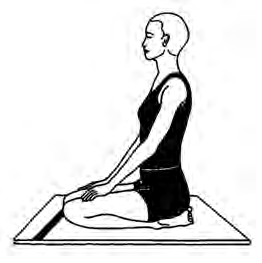
In Vajrasana the big toes touch but the heels do not. The heels stay apart and you sit between them.
Benefits of Vajrasana:
- It increases concentration and develops the power of thinking.
- It makes a person calm and fond of quiet time alone.
- It helps make the knees and thighs strong.
- Done for 5 to 10 minutes after a meal, it frees a person from indigestion, acidity and constipation.
Of these six asanas, Vajrasana is the one practised just after eating, which is why its benefits include better digestion.
Vakrasana (Twisted Pose)
Vakra means bent or twisted. In Vakrasana you sit on the floor and turn the upper body to one side, which gives the waist and back a twist.
Vakrasana: a sitting asana in which one leg is bent and the upper body and neck are turned to one side.
How to do it (twisting to the right):
- Sit on the floor with both legs stretched out straight in front.
- Bend the right leg and set its foot beside the left thigh, close against the left knee.
- Bring the left arm through the gap between the right leg and the stomach, and place the left hand near the right foot.
- Place the right hand straight down on the floor behind the waist.
- Turn the neck and look round to the right.
- Keep the left leg, the waist and the right arm straight.
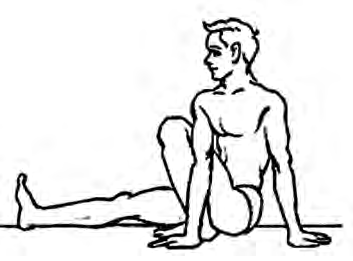
Vakrasana can be done 4 to 6 times. After twisting to the right, the same pose must be done from the other side: bend the left leg, bring the right arm through, and turn to the left.
Twisting to one side only is a mistake. Both sides must be done equally, so that both halves of the body become equally flexible.
Benefits of Vakrasana:
- It reduces the fat around the waist.
- It makes the body flexible.
- It improves the shape and appearance of the body.
Dhanurasana (Bow Pose)
Dhanu means a bow, the kind used to shoot arrows. In Dhanurasana you lie on your stomach and pull the body backwards until it curves like a drawn bow, with the straight arms looking like the bowstring.
Dhanurasana: an asana in which you lie face down, hold the bent-back feet with both hands, and lift the body into the shape of a bow.
How to do it:
- Lie face down, on your stomach.
- Bend both knees so that the feet come up behind you.
- Reach back and hold both feet with both hands.
- Lift up from the stomach as far as you can. Everything above and below the stomach rises off the floor, and both arms are pulled straight.
- Turn the face up towards the sky as far as it will go.
- Hold the pose for 10 to 30 seconds.
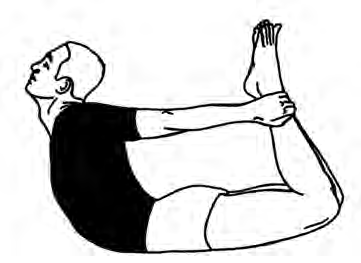
Benefits of Dhanurasana:
- It makes the spine flexible.
- It makes the body attractive and well shaped.
- Wrinkles, pimples and dull, dry skin clear away.
- The face gains brightness and a healthy glow.
- The body feels light.
- It helps with problems related to menstruation.
Bhujangasana (Cobra Pose)
Bhujanga means a snake, and a cobra raising its hood is the picture to keep in mind. The tail end of the snake stays on the ground and only the front part rises. Bhujangasana copies exactly that.
Bhujangasana: an asana in which you lie face down and, pressing on the palms, raise only the part of the body above the waist, the way a cobra lifts its hood.
How to do it:
- Lie face down.
- Place both palms flat on the floor, one on each side of the chest.
- Keep the legs together.
- Breathe in deeply, then press down with the hands and rise upwards the way a snake lifts its head.
- Lift only the part above the waist, as high as you can.
- Stay in this position for about 30 seconds.
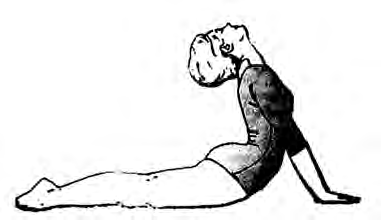
Bhujangasana and Dhanurasana are easy to mix up. In Bhujangasana the legs stay on the floor and the palms push only the upper body up. In Dhanurasana the hands hold the feet and the legs rise too.
Benefits of Bhujangasana:
- It exercises the lungs and the spine.
- Breathing improves with practice, which helps with asthma, whooping cough and wheezing.
- Because the back bends fully, the spine is worked, and back pain, waist pain and bone problems gradually get better.
Shalabhasana (Locust Pose)
Shalabha means a locust, an insect rather like a grasshopper. In Shalabhasana you lie face down and raise the legs, while the head and hands stay on the floor. It is the reverse of Bhujangasana. In Bhujangasana the upper body rises and the legs stay down; in Shalabhasana the legs rise and the upper body stays down.
Shalabhasana: an asana in which you lie face down with the palms under the thighs and lift both legs straight up without bending them.
How to do it:
- Lie face down.
- Slide both palms under the thighs.
- Without bending the knees, lift both legs straight up as high as you can.
- Keep the head and the hands on the floor the whole time.
- Hold this position for 10 to 30 seconds.
- Repeat the pose 5 to 6 times.
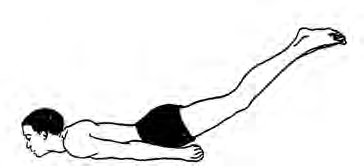
If lifting both legs together is hard at first, the same pose can be practised by raising the legs one at a time, in turns.
Benefits of Shalabhasana:
- It acts on the whole nervous system of the lower spine.
- It helps in paralysis, in legs and limbs that will not move properly, and in swollen veins and lumps in the legs.
Shirshasana (Headstand)
Shirsha means the head. In Shirshasana the body is turned upside down and balanced on the head and forearms. With the feet up and the head down, it needs a great deal of balance, so it is built up one stage at a time and never rushed.
Shirshasana: an asana in which the forearms rest on the ground and, with the body's weight balanced on the elbows, the legs are raised one by one until the body stands upside down.
How to do it:
- Kneel on the ground and interlock the fingers of both hands.
- Rest the forearms on the ground, from the elbows to the joined hands, and place the head on the ground between the clasped hands.
- Balancing the body's weight on the elbows, straighten the legs so that they lie parallel to the ground.
- Bend one knee and lift it up.
- Then lift the other knee as well and keep it bent.
- Now try to raise the bent legs upwards, one after the other.
- Come back down to the starting position in the same order in which the legs went up.
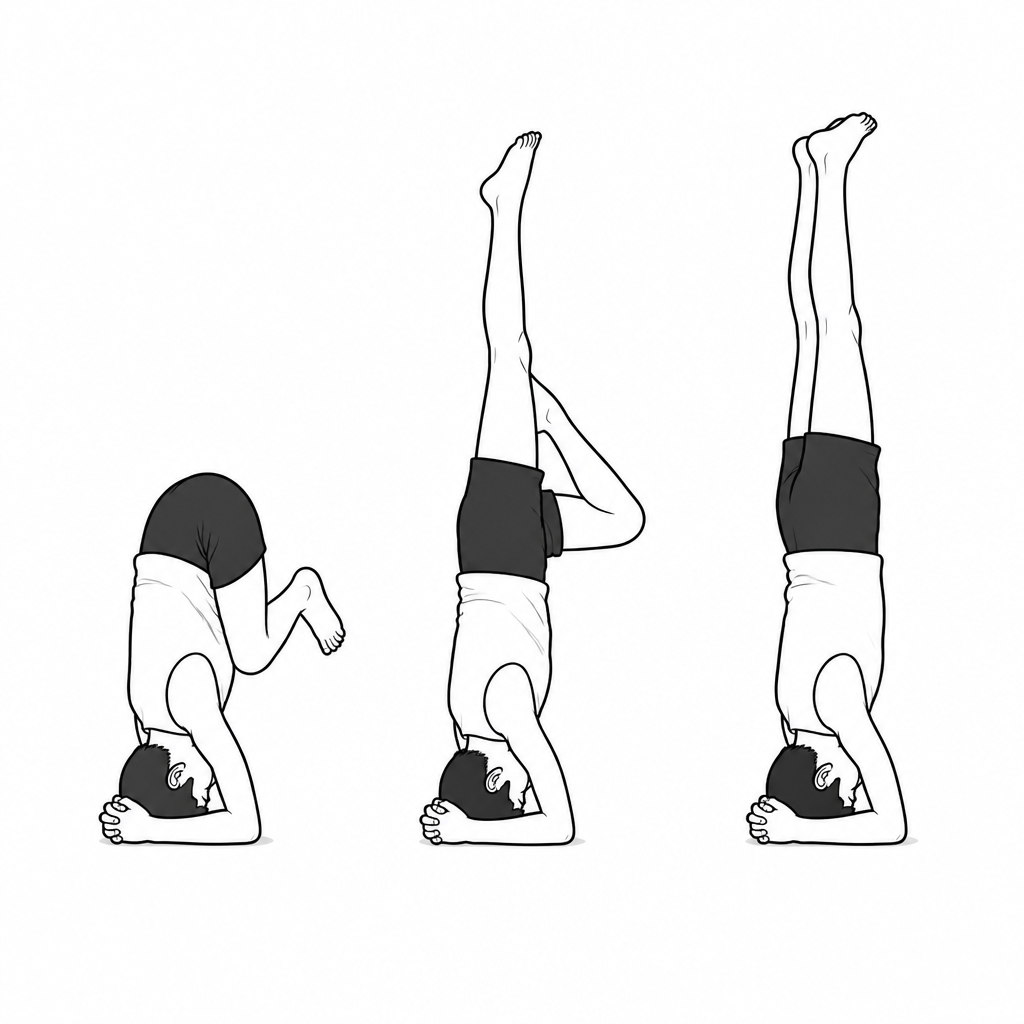
Shirshasana is begun at just 15 seconds. As practice grows, doing it for 5 to 10 minutes is good under normal conditions.
Do not stay upside down for long at the start. Begin at 15 seconds and increase the time slowly. When coming down, do not let the legs drop; lower them gently in the same order they went up.
Benefits of Shirshasana:
- Pure blood reaches the brain.
- Memory grows stronger.
- The ability to make quick decisions increases.
- Leadership ability develops.
- Eyesight improves.
- It is especially helpful in problems such as an irregular heartbeat, migraine, low blood pressure, diabetes and kidneys that are not working properly.
The Six Asanas at a Glance
By body position, the six asanas fall into three groups. Vajrasana and Vakrasana are done sitting. Dhanurasana, Bhujangasana and Shalabhasana are done lying face down. Shirshasana is done upside down. How long each pose is held, and how many times it is repeated, also differs from one asana to the next.
| Asana | Body position | How long or how often | Main benefits |
| Vajrasana | Sitting upright on the heels | 5 to 10 minutes after a meal | Concentration, calm mind, digestion |
| Vakrasana | Sitting, upper body twisted to one side | 4 to 6 times, on both sides | Less waist fat, flexibility |
| Dhanurasana | Face down, curved like a bow | 10 to 30 seconds | Flexible spine, clear and glowing skin |
| Bhujangasana | Face down, upper body raised | About 30 seconds | Lungs, breathing, back |
| Shalabhasana | Face down, both legs raised | 10 to 30 seconds, 5 to 6 times | Nerves of the lower spine |
| Shirshasana | Upside down, on the head and forearms | Start at 15 seconds, later 5 to 10 minutes | Brain, memory, quick decisions |
The full lesson is waiting for you
The notes are free to read in full. A free account opens the rest of the practice, and tracks your progress and confidence score for every subject. Presentations and videos need approval from Learn Yeti.