Volleyball: Nepal's National Game
Volleyball is the national game of Nepal. It is not played alone. It is a team game. A net is hung across the middle of the court, and one team stands on each side of it. Every team has two jobs. The first job is to stop the ball from falling to the ground inside its own area. The second job is to send the ball over the net so that it falls in the other team's area. Every skill a volleyball player learns, from passing and serving to spiking and blocking, exists to do one of these two jobs better.
Volleyball: a team game between two sides in which each side tries to keep the ball from touching the ground in its own area and tries to send it over the net so that it falls in the opponent's area.
How Volleyball Began and Spread Across the World
Volleyball began in America in 1895. The man who started it was William G. Morgan, so he is known as the founder of volleyball. The game travelled from one country to another. Once many countries were playing it, they needed one organisation to bring them all together. So in 1947 the International Volleyball Federation was formed. It is known everywhere by its short name, FIVB.
Seventeen years after the federation was formed, in 1964, volleyball was included as a competitive game in the Olympic Games held in Tokyo, Japan. The Olympics are the biggest sports competition in the world, so once volleyball was part of them it became a game known and played in a great many countries.
Three world dates: 1895, the game began in America; 1947, FIVB was formed; 1964, volleyball entered the Olympic Games in Tokyo.
Volleyball in Asia
The credit for developing volleyball in Asia goes to Japan. The game had already reached Asia by 1908, but it took many years to earn a place in big competitions. Men's volleyball was included at Tokyo, Japan, in 1958. Eight years later, in 1966, volleyball for women was also included, at Bangkok in Thailand. So men first, and then women as well, got the chance to play volleyball at the Asian level.
The countries of South Asia, Nepal among them, hold their own sports competition called the South Asian Games. Volleyball was included in the South Asian Games held in Calcutta in 1987.
Volleyball in Nepal
In Nepal, volleyball first became popular in the Royal Nepali Army. From the army the game slowly spread to the university. Along the way, the first volleyball competition in Nepal was held at Tri-Chandra College in 2013 BS. BS stands for Bikram Sambat, the calendar Nepal uses. In 2015 BS the National Health and Sports Council was formed. After that, new programmes were started to develop volleyball, and competitions began to be held at different levels.
The year 2033 BS is a special one for Nepali volleyball. National volleyball competitions began to be held from that year, and the Nepal Volleyball Association was formed in the same year. Once the association existed, the game took a big leap in its organised growth, because there was now a body whose job was to run the game and help it grow. Then, in 1980 AD, the Nepal Volleyball Association became a member of the International Volleyball Federation. With that, Nepali volleyball was joined to the world's volleyball organisation.
| When | What happened |
| 2013 BS | First volleyball competition, at Tri-Chandra College |
| 2015 BS | National Health and Sports Council formed, followed by new programmes and competitions at many levels |
| 2033 BS | National volleyball competitions begin and the Nepal Volleyball Association is formed |
| 1980 AD | Nepal Volleyball Association becomes a member of FIVB |
The dates of events inside Nepal are in BS, but the year the Nepal Volleyball Association joined FIVB, 1980, is in AD. Always write BS or AD beside a year in your answer, or 2033 and 1980 look as if they come from the same calendar.
What You Need to Play Volleyball
To run a game of volleyball, some equipment and facilities are needed. Without a place to play, a ball, players, a net across the middle, poles to hold the net, antennas on the net and a board to show the points, the game cannot be played properly. These are the seven things:
- The playing court
- The ball
- The players
- The net
- The poles
- The antennas
- The score board
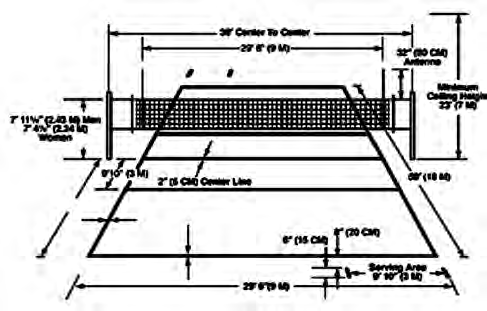
The Playing Court
A volleyball court is a rectangle, and its size is fixed:
- Length: 18 m
- Width: 9 m
- Thickness of the lines: 5 cm
The net stands at the middle, so the 18 m court is split into two equal halves. Each team's half is therefore 9 m long and 9 m wide, a square of 9 m by 9 m. All around the court there must be a free zone at least 3 m wide. Players often run outside the lines to chase the ball, so this open space around the court must have no wall, tree or anything else in the way.
The Ball
Three measurements are laid down for a volleyball. Each of them is given as a small range rather than one exact number, and the ball must fall within that range:
- Circumference: 65 to 67 cm
- Weight: 260 to 280 g
- Air pressure: 0.30 to 0.325 kg per square cm
Circumference is the distance all the way round the ball. Wrap a measuring tape once round the fattest part of the ball, and the length you read is its circumference. Air pressure tells us how tightly the ball is filled with air. With too little air the ball goes soft and does not bounce well. With too much air it becomes hard as a stone and stings the hand that hits it. So the pressure is kept inside the set range.
The Players
Each team must have 12 players, but only 6 from each team play on the court at a time. That means at any moment there are 12 players on the court altogether, 6 from each side, while each team's other 6 wait ready outside. Among each team's 12 players, one is the libero. The libero is a defence specialist: a player specially skilled at protecting the team's court from the other side's attacks.
Libero: the one player among a team's 12 who is the team's defence specialist.
The Net, the Poles and the Antennas
A volleyball net must be 9.50 m long and 1 m wide. The court is only 9 m wide, so the net is a little longer than the court and reaches past both side lines. The height of the net is different for women and men. For women the net must be 2.24 m high, and for men it must be 2.43 m high.
An easy way to remember the net heights: the men's net is the higher one. 2.43 m is for men and 2.24 m is for women.
To tie the net up and hold it in place, two poles 2.5 m tall are needed. These poles are set beyond both ends of the centre line, at a distance of 0.5 to 1 m, and the distance must be the same on both sides. When the two distances are equal, the net sits straight and tight exactly over the middle of the court.
An antenna is a flexible rod 1.80 m long with a diameter of 10 mm. One stands upright at each end of the net, directly above the side line of the court.
Antenna: a flexible rod, 1.80 m long and 10 mm in diameter, fixed upright on the net.
The Score Board
While the game is going on, a score board is needed to show everyone, players, referees and spectators alike, how many points each team has won. It shows the points of both teams and is changed as the game goes on. Anyone who looks at it can tell at once which team is ahead.
Score board: the board that shows how many points each team has won during a game.
All the Measurements in One Table
| Item | Measurement |
| Length of the court | 18 m |
| Width of the court | 9 m |
| Thickness of the lines | 5 cm |
| Free zone round the court | At least 3 m |
| Circumference of the ball | 65 to 67 cm |
| Weight of the ball | 260 to 280 g |
| Air pressure in the ball | 0.30 to 0.325 kg per square cm |
| Players | 12 in each team, 6 on the court |
| Net | 9.50 m long, 1 m wide |
| Height of the net | Women 2.24 m, men 2.43 m |
| Poles | 2.5 m tall, 0.5 to 1 m beyond the ends of the centre line |
| Antenna | 1.80 m long, 10 mm in diameter |
The Basic Skills of Volleyball
Once the court, ball and net are ready, a player needs the skills to play. Volleyball has four basic skills, and each has its own job:
- Passing: sending a ball that has come to you on to where a teammate is.
- Service: hitting the ball from outside the court to put it into play.
- Spiking: hitting the ball hard from above the net so that it lands in the opponent's court.
- Blocking: stopping the ball the opponent has spiked, right at the net.
Passing: Volley and Digging
A ball that comes over the net from the other side cannot always be sent straight back. So it is first sent on to where a teammate is standing, and the teammate makes the next move. This action is called passing. There are two kinds of pass, and which one a player uses depends on how high the ball arrives: the volley and the dig.
Passing: the action of sending a ball that has crossed the net from the opponents on to the place where a teammate is.
Volley: sending a ball that has come over the net, or one passed by a teammate, to a chosen spot by raising both hands above the head and striking it with the inner part of the fingers. It is also called fingering.
In a volley the ball arrives above the head. The player moves under the ball, bends the knees a little and raises both hands above the forehead. The fingers are spread, and the ball is touched with the inner part of the fingers, not with the palm. Then the knees and arms straighten together and push the ball upward. Because the fingers do the work, the volley is also called fingering. Fingers give a lot of control, so a volley can send the ball to exactly the spot the player wants.
Digging: passing a ball that arrives below chest level by striking it with the wrist and forearm area. It is also called the underhand pass.
Sometimes the ball comes very low and very hard. Fingers cannot hold a ball like that. To dig, the player bends the knees and sinks low, stretches both arms straight out in front and joins them together, and bounces the ball upward off the wrist area. This skill is used to lift hard, powerful services and spikes sent by the other side, and to pass the ball on to a teammate.
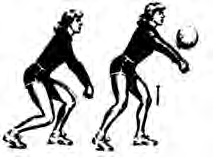
| Point | Volley | Digging |
| Where the ball arrives | Above the head | Below chest level |
| Part that touches the ball | Inner part of the fingers | Wrist and forearm area |
| Position of the arms | Both hands raised above the head | Both arms joined and stretched forward and low |
| Main use | A controlled pass to a teammate | Lifting hard services and spikes |
Trying to volley a hard ball that has come below the chest with the fingers loses control of the ball and can hurt the fingers. Play a high ball with a volley and a low ball with a dig.
Service and Its Four Kinds
In volleyball the ball is always brought into play by a service. The server stands outside the back line of the court, which is called the end line. The server throws the ball into the air, hits it with one hand and sends it over the net towards the other team's court. A good service makes the ball hard for the other side to take, so the service is also a team's first chance to attack.
Service: the action in which a player, from outside the court and without touching the end line, throws the ball into the air and hits it with one hand so that it goes over the net.
When serving, your foot must not touch the end line. A service is always made from outside the court.
Depending on how the ball is struck, there are four kinds of service:
- Underhand service
- Overhead service
- Hook service
- Ace service
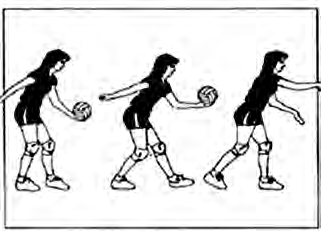
Underhand service: a service in which the player holds the ball on the palm of one hand and hits it hard from underneath with the other hand to send it into the opponent's court.
In an underhand service the hitting hand swings up from below. The movements come in this order:
- Hold the ball on the palm of one hand at about waist height.
- Swing the other arm straight back.
- Swing that arm forward from below and hit the underside of the ball hard.
- Let the arm carry on forward so the ball goes over the net into the opponent's court.
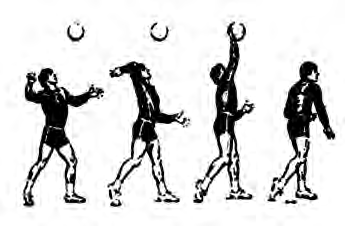
Overhead service: a service in which the player throws the ball into the air above the head and hits it with the same hand or the other hand to send it into the opponent's court.
In an overhead service the ball is hit above the head, so it travels faster and harder than an underhand one. The movements come in this order:
- Stand facing the net and throw the ball straight up above the head.
- Bend the elbow of the hitting arm and draw it back behind the head.
- As the ball starts to drop, stretch the arm fully upward and hit the ball hard.
- After the hit, let the arm and body follow through forward so the ball clears the net.
Hook service: a service in which the player stands outside the end line facing away from the court or sideways to it, throws the ball up with one hand, and swings the other arm round over the head to hit the ball over the net into the opponent's court.
In a hook service the player does not face the net. The hitting arm does not come straight forward. It swings round over the head in a curve, the way a hook curves. That is where the name comes from.
Ace service: a service after which the ball does not come back from the opponent's court, because no opposing player can even touch the ball that lands in their court. It is an attacking style of service.
An ace service goes so fast, so hard or to such an awkward spot that the other team never manages to touch the ball. For the serving team it is the most successful service of all.
Spiking
The part of the court close to the net is called the front zone. Usually a teammate volleys the ball high above the net. Then one of the players in the front zone jumps, reaches a hand above the net and hits the ball hard downward so that it falls inside the opponent's court. Because the ball travels steeply down at high speed, the other side finds it very hard to lift. That is why spiking is the strongest skill for winning points.
Spiking: the action in which one of the players in the front zone reaches above the net and hits a ball that has been raised above the net hard into the opponent's court.
Blocking
When the other side spikes, a team has to defend. So that the ball spiked by the opponents does not land in their own court, the players in the front zone jump and put both hands up above the net to stop the ball. When two or three of them jump together instead of one, their hands make a wider wall and the ball is more likely to be stopped. A good block sends the ball straight back into the opponents' own court.
Blocking: the action in which the players in the front zone jump and put both hands above the net to stop a ball spiked by the opponents from landing in their own court.
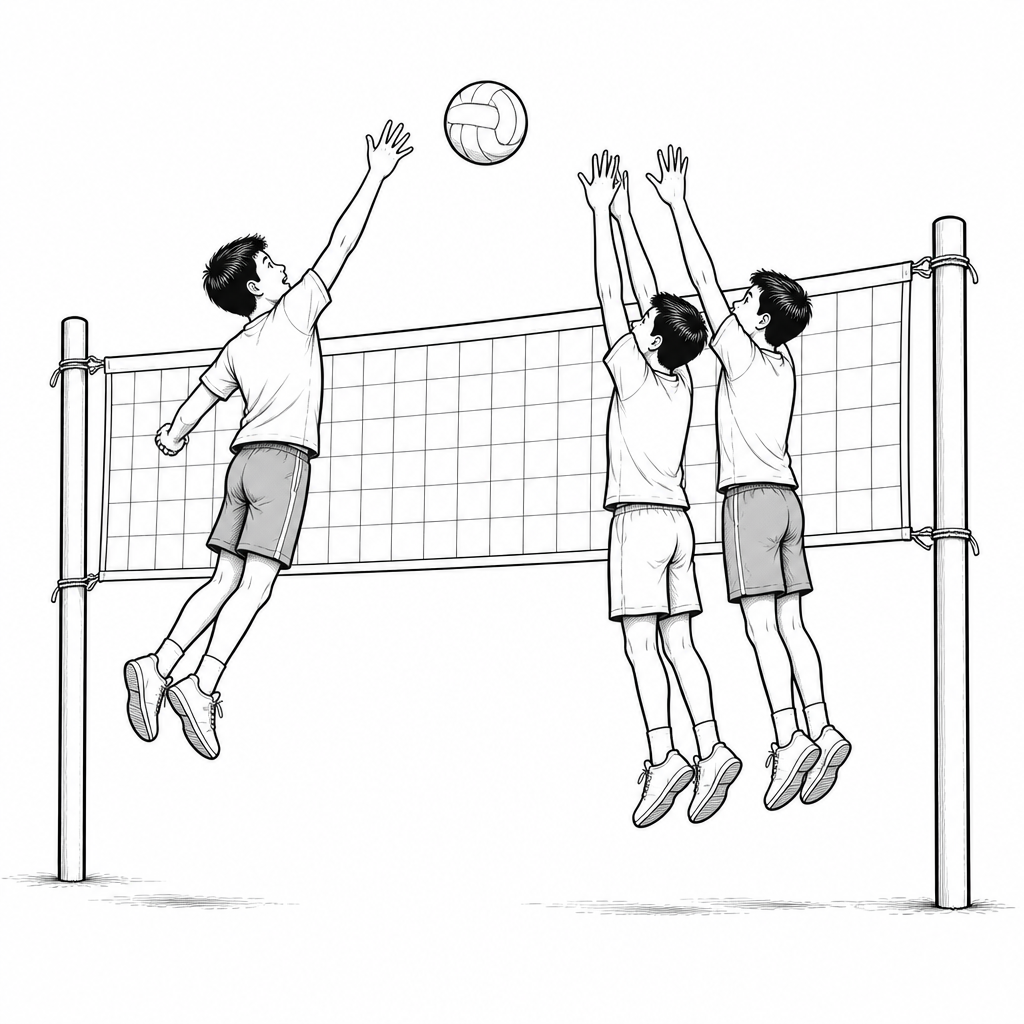
| Point | Spiking | Blocking |
| Purpose | Attack | Defence |
| Who does it | One of the front zone players | The front zone players |
| Hands | One hand hits hard | Both hands raised above the net |
| Result | The ball lands in the opponent's court | The ball is kept out of your own court |
The full lesson is waiting for you
The notes are free to read in full. A free account opens the rest of the practice, and tracks your progress and confidence score for every subject. Presentations and videos need approval from Learn Yeti.