Where Cricket Began and How It Spread
Cricket is a team game played with a bat and a ball. It developed in Britain in the 13th century. For a long time it was played only inside Britain, but slowly it gained written rules, then organised tournaments, and finally it spread to many countries of the world.
A game can only be played the same way in many places when everyone follows the same rules. A book on the rules of cricket and on how to keep its score was published in Britain in 1744. From then on, every team could play and count runs in the same way. In 1873 Britain held its first national championship tournament. In 1877 the first official Test match was played, between Britain and Australia.
In 1909 the Imperial Cricket Conference was set up, and with it cricket began to be promoted in other countries too. As the British expanded their empire, they carried the game with them to the lands they reached. In this way the game of one country became the game of many.
| Year | What happened |
| 13th century | Cricket developed in Britain |
| 1744 | A book on the rules and scoring was published in Britain |
| 1873 | First national championship tournament in Britain |
| 1877 | First official Test match, Britain against Australia |
| 1909 | Imperial Cricket Conference set up |
| 1965 | Renamed the International Cricket Conference (ICC) |
| 2007 | Twenty20 cricket developed |
The International Cricket Council (ICC)
Today the body that looks after cricket all over the world is the ICC. Its name has changed twice. It began in 1909 as the Imperial Cricket Conference. In 1965 it was renamed the International Cricket Conference (ICC), and later it became the International Cricket Council (ICC). Both the second and the third names shorten to ICC, so it is worth keeping the two full names apart.
- 1909: Imperial Cricket Conference
- 1965: International Cricket Conference (ICC)
- After that: International Cricket Council (ICC)
International Cricket Council (ICC): the international body that runs cricket across the world. It organises World Cup Cricket, and its full member nations play formal Test matches.
Since the ICC was formed, many nations have become its members. Ten of them are full members that play formal Test matches. Twenty20 cricket developed from 2007 and made the game shorter and livelier. World Cup Cricket is held under the ICC's own organisation.
Cricket in Nepal
Cricket in Nepal formally began in 2004 BS (Bikram Sambat, Nepal's own calendar), when the Nepal Cricket Association was founded. For a long time after that, the game stayed mostly in the cities. In 2007 BS the Nepal Cricket Association registered itself with the National Sports Council.
Two memberships brought Nepal into international cricket. In 1994 Nepal joined the Asian Cricket Council, and in 1996 it became an associate member of the International Cricket Council. In that same year, 1996, Nepal took part for the first time in the first ACC Trophy cricket competition, held in Malaysia. In 1998 Nepal hosted the ACC Trophy cricket competition itself for the first time.
Nepal's cricket history uses two calendars. The founding of the Association (2004) and its registration (2007) are in Bikram Sambat, but the membership and competition years (1994, 1996, 1998) are in the Western calendar. The year 2007 BS and the year 2007, when Twenty20 developed, are not the same year.
Since then Nepal has gone on hosting other international competitions successfully, and many international matches have been played at the Tribhuvan University (TU) ground. Of all the international competitions Nepal takes part in, cricket is the game in which it has had the most success. Nepali cricketers have played well abroad and have won a number of titles.
In recent years cricket has become very popular in Nepal. Several cricket premier leagues are now held in the country, and work is going on in different places to build stadiums good enough to host international cricket.
| Year | What happened in Nepali cricket |
| 2004 BS | Nepal Cricket Association founded |
| 2007 BS | Registered with the National Sports Council |
| 1994 | Member of the Asian Cricket Council |
| 1996 | Associate member of the ICC, and first ACC Trophy in Malaysia |
| 1998 | Hosted the ACC Trophy for the first time |
Introduction of the Game of Cricket
Cricket: a game played on an oval field between two teams of 11 players each, using equipment such as a ball, a bat and stumps.
A cricket field is not round but oval. Right in the middle is a long, narrow strip called the pitch, where the ball is bowled and hit. At one end of the pitch the batsman stands in front of the wicket, and from the other end the bowler bowls. The other players spread out over the field to stop and catch the ball. Fig 10.8 shows the field and the places where players stand.
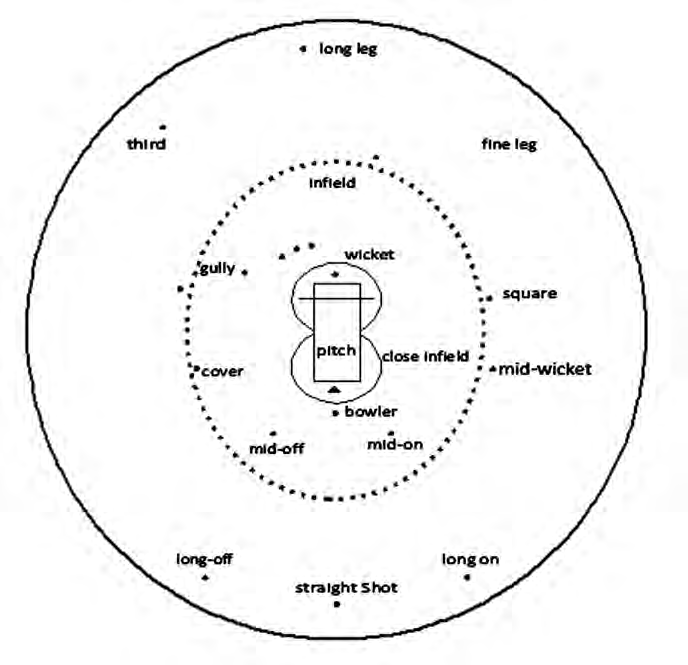
Looking closely at Fig 10.8, the wicket is at one end of the pitch and the bowler at the other. The area right beside the pitch is the close infield. Inside the dotted line is the infield, where fielders stand in places called gully, cover, mid-off, mid-on, mid-wicket and square. Beyond it lie the far positions, such as long-off, long on, third, fine leg and long leg. The captain places fielders in these spots by guessing where the batsmen are likely to hit the ball.
The Pitch and Its Three Creases
Pitch: the strip in the middle of a cricket field, 2.64 metres wide and 20.12 metres long, with a set of stumps at each end.
White lines are painted at both ends of the pitch. These lines are called creases, and they show where players may stand and where the ball may be bowled from. At each end of the pitch there are three kinds of crease:
- Bowling crease: the line drawn across the pitch where the stumps stand. The distance from one bowling crease to the other is the pitch length of 20.12 metres.
- Popping crease: the line drawn across the pitch 1.22 metres in front of the bowling crease. A batsman is safe while behind it, and a bowler's front foot must not go past it when bowling.
- Return crease: the lines drawn along the length of the pitch on either side of the stumps. They mark how far to the side the bowler may be when bowling.
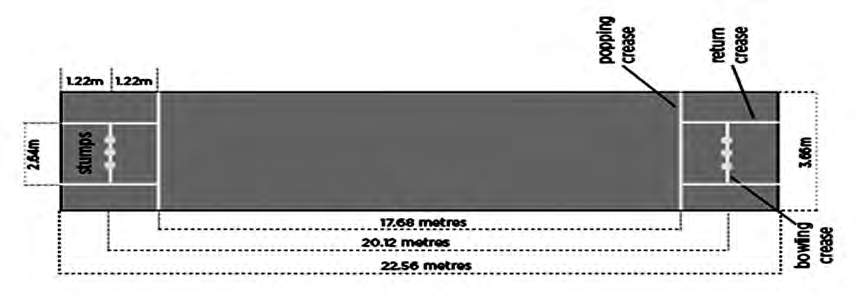
Fig 10.9 puts all the measurements of the pitch together. The distance between the two sets of stumps is 20.12 metres. At each end, the popping crease is 1.22 metres from the bowling crease. So if 1.22 metres is taken away at both ends of 20.12 metres, the distance between the two popping creases is 17.68 metres. In the same way, adding 1.22 metres at both ends gives 22.56 metres, the full length of the marked area. A width of 2.64 metres is marked across the stumps, and the full width of the marked area at the end is shown as 3.66 metres.
The Toss, the Innings and Winning
Before the game begins, the umpire calls the captain of each team and holds a toss. The team that wins the toss chooses whether to bowl first or bat first, and the game starts.
The batting team sends two players onto the field first. Their main aim is to hit the bowler's deliveries far away, striking fours and sixes, and score as many runs as they can. When one batsman is out, another comes in to take his place and play goes on.
Innings: one team's turn to bat. It ends when 10 of its 11 batsmen are out, or when the fixed number of overs is complete.
During an innings the two teams want opposite things. The batting side tries to stay in and score many runs, while the bowling side tries to get the batsmen out for few runs or none at all, which is called taking wickets. This tug of war is what makes the game so exciting. When the batting side is all out, or its overs are finished, the team that bowled first goes in to bat. At the end, the team that scored more runs in its innings wins.
The word wicket has two meanings. In one sense a wicket is the set of stumps itself. In the other, taking a wicket means getting a batsman out. So 'ten wickets in each innings' means ten batsmen can be out, not ten sets of stumps.
Three Kinds of Cricket Match
Cricket is played in three kinds of competition: the Test match, the One Day match and the Twenty20 match. The basic rules are the same in all three. What changes is how long the game lasts and how many times each team bats.
- Test match: lasts 5 days. Each side bats twice, so it plays two innings, and each innings has ten wickets.
- One Day match: finished in a single day. Each team plays 50 overs.
- Twenty20 (T20) match: the shortest form. Each team plays 20 overs.
| Kind of match | Length of play | Innings per team |
| Test | 5 days | Two |
| One Day | 50 overs each | One |
| Twenty20 | 20 overs each | One |
Twenty20 matches have become the most popular today. They finish in a short time, and with so many fours and sixes the game changes quickly.
Facilities and Equipment for Cricket
To play cricket you first need a large grassy field and space for spectators to sit. Then you need a pitch, stumps, bails, a ball and a bat. Each of these has a fixed size, so that the game is the same wherever in the world it is played. The basic things needed are:
- Playing area: the playing area is oval in shape. The length of the field is 157.28 metres.
- Pitch: a pitch of 20.12 metres lies in the middle of the playing area. That is, the distance between the stumps at the two ends is 20.12 metres, and the width is 2.64 metres.
- Stumps: stumps are also called wickets. A stump is a cylinder-shaped wooden stick. Three stumps stand at each end of the pitch. The height of the stumps is 71.12 cm.
- Bails: the short pieces of wood placed on top of the stumps are called bails. A bail is 11.10 cm long.
- Ball: a cricket ball is a small, round, red ball made of leather or hard rubber, with white stitching that can be seen. It weighs from 155.5 grams to 163 grams, and its circumference is 22.4 to 22.9 cm.
- Bat: the bat is a piece of equipment made of wood for hitting the ball. It is 96.5 cm long and 10.8 cm wide.
One way a batsman is out is when the ball hits the stumps and knocks off the bails. That is why the stumps and bails must always be the right size: taller stumps would help the bowler and shorter ones would help the batsman. The table below gathers all the measurements in one place.
| Item | Measurement |
| Field | Oval, 157.28 m long |
| Pitch | 20.12 m long, 2.64 m wide |
| Stumps | 71.12 cm high, 3 at each end |
| Bails | 11.10 cm long |
| Ball | 155.5 to 163 g in weight, 22.4 to 22.9 cm round |
| Bat | 96.5 cm long, 10.8 cm wide |
Protective Gear and Clothing
A cricket ball is hard and travels fast. So besides the equipment above, players need gear that protects them from injury. The other things needed to play cricket are:
- Batting gloves, worn by the batsman
- Wicket keeping gloves, worn by the wicketkeeper
- Leg guards and leg pads
- Helmet
- Abdomen guard
- Playing dress, shoes and cap
The names tell you what these are for. Batting gloves protect the fingers and hands. A wicketkeeper's gloves are large and padded, because the keeper stands behind the stumps catching fast balls. Leg guards or pads protect the legs, the helmet protects the head and face, and the abdomen guard protects the lower belly. Proper dress, shoes and a cap help a player stay comfortable through long hours in the sun.
Never bat or keep wicket with a hard cricket ball without a helmet, gloves, leg pads and an abdomen guard. A ball striking the head or face can cause a serious injury.
The full lesson is waiting for you
The notes are free to read in full. A free account opens the rest of the practice, and tracks your progress and confidence score for every subject. Presentations and videos need approval from Learn Yeti.