The Four Basic Skills of Cricket
Cricket is played between two teams. While one team bats, the other team bowls and fields, and later the two sides change over. So a cricketer has to be ready to send the ball down, to hit it, and to stop it in the field. Four basic skills make this possible, and each one needs regular practice:
- Bowling: sending the ball down towards the batsman
- Batting: hitting the ball with the bat to score runs
- Fielding: stopping, catching and throwing the ball in the field
- Wicket keeping: catching the ball behind the stumps
All four skills serve one aim: to score more runs than the other team. No team wins on one skill alone. Runs made by good batting can easily be given away again by careless fielding.
Bowling
To bowl, the bowler holds the ball in one hand using three fingers: the thumb, the index finger and the middle finger. Then he runs in and swings his arm over to send the ball towards the batsman.
Bowling: the way of holding the ball between the thumb, index finger and middle finger of one hand, running in, and swinging the arm over to send the ball towards the batsman.
The aim of bowling is to get the batsman out and, at the same time, to stop him taking runs. To bowl well, a player pays attention to four things. The skill is good only when all four work smoothly together:
- Grip: holding the ball correctly between the fingers
- Run-up: running in to bowl with a steady rhythm
- Delivery: swinging the arm over and letting the ball go towards the batsman
- Follow-through: letting the body carry on after the ball is released, then slowing down, stopping or turning back in balance
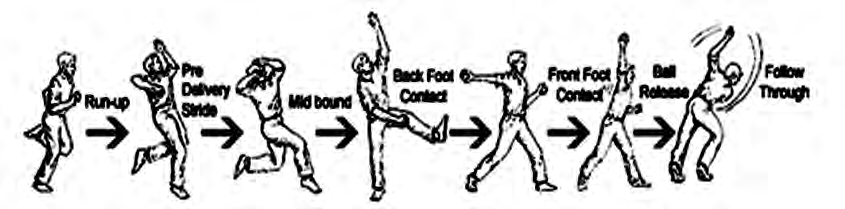
Bowling is done in overs, and every over has six balls. The overs are shared out among the players of the bowling side, and each over is bowled by one player.
Bowler: the player of the bowling side who bowls an over.
Two Kinds of Bowling: Fast and Spin
There are two main kinds of bowling: fast bowling and spin bowling. Both have the same aim, but they trouble the batsman in different ways.
Fast bowling: running in at high speed and using power to send the ball down quickly.
In fast bowling the ball reaches the batsman very quickly. He has only a moment to decide where to hit it and how, and a decision made in a hurry is easy to get wrong. This is why fast bowling gives a good chance of taking a wicket.
Spin bowling: taking only a few steps and sending the ball down slowly, but in a way that makes it turn.
A spun ball turns as it travels, and after it bounces it changes direction. The batsman plays for a ball coming straight, and it moves away from where he expected. Spin bowling therefore stops the other side from scoring many runs, and it also gives a good chance of a wicket. Very few players have the skill to bowl spin well.
| Feature | Fast bowling | Spin bowling |
| Run-up | A fast run | Only a few steps |
| Speed of the ball | Very fast | Slow |
| The bowler's main weapon | Power and speed | Turn on the ball |
| Why it troubles the batsman | Little time to decide | The ball changes direction after bouncing |
Batting
A cricket match is won with runs, and runs come from batting.
Batting: hitting the ball bowled by the other side with the bat.
Good batting means holding the bat the right way and hitting the ball hard, for a four or a six, to score plenty of runs. But scoring is only half of a batsman's job. He must also keep his wicket safe so the other side cannot get him out. To do both, he watches the speed and direction of each ball and sends it to a place where it is safe.
A batsman needs strength and endurance in the muscles of his hands and arms. He also needs accurate eyesight, because it is the eyes that judge how fast the ball is coming and in which direction. To build the skill, a batsman practises these things:
- holding the bat in the right place and in the right way
- bending into position while watching the direction the ball is coming from
- playing strokes, such as the drive
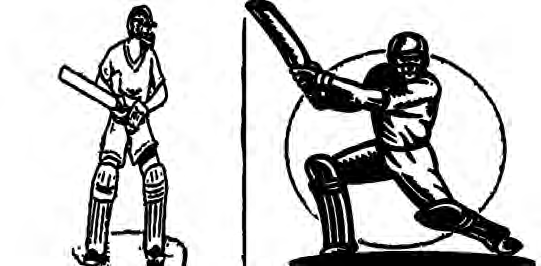
A batsman can be out in 10 ways:
- bowled
- timed out
- caught
- LBW (leg before wicket)
- stumped
- run out
- hit wicket
- the batsman handling the ball
- hitting the ball twice with the bat
- obstructing a fielder
Two Kinds of Batting: Offensive and Defensive
Batting is of two kinds: offensive batting and defensive batting. A good batsman chooses between them by reading the state of the game.
Offensive batting: hitting the ball hard.
Offensive batting puts the bowler under mental pressure. It is also how a team raises its score quickly, with fours and sixes. It is the right choice when many batsmen are still waiting to bat, because losing one wicket then does not leave the team short.
Offensive batting brings as much risk of getting out as it brings chances of runs. So a batsman attacks only when he sees the right chance.
Defensive batting: batting while keeping oneself safe from getting out. It is also called back defence play.
Defensive batting does not bring many runs. Its value is that it uses up the overs while the batsman stays in and his wicket stays safe. A batsman defending does the following:
- He puts his body weight on his right foot.
- He leans his body towards the stumps as he plays the ball.
- He taps the ball gently into the gaps between the fielders and tries to sneak a run.
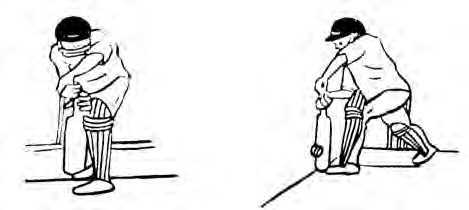
| Feature | Offensive batting | Defensive batting |
| What the batsman does | Hits the ball hard | Plays safely to stay in |
| Runs | Many, through fours and sixes | Few, by tapping into gaps |
| Risk of getting out | High | Low |
| When to use it | When a chance appears and many batsmen are left | When the wicket must be saved and overs used up |
Fielding
Fielding: the work of the players spread around the ground, inside the boundary, who stop the ball the batsman has hit or catch it to get him out.
All 11 players of the bowling side take up places on the ground. One of them bowls, one stands behind the batsman as wicket keeper, and the other 9 spread out to different parts of the field. Their main jobs are:
- stopping a ball the wicket keeper could not hold from running over the boundary
- stopping the batsmen from taking many runs
- throwing the ball back to the wicket keeper as quickly as possible
- catching a ball the batsman has hit high into the air, before it lands, to get him out
Fielding is an important skill. A weak fielding side drops catches and lets the ball cross the boundary line. If the ball is not collected and returned to the keeper quickly, the batsmen keep running and add many runs. Fielding improves with training and practice in catching, stopping, passing and hitting the stumps. Fielders must also work together. Otherwise two of them chase the same ball and leave another part of the ground empty.
Wicket Keeping
Wicket keeper: the player who waits, ready to catch the ball, just behind the stumps and behind the batsman. His work is called wicket keeping.
A wicket keeper has these main jobs:
- stopping balls that slip past the bat and come through behind the stumps
- catching the ball and breaking the stumps with it to get the batsman out
- collecting throws from the fielders and hitting the stumps with the ball
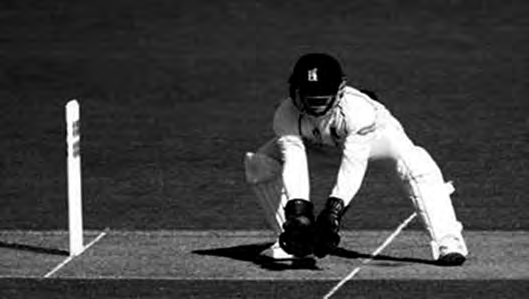
Wicket keeping is one of the hardest and most important jobs on the field. It needs physical fitness, a suitable build, quick movement, and good coordination of the hands, feet and eyes. The keeper must concentrate on every ball, because a ball from a fast bowler arrives in an instant. Lose focus for a moment and the ball is gone.
A wicket keeper must keep only after putting on his safety gear properly: keeping gloves, leg guards and a helmet. Without them, a fast ball can cause a serious injury.
Rules of Cricket
However good the skills, a match is played by its rules. The main rules about teams, the toss and players are these:
- A cricket match is between two teams, with 11 players in each team.
- The game begins with a toss between the two captains. The team that wins the toss chooses either to bat or to field.
- If the captain is absent during the game, the vice-captain does his work. The names of the captain and vice-captain must be given to the officials before the game starts.
- A substitute may come on only when a player is ill, injured or unable to play for some other reason. Otherwise no player may be changed during the game.
- A substitute may not bowl or bat without the umpire's permission.
How Runs Are Scored
Run: a point scored by the batting side in cricket.
After hitting the ball, if the batsman runs properly from one crease to the other, his team gets one run. If the ball rolls along the ground and over the boundary, the team gets four runs. If it flies over the boundary without touching the ground, the team gets six.
For example, suppose in one over a batsman runs once for a single, sends one ball rolling over the boundary, and lifts another ball over the boundary in the air. His team scores \( 1 + 4 + 6 = 11 \) runs in that over.
How a Batsman Gets Out
In many of the 10 ways of getting out, what matters is whether the bails fall. The bails are the two small pieces of wood resting on top of the stumps. When they fall, the wicket is broken.
The rules for the six most common ways are these:
| Way of getting out | When it happens |
| Bowled | The bowled ball hits the stumps directly and the bails fall |
| Caught | A fielder catches a ball that has touched any part of the bat |
| LBW | A ball that would have hit the stumps hits the batsman's body instead of his bat |
| Stumped | The batsman is out in front of his marked area while playing the ball, and the wicket keeper knocks the bails off with the ball in his hand |
| Run out | While the batsman is running, the bails are knocked off by the ball before he reaches his marked line |
| Hit wicket | The batsman knocks down his own wicket |
Stumped and run out are easy to mix up, because in both the batsman is outside his area and the bails fall. The difference: when stumped, he has stepped forward to play the ball and the wicket keeper breaks the wicket. When run out, he is running between the wickets for a run.
Innings and Extra Runs
In one-day cricket, each side may bowl 50 overs, and this is called one innings. In a Test match, an innings is 10 wickets: it ends when 10 batsmen are out.
Sometimes the batting side gets runs that the batsman did not make with his bat. These are extra runs:
No-ball: a ball bowled in a way the rules do not allow. It is not counted in the over and must be bowled again, and the batting side gets one run more than the batsman scored off it.
Wide: a ball bowled beyond the batsman's reach. The batting side gets one extra run, and the ball is not counted in the over.
Bye: a run scored when the batsman has not played the ball with his bat.
Leg bye: a run scored after the ball has hit the batsman's body.
| Name | What happens | What the batting side gets |
| No-ball | An illegal ball, not counted, bowled again | One run more than the batsman scored |
| Wide | A ball out of reach, not counted in the over | One extra run |
| Bye | Runs taken from a ball the bat did not touch | The runs they ran |
| Leg bye | Runs taken after the ball hit the body | The runs they ran |
In both a bye and a leg bye the bat does not touch the ball. If the ball hit the batsman's body before the run, it is a leg bye. If it did not, it is a bye.
Officiating
Officiating: running a competition smoothly, in a disciplined way, by making the players follow the rules.
To run a cricket match fairly and properly, and to make sure the players keep to the rules, these officials are needed:
- two umpires
- one extra umpire
- one match referee
- one scorer
- one scoreboard operator
- a third umpire
- other support staff
The two umpires on the field give decisions such as out, runs, no-ball and wide. The scorer records every run and wicket, and the scoreboard operator shows that record on the scoreboard for everyone to see. The third umpire sits off the field and helps with difficult decisions. Together, the officials keep the game fair.
The full lesson is waiting for you
The notes are free to read in full. A free account opens the rest of the practice, and tracks your progress and confidence score for every subject. Presentations and videos need approval from Learn Yeti.