Kho Kho: A Simple Team Game
Kho kho is a game played in teams. It is very simple and costs very little to play. It does not need a large ground, and it does not need expensive equipment either. Two posts, a few lines marked on the ground and a group of friends are enough, so a small school playground can become a kho kho court. This is why the game is played everywhere, from village schools to city campuses.
A kho kho match is played between two teams. One team chases, and its players are called chasers. The other team runs, and its players are called runners. After a fixed time the two teams swap roles, so each team gets a turn to chase and a turn to run. The team that scores more points within the fixed time wins the match.
The chasing team has two kinds of players on the court. One of them stands and chases the runners; this player is the active chaser. The others sit in a single row along the middle of the court; they are the inactive chasers. When the active chaser wants a sitting teammate to take over the chase, he touches that player and calls out 'kho'. That call is heard again and again throughout a match, and it gave the game its name: kho kho.
Kho: the call an active chaser makes while touching a sitting teammate, which passes the job of chasing to that teammate.
Runner: a player of the running team, who tries to dodge the chasers and avoid being touched.
Active chaser: the one player of the chasing team who is on his feet, chasing the runners.
Inactive chaser: a player of the chasing team who is sitting down and may only get up to chase after receiving kho.
How Kho Kho Grew in Asia and in Nepal
To spread kho kho across the countries of Asia, the Asian Kho Kho Federation was founded in 1987 AD. It was founded under the presidency of Sharad Chandra Shah. The federation has stayed active in trying to get kho kho included as a competitive event in the South Asian Games (SAG) and the Asian Games. If that happens, kho kho players from Nepal and its neighbours will be able to compete for medals at these big regional games.
In Nepal, the kho kho association received recognition from the National Sports Council in 2052 BS (Bikram Sambat, the calendar used in Nepal). From then on, kho kho had an official body to look after it, and this helped the game grow as an organised sport. Today kho kho is becoming more and more popular in schools, in campuses and among the general public.
| When | What happened |
| 1987 AD | Asian Kho Kho Federation founded, with Sharad Chandra Shah as president |
| 2052 BS | Nepal's kho kho association recognised by the National Sports Council |
Basic Requirements for Kho Kho
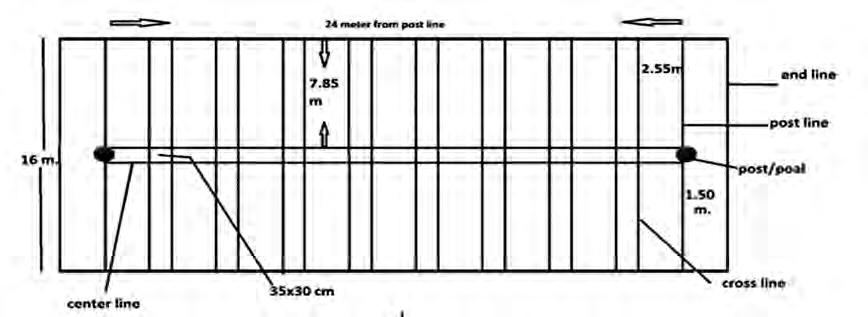
Two things are essential for a game of kho kho: a rectangular playing court, and two posts fixed at the two ends of it. Their standard sizes are these:
| Part | What is measured | Size |
| Playing court | Length | 27 metres |
| Playing court | Breadth | 16 metres |
| Post | Diameter | 10 to 11 cm |
| Post | Height | 1.20 metres |
A height of 1.20 metres is 120 cm, which reaches a little below the chest of most class 10 students. A post of this height is easy for a running player to reach, grip and turn around.
Lines and Parts of the Court
A kho kho court is more than an empty rectangle. Every line marked on it has a job. The main parts of the court are these:
- End line: the boundary line across the breadth of the court at each end.
- Post line: a line 1.50 metres inside each end line. The post stands at its middle.
- Post: the pole fixed at the centre of each post line, one at each end.
- Centre lane: the lane running along the length of the court through its middle, joining the two posts. From it to each long edge of the court is 7.85 metres.
- Cross lanes: lanes drawn across the breadth of the court, cutting through the centre lane. Where a cross lane meets the centre lane, a small box of 35 × 30 cm is formed, and this is where an inactive chaser sits. The first cross lane is 2.55 metres from the post line.
The two post lines are 24 metres apart. Adding the 1.50 metres left beyond each post line gives the full length of the court:
\[ 24 \text{ m} + 1.50 \text{ m} + 1.50 \text{ m} = 27 \text{ m} \]
Basic Skills of Kho Kho
Kho kho needs two sets of skills: running skills for the runner and chasing skills for the chaser. Because every team takes both roles during a match, every player has to learn both sets.
| Role | Main aim | Skills |
| Runner | To dodge the chaser and earn as many points as possible in the fixed time | Ring play, zig-zag running, straight running |
| Chaser | To earn as many points as possible while spending the least time and energy | Giving kho, diving, taking direction |
Running
A runner's main aim is to dodge the chaser and earn as many points as possible within the fixed time. Being fast is not enough. The path a runner chooses matters just as much as his speed. There are three running strategies a runner uses during a match.
Ring play: running in a round path, using a sitting inactive chaser as the base, in order to dodge the chaser.
When a runner circles like this, he stays just out of the active chaser's reach. The chaser keeps following him round the circle, and the sitting player in the middle stands between the two of them like a shield. In this way the runner uses up time without being touched.
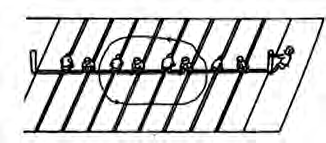
Zig-zag running: running towards the post by passing through the gap between each pair of sitting chasers, so that the runner's path bends first one way and then the other.
The path looks like the track of a snake. Because the runner comes out on one side of the row and then on the other, the active chaser finds it hard to guess where he will appear next.
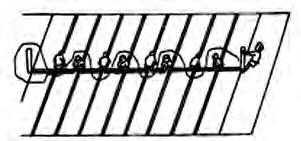
Straight running: running straight ahead at full speed so that the active chaser cannot reach the runner.
When the way ahead is open and the chaser is behind, a burst of speed in a straight line is better than any clever curve. This strategy depends on pace and a quick start.
Chasing
The active chaser may give kho to any one of the 8 inactive chasers, choosing according to how the game is going. Once he gives kho, he sits down and becomes an inactive chaser, and the player who received kho gets up as the new active chaser. In this way the chase is handed on from player to player, like a relay.
Kho kho is played against the clock. So the main aim of chasing is to earn as many points as possible while spending the least time and energy. Suppose a runner is racing towards the far end of the court. Rather than sprinting the whole way himself, the active chaser does better to give kho to a teammate sitting close to the runner. Time and energy are saved at once. The chaser's main strategies are giving kho, diving and taking direction.
Giving Kho
During play, the active chaser judges the situation and gives kho to an inactive chaser sitting in one of the small boxes. When giving kho, he must follow these rules:
- Say 'kho' loudly enough for the referee and umpire to hear.
- Always touch the sitting player on the back with the hand, from behind, while saying 'kho'.
- Do not cross that player's cross lane while giving kho.
- After giving kho, sit down in the box that has just been left empty.
- Do not get up from the box until you receive kho yourself.
Touching from the front or the side, whispering 'kho', and jumping up before receiving kho are all faults. Kho is always given from behind, on the back, in a clear voice, and a sitting player rises only after receiving it.
Four Ways of Giving Kho
There are four ways of giving kho, and a good chaser picks the one that suits the moment. The choice depends on where the runner is and how tired the chaser has become.
Simple kho: the active chaser, tired after chasing a runner, gives kho to any one of the inactive chasers.
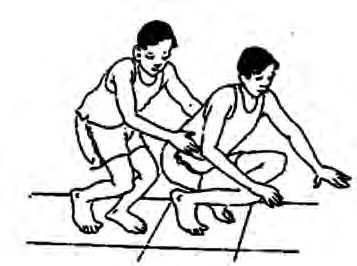
Early kho: as soon as a player receives kho, he immediately gives kho to the inactive chaser sitting just to his right or left.
Early kho is useful when the runner is already close to the next box. Passing the chase straight on to the neighbour puts a chaser beside the runner faster than getting up and running would.
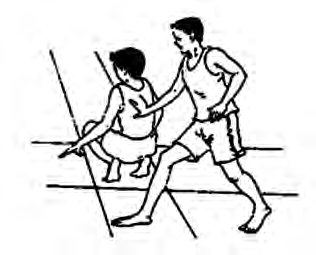
Late kho: the active chaser does not give kho straight away. He moves as if chasing the runner forward, keeping one foot on the cross lane, and gives kho only after that.
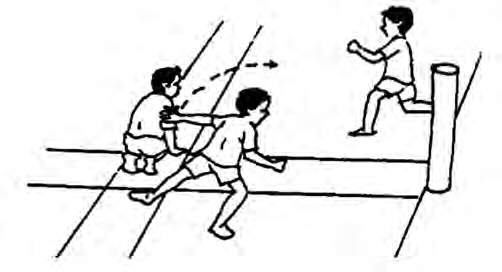
Fake kho: the active chaser pretends to give kho, which confuses the runner, and then chases the runner himself without giving kho at all.
In a fake kho, the runner expects the sitting player to spring up and turns to watch him. In that moment the active chaser carries on himself and tries to touch the runner.
| Way | When or how |
| Simple kho | When the chaser is tired, to any inactive chaser |
| Early kho | Right after receiving kho, to the chaser on the right or left |
| Late kho | After moving as if chasing, one foot on the cross lane |
| Fake kho | Pretending to give kho, then chasing oneself |
Diving
Sometimes the runner is so close that leaping at him is quicker than getting up and running. This leap is called a dive, and there are two kinds.
Spot diving: after receiving kho, springing forward straight out of the box, like a monkey or a frog, to try to touch the runner. It is done from the spot, while the chaser is still in the box.
Running diving: the active chaser leaps forward during the chase itself, while running, to try to touch the runner.
Before practising dives, clear the ground of stones, gravel and thorns. Practise slowly and over short distances first, and only then dive at full speed.
Taking the Direction
Before he moves, the active chaser must judge the runner's position and how far away the runner is, and choose his direction from that. He looks at where the runner is, how far off he is and which way he is heading, and only then decides which way to go. He must also make sure he faces straight in the direction he means to go, with his face and body pointing the same way. A chaser who sets off the wrong way wastes both time and energy, which is exactly what chasing is meant to avoid.
A runner's skill lies in choosing a path: round, zig-zag or straight. A chaser's skill lies in reaching the runner with the least time and energy: the right kho, the right dive and the right direction.
The full lesson is waiting for you
The notes are free to read in full. A free account opens the rest of the practice, and tracks your progress and confidence score for every subject. Presentations and videos need approval from Learn Yeti.