How a Volleyball Match Is Played
Volleyball is played between two teams of six players each. A high net is hung across the exact middle of the court and divides it into two equal halves, one for each team. During play, each team spreads its six players over its own half: three stand in the front zone close to the net, and the other three cover the back zone behind them.
Front zone and back zone: The front zone is the part of each half between the net and the attack line. The back zone is the part behind the attack line, stretching back to the endline.
At the start, a toss is made in the presence of both team captains. The team that wins the toss chooses either to serve first or to pick its side of the court. A player from the serving team waits for the referee's signal and then, standing outside the endline, hits the ball over the net into the opponents' half. The served ball must not touch the net or the antennae.
Once the ball comes into a team's half, its players must not let it touch the ground. They may touch the ball at most three times between them, working together to send it back over the net into the other half, or to make it land there. Both teams keep the ball in the air like this, sending it back and forth over the net. This exchange is called a rally.
When a team spoils the rally or breaks a rule, the other team wins one point and also wins the right to serve next. So a single mistake costs two things at once: a point, and the serve.
For example, Team A serves. Team B passes the ball twice and sends it back over the net on the third touch. A Team A player tries to return it, but the ball flies out of the court. Team B wins one point, and Team B now serves next.
Taking Turns to Serve: Rotation
As the game goes on, the right to serve keeps passing from one team to the other. Each time a team wins the serve back, its players must first move round by one position, in the same direction as the hands of a clock, and only then serve. If a team keeps winning points and so keeps the serve, its players stay where they are.
Rotation: When a team wins the serve back, each of its players moves one position clockwise. This change of places is called rotation.
Because of rotation, nobody stays at the net for the whole game, and nobody stays at the back. Every player takes a turn in the front zone and in the back zone, and every player gets a turn to serve.
Serving without rotating, or after rotating in the wrong order, is a fault. The other team then gets a point and the serve.
Points, Sets and the Winner
A volleyball match is divided into sets. Playing by the rules, the team that is first to reach 25 points wins that set.
Set: One section of a volleyball match. In the first four sets, the team first to 25 points wins the set. The fifth set is played to only 15 points.
If the score becomes 24-24, however, reaching 25 is not enough. A team must be 2 points ahead to win the set, for example 26:24 or 28:26. The set goes on until one team has that 2-point lead.
A match is decided over 5 sets, and the team that wins 3 of the 5 sets is declared the winner. If each team has won 2 sets, making the match level at 2:2, a fifth set is played. The fifth set is decided at 15 points: whichever team reaches 15 first wins it. This set starts with a fresh toss, and when either team reaches eight points, the teams change sides of the court. In the fifth set too, a score of 14-14 means a team needs a 2-point lead to win.
| Set | Points needed to win | If the score is level |
| First to fourth set | 25 points | At 24-24, a 2-point lead is needed |
| Fifth set | 15 points | At 14-14, a 2-point lead is needed |
Here is how one full match might go:
- First set: Team A 25, Team B 20. Team A wins.
- Second set: Team A 23, Team B 25. Team B wins.
- Third set: the score reaches 24-24. Team A then wins two points in a row and takes the set 26:24.
- Fourth set: Team A 21, Team B 25. Team B wins, so the match is level at 2:2.
- Fifth set: a new toss is made. When Team B reaches 8 points, the teams change sides. The score reaches 14-14, and Team A wins the set 16:14.
- Result: Team A has won 3 of the 5 sets, so it wins the match 3:2.
At 24-24, the team that scores the 25th point has not yet won the set, because a 2-point lead is needed. Another common slip is to think the fifth set also goes to 25. It ends at 15.
Rules for Starting Play and Serving
Volleyball has nineteen main rules, and they are easiest to learn in the order a game uses them. The first seven are about starting play and serving.
- Rule 1: The team that wins the toss is given the choice of serving or choosing its side of the court.
- Rule 2: The server starts play by serving only after the referee's signal.
- Rule 3: At the moment of the serve, the players of the serving team must be in their own positions.
- Rule 4: Once the serve has been made, players may change positions and play.
- Rule 5: The server may not touch the endline while serving.
- Rule 6: The served ball must not touch the antenna.
- Rule 7: If the served ball does not cross the net, or crosses it but lands outside the opponents' court, the opponents get one point and also the chance to serve.
These rules apply whichever way the ball is served. The server always stands outside the endline.
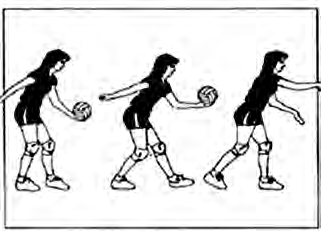
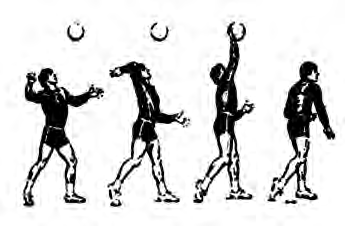

Rules at the Net, the Centre Line and for Touching the Ball
After the serve, players come close to the net and touch the ball many times as it goes back and forth. These rules govern that part of the game:
- Rule 8: While the game is on, no player of either team may deliberately touch the net.
- Rule 9: While the game is on, no player may cross the centre line.
- Rule 10: A ball coming from the opponents must be sent back to their side without touching the ground, through the joint effort of at most three players. Contact made while blocking is not counted in these three.
- Rule 11: A player may not hit the ball twice in a row. But if a blocked ball starts falling into the blocker's own court, that blocker may hit the ball again.

Jumping above the net to attack or to defend is the job of the front-zone players. The rule that keeps back-zone players out of it is this:
- Rule 12: Back-zone players may not spike or block by touching the attack line or by going into the front zone.
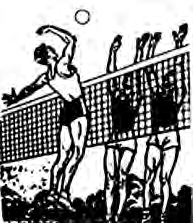

A touch made while blocking does not count as one of the three touches. Apart from that case, one player touching the ball twice in a row is a fault.
The Libero
In a competition, a team has 12 players in all, including its substitutes. One of these twelve is a special player called the libero. This is rule 13 of volleyball.
Libero: The one player out of a team's twelve who wears a different coloured uniform, may not spike, block or serve, and may replace any back-zone player at any time.
- Rule 13 (a): The libero's uniform must be a different colour from the rest of the team's.
- Rule 13 (b): The libero may not spike, block or serve.
- Rule 13 (c): The libero may send any back-zone player off and take that player's place at any time.
- Rule 13 (d): The libero does not need the referee's permission to make this change.
The different coloured uniform lets the referee and the other officials pick out the libero at a glance, so they notice at once if the libero spikes, blocks or serves against the rules.
Rules on Points, Sets and Time Outs
- Rule 14: When one team makes a mistake, the other team gets a point.
- Rule 15: To win, a team must win 3 sets out of 5. The fifth set is played to 15 points only. If both teams reach 24-24, a 2-point lead is needed to win the set. The fifth set starts again with a toss, and the teams change sides once either team reaches eight points. In the fifth set, if the score is level at 14-14, a 2-point lead is needed to win.
- Rule 16: If a team serves without rotating, or after rotating wrongly, the opponents get one point and also the chance to serve.
- Rule 17: In every set, each team may take 2 time outs of 30 seconds each. In every set, a technical time out is also taken at 8 points and at 16 points.
Time out: A short break in which a team stops the game for a moment. Each team may take 2 time outs of 30 seconds each in every set.
Technical time out: A time out that happens by rule at 8 points and at 16 points in every set, whether or not a team asks for it.
During a time out, the players gather with their team, catch their breath and plan how to play the next points. A team cannot take more than two time outs in the same set.
Rules on Lines and Registering Players
- Rule 18: Every line on the court must be 5 cm wide. If the ball touches a line during play, it counts as good, which means the ball is treated as inside the court.
- Rule 19: Before the game begins, the names of the six players of each team must be entered on the score sheet. Only registered players may enter the court. The team captain must sign the score sheet before going for the toss. If for any reason the captain has to leave the court during the game, the captain must hand the job of team leader to a teammate who is still playing.
For example, if a spiked ball just clips the outer edge of the sideline and bounces away, it still counts as in, and the spiking team wins the point. The line itself is part of the court.
The Officials of a Volleyball Match
The rules provide for four officials to be appointed to run a volleyball match. Linesmen also work at the edges of the court alongside them. The work is shared out like this:
- First referee: stands on a high chair and watches every fault that happens above the net. Blows the whistle and signals the start of play, each serve, player substitutions, fouls and time outs, and is in charge of the whole match.
- Second referee: stands beside the post opposite the first referee and watches all the faults below the net. Keeps an eye on the coaches and substitutes, tells the first referee when a substitution is wanted, checks carefully that players change places correctly, announces the score before every serve, tells the referee when a time out is asked for, and does any other work the first referee gives.
- Linesmen: four linesmen stand outside the two far ends of the court. With a red flag, they signal whether the ball landed inside or outside the sidelines and end lines. Each one signals in or out only for the lines on their own side.
- Scorer: writes the points on the score sheet, keeps a record of substitutes and time outs, and notes whether the players have changed positions correctly.
- Timekeeper: keeps a record of the technical time and of the time outs each team takes, and announces when the set time has run out.
The first referee judges faults above the net and the second referee judges faults below it. The linesmen signal whether the ball is in or out. The scorer keeps the points and records, and the timekeeper keeps track of time.
The full lesson is waiting for you
The notes are free to read in full. A free account opens the rest of the practice, and tracks your progress and confidence score for every subject. Presentations and videos need approval from Learn Yeti.