Key Words of the Game and Parts of the Court
Kho-kho is a game of chasing and escaping played between two teams. One team chases and the other runs inside the court, trying not to be touched. Almost every rule of the game uses a small set of words for the players and for the parts of the court, so those words come first.
Runner: a player of the team that runs inside the court and tries to escape without being touched by a chaser.
Chaser: a player of the team that chases the runners and tries to touch them. At any moment one team is chasing and the other is running.
Active chaser: the one chaser who is on his feet and actually chasing the runners at that moment.
Inactive chaser: any of the other chasers, who stay sitting in their squares until they are given kho.
The parts of the court are these:
- Post: one of the two poles fixed at the two ends of the court. The active chaser goes round a post when he needs to reach the other side.
- Centre lane: the long strip down the middle of the court joining the two posts. It divides the court into two sides.
- Cross lane: each of the lines that run across the width of the court, cutting through the centre lane.
- Square: one of the eight small boxes formed where the cross lanes meet the centre lane. The inactive chasers sit in these.
- Post line: the line drawn across the width of the court through a post.
- Rectangular area, also called the free zone: the area at each end of the court between the end line and the post line.
- Lobby: the space all round the outside of the court. Runners waiting for their chance stand ready in an entry area marked here.
Starting the Game, Players and Time (Rules 1 to 3)
Rule 1: The game begins with a toss. The team that wins the toss is given the choice of starting as runners or as chasers, and only after that choice is made does the game start.
Rule 2: Each team has 15 players. Only 12 of them are entered on the score sheet, and of those 12, only 9 are on the court playing.
| Players | Number |
| Players in a team | 15 |
| Names entered on the score sheet | 12 |
| Players on the court | 9 |
Rule 3: The whole match is divided into 2 innings. In each inning both teams play once as chasers and once as runners: 9 minutes chasing and 9 minutes running. Each of these 9 minute spells is called a turn.
Inning: the part of the match that is complete when both teams have chased once and run once. A match has 2 innings.
Turn: the 9 minutes in which one team plays as chasers or as runners. Each inning has 2 turns.
Between the two turns of one inning there is a 5 minute break, written as 9:5:9. After the first inning there is a 9 minute break, and the second inning is then played in exactly the same way. The whole match looks like this:
| Part of the match | Time |
| First inning, first turn | 9 minutes |
| Break between turns | 5 minutes |
| First inning, second turn | 9 minutes |
| Break between innings | 9 minutes |
| Second inning, first turn | 9 minutes |
| Break between turns | 5 minutes |
| Second inning, second turn | 9 minutes |
So a full match has 2 innings and 4 turns, and each team plays 2 turns as runners and 2 turns as chasers. The playing time alone is 4 turns × 9 minutes = 36 minutes. With the breaks added it comes to 36 + 5 + 9 + 5 = 55 minutes.
An inning and a turn are not the same thing. A turn lasts 9 minutes and an inning holds 2 turns. The answer to 'how many innings in a kho-kho match' is 2, not 4.
Where the Chasers Sit and How the Active Chaser Moves (Rules 4 to 7)
Rule 4: At the start, one player of the chasing team stands at one of the posts as the active chaser. The other eight sit as inactive chasers in the eight squares of the court. They face opposite directions one after another: if one faces one side of the court, the next faces the other side. They sit in the crouch or the parallel-thigh sitting position.
Sitting in alternate directions means both sides of the court are always being watched, so wherever a runner goes there is a seated chaser nearby who is ready to receive kho and chase.
Rule 5: While chasing, the active chaser must keep going forward in the direction of the post he is facing, keeping to a 90° angle and not swinging right and left. This rule does not apply in the rectangular area between the end line and the post line.
Rule 6: The active chaser may not cross the centre lane to reach the other side of the court. If he needs to go to the other side, he must go round a post. For example, if a runner is on the left half and the active chaser is on the right half, the chaser may not step straight across the middle. He must either run on to the post ahead and go round it, or give kho to a seated teammate who is closer.
Rule 7: Once the active chaser has crossed the post line into the rectangular area, he may come back out of this free zone on the same side from which he had come forward.
Giving Kho and Correcting a Fault (Rules 8 to 11)
Kho: the act by which the active chaser hands the chase to a seated teammate, touching that teammate's back with the hand and calling 'kho' at the same moment.
Rule 8: When the active chaser gives kho, he must always touch the teammate's back with his hand and call 'kho'. The touch and the call must happen together. The teammate who receives it rises and becomes the new active chaser.
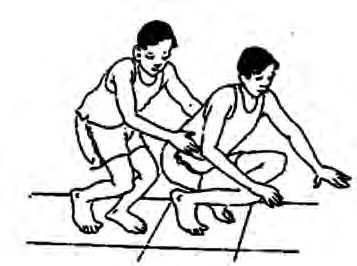
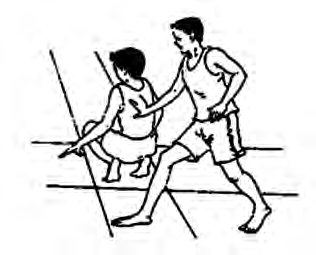
A touch alone, or a call alone, is not a kho. The hand must touch the back and the word 'kho' must be called at the same time.
Rule 9: Once the active chaser has passed a seated teammate's cross lane, he may not turn back to give that teammate kho. Before he reaches that cross lane, or while he has not yet crossed it, he may give kho. So the chaser has to decide whom to give kho to before running past that player's lane.
Rule 10: The inactive chasers sitting in their squares may not block or hinder a runner in any way, for example by stretching out a leg, spreading an arm across the path, or pushing.
Rule 11: If the active chaser commits a fault while chasing, then after the referee's signal he must correct it by going the opposite way and giving kho twice to other teammates.
Runners, Lines and Substitutes (Rules 12 to 17)
Rule 12: A runner is not out for leaving the court until both of his feet are outside it. With only one foot outside, he is still in the game.
Many players think stepping on the boundary or putting one foot out means out. By the rule, both feet must be outside.
Rule 13: No line marked on the court may be more than 3 cm thick.
Rule 14: The chasing team may change a player with the referee's approval. The running team, however, must hand its list of names to the referee before the game starts, and may change a player only after the turn has ended, with the referee's permission.
Rule 15: Before the game starts, the running team must give the referee its list of names in three groups of three, and must say clearly which group goes onto the court first. The first group enters the court before play begins. The second and third groups stand ready in the entry area marked in the lobby.
Rule 16: As soon as the first group of three is out, the three runners of the second group must already be on the court before the active chaser manages to give kho to a teammate. If they fail to get in before that kho, they are out, and the chasing team is given the points by the rule. This is why the waiting group has to stand alert in the lobby.
Rule 17: Runners may enter the court from one side only, every time.
Getting Out, Scoring and Ending the Game (Rules 18 to 21)
Rule 18: The inactive chasers may not get up and leave their squares until they receive kho. When kho is given, the previous active chaser sits down in the square that has just been emptied. In this way there is always exactly one standing chaser and eight seated ones.
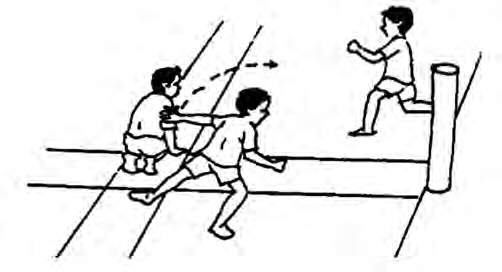
Rule 19: If the active chaser succeeds in touching a runner, that runner is out and the chasing team gains one point. This is how points are made in kho-kho: the chasing team scores one point for every runner it puts out.
Rule 20: If the scores of both teams are level after the two innings, one more inning is played. If that is also level, another extra inning is played. In this extra inning the play stops as soon as the first chasing team scores its first point, and the time taken is recorded. The other team is then given its chance to chase, and play ends the moment it scores its first point. The team that scored in less time is declared the winner.
Here is an example of the tie rule at work, in a match between the East team and the West team:
| Stage | East team | West team |
| Points in the first inning | 6 | 8 |
| Points in the second inning | 7 | 5 |
| Total after two innings | 13 | 13 |
| Points in one more inning | 4 | 4 |
| Time to score the first point in the next extra inning | 50 seconds | 1 minute 10 seconds |
After two innings both teams had 13, so one more inning was played. That ended 4 each, so another extra inning was played. East scored its first point in 50 seconds while West took 1 minute 10 seconds, so East, having scored in less time, won.
Rule 21: No player may leave the playing area until the referee has announced that the game is over.
How a Kho-Kho Match Is Played
Putting the rules together, a whole match runs like this:
- Kho-kho is played in two innings between two teams of 9 players each. One team chases while the other runs.
- Each inning is split into two turns, and in each inning every team plays once as chasers and once as runners.
- Each inning runs 9:5:9 minutes, with a 5 minute rest between its two turns, and there is a 9 minute rest between the two innings.
- At the start, one chaser stands near a post as the active chaser, and the other 8 sit one in each square, facing opposite ways in turn.
- The running team gives the officials the names of its 9 players in groups of 3, in order of priority, and the first group of three enters the court from one side.
- Each time the active chaser puts a runner out, his team earns one point.
- If all 9 runners are out while time is left, the running team comes back onto the court in the same order it gave before, and play goes on until the 9 minutes are up.
- When both teams have in turn chased once and run once, one inning is over.
- If the match is tied, an extra inning is played, and the team that scores more points in it is declared the winner.
In kho-kho only the chasing team scores. The running team's job is to survive as long as possible, so that the other side gets as few points as possible.
The Officials of the Game
A kho-kho match is run by five officials in all: one referee, two umpires, one timekeeper and one scorer. Together they conduct the game or competition and bring it to a finish.
| Official | Number |
| Referee | 1 |
| Umpire | 2 |
| Timekeeper | 1 |
| Scorer | 1 |
| Total | 5 |
Referee: the chief official, who holds the toss to give the teams their turn as runners or chasers, starts the game, watches it closely, gives the final decision on players' faults, and runs the game by the rules to decide who wins and who loses.
Umpire: an official who reports clearly to the referee any fault he sees, passes the referee's decision on clearly to the scorer, gives decisions only on faults on his own side of the court, and keeps a close eye on player changes.
Timekeeper: the official who watches the time carefully from the start of the game to its end, and at the close of each stage announces that time is up or tells the referee and umpires.
Scorer: the official who records the players who are out, the substitutes who come on, and the score, prepares the final result from both teams' scores, and after the game gets both umpires to sign the score sheet before handing it to the referee.
The umpires see and report, the referee gives the final decision, the timekeeper watches the clock, and the scorer writes everything down.
The 21 Rules at a Glance
| Rule | In short |
| 1 | Toss winner chooses to run or chase, then play starts |
| 2 | 15 in a team, 12 on the score sheet, 9 on court |
| 3 | 2 innings, 4 turns, 9:5:9 and 9 minutes between innings |
| 4 | One active chaser at a post, eight seated in the squares facing alternately |
| 5 | Straight on toward the post faced, at 90°, except in the rectangular area |
| 6 | No crossing the centre lane; go round the post |
| 7 | Leave the rectangular area on the side you came from |
| 8 | Touch the back and call 'kho' together |
| 9 | No turning back to give kho after passing the cross lane |
| 10 | Seated chasers may not hinder runners |
| 11 | A fault is corrected after the referee's signal with two kho the opposite way |
| 12 | Not out until both feet are outside |
| 13 | No line thicker than 3 cm |
| 14 | Chasers change with the referee's approval; runners only after the turn |
| 15 | Names in three groups of three; waiting groups ready in the lobby |
| 16 | The next group must be in before the next kho |
| 17 | Runners enter from one side only |
| 18 | No rising without kho; the old chaser takes the empty square |
| 19 | Runner touched is out; chasing team gets one point |
| 20 | A tie brings an extra inning, then a race to the first point |
| 21 | Nobody leaves until the referee declares the game over |
The full lesson is waiting for you
The notes are free to read in full. A free account opens the rest of the practice, and tracks your progress and confidence score for every subject. Presentations and videos need approval from Learn Yeti.