Solar Energy
Solar energy is the light and heat that the Earth receives directly from the sun. Grain drying in the sunshine, water warming in a bucket left in the yard and the brightness of the day are all solar energy being used directly. We can also use solar energy indirectly through different technologies, for example by changing the sun's heat and light into electricity. Every day the Earth receives an enormous amount of energy from the sun. All of that energy is produced when hydrogen nuclei inside the sun fuse together.
Solar energy is the main source of energy on the Earth. Life on Earth is possible only because of solar energy.
Some Facts About the Sun
The figures below show how large the sun is, how hot it is and how much energy it sends out. Learn them, because they are asked directly in examinations.
| Quantity | Value |
| Mass of the sun | \( 2 \times 10^{30} \) kg |
| Distance of the sun from the Earth | \( 1.5 \times 10^{8} \) km |
| Temperature of the sun's core | about 15,000,000 K |
| Temperature of the sun's surface | 5778 K |
| Power produced by the sun | \( 3.8 \times 10^{26} \) J/s |
| Solar radiation reaching each square metre of the Earth | 1.4 kW |
The Nuclear Reaction in the Sun
Isotopes are atoms of the same element that have the same atomic number but different atomic masses.
Hydrogen has three isotopes: protium \( ({}_{1}H^{1}) \), deuterium \( ({}_{1}H^{2}) \) and tritium \( ({}_{1}H^{3}) \). All three have atomic number 1, but their atomic masses differ. Knowing these isotopes matters here, because the very first step of the sun's reaction produces deuterium.
The sun is a medium sized star made of a vast amount of hydrogen gas. The temperature of its core is about 15 million °C. At such a high temperature the electrons of hydrogen atoms are torn away, leaving hydrogen ions (H⁺), which are simply protons. Every proton carries a positive charge, so protons repel each other strongly. The enormous pressure in the core overcomes that repulsion and pushes the protons close enough to fuse.
Thermonuclear fusion is the process in which, under the high temperature and pressure found in stars like the sun, hydrogen atoms fuse to form helium atoms. A huge amount of energy is released in this process as radiation.
The sun is not burning like a fire. Burning needs oxygen, and what happens inside the sun is not combustion at all. It is nuclear fusion, so calling the sun's energy the heat of a burning fuel is wrong.
The Three Steps of Thermonuclear Fusion
This process inside the sun is completed in three steps. Follow each step with its equation.
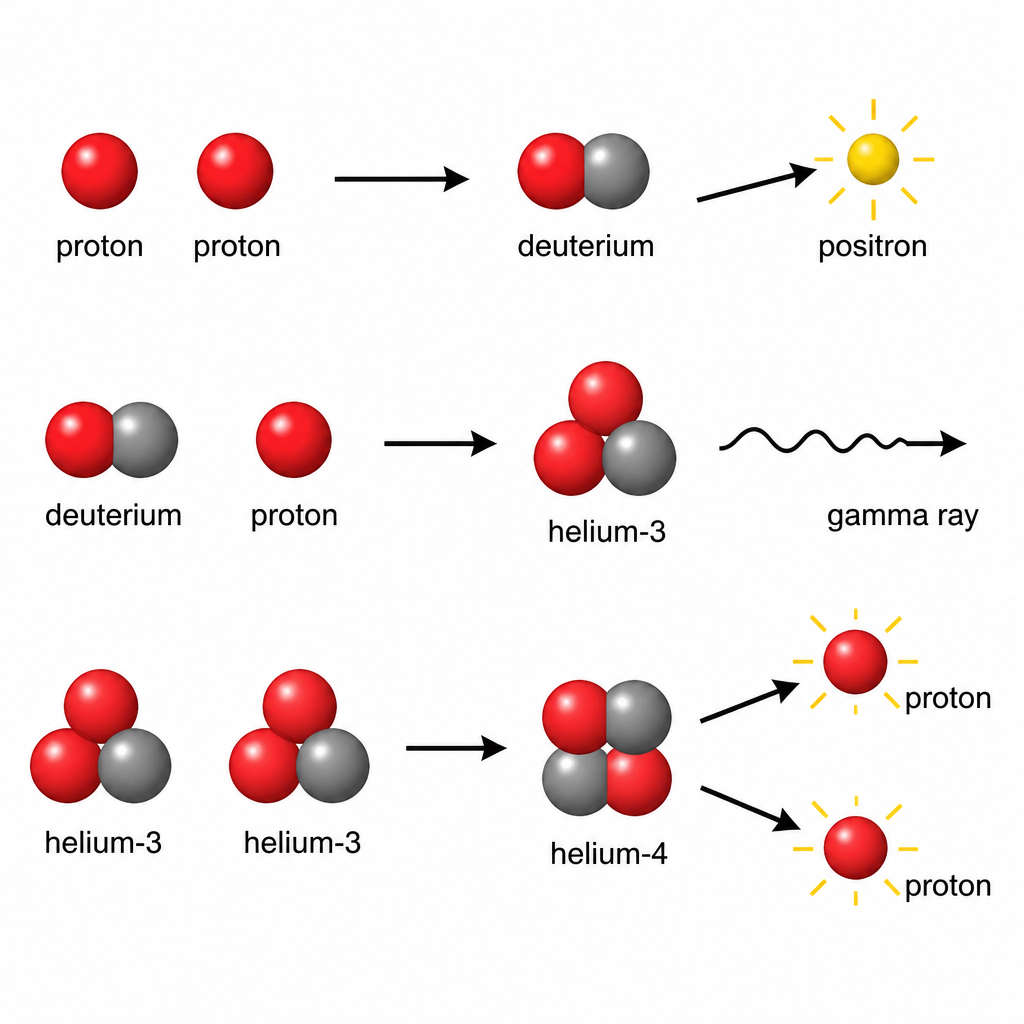
Step 1: Two protons fuse to form deuterium, an isotope of hydrogen, together with a positron \( ({}_{1}e^{0}) \):
\[ {}_{1}H^{1} + {}_{1}H^{1} \rightarrow {}_{1}H^{2} + {}_{1}e^{0} + \text{energy} \]
Step 2: The deuterium formed in the first step fuses with another proton to form the light helium isotope \( ({}_{2}He^{3}) \):
\[ {}_{1}H^{2} + {}_{1}H^{1} \rightarrow {}_{2}He^{3} + \gamma\text{-radiation} \]
Step 3: Finally two of these helium isotopes combine to form helium. Two protons are also produced in this step:
\[ {}_{2}He^{3} + {}_{2}He^{3} \rightarrow {}_{2}He^{4} + {}_{1}H^{1} + {}_{1}H^{1} + \text{energy} \]
The whole thermonuclear fusion reaction can be written in short as:
\[ 4\,{}_{1}H^{1} \rightarrow {}_{2}He^{4} + 2\,{}_{1}e^{0} + \text{energy} \]
Passing through these steps, four hydrogen atoms fuse in the sun to make one helium atom, and an enormous amount of energy is produced.
Conditions Needed for Thermonuclear Fusion
Three conditions explain why this reaction has kept running in the sun for billions of years.
- Abundant hydrogen: the sun holds enough hydrogen to keep thermonuclear fusion running continuously.
- High temperature: the sun's high temperature strips the electrons away and produces free protons.
- High pressure: the huge pressure in the sun's core brings the protons close enough to fuse.
Einstein's Mass-Energy Relation
The energy produced in a nuclear reaction can be calculated from Einstein's mass-energy relation. The relation is \( E = mc^{2} \), where 'm' stands for the mass destroyed in the nuclear reaction and 'c' stands for the velocity of light. The velocity of light is \( 3 \times 10^{8} \) m/s.
For example, if 0.1 g of mass is destroyed in a nuclear reaction, the energy released is calculated like this.
Step 1: Changing the mass into kilograms:
\[ m = 0.1\ g = 10^{-4}\ kg \]
Step 2: Putting the values into the formula:
\[ E = mc^{2} = 10^{-4} \times (3 \times 10^{8})^{2} \]
Step 3: Working it out:
\[ E = 9 \times 10^{16} \times 10^{-4} = 9 \times 10^{12}\ J \]
Even when a very small mass is destroyed in a nuclear reaction, an enormous amount of energy is released.
The mass in the formula must always be in kilograms. Substituting 0.1 straight in makes the answer wrong by a factor of one thousand. First turn 0.1 g into \( 10^{-4} \) kg, and only then substitute.
The Sun as the Prime Source of Energy
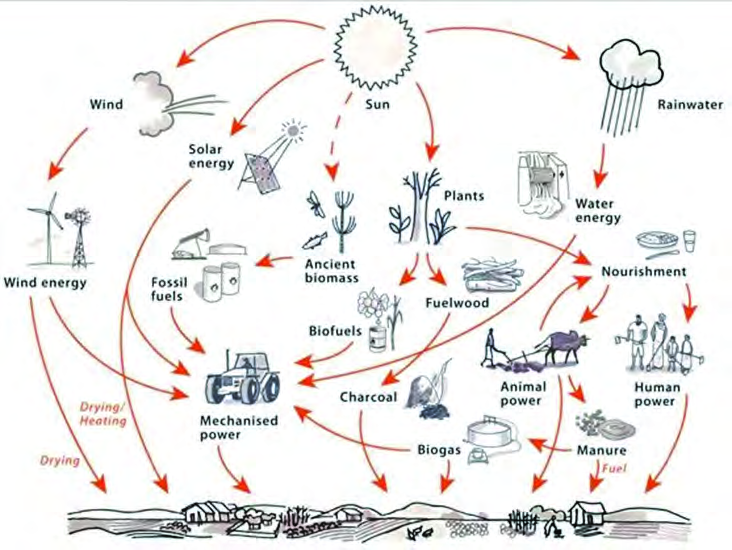
Every source of power available on the Earth, such as hydroelectricity, wind energy, biomass energy and fossil energy, is really solar energy in a changed form. That is why the sun is regarded as the prime source of power. The examples below trace each of these energies back to the sun.
Water Energy
The water cycle, also called the hydrological cycle, is the cycle in which the sun's heat turns water into vapour, the vapour forms clouds, and the water returns to the Earth as rain.
The sun's heat melts blocks of snow and ice, so the water sources fill up. When the water of lakes, rivers, streams, reservoirs and the sea is heated, it turns into vapour. The vapour cools in the atmosphere, forms clouds and falls as rain. Rainwater flows in rivers or collects in reservoirs. That water is stored behind large dams and used to generate electricity. In this way hydroelectricity is obtained indirectly from solar energy.
Fossil Fuel Energy
A small fraction of the sun's energy reaching the Earth is absorbed by green plants through the process of photosynthesis. In this process carbon dioxide and water are turned into starch. The sun's energy is thus changed into chemical energy and stored in the different parts of the plant. Animals eat these stored materials as food. So even the energy we get from our food comes indirectly from the sun.
Fossil fuels such as coal, petrol, diesel and natural gas are formed from dead plants and animals that stayed buried under the Earth's surface for hundreds of thousands of years. The energy those plants and animals stored while they were alive had come from the sun. So fossil energy is a product of solar power. Organic materials such as wood, vegetation, crop residue and waste are also used as sources of energy, and they too are products of solar energy.

Wind Energy
Wind energy is also based on solar energy. The sun's heat warms the air lying near the surface of the ground. The warm air becomes light and rises, and cooler air flows in from elsewhere to take its place. This is how air starts moving, and wind energy can be produced from that moving air. So wind energy too is a product of solar energy.
The full lesson is waiting for you
The notes are free to read in full. A free account opens the rest of the practice, and tracks your progress and confidence score for every subject. Presentations and videos need approval from Learn Yeti.