Compounds Around Us
From the sugar, salt, oil and ghee in the kitchen to the petrol in a vehicle and the urea spread on a field, we are surrounded by compounds of many kinds. They are all compounds, yet they do not behave alike. Sugar burns easily, but salt does not. Ghee refuses to dissolve in water, but salt dissolves at once. The root of this different behaviour lies in what the compounds are made of. Some compounds contain the element carbon, and some contain no carbon at all. Chemists therefore divide all compounds into two groups on the basis of the availability of carbon.
On the basis of the availability of carbon, compounds are divided into two groups: organic compounds and inorganic compounds.
Organic Compounds
Hydrocarbons and the compounds formed from hydrocarbons are called organic compounds.
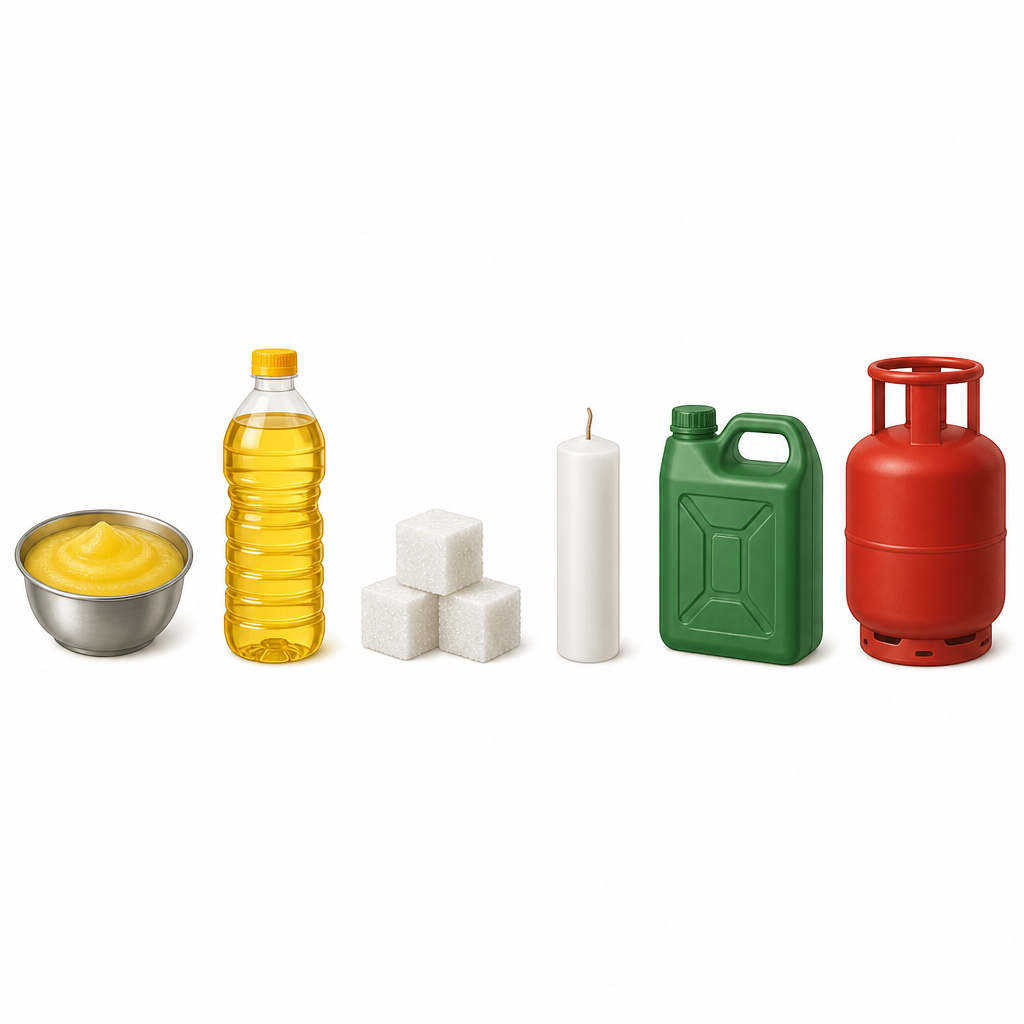
Methane, ethane, methanol, chloroform, urea, insulin, protein, carbohydrate and oil are all examples of organic compounds. Read that list and one thing stands out: most compounds connected with food, fuel and living bodies are organic. The carbohydrate in the rice and bread we eat, the protein that builds our muscles, and the insulin that balances sugar in our blood all belong to this group.
In general, organic compounds contain the element carbon, and the different elements inside the compound are held together by covalent bonds. In most organic compounds carbon forms covalent bonds with other carbon atoms and with hydrogen, while oxygen, nitrogen, the halogens, sulphur and phosphorus are also joined in through covalent bonds. In some organic compounds even metals are found bonded into the structure.
A compound is not organic just because it contains carbon. Carbon dioxide, carbon monoxide, carbonates, bicarbonates and carbides all contain carbon, yet every one of them is an inorganic compound.
Organic Compounds and Water
Most organic compounds do not dissolve in water, because they cannot form hydrogen bonds with water. Ghee, wax, petrol and kerosene are examples. Pour oil into water and it simply floats on top without dissolving. But organic compounds that can form hydrogen bonds with water do dissolve, such as sugar and alcohol. That is why sugar disappears easily into a cup of tea while ghee dropped into the same tea only floats.
The solvents in which organic compounds dissolve are called organic solvents. Ether, carbon tetrachloride and benzene are organic solvents.
Organic compounds that refuse to dissolve in water do dissolve in organic solvents. This is why a greasy stain on clothing will not wash out with water alone, but goes away in dry cleaning, which uses special solvents instead of water.
Inorganic Compounds
All compounds in which hydrogen is not joined to carbon are called inorganic compounds. In other words, every compound except the organic ones is an inorganic compound.
Carbon is not an essential element in an inorganic compound. Inorganic compounds are formed when various elements combine. They mainly contain electrovalent bonds, though some have covalent bonds or both kinds together. Inorganic acids, bases and salts are all inorganic compounds. The oxides of carbon, the carbonates, the bicarbonates and the carbides are also inorganic compounds.
Inorganic Compounds and Water
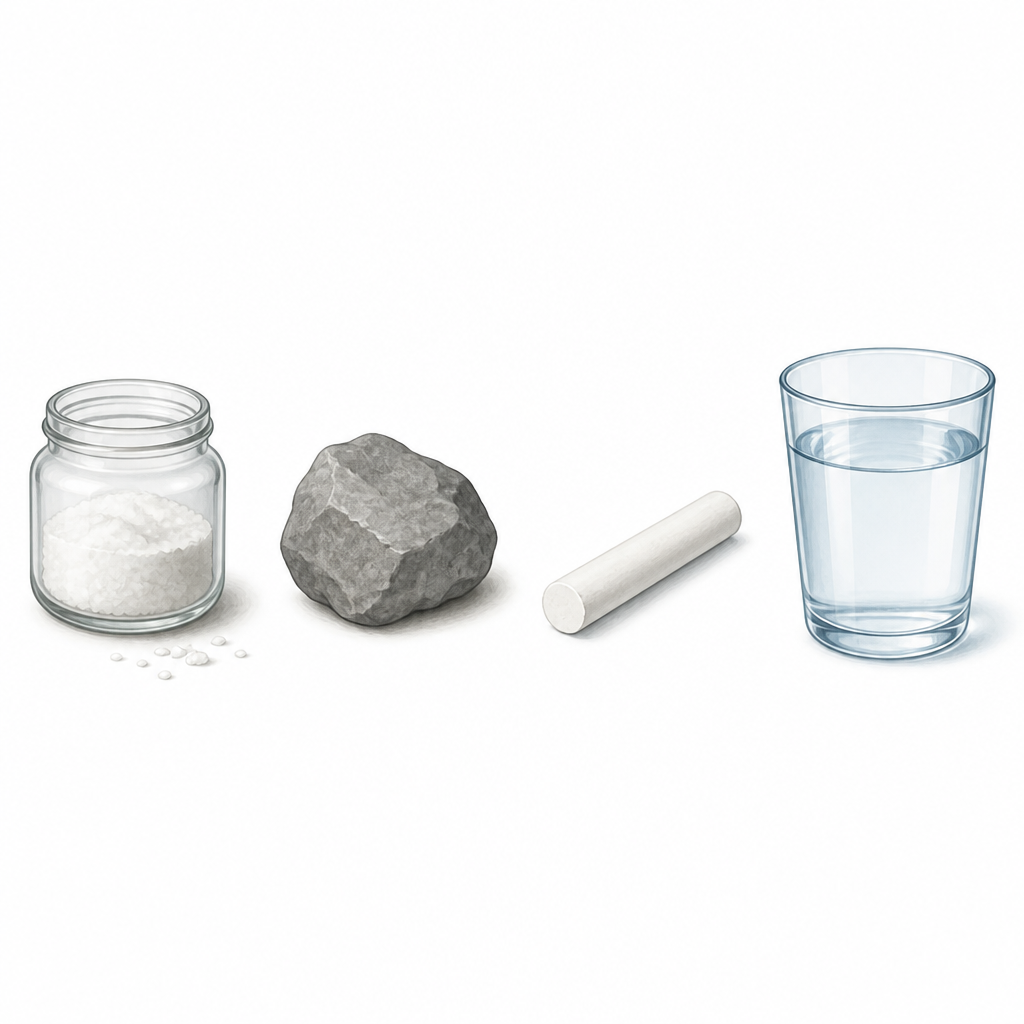
Most inorganic compounds dissolve in water because they ionise in water and split into ions. Sodium chloride, hydrochloric acid and magnesium hydroxide \( \mathrm{(Mg(OH)_2)} \) all dissolve this way. Salt seems to vanish the moment it enters water because its particles break up into ions and spread through the whole liquid. But inorganic compounds whose ions cannot separate in water do not dissolve. Silver chloride (AgCl), barium sulphate \( \mathrm{(BaSO_4)} \) and calcium carbonate \( \mathrm{(CaCO_3)} \) are examples of these.
Remember the solubility rule this way: most organic compounds do not dissolve in water but dissolve in organic solvents, while most inorganic compounds dissolve in water but not in organic solvents.
Six Differences Between Organic and Inorganic Compounds
Put organic compounds such as sugar, oil, ghee and urea beside inorganic compounds such as an acid, a base, a salt, a carbonate and a bicarbonate, and clear differences show up in colour, smell, physical state, solubility and flammability. The table below sets these differences out under six headings.
| Basis of difference | Organic compounds | Inorganic compounds |
| Physical state | Found in all three states: solid, liquid and gas. | Mostly solids, though a few are liquids (such as water and hydrochloric acid) and a few are gases (such as carbon dioxide and hydrogen sulphide). |
| Chemical bond | Organic compounds have covalent bonds. | Inorganic compounds mostly have electrovalent bonds, though some also have covalent bonds. |
| Ionisation | Organic compounds do not ionise. | Inorganic compounds ionise. |
| Solubility | Most organic compounds do not dissolve in water but dissolve in organic solvents. | Most inorganic compounds dissolve in water but do not dissolve in organic solvents. |
| Melting and boiling temperature | Organic compounds have low melting and boiling temperatures. | Inorganic compounds have high melting and boiling temperatures. |
| Flammability | Organic compounds burn easily (for example ghee, oil, petrol and LPG). | Inorganic compounds mostly do not burn (for example salt, lime and stone). |
When observing flammability, never take petrol, kerosene, LPG or any other easily burning substance near a flame. Test burning only with a teacher present, only with a tiny amount, and only in an open space.
This table can be used to identify any compound. Take ghee: it does not dissolve in water, it melts at a gentle heat, and it burns easily, so it is organic. Now take salt: it dissolves in water by forming ions, it melts only at a very high temperature, and it does not burn, so it is inorganic. Whenever you meet a new substance, make it a habit to test it against these six points.
The full lesson is waiting for you
The notes are free to read in full. A free account opens the rest of the practice, and tracks your progress and confidence score for every subject. Presentations and videos need approval from Learn Yeti.