Carbon's Valency and Covalent Bonds
Carbon is a special and rather unusual non-metal. A carbon atom has six electrons in total. Two of them sit in the inner shell, and the remaining four sit in the outermost shell, the shell that decides valency. To complete its octet, carbon needs four more electrons. Giving away four electrons at once is very hard, and pulling in four at once is just as hard, so carbon does neither. Instead it shares all four of its outer electrons with other atoms and forms four covalent bonds. That is why the valency of carbon is four.
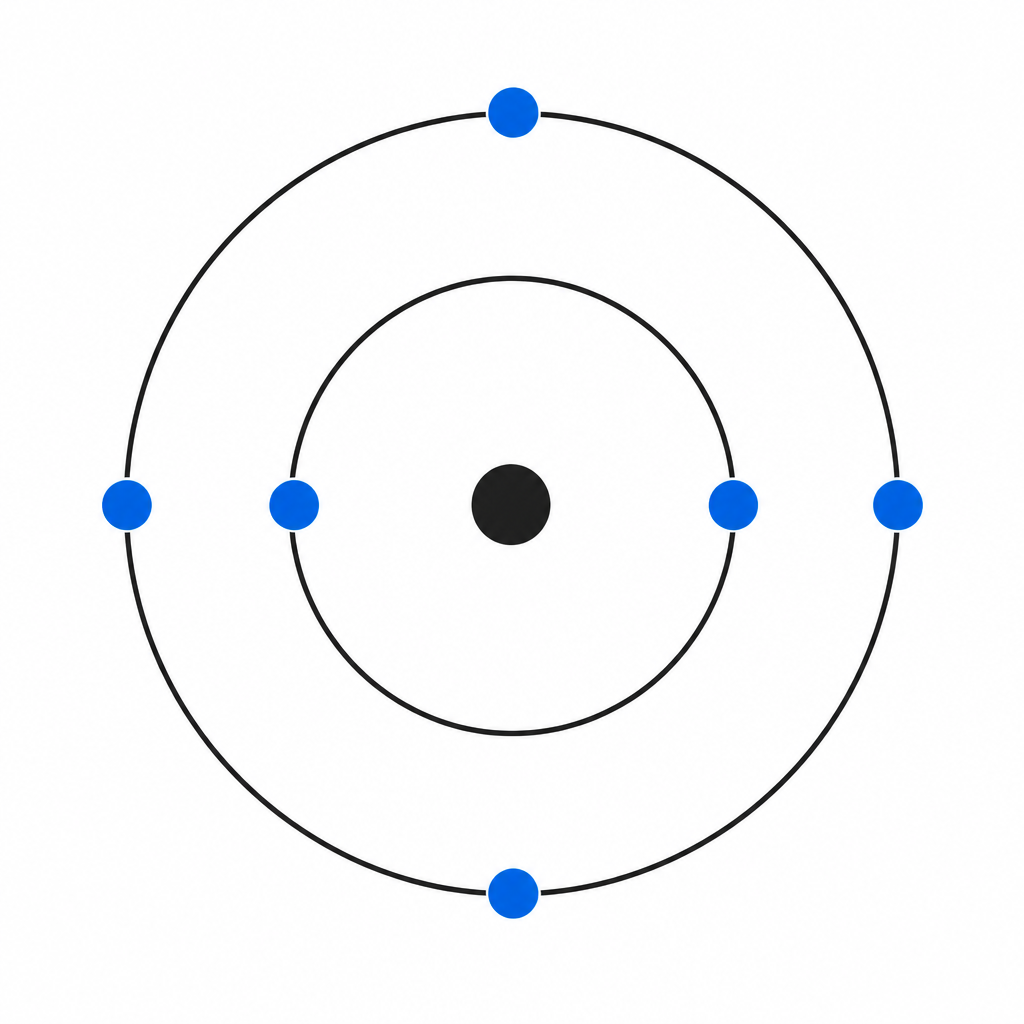
Carbon joins easily with hydrogen, with other carbon atoms, with oxygen and with many other elements to form covalent compounds. In methane, for example, one carbon shares one electron with each of four hydrogen atoms, and its four bonds are complete. Because carbon bonds so readily, hundreds of thousands of carbon compounds have been discovered so far.
In every compound, every carbon atom makes exactly four bonds. If a structure shows a carbon with more than four bonds or fewer, the structure itself is wrong.
Catenation: How Carbon Builds Chains
Most elements do not share electrons with many atoms of their own kind when they form covalent bonds. Carbon is different. One carbon atom can make a covalent bond with another carbon atom, and that carbon can bond with yet another, and so on. In this way carbon atoms link up into long chains.
Catenation is the unusual property by which one carbon atom bonds covalently with other carbon atoms to build long chains.
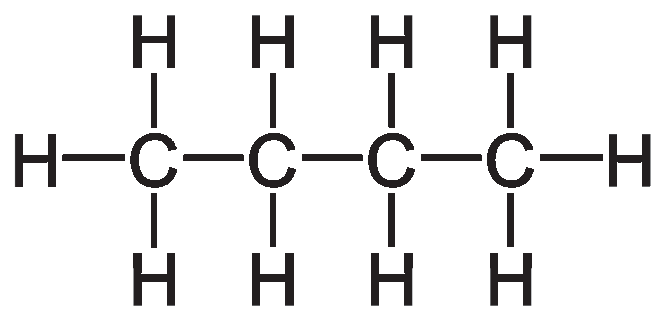
In the structure above, four carbons are joined in a row. Each middle carbon uses two bonds for its carbon neighbours and two for hydrogen, while each end carbon uses one bond for carbon and three for hydrogen. However long the chain grows, the rule of four bonds is never broken anywhere. Because of this property, countless compounds such as butane, pentane, polythene and polyvinyl chloride exist.
Catenation has produced so many carbon compounds that chemistry keeps a separate branch just to study them.
Organic chemistry is the separate branch of chemistry that studies the compounds of carbon.
Allotropes and Allotropy
Some substances contain nothing but the element carbon: coal, charcoal, soot, graphene, diamond, graphite and so on. To the eye they look completely different. Coal is black and dull while diamond sparkles and lets light through. Yet all of them are different forms of one and the same element, carbon.
Allotropes are the different forms of the same element that have different physical properties.
Allotropy is the process by which an element forms its allotropes.
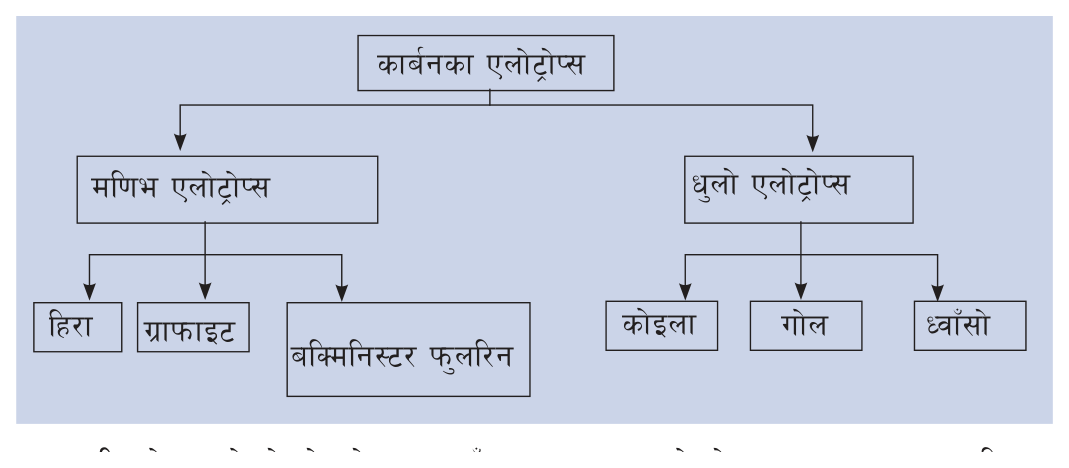
In diamond, graphite and buckminsterfullerene the carbon atoms sit in a fixed geometric pattern, so these are the crystalline allotropes. In coal, charcoal and soot the atoms have no such regular arrangement, so these are the amorphous allotropes.
| Crystalline allotropes | Amorphous allotropes |
| Diamond | Coal |
| Graphite | Charcoal |
| Buckminsterfullerene | Soot |
Allotropes and allotropy sound alike but mean different things. The forms themselves are the allotropes, and the process of forming them is allotropy. In an exam, write the two definitions separately.
Inside Graphite and Diamond
In graphite only three electrons of each carbon atom form bonds, and one electron stays free. That free electron can move about, which is why graphite conducts heat and electricity. In diamond all four electrons of the valence shell form bonds. No electron is left free, so diamond does not conduct electricity.
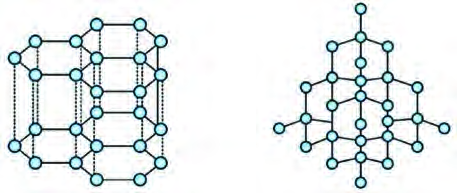
Same atoms, different arrangement, different properties. Every difference between graphite and diamond traces back to this one fact.
Physical Properties of Carbon
Carbon's physical properties change a great deal from one allotrope to another. The main ones are these:
- Carbon is an element found in the solid state. Diamond, graphite and buckminsterfullerene occur in the crystalline state, while coal, charcoal and wood charcoal occur in the amorphous state.
- Carbon is insoluble in water.
- When heated to a very high temperature, carbon changes straight from solid to gas.
- Carbon is black in colour, but diamond is colourless and transparent.
- Carbon has no lustre, but diamond shines.
- Carbon is a bad conductor of electricity and heat, but graphite conducts electricity.
- The density of carbon ranges from 1.5 g/cm³ to 3.5 g/cm³ depending on the allotrope.
Many students lose marks by leaving out the exceptions. When you write that carbon is a bad conductor, add that graphite conducts electricity, and when you write that carbon is black, add that diamond is colourless and transparent.
The full lesson is waiting for you
The notes are free to read in full. A free account opens the rest of the practice, and tracks your progress and confidence score for every subject. Presentations and videos need approval from Learn Yeti.