Oxygen Gas and Where It Is Found
Hold your breath for a few seconds and your body soon tells you something is missing. That missing thing is oxygen. Humans, animals, plants and most tiny living things need oxygen gas for respiration, the process that releases energy from food inside their cells. Without a steady supply of oxygen, a living cell cannot keep working for long.
Oxygen exists in two ways. Some of it is free, as a gas in the air. By volume, the atmosphere contains about 21% oxygen, so every 100 litres of air holds about 21 litres of oxygen gas. The rest of the oxygen on Earth is joined with other elements inside compounds. We cannot breathe that combined oxygen, but the element is still there.
- In the air: about 21% by volume, as free oxygen gas.
- In organic compounds: carbohydrates, proteins, fats, wood and so on.
- In inorganic compounds: limestone, silica, water and so on.
Water is an easy example to remember. Every molecule of water is made of hydrogen and oxygen, so the rivers, lakes and seas of the world are a huge store of combined oxygen.
The Discovery of Oxygen
In 1774 the British scientist Joseph Priestley heated the red oxide of mercury, \( \mathrm{HgO} \), and collected the gas that came off. That gas was the first oxygen ever prepared. The name oxygen was given later by the scientist Lavoisier. From the work of these scientists we learned that one part in every five parts of air is oxygen.
One part in five is 20%, which is very close to the 21% measured today.
Oxygen at a Glance
| Symbol | Atomic number | Atomic mass | Molecular formula | Density |
| O | 8 | 16 | \( \mathrm{O_2} \) | \( 1.43\ \mathrm{kg\,m^{-3}} \) |
An atomic number of 8 means each oxygen atom has 8 protons. Oxygen gas is not made of loose single atoms. Two oxygen atoms join to make one molecule, so the molecular formula of oxygen gas is \( \mathrm{O_2} \). Its density is \( 1.43\ \mathrm{kg\,m^{-3}} \), which means one cubic metre of oxygen gas has a mass of 1.43 kilograms.
Laboratory Preparation of Oxygen Gas
In the school laboratory oxygen is made in two ways. In the first way a solid is heated. In the second way no heat is needed. Both ways use a black powder, manganese dioxide \( (\mathrm{MnO_2}) \), as a catalyst, and both collect the gas over water.
Catalyst: A substance that changes the speed of a chemical reaction but is left unchanged when the reaction is over. In a chemical equation the catalyst is written above the arrow.
Method 1: Heating Potassium Chlorate
Some salts that contain oxygen give off oxygen gas when they are heated. Potassium chlorate \( (\mathrm{KClO_3}) \) is one of them. Heated with a little manganese dioxide as a catalyst, it breaks down into potassium chloride and oxygen:
\[ \mathrm{2KClO_3 \xrightarrow{MnO_2} 2KCl + 3O_2} \]
Read it like this: two molecules of potassium chlorate give two molecules of potassium chloride and three molecules of oxygen. Manganese dioxide sits above the arrow because it is not used up. It helps the salt release its oxygen faster and at a lower temperature, and it is still there, unchanged, when the reaction ends.
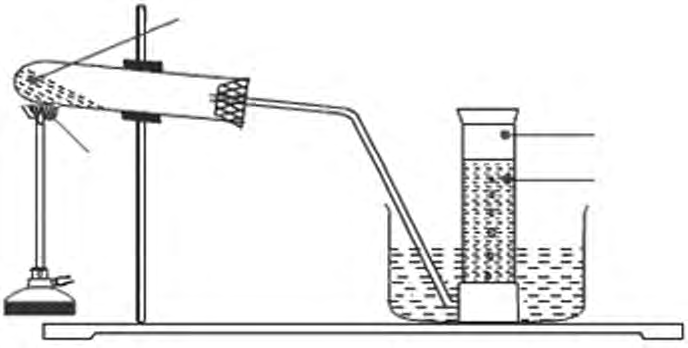
As the mixture is heated, oxygen comes off and travels along the delivery tube to the gas jar. Bubbles of gas rise into the jar and push the water inside it down and out. Oxygen is lighter than water and dissolves in it only partly, so the gas gathers at the top of the jar while the water is displaced downward.
Downward displacement of water: A way of collecting a gas by bubbling it into an upside down jar full of water, so that the gas pushes the water down and takes its place. Only a gas that does not dissolve much in water can be collected like this.
Precautions for this method:
- Fix the hard glass test tube tilted slightly downward towards its mouth. Then any drops of water that form during the reaction run towards the mouth instead of flowing back into the hot mixture.
- Join all the apparatus so that no air can leak in or out.
- Fill the gas jar right to the top with water, so that no air bubbles are left inside.
When the gas has been collected, first lift the end of the delivery tube out of the water, and only then take the burner away. If the flame is removed first, the tube cools, cold water from the trough can be sucked back into the hot test tube, and the glass may crack.
Method 2: Without Heat, from Hydrogen Peroxide
Hydrogen peroxide \( (\mathrm{H_2O_2}) \) is a liquid. In the presence of manganese dioxide as a catalyst it breaks down, even at room temperature, into water and oxygen gas:
\[ \mathrm{2H_2O_2 \xrightarrow{MnO_2} 2H_2O + O_2} \]
Manganese dioxide is placed in a clean conical flask. A thistle funnel passes through the cork down into the flask, and a delivery tube links the flask to an upside down gas jar in a trough. Hydrogen peroxide is poured in slowly through the thistle funnel. As soon as it touches the manganese dioxide, oxygen is given off, and it is collected by pushing the water down in the jar, just as in the first method.
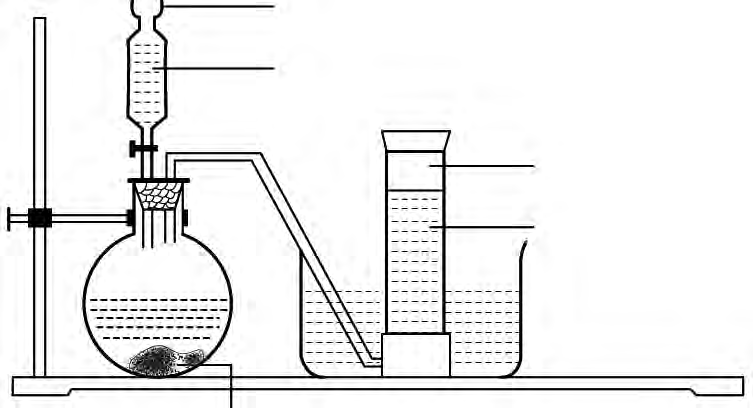
Precautions for this method:
- Join the apparatus so that it is air tight.
- Pour in enough hydrogen peroxide to keep the lower tip of the thistle funnel under the liquid. Otherwise the oxygen escapes up through the funnel.
- Use pure manganese dioxide.
The two methods side by side:
| Point | With heat | Without heat |
| Starting substance | Potassium chlorate (solid) | Hydrogen peroxide (liquid) |
| Catalyst | Manganese dioxide | Manganese dioxide |
| Container | Hard glass test tube | Conical flask with thistle funnel |
| Heat needed? | Yes | No |
| Other product | Potassium chloride | Water |
| Collection | Downward displacement of water | Downward displacement of water |
Testing for Oxygen Gas
Oxygen has no colour and no smell, so you cannot tell just by looking whether a jar is full of it. A simple test settles the question. Keep the gas jar upside down and lift it slowly out of the water. Then bring a burning matchstick to the mouth of the jar. If the matchstick suddenly burns much more brightly, the gas is confirmed to be oxygen.
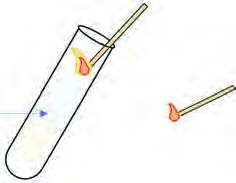
Oxygen helps other things burn. It does not burn itself, but it makes a flame brighter and hotter.
Physical Properties of Oxygen
The properties of oxygen gas are of two kinds, physical and chemical. Physical properties are the ones we can observe or measure without changing oxygen into a new substance. The physical properties of oxygen are:
- Oxygen gas has no colour, no smell and no taste.
- It is slightly heavier than air.
- It dissolves in water only partly. The small amount that does dissolve is what fish and other water animals breathe.
- It is neutral, so it has no effect on litmus paper.
- When cooled, it becomes a liquid at -183°C and a solid at -219°C.
Neutral substance: A substance that is neither acidic nor basic. It does not change the colour of red or blue litmus paper.
These properties explain the laboratory method. Oxygen dissolves only a little in water, which is why it can be collected over water. It has no colour, which is why a matchstick test is needed to identify it.
Chemical Properties of Oxygen
Chemical properties describe how oxygen reacts with other substances to make new ones. Oxygen is a very reactive element. Many of its reactions are kinds of burning, which give out heat and light.
Oxide: A compound made of oxygen and one other element, such as magnesium oxide \( (\mathrm{MgO}) \) or carbon dioxide \( (\mathrm{CO_2}) \).
1. Some metals burn in oxygen to form metal oxides: metal + oxygen → metal oxide.
- \( \mathrm{4Na + O_2 \rightarrow 2Na_2O} \) (sodium oxide)
- \( \mathrm{4K + O_2 \rightarrow 2K_2O} \) (potassium oxide)
- \( \mathrm{2Mg + O_2 \rightarrow 2MgO} \) (magnesium oxide)
Burning a strip of magnesium ribbon shows this clearly. The ribbon burns with a dazzling white light and leaves a white powder behind. That white powder is magnesium oxide.
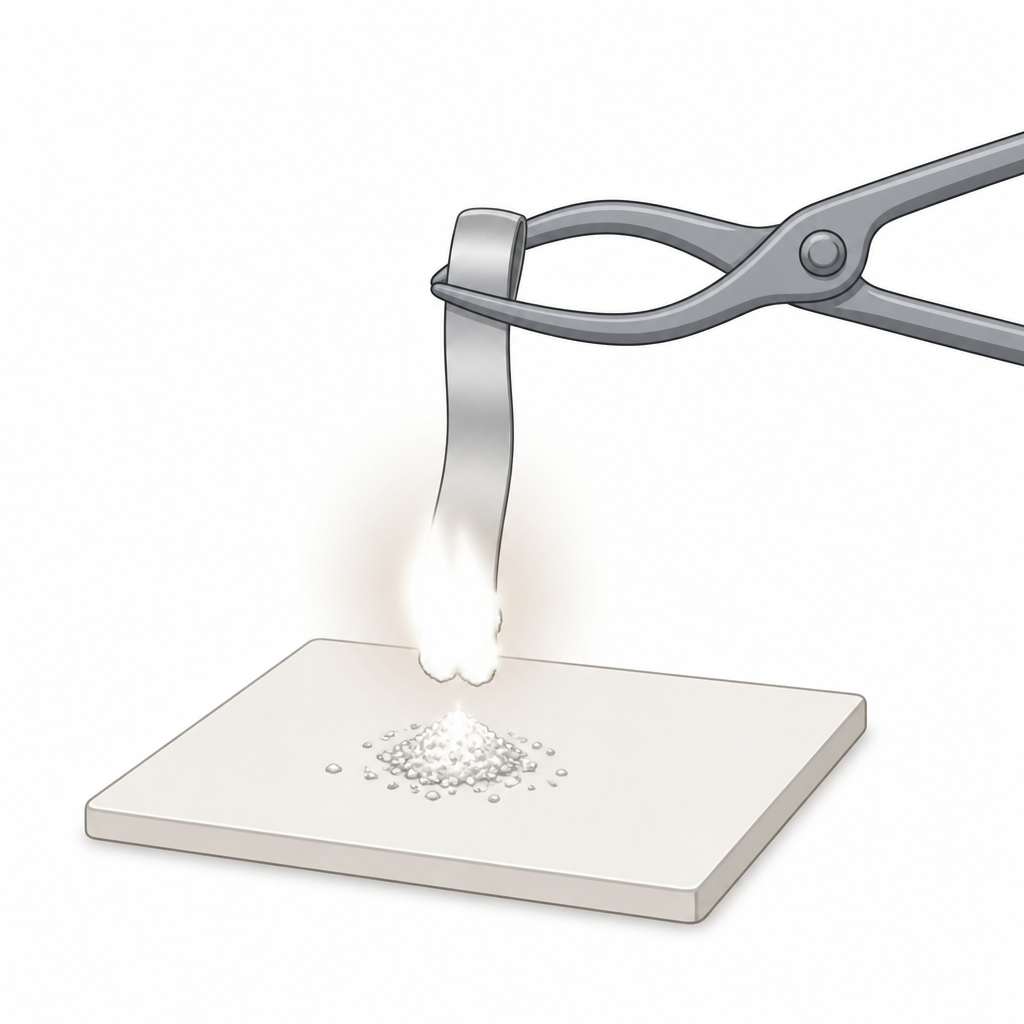
Always hold the ribbon with tongs, never with your fingers. Do not stare straight at the burning ribbon, because its light is bright enough to harm your eyes.
2. Non-metals burn in oxygen to form non-metal oxides: non-metal + oxygen → non-metal oxide.
- \( \mathrm{2H_2 + O_2 \rightarrow 2H_2O} \) (water)
- \( \mathrm{C + O_2 \rightarrow CO_2} \) (carbon dioxide)
- \( \mathrm{S + O_2 \rightarrow SO_2} \) (sulphur dioxide)
- \( \mathrm{4P + 5O_2 \rightarrow 2P_2O_5} \) (phosphorus pentoxide)
3. Compounds made only of hydrogen and carbon are called hydrocarbons. Cooking gas and many fuels are hydrocarbons. When hydrocarbons burn in oxygen they give carbon dioxide, water and energy: hydrocarbon + oxygen → carbon dioxide + water + energy.
- Methane: \( \mathrm{CH_4 + 2O_2 \rightarrow CO_2 + 2H_2O} \), plus energy
- Ethene: \( \mathrm{C_2H_4 + 3O_2 \rightarrow 2CO_2 + 2H_2O} \), plus energy
4. Oxygen reacts with glucose to give carbon dioxide, water and energy. This is the reaction that produces energy inside cells during respiration in living things. Glucose and oxygen give:
\[ \mathrm{C_6H_{12}O_6 + 6O_2 \rightarrow 6CO_2 + 6H_2O} \]
5. Oxygen also reacts with alcohol to give carbon dioxide, water and energy. When ethyl alcohol burns:
\[ \mathrm{C_2H_5OH + 3O_2 \rightarrow 2CO_2 + 3H_2O} \]
When you copy an equation, check that each kind of atom has the same number on both sides. In the glucose equation there are 18 oxygen atoms on the left (6 in glucose and 12 in \( \mathrm{6O_2} \)) and 18 on the right (12 in \( \mathrm{6CO_2} \) and 6 in \( \mathrm{6H_2O} \)).
Uses of Oxygen Gas
Oxygen helps things burn and living things need it to breathe. Because of these two facts it is used in many places:
- Animals and other living things use oxygen in respiration to produce energy.
- Oxygen is used to cut and join (weld) metals. An oxy-acetylene flame or an oxy-hydrogen flame is used for this, and it is hot enough to melt steel.
- Oxygen cylinders give artificial respiration to patients who find it hard to breathe.
- Oxygen cylinders are carried where there is not enough oxygen in the air: in mines, in mountain climbing, in space travel and during work under water.
- Oxygen is used in making steel.
This is why climbers on Mount Everest carry oxygen cylinders. High up, the air is thin and each breath brings in too little oxygen.
The full lesson is waiting for you
The notes are free to read in full. A free account opens the rest of the practice, and tracks your progress and confidence score for every subject. Presentations and videos need approval from Learn Yeti.