Nitrogen Gas: Its Discovery and Where It Is Found
Air is not one gas. It is a mixture, and when the gases in it are compared by volume, one of them is far ahead of all the others. That gas is nitrogen. Roughly 78 parts out of every 100 parts of air are nitrogen, while oxygen makes up only about 21 parts. So most of every breath you take is nitrogen. Your body takes nothing from it and breathes it out again just as it came in.
Nitrogen was discovered in 1772 by Daniel Rutherford. He found a gas that would not take part in reactions the way oxygen does. In 1790 Chaptal gave this gas the name nitrogen. So the gas was known for eighteen years before it received the name we use today.
Inert gas: a gas that does not react with other elements or compounds under ordinary conditions. Compared with other gases, nitrogen is inert, because at normal temperature and pressure it does not react with other substances.
Nitrogen is not found only in the air. It is one of the elements living things are made of. The proteins that build muscle and skin, the enzymes that control the chemical work inside cells, and the RNA and DNA that carry the instructions of life all contain nitrogen, in plants and animals alike. Nitrogen is also present in some rocks and minerals. In living bodies and in rocks it is not a free gas. There it is joined to other elements and exists as compounds.
Nitrogen occurs in two forms. In air it is a free gas made of \( \mathrm{N_2} \) molecules. In proteins, enzymes, RNA, DNA, rocks and minerals it is present in compounds.
Laboratory Preparation of Nitrogen Gas
Nitrogen can be separated from air, but in a school laboratory it is easier to make it by a chemical reaction. A mixture of sodium nitrite \( (\mathrm{NaNO_2}) \) and ammonium chloride \( (\mathrm{NH_4Cl}) \) is dissolved in water and the solution is heated. The two compounds react and nitrogen gas is given off:
\[ \mathrm{NaNO_2 + NH_4Cl \xrightarrow{\text{heat}} N_2\uparrow + NaCl + 2H_2O} \]
Read the equation from left to right. Sodium nitrite and ammonium chloride are the reactants. Heat is written above the arrow because the reaction has to be heated to start. The products are nitrogen gas, sodium chloride (common salt) and water. The small upward arrow beside \( \mathrm{N_2} \) shows that nitrogen leaves the flask as a gas. The sodium chloride stays dissolved in the flask.
Sodium nitrite \( (\mathrm{NaNO_2}) \), sodium nitrate \( (\mathrm{NaNO_3}) \) and sodium chloride \( (\mathrm{NaCl}) \) sound alike but are different compounds. The chemical put into the flask is sodium nitrite. Sodium chloride is not a starting chemical here. It is a product left behind in the flask after the reaction.
Procedure
The apparatus is a round-bottom flask fitted with a cork, a thistle funnel, a delivery tube, a stand with a clamp, a tripod with wire gauze, a burner, a trough of water and a gas jar. The chemicals needed are:
- about 5 g of sodium nitrite
- about 4 g of ammonium chloride
- about 50 ml of water
The gas is prepared in this order:
- Put a mixture of about 5 g of sodium nitrite and about 4 g of ammonium chloride into a clean round-bottom flask.
- Add about 50 ml of water to the mixture to make a solution.
- Stand the flask on the wire gauze over the tripod and clamp it. Fit the thistle funnel and the delivery tube through the cork, and lead the other end of the delivery tube under a gas jar full of water, standing upside down in the trough.
- Heat the solution slowly.
- Once the mixture is warm, nitrogen gas is given off and travels along the delivery tube.
- Collect the nitrogen in the gas jar by the water displacement method.
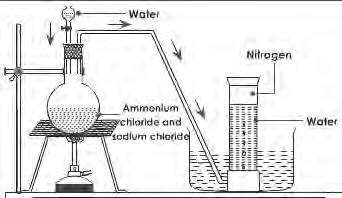
Follow the path of the gas through the set-up. Water can be added to the flask through the thistle funnel. Its lower end must dip into the solution, or the gas would escape through it. The nitrogen formed in the flask passes along the delivery tube, bubbles up into the upside-down jar and pushes the water in the jar down and out. When the jar is full of gas, its mouth is covered while still under water and the jar is lifted out.
Water displacement method: a way of collecting a gas by passing it into a gas jar that is full of water and stands upside down in a trough of water. The gas gathers at the top of the jar and pushes the water out.
Why collect nitrogen over water? Nitrogen dissolves only slightly in water, so very little of it is lost. Also, nitrogen is only a little lighter than air. If we tried to collect it by pushing air out of a jar, it would mix with the air and we would not get pure nitrogen. Collecting it over water gives a jar of nitrogen with no air in it.
Precautions
Two precautions keep the preparation safe and make sure the gas is actually collected.
- The apparatus must be fitted so that no air can leak in or out, and the mixture must be heated slowly. A loose cork lets nitrogen escape and lets air in. Strong heating makes the reaction too violent, and the solution can froth up into the delivery tube.
- The mixture must be dissolved in water before heating, because solid ammonium chloride is volatile and turns into gas at a low temperature. If the dry solid were heated, much of the ammonium chloride would turn to vapour and leave the flask before it could react.
Volatile: describes a substance that changes into a gas easily, at a low temperature. Solid ammonium chloride is volatile.
Never taste laboratory chemicals or handle them with bare hands. The flask and the wire gauze get very hot during heating, so do not hold them.
Test of the Gas
Nitrogen has no colour and no smell, so looking at the jar tells us nothing. A burning splinter goes out in nitrogen, but it also goes out in carbon dioxide, so that alone does not prove the gas is nitrogen. The test that confirms nitrogen uses magnesium:
- Light a magnesium ribbon and lower it, still burning, into the gas jar.
- The ribbon goes on burning inside the jar, and at the end it has turned into a yellow powder.
- Add a few drops of water to the yellow powder. If a smell of ammonia comes out, the gas collected in the jar is nitrogen.
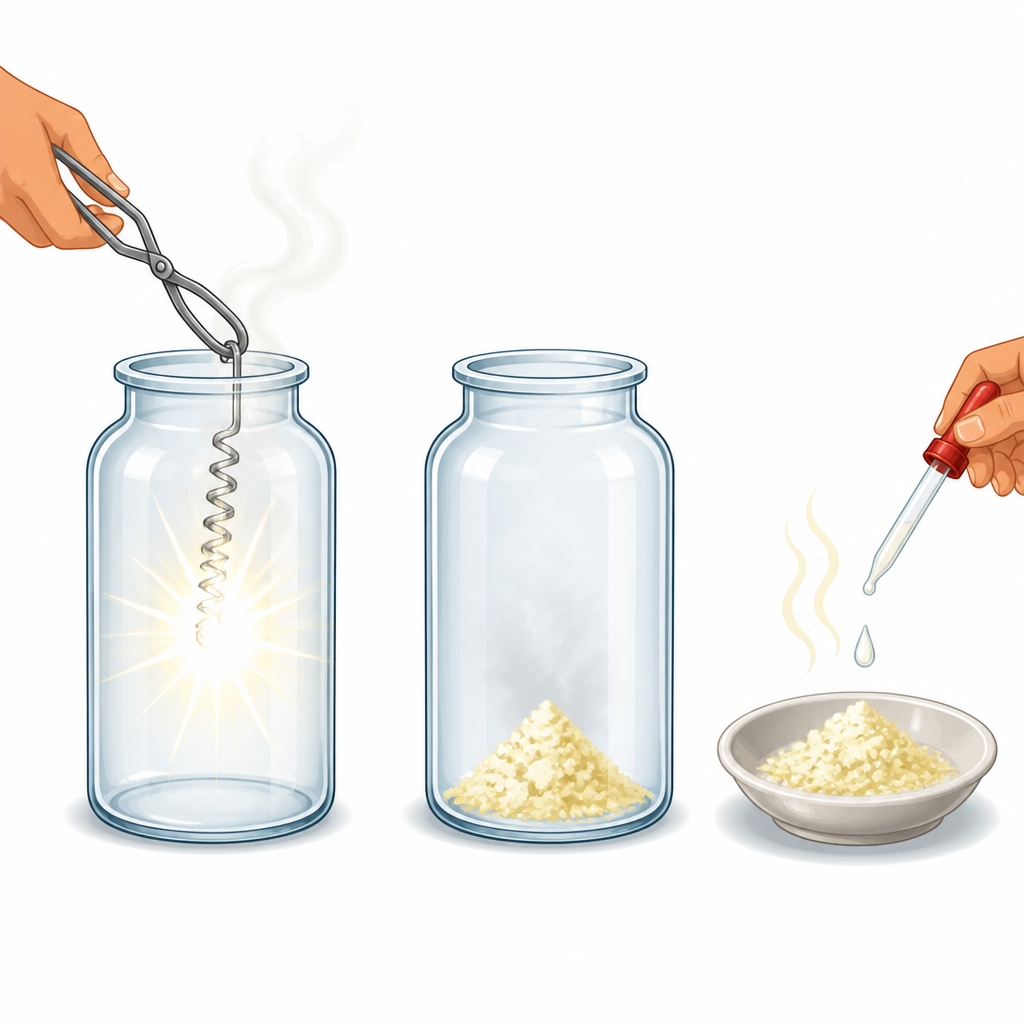
Why does this work? Very hot magnesium is one of the few metals that combines with nitrogen. The yellow powder is magnesium nitride:
\[ \mathrm{3Mg + N_2 \xrightarrow{\text{heat}} Mg_3N_2} \]
Magnesium nitride reacts with water and gives off ammonia gas, whose sharp smell is easy to recognise:
\[ \mathrm{Mg_3N_2 + 6H_2O \rightarrow 3Mg(OH)_2 + 2NH_3} \]
Burning magnesium gives a very bright white light. Do not stare at it. To smell the ammonia, never put your nose over the jar. Gently wave the air above it towards your nose with your hand.
Physical Properties of Nitrogen Gas
The physical properties of nitrogen are the ones we can observe or measure without changing it into a new substance. They are:
- Nitrogen gas is colourless, odourless and tasteless.
- Nitrogen gas is lighter than air.
- Nitrogen gas dissolves in water to a small extent.
- Nitrogen gas is neutral, so it has no effect on litmus. It turns neither blue litmus red nor red litmus blue.
- Nitrogen gas does not burn, and it does not help other things to burn.
- Nitrogen gas becomes a liquid at -196°C and a solid at -210°C.
The fact that nitrogen neither burns nor helps things burn explains most of the ways it is used.
Chemical Properties of Nitrogen Gas
Compared with other gases, nitrogen is inert. It does not react easily with other elements. The two atoms in a nitrogen molecule are held together very strongly, and a lot of energy is needed to separate them. Under special conditions, such as very high temperature, high pressure or the help of a catalyst, it does react with several substances.
1. Reaction with hydrogen. At about 450°C and 500 atm (atmospheric pressure), with iron and molybdenum (Fe/Mo) as a catalyst, nitrogen combines with hydrogen to form ammonia gas:
\[ \mathrm{N_2 + 3H_2 \xrightarrow[\text{Fe/Mo}]{450^\circ C,\ 500\ atm} 2NH_3} \]
Catalyst: a substance that speeds up a chemical reaction without itself being used up. Iron and molybdenum (Fe/Mo) act as the catalyst when ammonia is made.
2. Reaction with oxygen. At 2000°C to 3000°C, in an electric arc, nitrogen reacts with oxygen to form nitric oxide:
\[ \mathrm{N_2 + O_2 \xrightarrow{\text{electric arc}} 2NO} \]
An electric arc is a powerful electric spark that jumps across the gap between two electrodes. A flash of lightning produces the same kind of intense heat, so a little nitric oxide forms in the air during a thunderstorm. Nitrogen and oxygen sit together in air all the time, but at ordinary temperatures they do not react.
3. Reaction with metals. When a burning metal such as magnesium, calcium or aluminium is placed in a vessel of nitrogen, it keeps on burning and forms the nitride of that metal:
\[ \mathrm{3Mg + N_2 \xrightarrow{\text{heat}} Mg_3N_2} \]
\[ \mathrm{3Ca + N_2 \xrightarrow{\text{heat}} Ca_3N_2} \]
The first reaction gives magnesium nitride and the second gives calcium nitride. Aluminium forms aluminium nitride \( (\mathrm{AlN}) \) in the same way. Nitrogen itself does not burn, but these very hot metals keep burning by combining with it.
Nitride: a compound formed when nitrogen combines with a metal, such as magnesium nitride \( (\mathrm{Mg_3N_2}) \) or calcium nitride \( (\mathrm{Ca_3N_2}) \).
| Reacts with | Conditions needed | Product |
| hydrogen | about 450°C, 500 atm, Fe/Mo catalyst | ammonia \( (\mathrm{NH_3}) \) |
| oxygen | 2000°C to 3000°C, electric arc | nitric oxide \( (\mathrm{NO}) \) |
| burning magnesium | heat | magnesium nitride \( (\mathrm{Mg_3N_2}) \) |
| burning calcium | heat | calcium nitride \( (\mathrm{Ca_3N_2}) \) |
Uses of Nitrogen Gas
Almost every use of nitrogen comes straight from one of its properties. Sometimes it is its inertness that matters, sometimes the compounds made from it, and sometimes the extreme cold of liquid nitrogen.
- Nitrogen gas is used on a large scale to make compounds such as ammonia and nitric acid, which industry needs for producing chemical fertilisers.
- Packets of food are filled with nitrogen gas to stop the food from going bad.
- Electric bulbs are filled with nitrogen gas so that the tungsten filament inside does not burn away.
- Liquid nitrogen is at -196.5°C, so it is used to cool refrigerators.
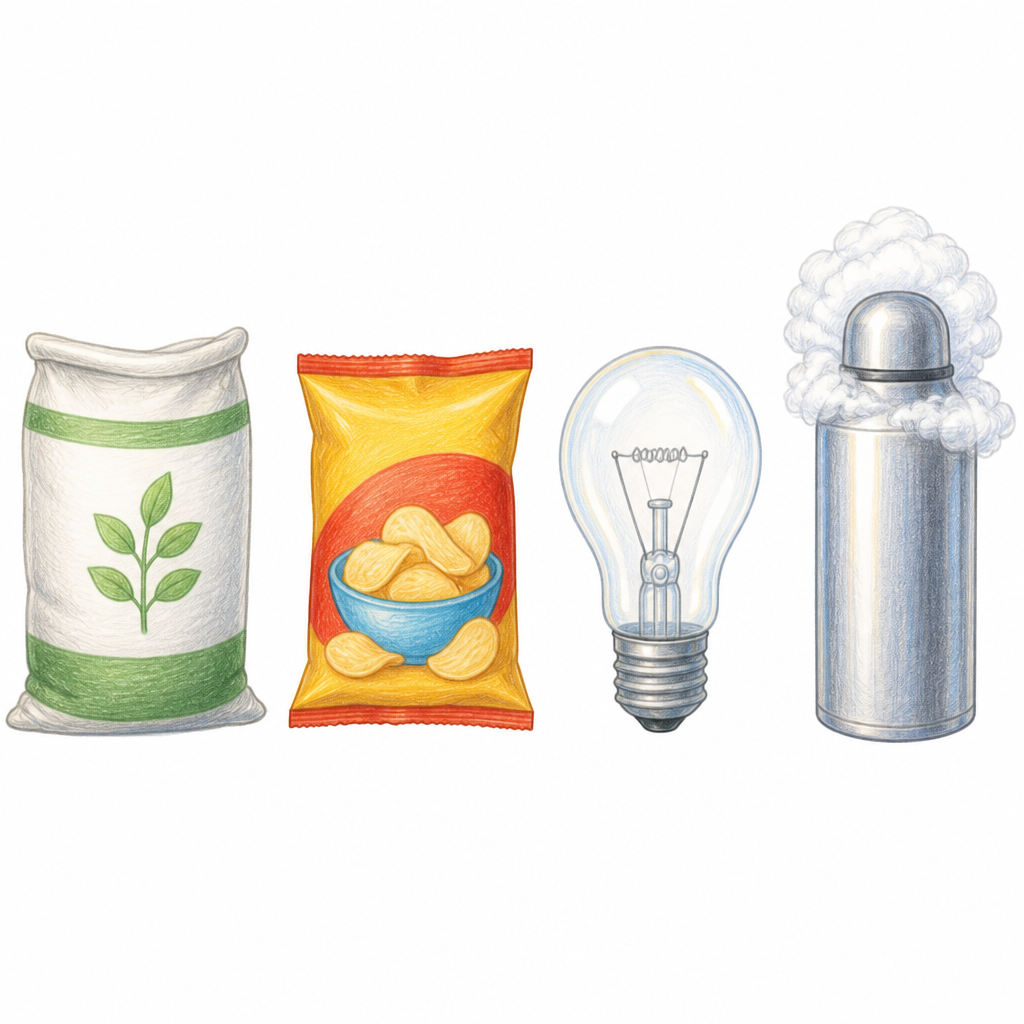
| Use | The property behind it |
| making fertiliser | under special conditions it reacts with hydrogen and oxygen to give ammonia and oxides of nitrogen |
| food packets | it is inert and keeps oxygen out of the packet |
| electric bulbs | it neither burns nor lets the hot filament burn |
| cooling | liquid nitrogen is extremely cold |
Liquid nitrogen is so cold that it injures skin the way a burn does. Never touch it with bare hands.
The full lesson is waiting for you
The notes are free to read in full. A free account opens the rest of the practice, and tracks your progress and confidence score for every subject. Presentations and videos need approval from Learn Yeti.