Ozone: Oxygen with Three Atoms
The oxygen we breathe in is made of molecules that each contain two oxygen atoms, so it is written \( \mathrm{O_2} \). When three oxygen atoms join together instead, a different gas is formed. This gas is ozone, and its molecular formula is \( \mathrm{O_3} \). Both gases are made only of the element oxygen, yet because their molecules hold a different number of atoms, they behave differently and do different jobs.
Ozone: a blue gas whose molecules are made of three oxygen atoms joined together. Its molecular formula is O₃.
As a gas, ozone is blue. If it is cooled until it becomes a liquid, its colour deepens to dark blue. The table below sets the two forms of oxygen side by side.
| Feature | Oxygen | Ozone |
| Atoms in one molecule | 2 | 3 |
| Molecular formula | O₂ | O₃ |
| Colour | Colourless | Blue, dark blue as a liquid |
| Main use to us | Used in respiration | Absorbs the Sun's ultraviolet rays |
How Ozone Forms
Sunlight carries ultraviolet rays, which our eyes cannot see and which carry a lot of energy. High in the atmosphere, these rays strike oxygen molecules and break each one into two separate oxygen atoms. A single atom freshly split off in this way is called nascent oxygen.
Nascent oxygen: a single oxygen atom that has just split off from an oxygen molecule. It is alone and very reactive, so it quickly joins with something else.
A lone oxygen atom does not stay alone for long. It joins a nearby oxygen molecule, and the result is a molecule of ozone. The process is written in two steps.
Step 1: Ultraviolet rays split one oxygen molecule into two oxygen atoms:
\[ \mathrm{O_2} \xrightarrow{\text{UV}} \mathrm{O} + \mathrm{O} \]
Step 2: One oxygen molecule joins one nascent oxygen atom, giving ozone:
\[ \mathrm{O_2} + \mathrm{O} \xrightarrow{\text{UV}} \mathrm{O_3} \]
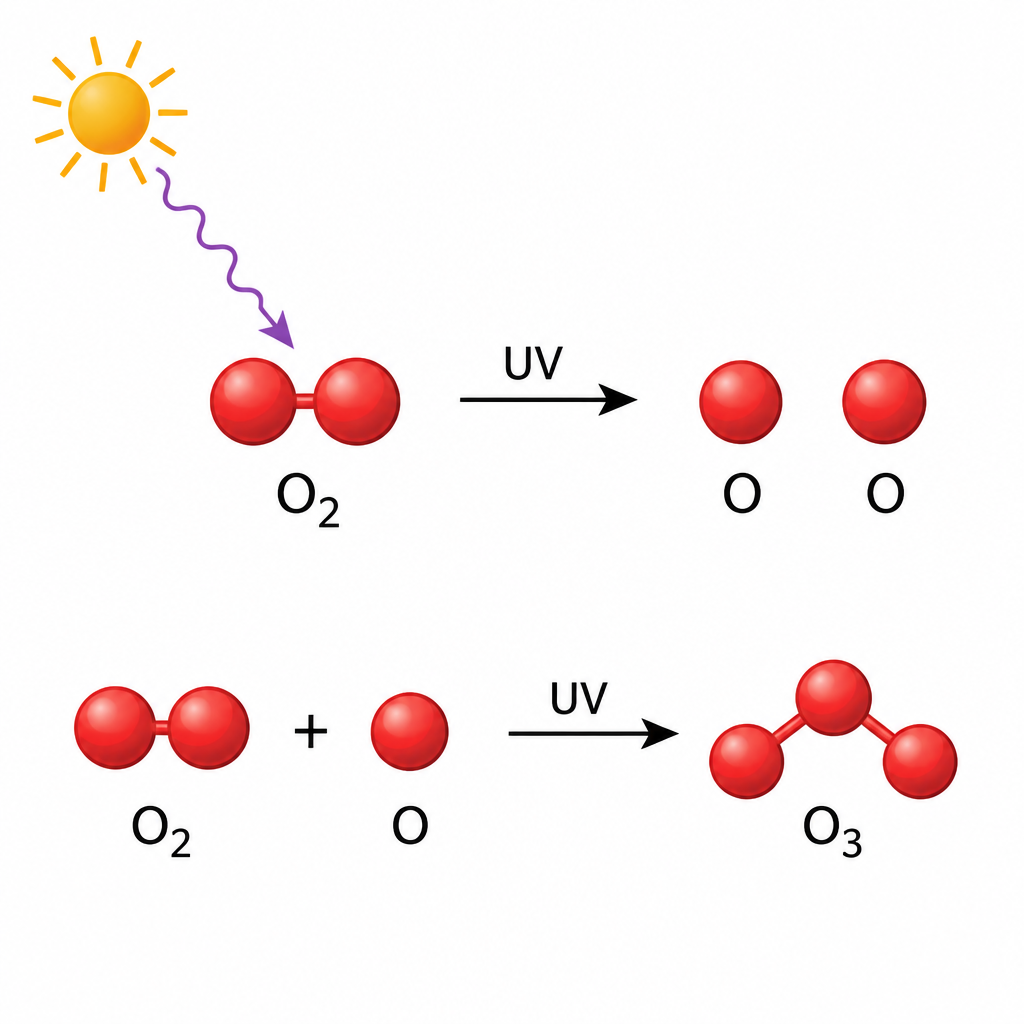
Ozone can only be made with the help of ultraviolet rays. That is why it forms high in the atmosphere, where the Sun's rays arrive at full strength.
The Ozone Layer
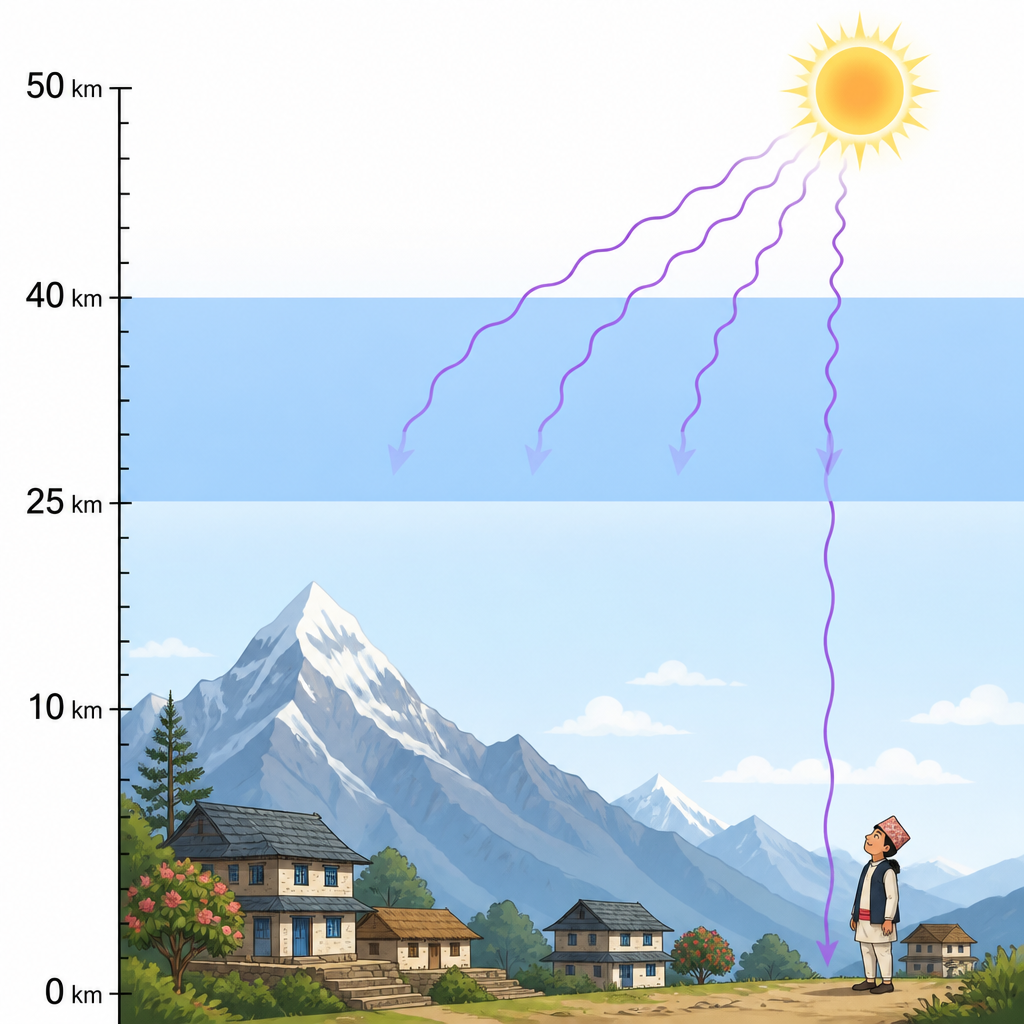
The ozone formed in this way is not spread evenly through the air. Most of it collects in the part of the atmosphere called the stratosphere, where it builds up into a thick layer. This layer stretches from about 25 to 40 km above the Earth's surface. To picture the height, compare it with Mount Everest, which is about 8.8 km tall. The bottom of the ozone layer alone is nearly three times higher than the summit of Everest.
Ozone layer: the thick layer of ozone gas that collects in the stratosphere of the atmosphere. It extends from about 25 to 40 km above the Earth's surface.
Why the Ozone Layer Matters
Ultraviolet radiation from the Sun is harmful to living things. The ozone layer absorbs most of this radiation before it can reach the Earth's surface. It works for the whole planet the way an umbrella works for you on a sunny day, standing between you and the harsh rays. For this reason the ozone layer is also called the protective layer.
Protective layer: another name for the ozone layer, given because it protects life on Earth by absorbing most of the harmful ultraviolet radiation from the Sun.
The ozone layer matters in these ways:
- (a) It plays an important part in keeping the Earth's weather and temperature balanced.
- (b) It helps protect the ecosystems of water and of land.
- (c) It keeps ecosystems from breaking down and helps hold them in balance.
- (d) By absorbing most ultraviolet radiation, it protects humans and other living things from the diseases that radiation can cause.
Depletion of the Ozone Layer
The ozone layer does not automatically stay as thick as it has always been. Some chemicals made by people rise up to it, break its ozone molecules apart, and slowly make it thinner.
Depletion of the ozone layer: the process by which the ozone layer in the stratosphere becomes thinner and thinner.
The main chemical that destroys the ozone layer is chlorofluorocarbon, shortened to CFC. CFCs were widely used in modern equipment such as older refrigerators, air conditioners and spray cans. Several other chemicals also damage the layer:
- methyl chloroform
- carbon tetrachloride
- methyl bromide
- oxides of nitrogen
Although these chemicals are released on the ground, they mix into the air and slowly drift up to the stratosphere. There the strong ultraviolet rays break them apart, setting free atoms of chlorine and bromine. These atoms break large numbers of ozone molecules and turn them into ordinary oxygen. When the layer keeps thinning like this, an ozone hole forms.
Ozone hole: a region where continuous depletion has made the ozone layer extremely thin.
An ozone hole is not an open gap punched through the sky. Some ozone is still there, but the layer is so thin that it can no longer hold back the ultraviolet rays.
How CFCs Break Ozone
Taking one CFC, \( \mathrm{CFCl_3} \), as the example, the destruction of ozone happens in these steps.
Step 1: Ultraviolet rays break the CFC molecule and set a chlorine atom free:
\[ \mathrm{CFCl_3} \xrightarrow{\text{UV}} \mathrm{CFCl_2} + \mathrm{Cl} \]
Step 2: The chlorine atom pulls one oxygen atom off an ozone molecule, turning the ozone into ordinary oxygen:
\[ \mathrm{Cl} + \mathrm{O_3} \longrightarrow \mathrm{ClO} + \mathrm{O_2} \]
Step 3: The ClO formed breaks up, and the chlorine atoms become free again:
\[ 2\mathrm{ClO} \longrightarrow 2\mathrm{Cl} + \mathrm{O_2} \]
The chlorine atom freed in Step 3 goes straight back to Step 2 with another ozone molecule, and the cycle runs again and again. This is why a single chlorine atom can destroy a great many ozone molecules.
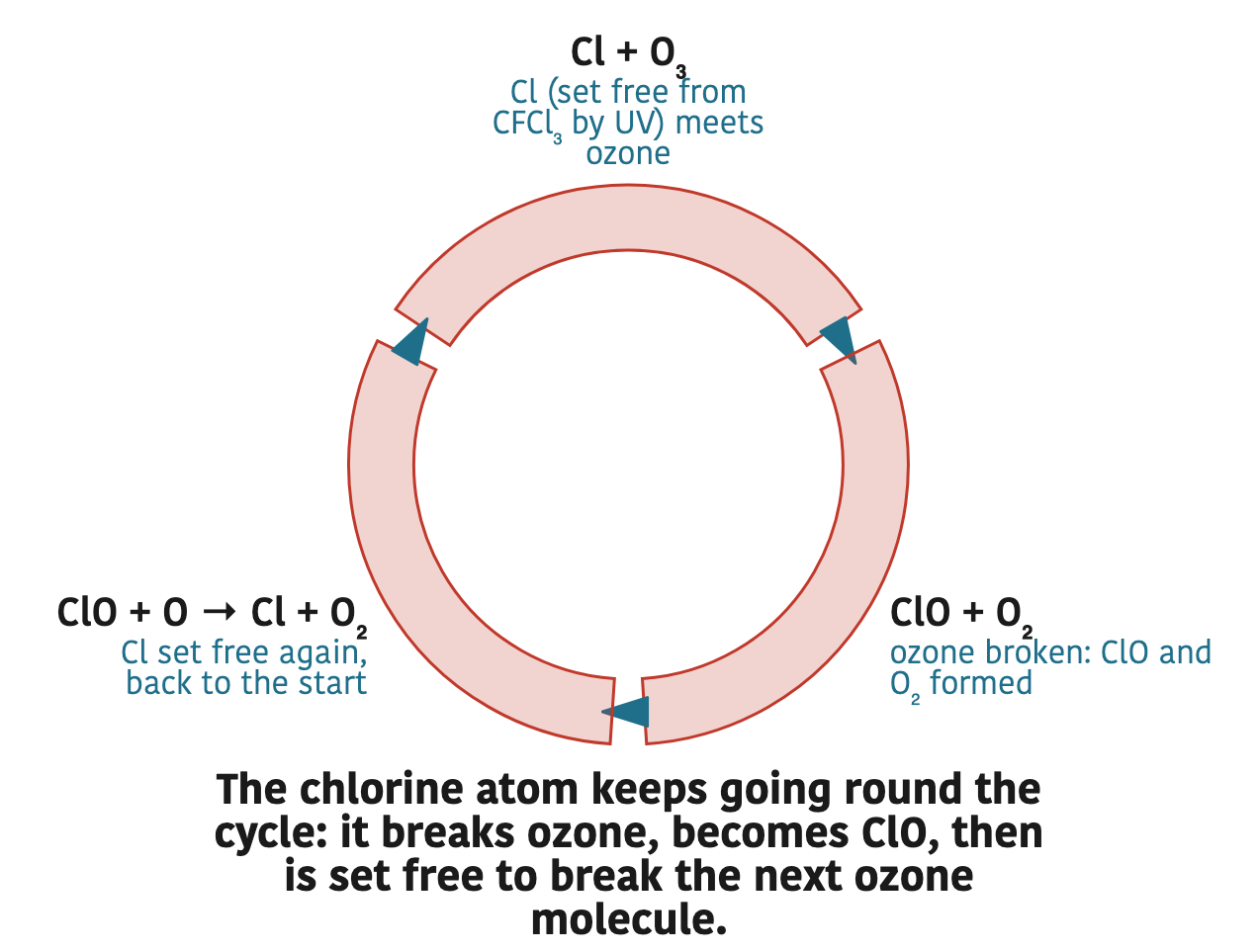
The chlorine atom is not used up when it breaks ozone. Because it keeps coming back free, even a small amount of CFC does a lot of damage to the ozone layer.
Effects of Ozone Layer Depletion
Once the ozone layer thins, much of the Sun's ultraviolet radiation is no longer stopped and reaches the Earth's surface. This harms both living things and the physical environment:
- (a) Effects on human health: ultraviolet radiation causes burning and itching of the eyes and leads to cataracts. It burns the skin of people and animals, making it itch and crack, and raises the chance of skin cancer. It weakens the human immune system and lowers the ability of animals to reproduce.
- (b) Effects on plants: ultraviolet radiation slows the growth of plants and interferes with photosynthesis. As a result, crop production falls.
- (c) Rise in temperature: with a thinner ozone layer, more of the high energy ultraviolet rays reach the Earth, and the Earth's temperature goes up.
- (d) Effects on ecosystems: the loss of ozone affects every part of an ecosystem. When one part is damaged, the others suffer too, and the whole system falls out of balance.
These effects are linked to one another. When plants grow poorly, farmers harvest less, and the animals that feed on those plants also go short of food. When temperatures rise, snow on the mountains melts and the flow of rivers changes too.
Ways to Protect the Ozone Layer
The ozone layer is being thinned by chemicals that people use, so the remedy is also in people's hands. The main measures are these:
- (a) Since CFCs are the main cause of ozone loss, the machines and equipment that use them should be used less.
- (b) Machines that use CFCs should be encouraged to switch to hydrofluorocarbons instead.
- (c) Nitrogen fertilisers release oxides of nitrogen, so their use should be reduced.
- (d) The use of vehicles that run on petroleum should be cut down, and the use of electric vehicles increased.
Every one of these measures rests on the same idea: if fewer ozone destroying chemicals reach the air, the natural process that makes ozone can slowly thicken the layer again. At home, choosing a CFC free model when replacing an old fridge or air conditioner, and walking or cycling for short trips, are small but real contributions.
The full lesson is waiting for you
The notes are free to read in full. A free account opens the rest of the practice, and tracks your progress and confidence score for every subject. Presentations and videos need approval from Learn Yeti.