The Gases in the Air Around Us
The Earth is wrapped in a layer of air on every side. This layer is called the atmosphere. The atmosphere is not made of one gas. It is a mixture of many gases, and the pie chart below shows how much of the air each gas takes up by volume.
Atmosphere: the layer of air that covers the Earth on all sides.
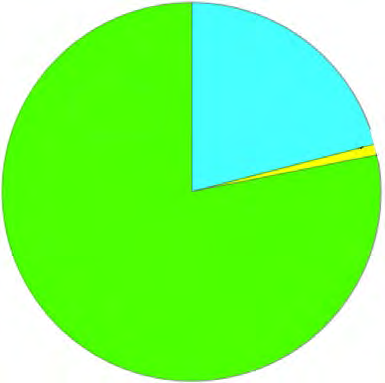
| Gas | Share of the air by volume |
| Nitrogen | about 78% |
| Oxygen | about 21% |
| Others: carbon dioxide, hydrogen, argon, ozone and more | about 1% |
The chart makes one thing clear: nitrogen and oxygen together fill about 99 percent of the atmosphere. Carbon dioxide, hydrogen, argon, ozone and every other gas put together come to only about 1 percent. Being small in amount does not make them unimportant. Plants need carbon dioxide to make their food, and the ozone layer shields us from harmful rays from the Sun.
Gases Held Inside Living Things and Materials
Gases are not found only in the air. Plants, animals, water, food and minerals all hold gases joined up inside compounds. Every molecule of water, for example, contains hydrogen and oxygen bonded together, and the sugar we eat contains hydrogen and oxygen along with carbon. These gases take part in breathing, in photosynthesis and in building many kinds of compounds.
By mass, about 96 percent of the human body is made of just four elements: oxygen, hydrogen, nitrogen and carbon. Three of these, oxygen, hydrogen and nitrogen, are gases. That is why gases matter so much to life.
We get the gases we need either straight from the atmosphere or by making them in factories. To study how a gas behaves, scientists also prepare it in the laboratory. The gas studied closely here is hydrogen.
Hydrogen: The Lightest Element and Where It Is Found
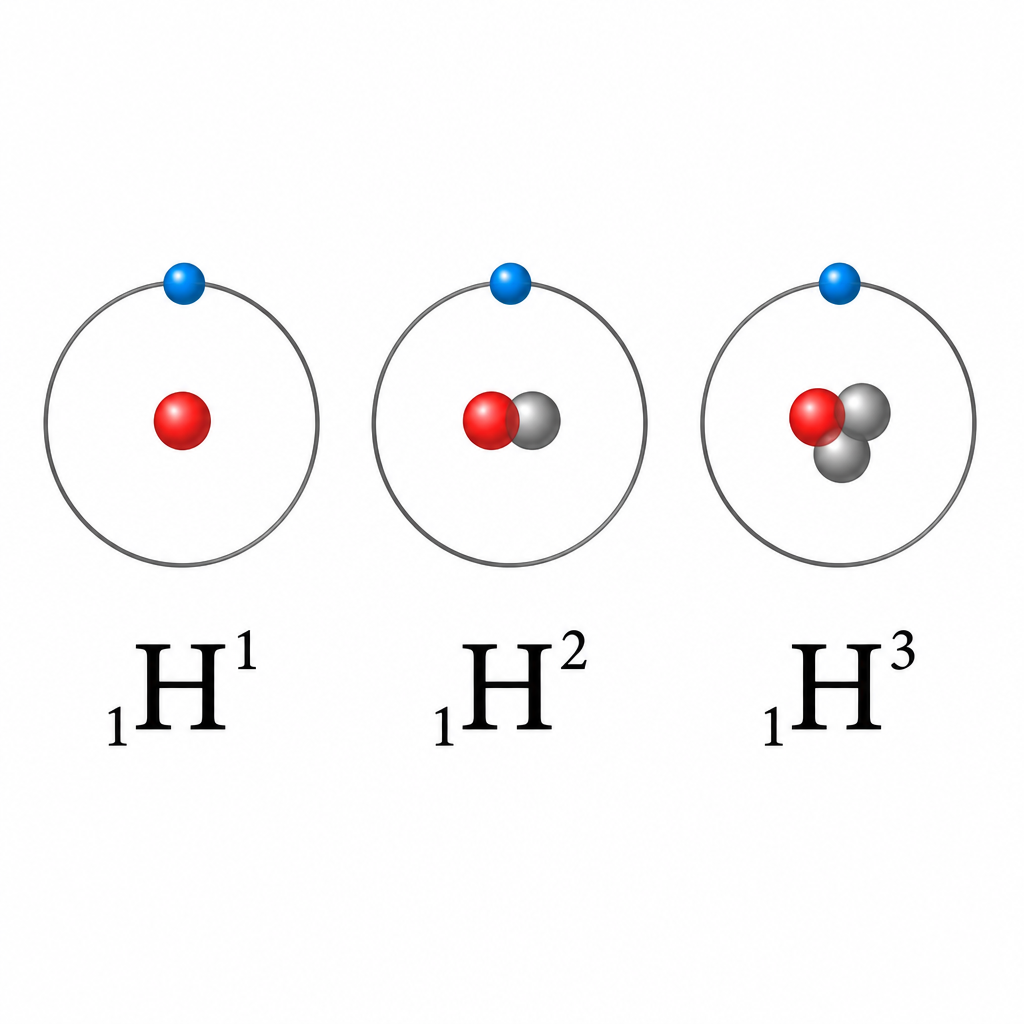
Hydrogen is the lightest element in the universe. On Earth it is seldom found as a free gas. It is usually found joined to other elements in compounds. Acids, bases, hydrocarbons such as kerosene and LP gas, carbohydrates such as the starch in rice and bread, and proteins all contain hydrogen. Beyond the Earth, the Sun and the other stars contain huge amounts of hydrogen in the form of its isotopes.
Isotopes: atoms of the same element that have the same atomic number but different atomic masses. Example: \( {}_{1}\mathrm{H}^{1} \), \( {}_{1}\mathrm{H}^{2} \), \( {}_{1}\mathrm{H}^{3} \)
These symbols are easy to read. The small number at the bottom left is the atomic number, and the number at the top right is the atomic mass. All three isotopes of hydrogen have atomic number 1, so all three are hydrogen. Their atomic masses, however, are 1, 2 and 3.
How Hydrogen Got Its Name, and Its Key Facts
The chemist Henry Cavendish called this gas 'inflammable air', because it caught fire so easily. Later it was found that when this gas burns with oxygen, water is formed. For this reason Lavoisier named it hydrogen, a word meaning 'water producer'.
| Symbol | Atomic number | Atomic mass | Molecular formula | Density |
| H | 1 | 1 | H₂ | 0.09 kg m⁻³ |
The molecular formula H₂ tells us that one molecule of hydrogen gas is two hydrogen atoms joined together. Its density is only 0.09 kg m⁻³, while the density of air is about 1.29 kg m⁻³. So one cubic metre of hydrogen is roughly 14 times lighter than one cubic metre of air.
Preparing Hydrogen Gas in the Laboratory
Active metals such as zinc (Zn) and magnesium (Mg) displace the hydrogen in an acid. The metal takes hydrogen's place in the compound and pushes the hydrogen out as a gas. The laboratory method uses this idea: granulated zinc is made to react with dilute hydrochloric acid, and hydrogen gas comes off.
\[ \mathrm{Zn(s) + 2HCl(aq) \rightarrow ZnCl_2(aq) + H_2\uparrow} \]
In words: zinc and dilute hydrochloric acid react to give zinc chloride and hydrogen. The upward arrow shows that the hydrogen escapes as a gas. Dilute sulphuric acid can be used in place of hydrochloric acid, and hydrogen is given off in the same way, with zinc sulphate left behind.
\[ \mathrm{Zn + H_2SO_4 \rightarrow ZnSO_4 + H_2\uparrow} \]
Pure zinc reacts only slowly. So the laboratory uses impure zinc instead. The impurities in it act as a catalyst, which makes the reaction go faster.
The apparatus used, and the job each part does:
- Woulfe's bottle: a bottle with two mouths. The zinc pieces sit inside it and the reaction happens here.
- Thistle funnel: a funnel with a long stem, fitted through one mouth. The acid is poured in through it.
- Delivery tube: a bent tube fitted through the other mouth. It carries the gas out of the bottle to the gas jar.
- Trough of water and beehive shelf: the gas jar stands upside down on the beehive shelf inside the trough, and the end of the delivery tube is fitted into the shelf.
- Gas jar: a jar filled completely with water and turned upside down. The hydrogen collects in it.
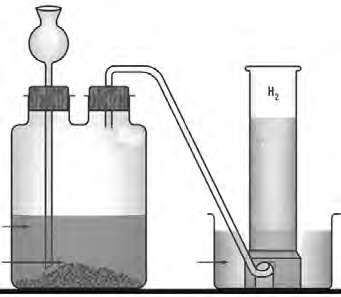
As soon as the acid poured down the thistle funnel touches the zinc, hydrogen starts bubbling off. The gas travels along the delivery tube into the gas jar. Hydrogen does not dissolve in water and is far lighter than water, so it gathers at the top of the jar and pushes the water down and out. Collecting a gas by pushing water out of an upturned jar in this way is called collection by downward displacement of water.
Precautions While Preparing Hydrogen
For the experiment to work and give a clean sample of gas, these points must be followed. Knowing the reason for each one makes them easy to remember.
- All apparatus must be washed clean, so that nothing else mixes in and spoils the gas.
- Impure zinc must be used, because pure zinc reacts too slowly.
- Every joint must be airtight, otherwise the gas leaks out.
- Dilute acid must be used, because concentrated acid does not give hydrogen gas.
- The acid level must cover the bottom of the thistle funnel but stay below the end of the delivery tube. If the funnel's end is not under the acid, the gas escapes up the funnel; if the delivery tube's end is under the acid, acid rather than gas is pushed into the tube.
- The gas jar must be completely full of water with no air bubbles in it, otherwise air mixes with the hydrogen collected.
Hydrogen mixed with air can explode when it catches fire. Keep lit matches, lamps and burners away from the apparatus while the gas is being made. Do not let the acid touch your skin, and carry out this experiment only with a teacher present.
Testing for Hydrogen Gas
A test is used to confirm that the gas in the jar really is hydrogen. The gas jar is lifted out slowly while it is still upside down, with its mouth facing downwards. A burning matchstick is then brought to the mouth of the jar. The matchstick's flame goes out, but the gas itself catches fire with a 'pop' sound and burns with a blue flame. That 'pop' is the sign of hydrogen.
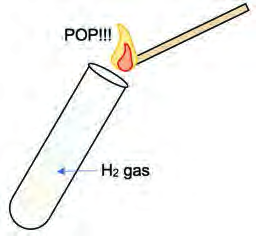
Do not turn the jar of hydrogen mouth upwards. Hydrogen is lighter than air, so it floats straight out of an open jar that faces up, and the test then gives no 'pop'.
Physical Properties of Hydrogen Gas
Physical properties are the ones we can find by looking, smelling or measuring, without turning the substance into something new. Hydrogen's physical properties are:
- Hydrogen gas has no colour, no smell and no taste.
- Hydrogen gas is lighter than air.
- Hydrogen gas does not dissolve in water.
- Hydrogen gas has no effect on litmus, so it is a neutral gas.
- Hydrogen gas turns into a liquid at -253°C and into a solid at -259°C.
Neutral gas: a gas that turns neither blue litmus red nor red litmus blue, because it is neither acidic nor basic.
These properties explain the laboratory method. Because hydrogen does not dissolve in water, it can be collected over water. Because it is lighter than air, its jar is kept upside down. It also has to be made extremely cold before it changes state. Water freezes at 0°C, but hydrogen must be cooled to -253°C just to become a liquid.
Chemical Properties of Hydrogen Gas
Chemical properties show how a substance reacts with other substances to form new ones. First: hydrogen reacts with oxygen to form water. This is exactly the property that gave hydrogen its name, 'water producer'.
\[ \mathrm{2H_2 + O_2 \rightarrow 2H_2O} \]
Second: at high temperature, hydrogen reacts with most non-metals. With carbon it forms methane:
\[ \mathrm{C + 2H_2 \rightarrow CH_4} \]
With sulphur it forms hydrogen sulphide:
\[ \mathrm{S + H_2 \rightarrow H_2S} \]
Third: metals such as sodium, potassium and calcium react with hydrogen to form unstable hydrides. A hydride here is a compound made of a metal and hydrogen only. Sodium gives sodium hydride:
\[ \mathrm{2Na + H_2 \rightarrow 2NaH} \]
Potassium gives potassium hydride:
\[ \mathrm{2K + H_2 \rightarrow 2KH} \]
Calcium gives calcium hydride:
\[ \mathrm{Ca + H_2 \rightarrow CaH_2} \]
Reduction: Hydrogen Takes Oxygen Away From a Metal Oxide
Hydrogen's fourth chemical property is the most useful one. When hydrogen gas is passed over the red-hot oxide of a less active metal, the metal and water are formed. The hydrogen joins with the oxygen in the metal oxide to make water, and once the oxygen has gone, the metal is left free. This is how a metal can be taken out of its oxide, and the process is called a reduction reaction.
Reduction reaction: a reaction in which hydrogen is added to form a compound, or in which oxygen is removed from a metal oxide to leave the free metal.
Take copper oxide as an example. Black copper oxide is placed in a tube, heated until it glows red, and hydrogen is passed over it. After a while the black powder turns into reddish-brown copper metal, and drops of water appear on the cooler part of the tube.
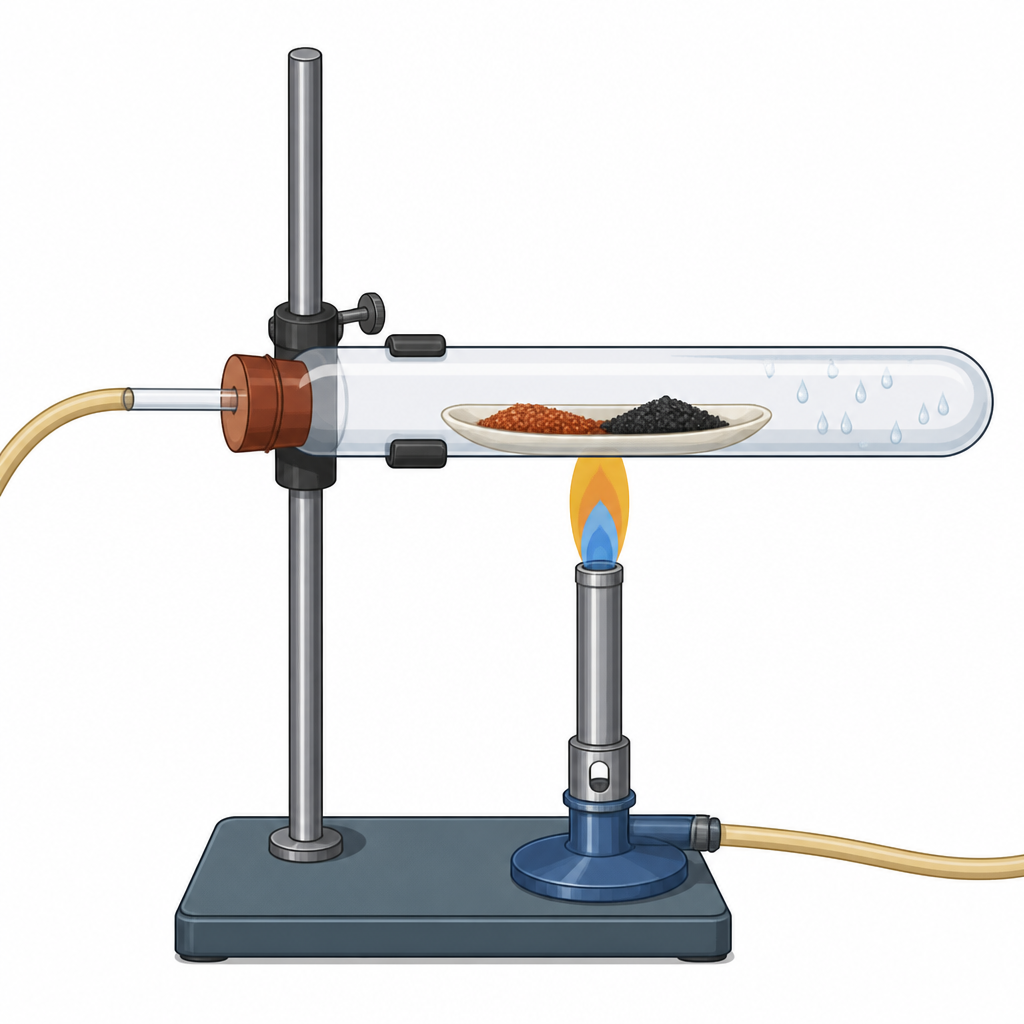
\[ \mathrm{CuO + H_2 \rightarrow Cu + H_2O} \]
Lead is taken out of lead oxide in the same way:
\[ \mathrm{PbO + H_2 \rightarrow Pb + H_2O} \]
And iron is taken out of iron oxide:
\[ \mathrm{2Fe_2O_3 + 6H_2 \rightarrow 4Fe + 6H_2O} \]
All three equations follow one pattern: metal oxide plus hydrogen gives metal plus water. The oxygen leaves the metal and joins the hydrogen.
Uses of Hydrogen Gas
Each use of hydrogen comes straight from one of the properties above. Its main uses are:
- Hydrogen is used to extract metals from their oxides. This puts its reducing property to work.
- Hydrogen is reacted with nitrogen to make ammonia gas, which is then used to make chemical fertilisers.
- Hydrogen is passed through vegetable oil to turn it into solid vegetable ghee. This process is called hydrogenation.
- Hydrogen is used as rocket fuel. When hydrogen and oxygen react, a great deal of energy is released, and this helps to launch the rocket.
- Burning hydrogen in oxygen gives a flame of about 3000°C. This is called the oxy-hydrogen flame, and it is used to cut and join metals. Joining metals with such a flame is called welding.
\[ \mathrm{N_2 + 3H_2 \rightarrow 2NH_3} \]
Hydrogenation: the process of passing hydrogen gas through vegetable oil to make vegetable ghee.
Oxy-hydrogen flame: the flame of about 3000°C produced when hydrogen burns in oxygen.
Welding: joining pieces of metal using a very hot flame such as the oxy-hydrogen flame.
The full lesson is waiting for you
The notes are free to read in full. A free account opens the rest of the practice, and tracks your progress and confidence score for every subject. Presentations and videos need approval from Learn Yeti.